For home and the classroom
Mahabharata Activities for Kids
Five Mahabharata activities for children aged 10 to 16 that need only paper and pencils, drawn from all three books: The Vow, The Dice and The War. Draw your own emblem, take a quiz on each book, play a names game, hold a Krishna asks debate, or map the places the story travels. Each takes 10 to 40 minutes, at home or in class.
What's inside
All five activities come from the three books of my illustrated Mahabharata, The Vow, The Dice and The War, and use the books' own paintings. Nobody has to have read the books to begin, and the quizzes and the maps come with answers.
| Activity | Ages | Time | You need |
|---|---|---|---|
| Draw your own emblem | 8 and up | 20 to 30 minutes | Paper, a pencil, colored pencils |
| A quiz for each book | 10 and up | 15 minutes a quiz | A pencil |
| Say the names | 8 and up | 10 minutes | Twelve to eighteen slips of paper or index cards |
| A Krishna asks debate | 10 and up, with adults | 15 to 20 minutes | Slips of paper |
| Map the places | 10 and up | 30 to 40 minutes a book | The blank map, printed or traced |
To print, use your browser's Print command. Each activity starts on a fresh sheet, and the quiz answers stay folded away so the sheet works as a test. A printable PDF is coming soon.
How to use them at home or in class
At home
Pick one after a chapter, while the story is fresh. The Book One quiz fits well after chapter 6 of The Vow, when all the cousins have been born. Save the Book Two and Book Three quizzes for when a reader has finished that book. The map can grow as you read, one place at a time. The debate works best at the dinner table, with grown-ups answering too.
In class
The names game makes a five-minute warm-up before reading aloud. An emblem makes a good end-of-chapter task. Students draw one for the chapter they just finished and explain their choice in a sentence. The quizzes work in pairs, and a class map can go up on the wall at the start of a unit and fill in week by week. Our guides for teachers have a unit plan for each book and every chapter's Krishna question. The question cards give one or two questions for every chapter, and the mock trial kit puts a character from the story on trial.
Draw your own emblem
Ages 8 and up · 20 to 30 minutes · paper, a pencil, colored pencils.
Every chapter in the three books opens with a small square emblem, one object that stands for the whole chapter. It sits at the head of the chapter and again, tiny, beside the page numbers. Each book's chapters have emblems of their own: 19 in The Vow, 15 in The Dice and 15 in The War.
 The Terrible VowBook One, chapter 2. The silver circlet Devavrata gave up, with the flowers the gods showered on him when he swore.
 The Basket on the RiverBook One, chapter 5. The basket that carried baby Karna away down the river.
 Poison and the Serpent KingdomBook One, chapter 7. A serpent for the Nagas, who saved Bhima from poison under the river.
 The Uninvited ChampionBook One, chapter 11. The sun. Karna is the sun god's son, born wearing golden armor and earrings.
 The Fish in the SkyBook One, chapter 15. The golden fish and the turning wheel, the target Arjuna hit to win Draupadi.
 Water That Was FloorBook One, chapter 19. Ripples from one drop, for the pool Duryodhana took for a polished floor.
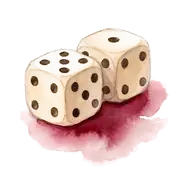 Shakuni's DiceBook Two, chapter 1. The two ivory dice Shakuni throws for Duryodhana.
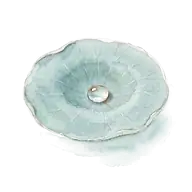 The Lake of QuestionsBook Two, chapter 9. A lotus leaf with one drop of water, for the lake and the one brother Yudhishthira may bring back.
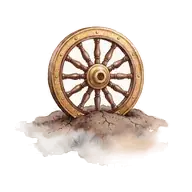 The Sinking WheelBook Three, chapter 8. Karna's chariot wheel, held fast by the earth.
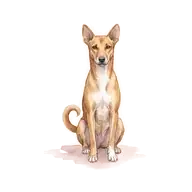 The Road to HeavenBook Three, chapter 15. The dog that follows Yudhishthira all the way up the mountain.
How to design one
- Pick a story. A chapter you just read, a story from your own family, or yourself.
- List five things from it. Things only, no people. Think of what someone carries, wears, makes or loses.
- Choose the one that belongs to this story and no other. A crown could belong to any king. A circlet with flowers fallen on it belongs to Devavrata.
- Draw it in a square about three inches wide, with blank paper all around. Keep it one object, about as wide as it is tall. A long thing needs help: the emblem for The Burning Forest crosses Arjuna's bow with an arrow so the two make a compact X.
- Do the thumbnail test. Draw it again the size of your fingernail, about a third of an inch. Show it to someone. If they can tell what it is, it works. If not, take out details until they can.
- Color it with two or three colors. Fewer colors read better when small.
An emblem for yourself
Try the same steps with your own life. Choose a thing you would grab first if you had to leave home in a hurry, or the thing your friends would draw for you. Write one sentence under it to say why you chose it. Then swap with a friend and see whether you can guess each other's before reading the sentence.
A quiz for each book
Ages 10 and up · 15 minutes a quiz · a pencil.
Ten questions for each book, about the people in it and the choices they make. Tap a question to see its answer. If you get stuck, the Mahabharata family tree has the whole family, painted and listed, and who's who has a page for each of the main people.
In Book One: The Vow
Ten questions about the family.
How are the Pandavas and the Kauravas related?
They are first cousins. Their fathers, Pandu and Dhritarashtra, were brothers.
Who is Bhishma's mother?
Ganga, the river goddess. His father is King Shantanu.
The princes call Bhishma Grandsire. What is he to them really?
He is their grandfather's half-brother. He vowed never to marry or have children, so he looks after the whole family.
Who is the father of Dhritarashtra, Pandu and Vidura?
The sage Vyasa, Satyavati's first son. He is also the sage who tells the Mahabharata.
Which of those three brothers was born blind?
Dhritarashtra, the eldest. Pandu was born pale, and Vidura, the son of a palace maid, grew up to be the wisest man at court.
Who is the eldest of the hundred Kaurava brothers, and what is their sister's name?
Duryodhana is the eldest. Their sister is Duhshala.
Name the five Pandavas and say who their mothers are.
Kunti is the mother of Yudhishthira, Bhima and Arjuna. Madri is the mother of the twins, Nakula and Sahadeva.
Who is Karna's mother, and who raised him?
Kunti is his mother, and the sun god Surya is his father. A charioteer named Adhiratha and his wife, Radha, found him in a basket on the river and raised him. In Book One, Karna does not know who his mother is, and neither do the Pandavas.
How is Krishna related to the Pandavas?
He is their cousin on their mother's side. Krishna's father is Kunti's brother.
Who is Gandhari's brother?
Shakuni, the uncle who plans the game of dice at the end of Book One.
In Book Two: The Dice
Who throws the dice for Duryodhana, and what is he to Duryodhana?
Shakuni, his uncle, Gandhari's brother. Yudhishthira says one man playing for another is against the rules, and plays anyway.
Draupadi asks the hall whether Yudhishthira lost himself before he staked her. Which of the hundred Kaurava brothers stands up to answer her?
Vikarna, one of the youngest. He says Draupadi was never won, and the whole hall cheers him. Then Vidura asks the kings for answers of their own, and they sit silent.
The blind king offers Draupadi gifts. What does she ask for, and why won't she take a third?
First Yudhishthira's freedom, then freedom for Bhima, Arjuna and the twins, with their chariots and their bows. She turns down a third gift: "Greed eats away at what is right." Her husbands are free, and they can win back the rest by their own deeds.
Arjuna spends five years in heaven. Whose palace is he staying in?
His father's. Arjuna is the son of Indra, king of the gods, who sends his charioteer Matali to bring him up.
The old monkey lying across Bhima's path calls him "little brother." Why?
The monkey is Hanuman, and Vayu, the Wind, is father to them both.
Karna gives Indra the armor and earrings he was born with. What does he ask for in return?
Indra's spear, the one that never misses. The sun god had come to Karna in a dream to warn him that Indra was coming.
At the lake, Yudhishthira may bring back one of his four brothers. Whom does he choose, and why?
Nakula. Kunti still has a son alive, Yudhishthira himself, so he wants Madri to have one too. The spirit of the lake is Dharma, Yudhishthira's father, and he lets all four brothers live.
In King Virata's court, who are Kanka, Ballava, Brihannala and Sairandhri?
Kanka is Yudhishthira, who plays dice with the king. Ballava is Bhima, the cook who wrestles. Brihannala is Arjuna, the dance teacher. Sairandhri is Draupadi, who serves the queen. Nakula keeps the king's horses and Sahadeva his cows.
Krishna lets Arjuna and Duryodhana choose between his army and Krishna himself, who will not fight. Who takes what?
Arjuna chooses first, and he chooses Krishna. Duryodhana takes the army, the Narayanas, and can hardly hide his grin.
Krishna tells Karna that Kunti is his mother. When Kunti comes to him at the river, what does Karna promise her?
He will not kill Yudhishthira, Bhima, Nakula or Sahadeva. Arjuna is the only one of her sons he will fight to the death, so whichever of them lives, she will still have five sons.
In Book Three: The War
On the first morning, Arjuna sees his teachers and cousins across the field and lays down his bow. Who answers him, and what is their talk called?
Krishna, who is driving his chariot. Their talk is the Bhagavad Gita, which gives chapter 1 its name.
Before the fighting starts, Yudhishthira takes off his armor and walks across to the Kaurava army. Why?
To ask his elders on the other side for their permission and their blessing before he fights them. Bhishma, Drona, Kripa and Shalya each bless him, and each goes back to his place to fight.
Who was Shikhandi in an earlier life, and why won't Bhishma fight him?
Amba, born again in King Drupada's family, as Shiva had promised her. Bhishma will not raise his bow against anyone who was born a woman.
How did Abhimanyu learn to break into Drona's wheel, and why doesn't he know the way out?
He heard it before he was born. Arjuna explained the wheel to Abhimanyu's mother, Subhadra, while she was carrying him, and she fell asleep just as he came to the hard part, getting out.
Yudhishthira tells Drona, "Ashwatthama is dead." What does he add under his breath?
"The elephant." An elephant named Ashwatthama had been killed. Drona was asking about his son, Ashwatthama, and Yudhishthira knew it.
In Book Two, Karna made Kunti a promise. Does he keep it?
Yes. He beats Yudhishthira and Nakula in battle and lets them both go. Krishna says, "Karna kept his promise to his mother and spared four of his brothers."
Who tells the Pandavas that Karna was their eldest brother, and when?
Kunti, after the war, standing in the Ganga where the women pour out water for the men they have lost. Yudhishthira then stands in the river with Karna's family and pours water for his brother.
Yudhishthira wants to give up the kingdom. Who teaches him how to rule?
Bhishma, from his bed of arrows, with Krishna beside him. One of his lessons: "A king must care for his people the way a mother cares for the child she's carrying."
Who is Parikshit?
Abhimanyu and Uttara's son, the baby Krishna brought back to life on the day he was born. Krishna names him, and before the last walk Yudhishthira crowns him king of the Kurus.
A dog follows the brothers and Draupadi all the way up the mountain. When Indra comes to take Yudhishthira to heaven, why won't he leave the dog behind, and who is it?
He once vowed never to turn away anyone who is frightened or who has come to him for help, and the dog has stayed with him the whole way. The dog turns out to be Dharma, his father, who tested him once before at the lake in Book Two.
If you like scores, give one point for each question and a bonus point for anyone who can draw the family from Shantanu down to the five Pandavas without looking. For Book Three, add a bonus point for anyone who can carry the family on down to Parikshit.
Say the names: a card game
Ages 8 and up · 10 minutes · twelve slips of paper or index cards, or eighteen with the cards for Books Two and Three.
The names in the Mahabharata come from Sanskrit, and they are easier than they look. Say the part in capital letters a little more strongly than the rest. Write each name on the front of a card and its sound on the back.
| Name | Say it | Who |
|---|---|---|
| Bhishma | BHEESH-ma | The prince who gave up the throne |
| Draupadi | DRAU-pa-dee | Princess of Panchala |
| Yudhishthira | yu-DHISH-ti-ra | Eldest of the Pandavas |
| Duryodhana | dur-YO-dha-na | Eldest of the Kauravas |
| Dhritarashtra | dhri-ta-RAASH-tra | The blind king, father of the Kauravas |
| Gandhari | gaan-DHAA-ree | His wife, who wears a blindfold |
| Kunti | KUN-tee | Mother of the Pandavas |
| Arjuna | AR-ju-na | The archer |
| Karna | KAR-na | The charioteer's son |
| Ekalavya | ay-ka-LAV-ya | The boy who taught himself archery |
| Hastinapura | has-ti-NAA-pu-ra | The capital of the Kurus |
| Ganesha | ga-NAY-sha | The god who wrote the story down |
Six more cards for Books Two and Three
| Name | Say it | Who |
|---|---|---|
| Shakuni | SHA-ku-ni | Duryodhana's uncle, who throws the dice |
| Hanuman | HA-nu-maan | The old monkey lying across Bhima's path |
| Abhimanyu | a-bhi-MAN-yu | Arjuna's son, who breaks into the wheel |
| Shikhandi | shi-KHAN-dee | Amba, born again as Drupada's child |
| Ashwatthama | ash-wat-THAA-maa | Drona's son |
| Parikshit | pa-RIK-shit | Abhimanyu's son, crowned king of the Kurus |
How to play
- Shuffle the cards and put them name side up.
- The first player picks a card and says the name out loud. Everyone else claps once, on the strong part.
- Turn the card over to check. If the clap landed in the right place, the player keeps the card.
- For a harder round, read only the "Who" line and let the others call out the name.
Many families say these names the Hindi way, without the short a at the end: Arjun, Bhim, Eklavya. Both are right. Every name in the series, with Devanagari and other spellings, is on how to say the Mahabharata names.
A Krishna asks debate
Ages 10 and up, with adults · 15 to 20 minutes · slips of paper.
After key scenes in all three books, Krishna holds up a balance scale and asks the reader what they think. There is no wrong answer, and you are free to argue with Krishna.
How to run it
- Read the scene aloud. If you have the book, read the chapter's last pages.
- Everyone writes an answer on a slip of paper and folds it. No names.
- Open the slips together and read them out.
- Each person gives one reason from the story for their answer. Grown-ups too.
- Anyone may change their mind. If you do, say what changed it.
Krishna's own thought on the first question is short: "A promise does not know what tomorrow will bring." Read it at the end, after everyone has spoken, and see who agrees. On the Book Two question he offers a reason of his own: "Some of those kings truly didn't know the law, and many were afraid of Duryodhana." On the Book Three question he owns his part, since he gave the order: "The rules both armies swore to say you leave a man like that alone."
The guides for teachers list every Krishna question chapter by chapter, for The Vow, The Dice and The War. For a talking point on every chapter, print the question cards. For a longer argument, the mock trial kit puts one person from the story on trial, with ready cases from each book.
Map the places in the three books
Ages 10 and up · 30 to 40 minutes a book · the blank map, printed or traced, and a pencil.
The blank map is the one painted for The Vow, with its labels taken off. The Dice and The War print the same painting, each with its own places. It shows ancient northern India the way a storyteller might draw it, and it is not to scale. The snowy Himalaya run along the top. The Indus flows down the left side to the western sea. The two long rivers on the right are the Yamuna, on the left of the pair, and the Ganga. They meet low on the map, and the Ganga runs on to the eastern sea.
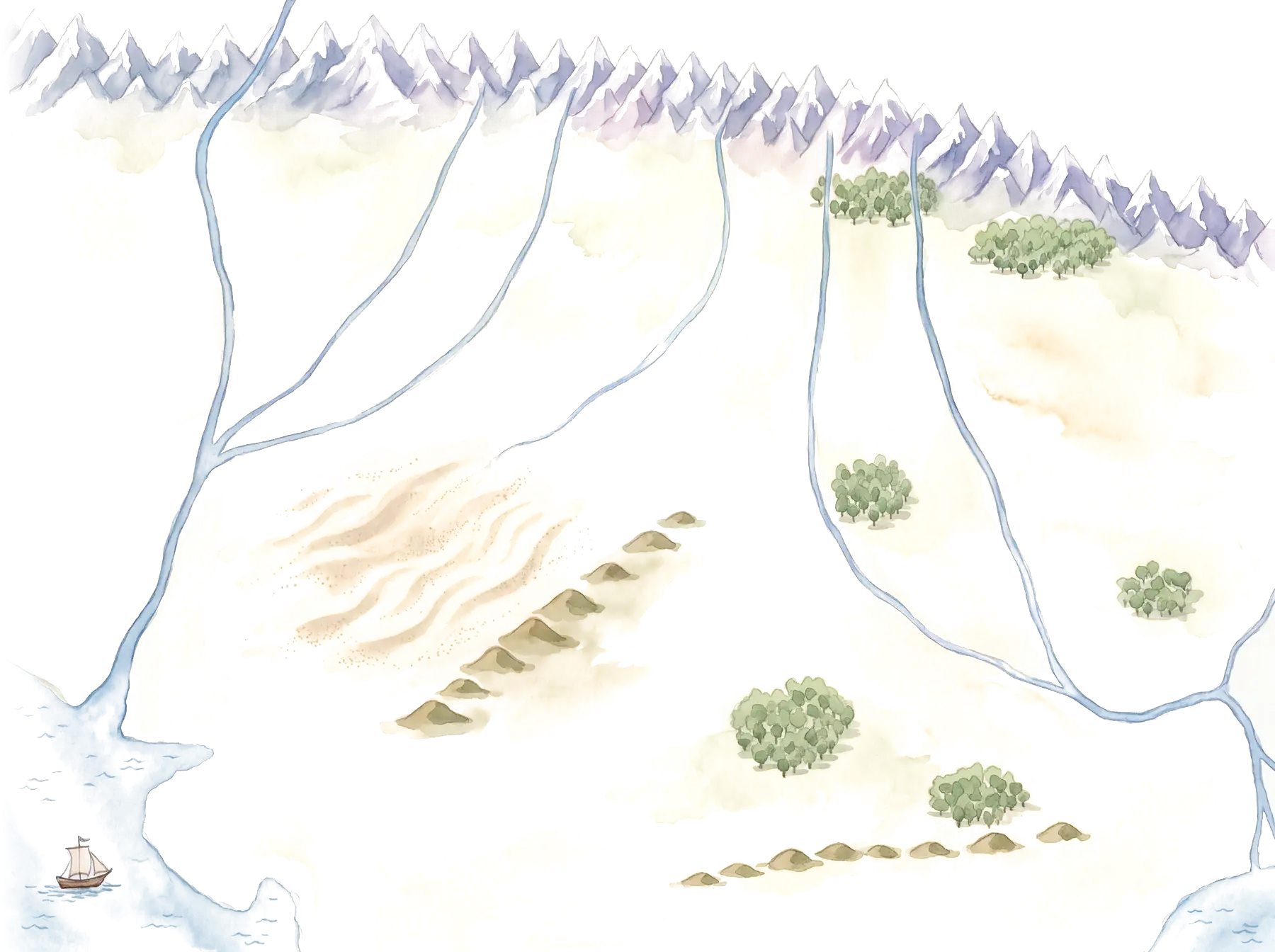
Read each clue, then mark the place with a dot and write its name. Add the chapter number beside it in a small circle, the way the books' maps do. Use a different color for each book, or start a fresh map for each one.
In Book One: The Vow
- Hastinapura (chapter 1). The capital of the Kurus, where the whole family grows up. It stands on the bank of the Ganga, not far below the mountains.
- Kurukshetra (chapter 3). The wide plain where Bhishma fought his old teacher Parashurama for twenty-three days. It lies northwest of Hastinapura, on the far side of the Yamuna.
- Kashi (chapter 3). The kingdom of Amba and her sisters, far down the Ganga to the southeast.
- Gandhara (chapter 4). Gandhari's home, and Shakuni's, in the far northwest beyond the Indus.
- Anga (chapter 5). The land far in the east where Karna's basket came ashore and where he grew up.
- Panchala (chapter 8). King Drupada's kingdom, on the far side of the Ganga from Hastinapura.
- Varanavata (chapter 13). The festival town where the house of lac was built. It is south of Hastinapura, between the two rivers.
- Ekachakra (chapter 14). The town where the Pandavas hid as a poor brahmin family and Bhima faced the rakshasa Baka. Put it low between the two rivers, before they meet.
- Indraprastha and the Khandava Forest (chapters 16 and 17). The Pandavas' new city on the Yamuna, beside the forest that burned.
- Dwaraka (chapter 16). Krishna's city, on the coast of the western sea.
Check your map
Divide the map into three columns and three rows, like a tic-tac-toe board.
- Top row, left column: Gandhara.
- Top row, middle column, near its right edge: Kurukshetra, just west of the Yamuna.
- Top row, right column: Hastinapura, on the Ganga.
- Middle row, middle column, on the right edge: Indraprastha, on the west bank of the Yamuna.
- Middle row, right column: Varanavata, between the rivers, with the Khandava Forest a little below it. Panchala is to the east, across the Ganga.
- Bottom row, right column: Ekachakra, between the rivers just before they meet, then Anga, Kashi and the sea farther east.
- Bottom row, left column: Dwaraka, on the coast near the little boat.
In Book Two: The Dice
- Hastinapura (chapter 1). The game of dice is played here, in the blind king's new hall with its crystal arches, a thousand pillars and a hundred doors. If it is already on your map from Book One, circle it.
- Dwaraka (chapter 1). Krishna's city, far away by the western sea. In chapter 12, Arjuna and Duryodhana both come here to ask for his help.
- The Kamyaka Forest (chapter 4). Where the Pandavas live in the first days of their exile. It lies far to the west of Hastinapura, southwest of Kurukshetra.
- The Dwaita Woods (chapter 4). Another forest home in the exile, a little southwest of the Kamyaka Forest. The lake of questions in chapter 9 is in these woods.
- Indrakila (chapter 4). The mountain in the Himalayas where Arjuna fights a hunter who turns out to be Shiva. Put it high in the mountains, north and a little east of Hastinapura.
- Gandhamadana (chapter 6). The mountain Bhima climbs for golden lotuses, where he meets the old monkey on the path. It is a little lower and farther east than Indrakila.
- Matsya (chapter 10). King Virata's kingdom, where the Pandavas and Draupadi spend the thirteenth year in disguise. Put it south of the Dwaita Woods.
- Upaplavya (chapter 12). The town where the Pandavas camp after the year in disguise, and where kings march to join them. It lies a little east of Matsya.
- Kurukshetra (chapter 15). The plain where eighteen armies gather at the end of the book. Circle it if it is already on your map.
- The road of the exile. Draw it with a dashed line, from Hastinapura to the Kamyaka Forest, on to the Dwaita Woods, down to Matsya and across to Upaplavya.
Check your Book Two map
Use the same three columns and three rows.
- Top row, middle column, near its right edge: Kurukshetra.
- Top row, right column: Hastinapura, on the Ganga, with Indrakila high in the mountains above it and Gandhamadana a little lower and farther east.
- Middle row, middle column, at its left edge: the Kamyaka Forest.
- Middle row, left column, near its right edge: the Dwaita Woods, with Matsya below them.
- Middle row, middle column, low down and near its left edge: Upaplavya.
- Bottom row, left column: Dwaraka, on the coast.
- The road of the exile runs west from Hastinapura, then bends south through the two forests to Matsya and Upaplavya.
In Book Three: The War
- Kurukshetra (chapter 1). The plain where the war is fought for eighteen days. Circle it if it is already on your map.
- Dwaraka (chapter 3). Krishna's city on the western sea.
- The lake where Duryodhana hid (chapter 9). When his army is beaten, Duryodhana walks east from the field to a lake and hides in it. The book's map leaves it off because it is so close to the battlefield, so draw a tiny pool just east of Kurukshetra.
- Prabhasa (chapter 14). The shore where Krishna's people, the Yadavas, go to bathe in the holy sea, and where they quarrel. It lies down the coast from Dwaraka.
- The eastern sea (chapter 15). On its shore, at the fire god's word, Arjuna throws his bow, the Gandiva, far out into the water. Write its name in the water at the bottom right.
- Meru (chapter 15). On the last road the brothers and Draupadi go north beyond the Himalayas, across a desert of sand, toward Meru, "white against the sky." Put it at the very top of the map.
- The last road. Draw it with a dotted line: out of Hastinapura to the east, down to the eastern sea, south along the coast, then west to a headland where the brothers see Dwaraka's white towers under the water, and north over the mountains toward Meru.
Check your Book Three map
Use the same three columns and three rows.
- Top row, middle column, near its right edge: Kurukshetra, with the tiny lake just east of it.
- Top row, right column, at the very top edge: Meru, beyond the snowy mountains.
- Bottom row, right column, in the water: the eastern sea.
- Bottom row, left column: Dwaraka on the coast, with Prabhasa a little farther down it.
- The last road runs east from Hastinapura and down the right side of the map to the sea, back west along the bottom to Dwaraka, then north up the left side and across the top to Meru. The book's line is only a sketch of the route, so any road that goes east, south, west and then north is right.
Book details for ordering
| Book One | Book Two | Book Three | |
|---|---|---|---|
| Title | The Vow | The Dice | The War |
| Contents | Prologue and 19 chapters | Prologue and 15 chapters | Prologue, 15 chapters and Epilogue |
| Pages | 197 | 205 | 236 |
| ISBN | 979-8-9828468-0-8 | 979-8-9828468-1-5 | 979-8-9828468-2-2 |
| Release | November 30, 2026 | December 7, 2026 | December 14, 2026 |
| Series | Mahabharata, three books | ||
| Author | Ankita Sharma | ||
| Format | Paperback, 6 × 9 in, full color | ||
| Publisher | Sharma Ink | ||
| Ages | 10 to 16 (about grades 5 to 10) | ||
Questions about these activities
Do you need the books to do these activities?
No. The quizzes and the maps come with answers to check against. The books help, though. Children who have read a chapter draw better emblems for it and argue harder in the debate, because they know what happened and how the people in it felt.
What age are these Mahabharata activities for?
Most suit children aged 10 to 16, the same readers the three books are written for. Younger children of about eight can enjoy the emblem drawing and the names game, especially with an adult. The Book Three quiz and debate come from the war, so they suit readers who have read that far. The debate works best with a mix of ages, since grown-ups answering honestly makes it easier for children to do the same.
Is there a printable PDF of these activities?
A printable PDF is coming soon. Until then, print the page from your browser. Each activity starts on a fresh sheet, and the quiz answers stay hidden, so you can hand the quizzes out as they are.
Can these activities be used in a classroom?
Yes. They were written with classrooms in mind and need nothing beyond paper and pencils. The names game works as a warm-up, the quizzes in pairs, and the map as a wall display that grows over a unit. The guides for teachers add a unit plan for each book, with every Krishna question in it. Pair them with the question cards and the mock trial kit.
Where this comes from: The family facts and places follow K. M. Ganguli's English translation of the Mahabharata, as retold in the three books. The Vow draws mostly on the Adi Parva, The Dice on the Sabha, Vana, Virata and Udyoga Parvas, and The War on the Bhishma Parva and the parvas after it. Where the stories come from lists the sections behind each chapter. The emblems, the line drawing and the map are the books' own art. In Ganguli the archery target sits above a turning wheel; its golden fish shape comes from later, popular tellings. Krishna's questions belong to this retelling.