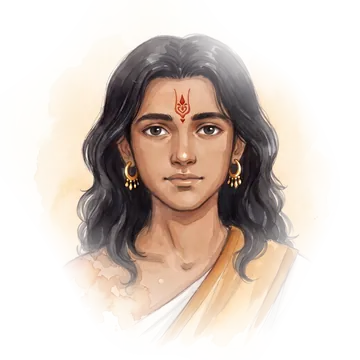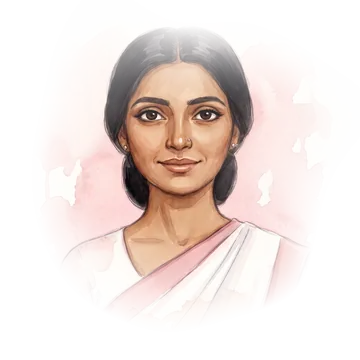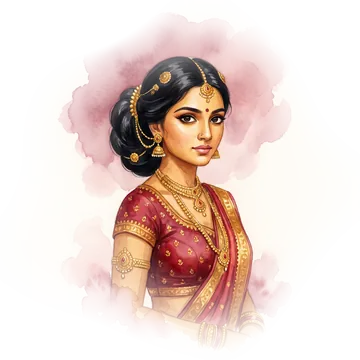
Draupadi is the princess of Panchala in the Mahabharata, who rose from the altar of her father's sacred fire. Arjuna won her at her swayamvara by hitting a golden fish high above a turning wheel, and she married all five Pandava brothers. In Book Two, after Yudhishthira loses her at dice, she asks the hall whether a man who has lost himself can stake his wife, and in Book Three she loses her brother and all five of her sons on the last night of the war.
- Family
- Daughter of King Drupada of Panchala and his queen · sister of Dhrishtadyumna, who came from the same fire · wife of the five Pandava brothers, Yudhishthira, Bhima, Arjuna, Nakula and Sahadeva · mother of five sons, one by each brother · Kunti is her mother-in-law
- Known for
- Rising from a sacred fire · the swayamvara of the golden fish · marrying five brothers · her question in the dice hall · the vow to leave her hair loose until Duhshasana paid
- Home
- Panchala, then Indraprastha
- First appears
- Book One, chapter 12, The Teacher's Fee
Draupadi's story in Book One
How was Draupadi born?
King Drupada wanted a son who could kill Drona, the teacher whose pupils had taken half his kingdom. He found two holy brothers who would light a great sacrificial fire for him. Out of the flames stepped a young warrior in armor, Dhrishtadyumna. Then a young woman rose from the middle of the altar. She shone like a goddess, her dark eyes as wide as lotus petals, and the scent of blue lotuses drifted from her over the crowd.
A voice from the sky said she would be the first of all women, and that through her many warriors would fall. Everyone called her Draupadi, Drupada's daughter. Her father looked at her and thought of Arjuna, the young archer who had once leaped into his chariot and taken him prisoner.
What happened at Draupadi's swayamvara?
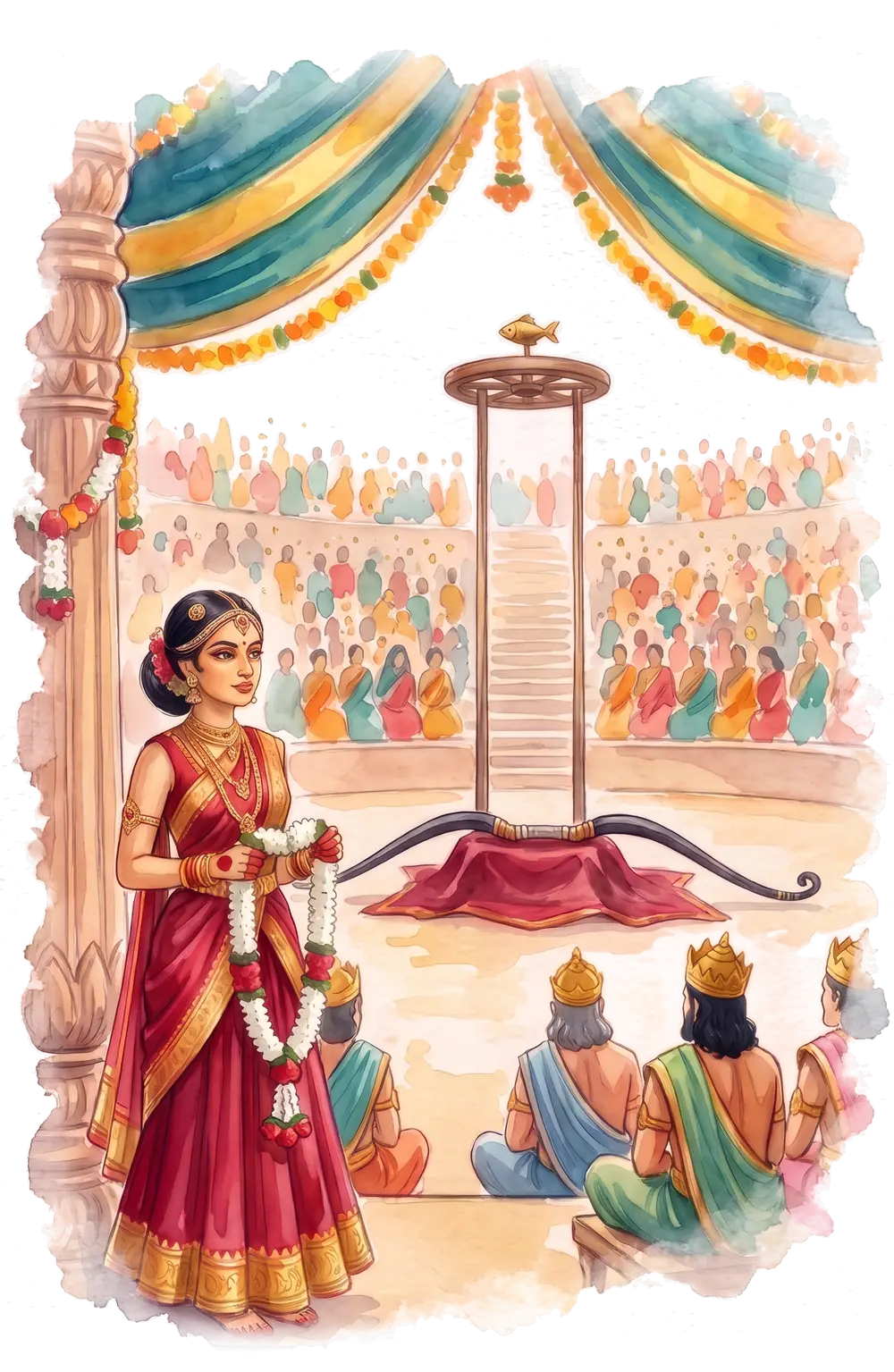
A swayamvara is a bride's own choice. At Draupadi's, a contest decided who could win her. A huge bow lay on a silk cloth, and high above it a wheel turned on a tall frame, with a small golden fish hanging over its one opening. Any man who strung the bow and sent five arrows through the opening into the target would marry her.
King after king came down to the bow, and it threw them about like a bad-tempered bullock. Duryodhana ended up flat on his back. Then Karna, king of Anga, strung it before anyone had finished whispering his name. Draupadi lifted her chin and said, so the whole hall could hear, that she would not choose a charioteer's son. Karna laughed once, threw down the bow and walked back to his seat. Nobody told her she was wrong. Still, she could see that until then he was the only one who had strung it.
At the back of the hall, a young man stood up among the brahmins. He bowed his head to Shiva and strung the bow in the time it takes to blink. Draupadi heard five quick hisses, and the golden fish dropped through the wheel to the floor. Flowers poured down out of nowhere. She walked the whole length of the hall and hung her garland around the stranger's neck. Nobody there knew his name. He was Arjuna, hiding with his brothers as a poor brahmin.
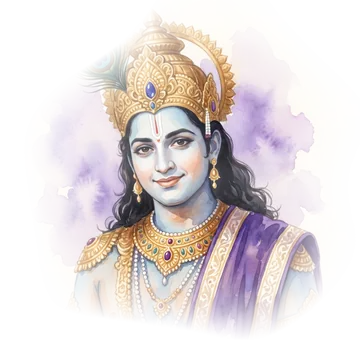
The kings were furious that a brahmin had won, and they attacked. The archer's huge friend, who was Bhima, pulled a tree out of the ground and held it like a club. Krishna had watched it all from his seat, smiling. He guessed who they were. "This princess was won fairly," he told the kings, and they put down their bows. Draupadi followed the archer out into the street.
Why did Draupadi marry five brothers?
The brothers were living with their mother, Kunti, in a potter's house. Bhima called up the lane for her to come and look at the alms they had brought. Kunti stood at the hearth with her back to the door. "Share it equally," she called, "all of you." Then she turned and saw a princess in red silk standing in the doorway. "Oh," said Kunti. "What have I said?"
Kunti would not let her word become a lie, and she would not let any wrong touch the girl. She asked her eldest son, Yudhishthira, what to do. Arjuna had won Draupadi, but he would not marry before his elder brothers. Yudhishthira saw in his brothers' faces what he felt himself. He remembered the sage Vyasa telling them that Drupada's daughter was meant to be the wife of them all, and he thought of the five of them years from now, one married to her and four not. "She will be the wife of all of us," he said. Draupadi stood beside Kunti with her face set, the way a princess holds it in front of a crowd. No one turned to ask her.
King Drupada was shocked. "A man may have many wives," he said. "Who ever heard of a woman with many husbands?" Then Vyasa told him a story from another life. A sage's daughter had prayed to Shiva for a husband with every good quality, and in her hurry she asked five times. "You asked me five times," said the god, and so in another life she would have five husbands. Draupadi, Vyasa said, was that girl, born again from Drupada's fire. So Draupadi married all five brothers, one each day before the sacred fire, Yudhishthira first.
What was Draupadi's life in Indraprastha like?
King Dhritarashtra gave the Pandavas half the kingdom, a wilderness called Khandavaprastha. There they built Indraprastha, a city whose walls rose as white as clouds. Krishna stayed until the walls were up, and he soon had Draupadi laughing at his stories of stolen butter.
The sage Narada warned the brothers that one wife could split them apart, so they made a rule. When Draupadi was alone with one brother, no other brother would come in, and whoever broke the rule would live in the forest for twelve years. One day thieves took a brahmin's cows, and the brothers' weapons were in the room where Yudhishthira sat with Draupadi. Arjuna walked in for his bow, brought the cows home, and then left Indraprastha, as he had sworn.
When he came back, he had married Krishna's sister, Subhadra. "Go to your Yadava princess," Draupadi told him. "A second knot always loosens the first." Then Subhadra came to her dressed as a plain cowherd girl and bowed at her feet. "I am your servant," she said. Draupadi pulled her up and held her close. In time Draupadi had five sons, one by each of the brothers.
Did Draupadi laugh at Duryodhana?
In this book she doesn't, because in the Ganguli translation she isn't in the hall. Many retellings have Draupadi watch Duryodhana fall into a pool in the Palace of Illusions and laugh at him as "a blind man's son." In Ganguli, Bhima laughs first. Arjuna and the twins join in, and so do the palace servants. The book follows Ganguli.
Questions about Draupadi
How do you pronounce Draupadi?
Say DRAU-pa-dee. The first part rhymes with how and is said a little more strongly than the rest, the middle is a short pa, and the end is dee, as in see. Her name means daughter of Drupada, the king of Panchala, which is why she is also called Panchali.
Why did Draupadi marry five brothers?
When the brothers brought her home, Bhima called out to their mother, Kunti, to come and see the alms they had brought. Kunti, with her back to the door, told them to share it equally. She would not let her word become a lie, and Yudhishthira chose to keep the five brothers together. The sage Vyasa then told of a girl in a past life who had asked Shiva five times for a husband.
Who were Draupadi's parents?
Her father was King Drupada of Panchala. She rose, already grown, from the altar of a sacred fire that Drupada lit to win a child who could stand against Drona, and her brother Dhrishtadyumna rose from the same fire.
In Book Two: The Dice
Yudhishthira stakes Draupadi last, after himself, and loses her (chapter 1). She sends the usher back to the hall with a question. "Whom did he lose first, himself or me?" Duhshasana drags her into the hall by her hair, and she asks the elders and the kings to answer her. Only Vikarna does. When Duhshasana pulls at her cloth, she calls on Krishna, and the cloth never ends. Then the blind king offers her gifts, and she asks for her husbands' freedom and turns down a third gift (chapter 2, Draupadi's Question).
As the Pandavas leave for the forest, she swears at the gate to leave her hair loose, the way Duhshasana left it, until he has paid (chapter 3). In the forest she asks Yudhishthira why his anger never blazes up (chapter 4) and sends Bhima up a mountain for golden lotuses (chapter 6). When King Jayadratha carries her off, her husbands ride after him and bring her back the same day (chapter 7).
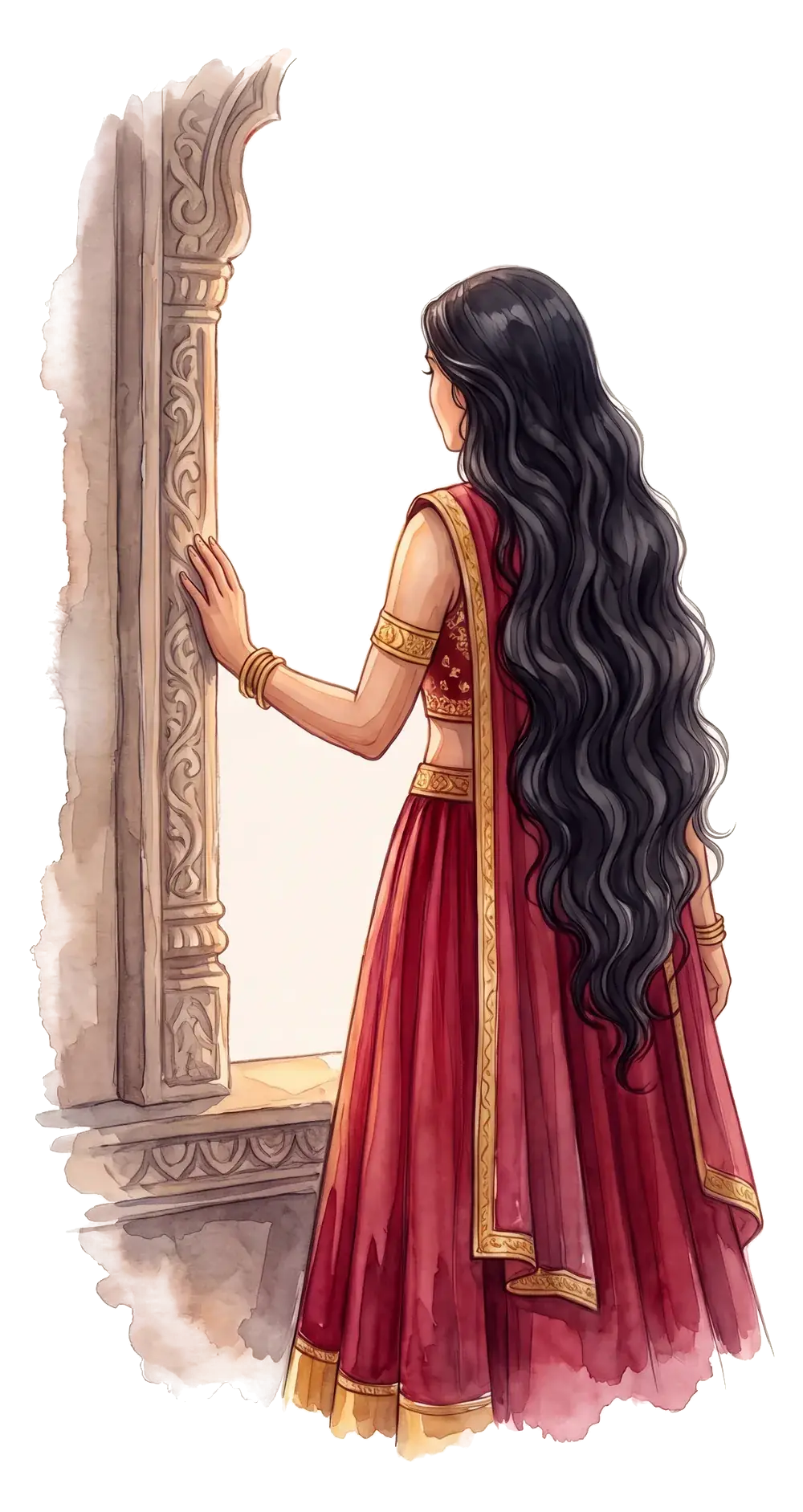
In the year of hiding she is Sairandhri, a maid to Queen Sudeshna. The queen's brother Kichaka hounds her and kicks her in front of King Virata's court, and the king does nothing. That night she goes to Bhima, and the next night Kichaka is dead (chapter 10, The Year of Disguises). On the eve of the war, Sanjaya sees her at a window in Upaplavya, her hair still loose, looking toward the field (chapter 15).
In Book Three: The War
Her hair stays loose until the seventeenth day, when Bhima kills Duhshasana and shouts for someone to tell her it is paid (chapter 8). On the last night of the war, Ashwatthama's raid on the sleeping camp kills her brother Dhrishtadyumna and all five of her sons. Draupadi sits down on the bare ground and will not eat until Ashwatthama pays. When Bhima brings her the jewel from his forehead, she gives it to Yudhishthira. "I only wanted the debt paid," she says (chapter 10, Night of the Owl).
When Yudhishthira wants to give up the kingdom and go to the forest, Draupadi, her hair now tied up plainly, reminds him of everything they have lost. "But don't tell me it was all for nothing" (chapter 12). Years later she sets out with the five brothers on the road to heaven, walking last, and she is the first to fall on the mountain. In heaven Yudhishthira finds her garlanded with lotuses, with her five sons around her (chapter 15).
Where this comes from: In the Ganguli translation of the Mahabharata, Draupadi's birth is in Adi Parva §167–169 and her swayamvara in §187–192. Her marriage and Narada's rule are in §193–214, and Arjuna's years away with Subhadra in §214–236. The pool in the Palace of Illusions is Sabha Parva §45–58. Ganguli's target is a mark fixed to a machine high in the air; the turning wheel and the golden fish come from later tellings. Krishna's stories of stolen butter come from later tales of his childhood. In Book Two the dice hall follows Sabha Parva §66–79, where the god Dharma, unseen, covers her; Krishna sending the cloth comes from popular retellings. Jayadratha is Vana Parva §260–270 and Kichaka Virata Parva §1–24. Book Three follows Sauptika Parva §1–16 for the night raid and Mahaprasthanika Parva §1–3 for the road to heaven. More on the sources.