For teachers · Book Three
Teaching The War: A Four-Week Mahabharata Unit
The War, Book Three of an illustrated Mahabharata, is written for readers aged 10 to 16, about grades 5 to 10. Its Prologue, 15 short chapters and Epilogue run from the Bhagavad Gita through the eighteen days at Kurukshetra to the road to heaven, with a painting on every page. After key scenes Krishna asks readers what they would have done. This unit takes about four weeks.
How The War is organized
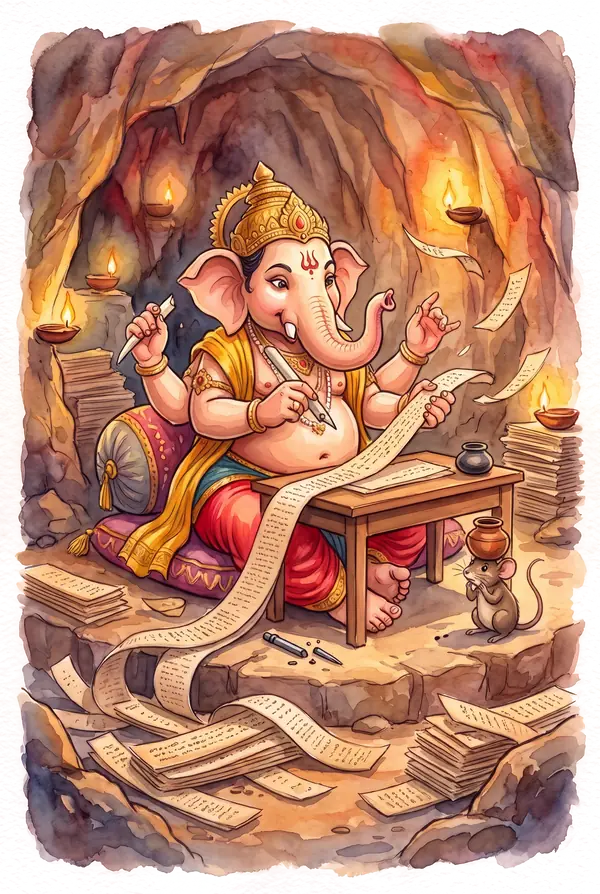
Ganesha tells the Prologue, a fast retelling of Books One and Two, and comes back for the Epilogue. Some chapters pause for A Tale Within the Tale, and after key scenes Krishna asks about a hard choice.
Prologue · The Story So Far. Ganesha retells Books One and Two, from Bhishma's vow to the two armies facing each other at Kurukshetra.
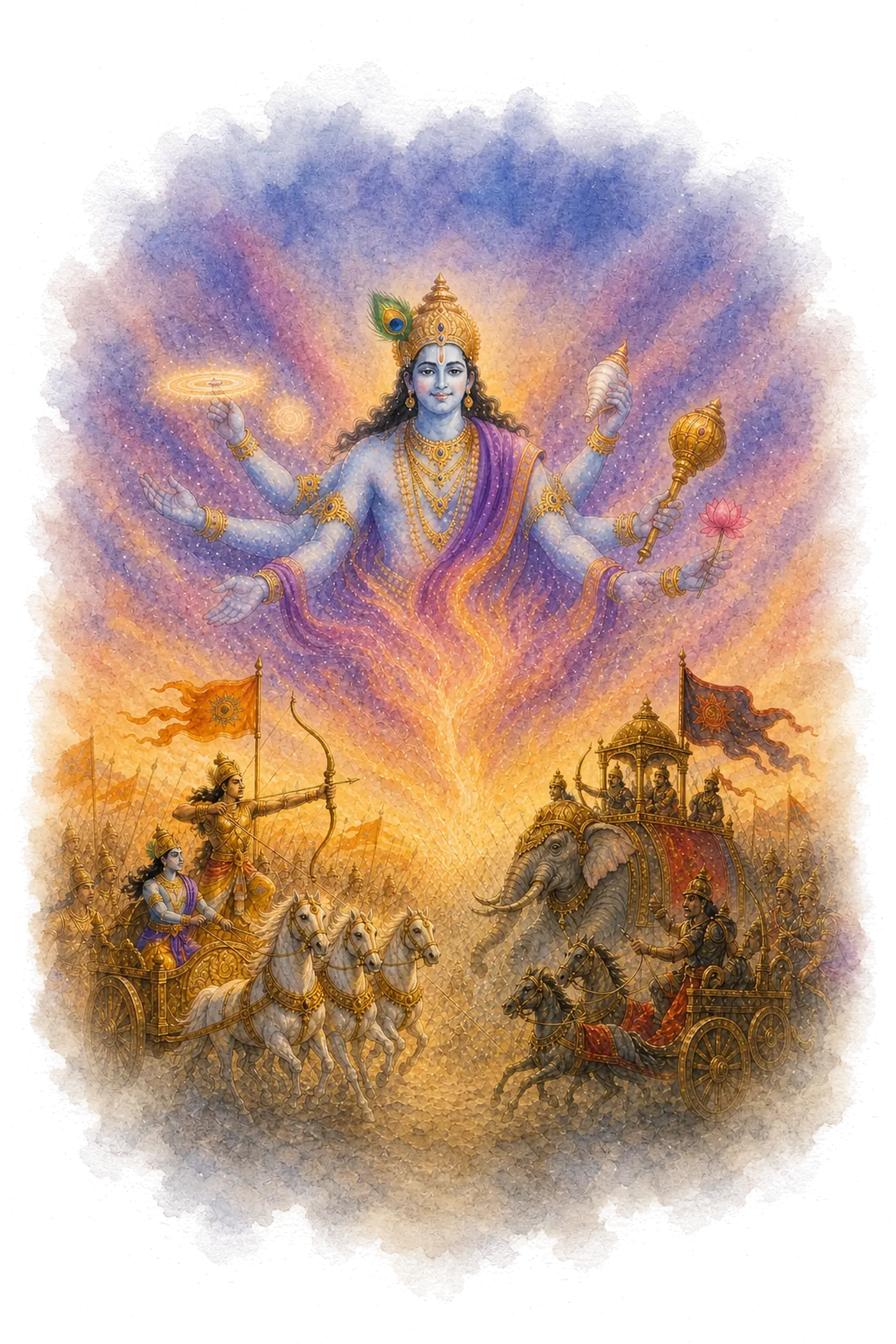
- The Bhagavad Gita. Between the two armies, Arjuna sees his teachers and cousins and lowers his bow. Krishna answers him.
- The Grandsire's Ten Days. Bhishma leads the Kauravas for ten days, until Arjuna brings him down from behind Shikhandi. A Tale Within the Tale: "Amba Born Again."
- The Wheel of Death. Drona's army forms a great wheel, and young Abhimanyu breaks into it alone. Tales: "Son of the Moon" and "Half a Lesson."
- Before Sunset. Arjuna swears to kill Jayadratha before the next sunset, and Krishna helps him keep his word.
- The Arm and the Sword. Satyaki fights his way through to Arjuna, and an old quarrel between two families comes due. A Tale Within the Tale: "The Old Quarrel."
- "Ashwatthama Is Dead." The fighting goes on into the night, and Yudhishthira tells Drona a half-truth.
- Give Away Your Bow. Yudhishthira tells Arjuna to give his bow to someone else, and Arjuna has sworn to kill anyone who says it.
- The Sinking Wheel. Karna leads the Kauravas, and on the seventeenth day his chariot wheel sinks into the earth. A Tale Within the Tale: "The Crow Who Raced the Swans."
- The Lake and the Mace. Duryodhana hides in a lake, then comes out to fight Bhima with the mace.
- Night of the Owl. Ashwatthama attacks the Pandava camp while it sleeps, and Draupadi demands that he pay. A Tale Within the Tale: "The Discus He Could Not Lift."
- The Mothers' Grief. The war is over. The women of both sides walk out to the field, and Kunti tells her sons who Karna was.
- Lessons from a Bed of Arrows. Yudhishthira wants to give up the kingdom, and Bhishma, on his bed of arrows, teaches him how to rule. A Tale Within the Tale: "The Ocean and the Rivers."
- The Last Walk into the Forest. Krishna brings Abhimanyu's baby son to life. Years later the blind king, Gandhari and Kunti leave for the forest.
- The Fall of the Yadavas. Thirty-six years after the war, Krishna's own people quarrel at Prabhasa, and Krishna leaves the world. A Tale Within the Tale: "The Iron Pestle."
- The Road to Heaven. The five brothers and Draupadi walk toward the mountains with a dog, and only Yudhishthira reaches heaven's gate.
Epilogue · The Broken Tusk. Ganesha finishes writing and tells how the story was first heard.
A four-week Mahabharata lesson plan
The Prologue, 15 chapters and Epilogue of The War fit a four-week unit, about four chapters a week in two or three class periods. Read ahead before week 3, which holds the hardest chapters.
| Week | Read | Talk and do |
|---|---|---|
| 1 | Prologue to chapter 3: the Bhagavad Gita, Bhishma's ten days, the wheel of death | Bring back the heroes and villains lists from Books One and Two. Read Krishna's answer to Arjuna in chapter 1 aloud and ask what helps students hold their minds still. Hold a Krishna asks debate on chapter 2. |
| 2 | Chapters 4 to 7: before sunset, the old quarrel, the half-truth, the bow | Hold a mock trial on Yudhishthira's half-truth. Talk about when a promise or a rule should give way. |
| 3 | Chapters 8 to 11: the sinking wheel, the mace fight, the night raid, the mothers | Look back at the rules of war both sides agreed in Book Two, chapter 15. List each rule that was broken, by whom, and what reason they gave. |
| 4 | Chapters 12 to 15 and the Epilogue: Bhishma's lessons, the forest, the Yadavas, the road to heaven | Use the question cards for chapters 12 to 15. Finish with each student's final heroes and villains list across all three books, and a short essay on one Krishna question. |
Krishna asks: the Right Path questions by chapter
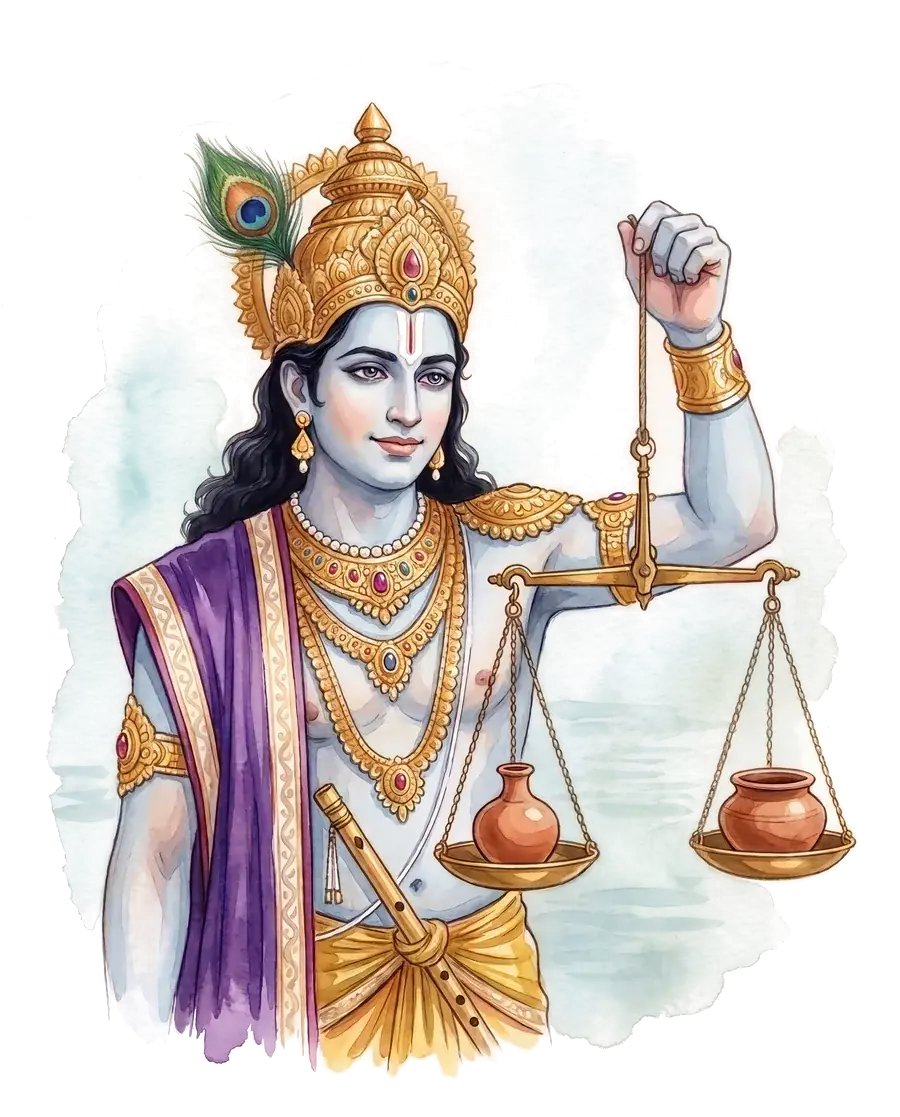
Eleven chapters end with Krishna holding up a balance scale. In this book he is often asking about his own choices, and readers are free to argue with him. Chapters 9, 12, 13 and 14 have no question from Krishna, so use the discussion questions for those.
| Chapter | The choice | Krishna asks |
|---|---|---|
| 1 · The Bhagavad Gita | Arjuna faces his own family | Can you stand against someone and still honor them? |
| 2 · The Grandsire's Ten Days | Krishna runs at Bhishma | Was I right to break my promise, or should I have stayed with the reins? |
| 3 · The Wheel of Death | Abhimanyu goes into the wheel | If you are the only one who can do something dangerous, do you have to do it? |
| 4 · Before Sunset | Krishna hides the sun | I hid the sun so a man would step out into the open. Was that fair, when six warriors stood around him so he could never be reached? |
| 5 · The Arm and the Sword | Satyaki and Bhurishravas | When a quarrel is handed down from one generation to the next, can anyone ever end it? |
| 6 · "Ashwatthama Is Dead" | Yudhishthira's whisper | When Yudhishthira whispered "the elephant," were his words a lie? |
| 7 · Give Away Your Bow | Angry words between brothers | Why are the people we love most so often the ones we hurt with words? |
| 8 · The Sinking Wheel | Karna's wheel | Should Arjuna have waited for Karna to free his wheel? |
| 10 · Night of the Owl | Ashwatthama's raid | When the other side has broken the rules, does that free you to break them too? |
| 11 · The Mothers' Grief | Kunti's secret | Is there ever a secret that should be kept from the person it belongs to? |
| 15 · The Road to Heaven | Yudhishthira and the dog | What do we owe to someone who has followed us all the way? |
Mahabharata discussion questions
The book gives every chapter discussion questions of its own, on a different part of the chapter from Krishna's. There are no model answers. Students may disagree with Krishna, with each other and with you, as long as they can say why. A few to start with:
Put a character on trial
Five cases from The War are ready to run, each with the charge, the evidence by chapter, witnesses and questions for both sides. They are on mock trial cases from The War. The roles, the step-by-step plan and the rubric are in the mock trial kit.
Handling the hard moments
This is the book of the war, and many people die in it, some of them young. The book says plainly who falls and keeps away from wounds and blood. It stays with the choices people make and the people who grieve. Read ahead where your class needs it.
- The battle (chapters 2 to 9). Bhishma, Abhimanyu, Drona, Karna and Duryodhana fall, each after a choice that students will want to argue about.
- Abhimanyu (chapter 3). A boy of sixteen is surrounded by six warriors. This is the death many readers feel most.
- The night raid (chapter 10). Ashwatthama attacks the camp while it sleeps, and Draupadi's sons are among the dead. It is the hardest chapter in the series.
- The mothers (chapter 11). Gandhari, Kunti and the women of both sides grieve on the field.
- The end of the Yadavas and the last road (chapters 14 and 15). Krishna's people turn on one another, Krishna leaves the world, and the brothers and Draupadi fall one by one on the mountain.
Our age guide covers the series as a whole.
Book details for ordering
| Title | The War |
|---|---|
| Series | Mahabharata, Book Three of three |
| Author | Ankita Sharma |
| Pages | 236 |
| Format | Paperback, 6 × 9 in, full color |
| ISBN | 979-8-9828468-2-2 |
| Publisher | Sharma Ink |
| Ages | 10 to 16 (about grades 5 to 10) |
| Release | December 14, 2026 |
Questions teachers ask
Do students need to read Books One and Two first?
It helps a great deal, because the war is where the promises and quarrels of the first two books come due. The War opens with The Story So Far, in which Ganesha retells both earlier books, so a class can follow it without them.
Is the Bhagavad Gita in the book?
Yes. Chapter 1 tells it as the talk between Arjuna and Krishna on the first morning of the war, in plain words for young readers. It tells the heart of Krishna's answer to Arjuna in a few pages, including the vision of his universal form.
How does the book handle the battles and deaths?
It says plainly who dies and keeps away from wounds and blood. The chapters stay with the choices that led there and with the people left grieving. The night raid in chapter 10 is the hardest moment in the series, so read it before your class does.