The whole story · A 5-minute read
Mahabharata Summary: The Whole Story in 5 Minutes
The Mahabharata is the story of two families of royal cousins, the five Pandava brothers and the hundred Kauravas, who quarrel over one kingdom. The Pandavas lose everything in a crooked game of dice and spend thirteen years in exile. Then they win their kingdom back in an eighteen-day war at Kurukshetra that costs them almost everyone they love.
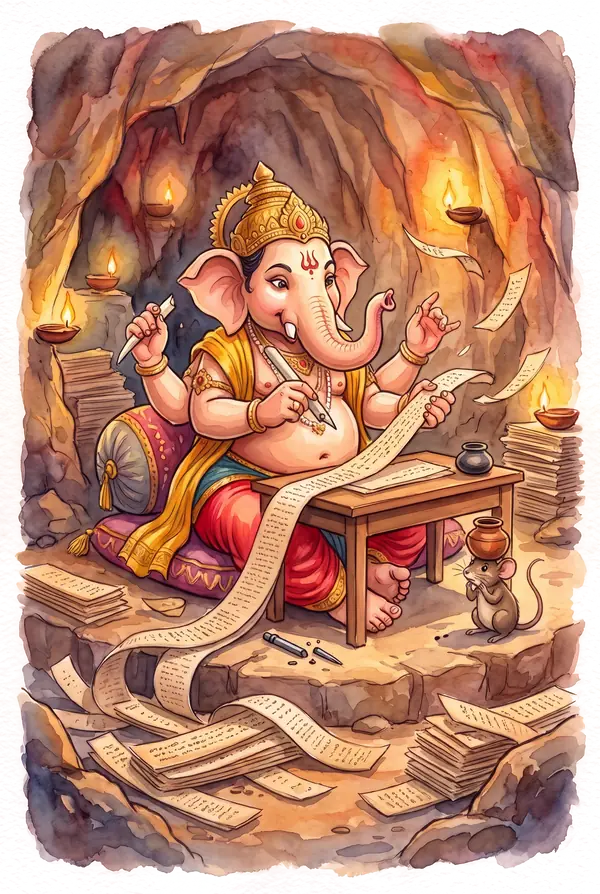
The sage Vyasa composed the Mahabharata (महाभारत, often spelled Mahabharat), and the elephant-headed god Ganesha wrote it down as he spoke. The story falls into three parts, the same three as the books in this series. New to the epic? The parents' guide says where to begin with a child.
Book One, The Vow: how the quarrel began
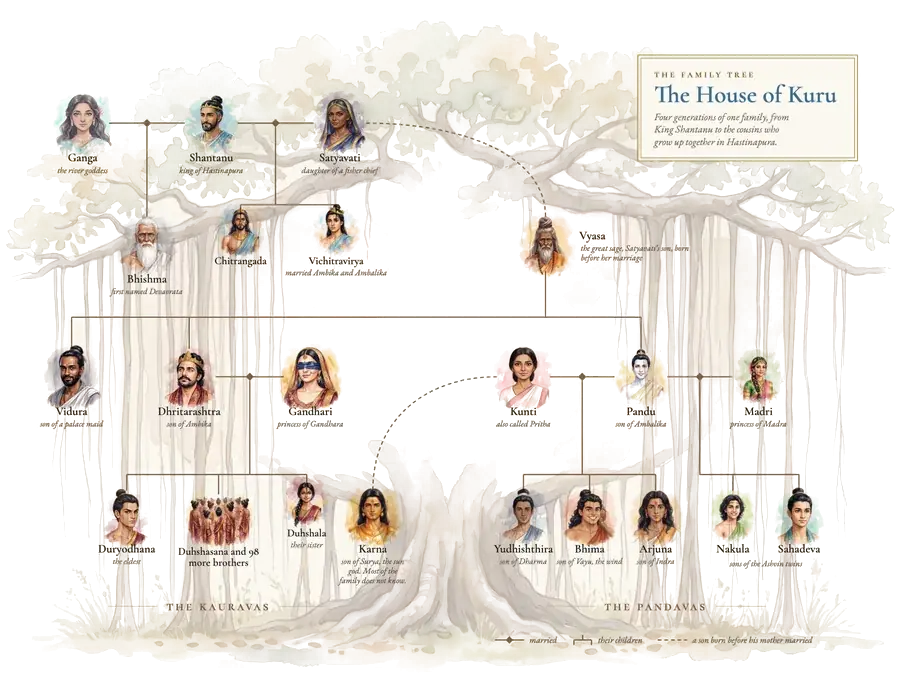
The family and the vow
The quarrel starts a generation before the cousins are born. King Shantanu of Hastinapura marries the river goddess Ganga, and their son Devavrata grows up as heir to the throne. Then Shantanu falls in love with Satyavati, a fisher chief's daughter, whose father wants her sons to rule. So Devavrata swears never to be king and never to marry. The gods name him Bhishma for that terrible vow.
Bhishma carries off three princesses as brides for his young half-brother. One of them, Amba, is turned away by the king she loves, and she vows to bring Bhishma down, in this life or the next. By the sage Vyasa's blessing, two princes are born. Dhritarashtra is born blind, so the crown goes to his younger brother Pandu. Dhritarashtra's bride, Gandhari, ties a cloth over her own eyes out of love and respect for him.
The cousins
Pandu is cursed while hunting and goes to live in the forest with his wives, Kunti and Madri. As a girl, Kunti had used sacred words to call the sun god and had a son born in golden armor. Frightened, she set him afloat on a river, and a charioteer raised him. His name is Karna. Now the same words bring the five Pandavas. Yudhishthira, Bhima and Arjuna are Kunti's sons, and the twins Nakula and Sahadeva are Madri's.
When Pandu dies, Kunti brings the boys home to their hundred cousins, the sons of Dhritarashtra and Gandhari. The eldest, Duryodhana, poisons Bhima, who comes back stronger. The teacher Drona trains all the princes, and Arjuna becomes the finest archer. Drona even asks a forest archer, Ekalavya, for his right thumb, so that no one will outshine Arjuna.
At the princes' tournament Karna challenges Arjuna and is mocked for his birth, and Duryodhana makes him a king on the spot. For his teacher's fee, Drona has his old friend King Drupada captured, and Drupada prays for revenge. Duryodhana tries again, with a house built to burn with the Pandavas inside. They escape into the forest, where Bhima fights rakshasas and marries one, Hidimbi.
Draupadi
Drupada's daughter, Draupadi, rises out of his sacrificial fire. Dressed as a poor brahmin, Arjuna wins her at her swayamvara by hitting a target no king can hit. At home Kunti tells her sons to share what they have brought before she sees what it is, and Draupadi marries all five.
Indraprastha
The Pandavas get half the kingdom and build their city, Indraprastha. Arjuna and his cousin and best friend, Krishna, help the fire god burn the Khandava forest. The builder Maya, spared from the flames, makes them a hall full of wonders, where the kings hail Yudhishthira as emperor. In that hall Duryodhana walks onto a floor that is really water and falls in, and Bhima laughs. Duryodhana's uncle Shakuni, who never loses at dice, has a plan. Vidura carries the invitation to a game, and Yudhishthira says yes.
Book Two, The Dice: one game and thirteen years away
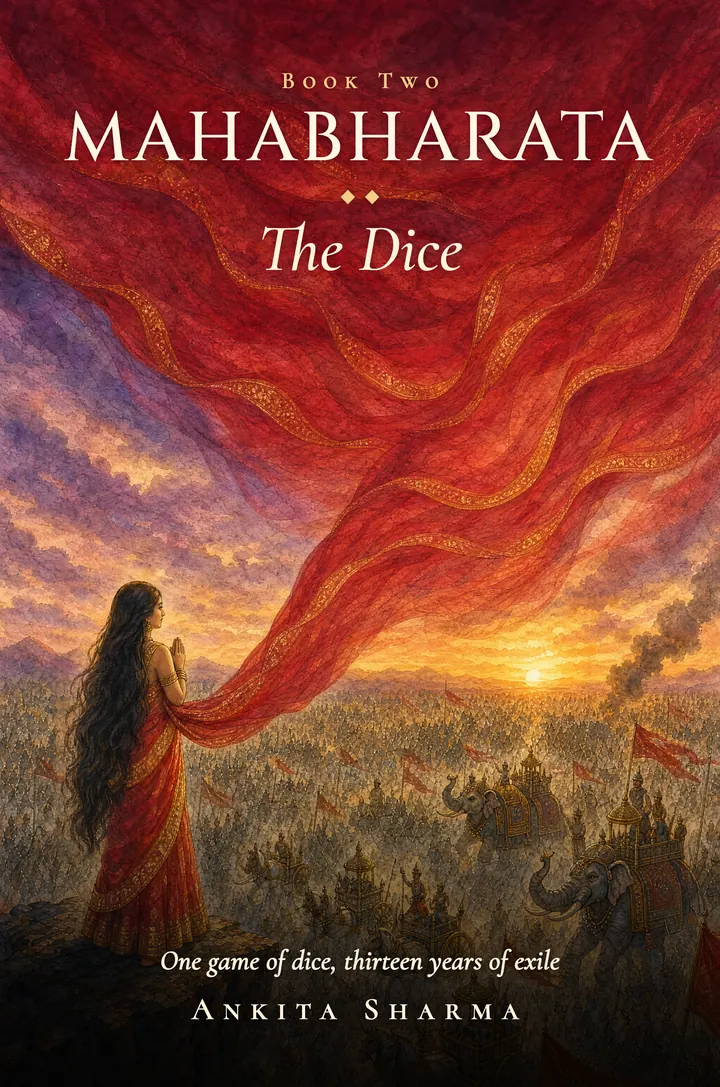
The Dice comes out on December 7, 2026.
The dice game
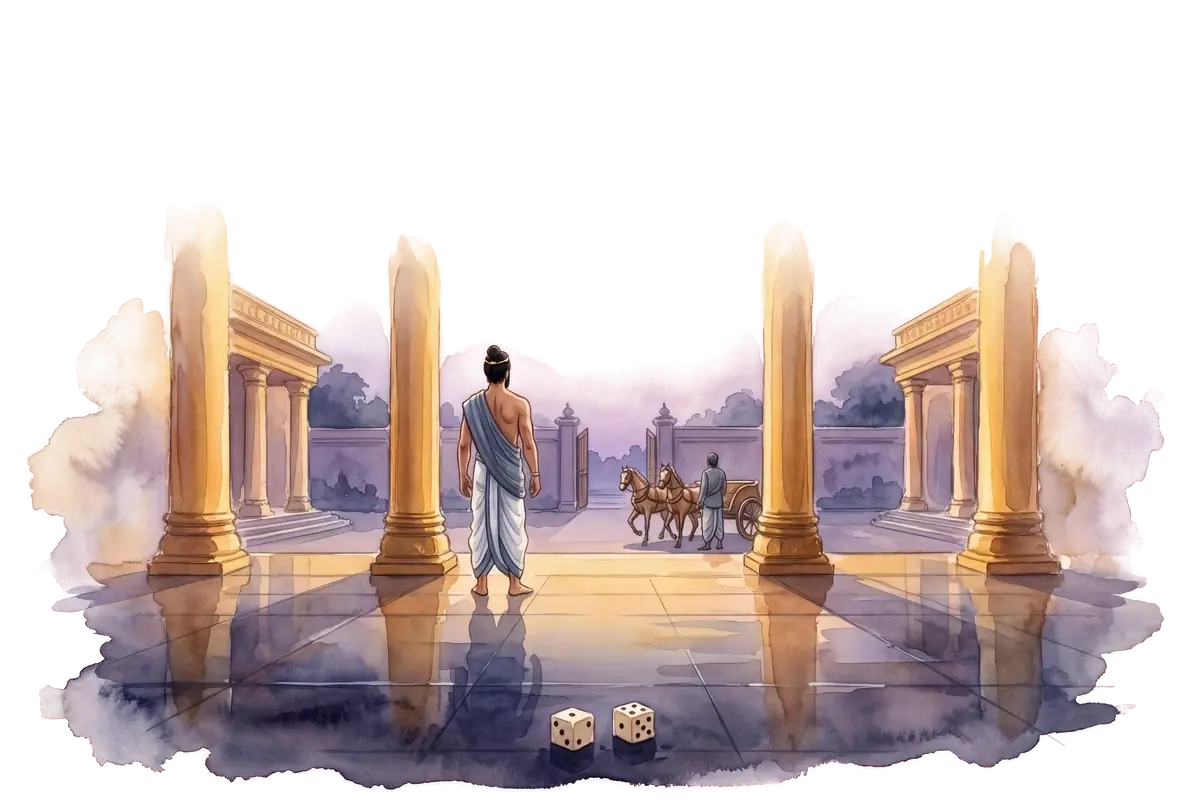
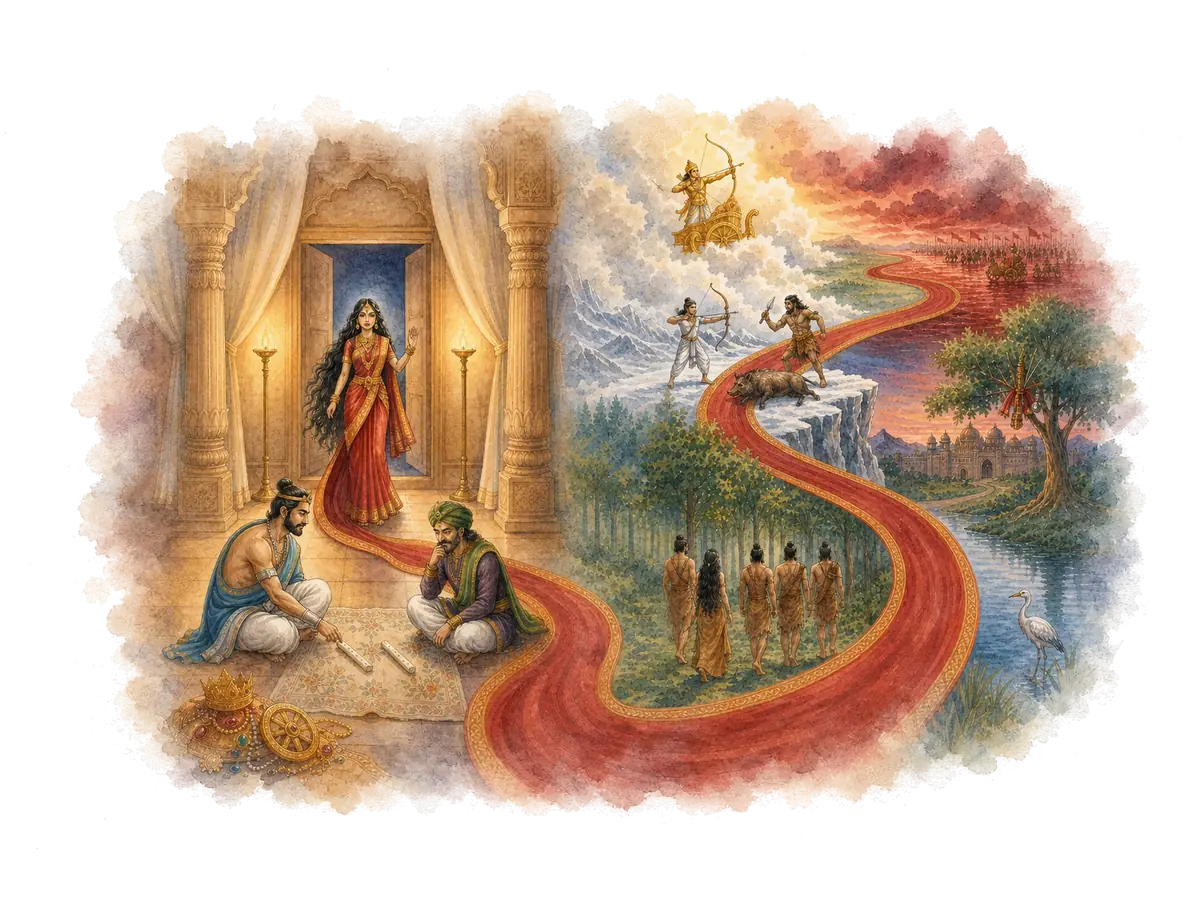
In the blind king's new hall, Shakuni throws the dice for Duryodhana, and they keep falling his way. Yudhishthira has sworn never to refuse a challenge, and he plays on. He loses his gold, his army, his kingdom, his four brothers and himself. Then he stakes Draupadi, and loses her too. The dice game, told in full.
Draupadi's question
Duryodhana's brother Duhshasana brings Draupadi into the hall by force. She asks the elders a question none of them will answer. If her husband had already lost himself, how could he stake her? Then Karna tells Duhshasana to take her cloth, the moment many families know as the vastraharan. Draupadi calls on Krishna, her cloth does not end, and she stays covered. Bhima swears to kill Duhshasana and break Duryodhana's thigh. Frightened by omens, the blind king grants Draupadi wishes. She frees her husbands, and everything is given back. Draupadi's question, told in full.
The exile
It does not last. Duryodhana talks his father into one more game. The losers must spend twelve years of exile in the forest, the vanvas, and a thirteenth in disguise, and start again if they are found. Yudhishthira loses.
The forest years are full of stories. Arjuna fights a hunter who turns out to be the god Shiva, then learns the weapons of the gods in Indra's heaven. Bhima meets an old monkey whose tail he cannot lift, his brother Hanuman. Karna trades the golden armor he was born in to Indra, disguised as a brahmin, for a spear that can kill one enemy. At a lake, four of the brothers drink without answering a voice's questions and fall dead. Yudhishthira answers its questions, the Yaksha Prashna, and the voice, a yaksha who is really his father Dharma, gives all four back.
The year in disguise
For the thirteenth year they hide as servants at King Virata's court. Arjuna becomes a dance teacher named Brihannala, Bhima a cook, and Draupadi the queen's maid. When the queen's brother Kichaka harasses Draupadi, Bhima kills him in secret. At the end of the year the Kauravas raid Virata's cattle, and Arjuna takes his bow down from its hiding place in a tree and drives them all back.
The road to war
Duryodhana still will not give back their kingdom. Arjuna and Duryodhana reach Krishna on the same day. Arjuna chooses Krishna himself, who will not fight, and Duryodhana gladly takes Krishna's army. Krishna goes to Hastinapura to ask for peace, even for five villages, and Duryodhana will not give up land the size of a needle's point.
On his way out, Krishna tells Karna the secret of his birth. Karna is Kunti's eldest son. Karna stays with Duryodhana, who made him a king. He promises Kunti he will kill none of her sons except Arjuna, so that she will always have five. Eighteen armies gather at Kurukshetra, and the conches sound.
Book Three, The War: eighteen days at Kurukshetra
The War comes out on December 14, 2026. It tells the war and everything after it, to the end of the story.
The Bhagavad Gita
As the battle is about to begin, Arjuna looks across the field at Bhishma, at his teacher Drona and at his cousins, and lets his bow fall. Krishna, driving his chariot, tells him to do his duty without clinging to its rewards, and that the soul can never be killed. Their talk is the Bhagavad Gita. The Bhagavad Gita for kids, told in full.
The eighteen days
The war lasts eighteen days, and both sides break the rules they agreed to fight by. Bhishma will not fight Prince Shikhandi, who was Amba in a past life, so on the tenth day Arjuna shoots from behind Shikhandi and brings Bhishma down onto a bed of arrows. Arjuna's son Abhimanyu, who is sixteen, fights his way alone into the enemy's wheel-shaped formation, the chakravyuha, and six warriors close around him there until he is killed. Karna uses Indra's spear on Bhima's son Ghatotkacha, though he had been saving it for Arjuna.
To stop Drona, Yudhishthira, who never lies, says that Ashwatthama is dead, meaning an elephant with the same name as Drona's son. Drona lays down his weapons and is killed. Karna's chariot wheel sinks into the earth, and Arjuna shoots him as he tries to free it. On the last day Bhima breaks Duryodhana's thighs with his mace, a blow the rules forbid. That night Drona's son Ashwatthama creeps into the Pandava camp and kills the warriors asleep there, Draupadi's five sons among them.
After the war
The Pandavas have won, and almost everyone they love is dead. Gandhari, who has lost all her hundred sons, blames Krishna for not stopping the war and curses his people to destroy each other. Kunti tells her sons at last that Karna was their eldest brother. Yudhishthira becomes king, and Bhishma, still on his bed of arrows, teaches him how to rule before he dies. Abhimanyu's son Parikshit is born dead, struck by Ashwatthama's weapon before his birth, and Krishna gives him life.
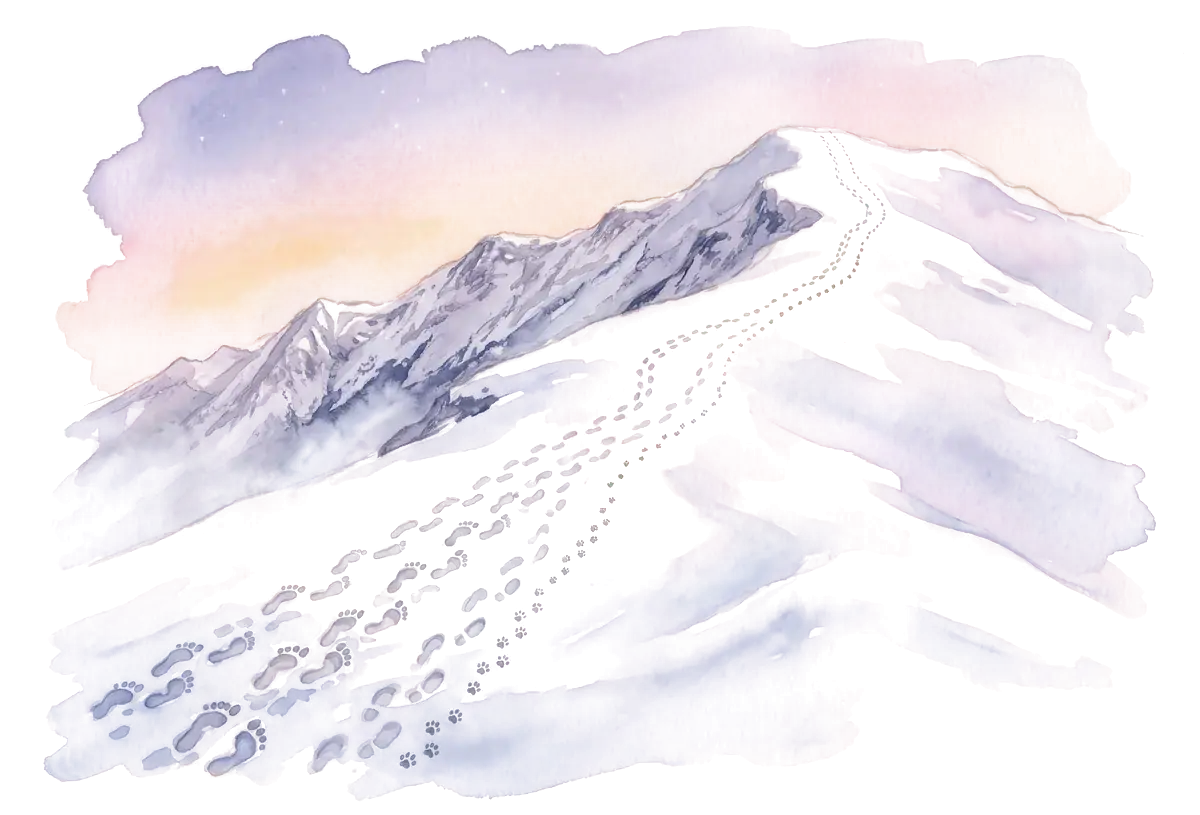
Thirty-six years later Gandhari's curse comes true, and Krishna is shot by a hunter who takes him for a deer. The Pandavas give the kingdom to Arjuna's grandson Parikshit and walk into the Himalayas with Draupadi, and a dog follows them. One by one they fall, until only Yudhishthira and the dog are left. He will not enter heaven without the dog, and the dog turns out to be Dharma, testing him one last time. After one last test, Yudhishthira finds his brothers, Draupadi and Karna again in heaven.
In the Epilogue, Ganesha tells how the story was first told aloud, years later, to Parikshit's son, King Janamejaya.
Questions about the story
Who wins the Mahabharata war?
The Pandavas win. After eighteen days of fighting at Kurukshetra, Yudhishthira becomes king in Hastinapura. The victory costs them nearly everyone they love, among them their sons, their teacher Drona and Bhishma, the grandsire who raised them. When the fighting ends, only seven warriors on their side are still alive. The epic gives the winners as much grief as the losers.
How does the Mahabharata end?
After thirty-six years as king, Yudhishthira hands the kingdom to Arjuna's grandson Parikshit. The five brothers walk north into the Himalayas with Draupadi, and a dog follows them. One by one they fall, until only Yudhishthira and the dog are left. He refuses to enter heaven without the dog, which turns out to be the god Dharma. In heaven he finds his family again.
Who killed Karna?
Arjuna did, on the seventeenth day of the war, while Karna was trying to free his chariot wheel from the earth. They were brothers, both sons of Kunti. In this series Karna learns the secret from Krishna just before the war, in Book Two, and the five Pandavas hear it only after Karna is dead, from their mother, in Book Three.
What is the Bhagavad Gita?
It is the talk between Krishna and Arjuna on the field of Kurukshetra, just before the battle, when Arjuna cannot bring himself to fight his own family. Krishna tells him to do his duty without clinging to its rewards, and teaches him that the soul cannot be killed. The Gita sits inside the Bhishma Parva, the sixth book of the epic, and is often read on its own.
Who wrote the Mahabharata?
Tradition says the sage Vyasa composed the Mahabharata, often spelled Mahabharat, and that the elephant-headed god Ganesha wrote it down as Vyasa spoke. Ganesha agreed on one condition, that Vyasa never stop, and Vyasa asked in return that Ganesha understand every verse before he wrote it. Vyasa is also in the story, as the grandfather of both the Pandavas and the Kauravas. Scholars think the epic grew over many centuries, roughly from 400 BCE to 400 CE, as generations of storytellers added to it. Kisari Mohan Ganguli made the first complete English translation, published between 1883 and 1896.
How long is the Mahabharata?
About a hundred thousand verses, which makes it one of the longest poems ever composed. It is divided into eighteen books called parvas, and inside the main story sit many shorter ones. This series tells the whole of it in three illustrated books for readers aged 10 to 16, with a painting on every page.
Where can a child read the Mahabharata in simple English?
The three illustrated books, The Vow, The Dice and The War, retell the whole epic in plain modern English for readers 10 to 16, with a painting on every page. For older readers and adults, C. Rajagopalachari's short Mahabharata is the classic retelling in simple English. The Mahabharata books for kids, compared sets out the other choices by age.
Is this summary all right for a ten-year-old?
For most children from about ten, yes. It names the deaths in the war plainly and briefly, with no gory detail, the way the books do. If your child is reading the series and wants to be surprised, read only as far as the book they have finished. Our age guide lists every hard moment in the three books and how each book tells it.
Where this comes from: The events follow the Mahabharata in Kisari Mohan Ganguli's English translation (1883–1896), which divides the epic into eighteen parvas. Book One comes mostly from the Adi and Sabha Parvas, and Book Two from the Sabha, Vana, Virata and Udyoga Parvas. The war fills the Bhishma, Drona, Karna and Shalya Parvas. The night raid is the Sauptika Parva, the grief and Bhishma's teaching are in the Stri, Shanti and Anushasana Parvas, and the last five parvas tell of the years after the war, Krishna's death and the walk to heaven. Two details here follow a popular telling. In Ganguli's Sabha Parva the god Dharma, unseen, keeps Draupadi covered, and in the Udyoga Parva Karna already knows who his mother is when Krishna tells him. Our sources page lists the rest, chapter by chapter.