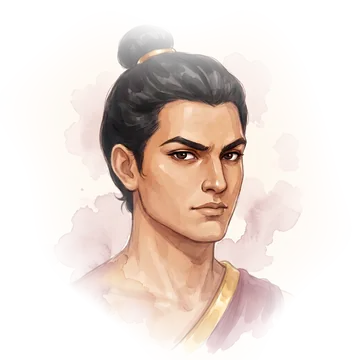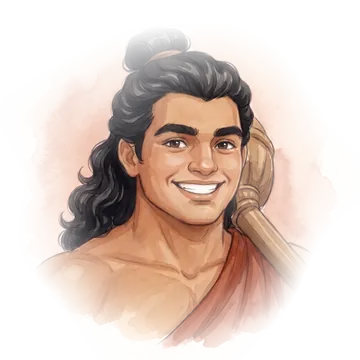
Bhima is the second of the five Pandava brothers in the Mahabharata, the son of Queen Kunti, born by the blessing of Vayu, the wind god. He is the strongest and hungriest of the brothers, and in Book One he survives his cousin Duryodhana's poison and carries his whole family out of a burning house. In Book Two he swears two vows in the dice hall, to kill Duhshasana and to break Duryodhana's thigh, and in Book Three he keeps them both.
- Family
- Son of Kunti and King Pandu, born by the blessing of Vayu. Brother of Yudhishthira, Arjuna, Nakula and Sahadeva. Cousin of Duryodhana and his ninety-nine brothers. Husband of Hidimbi, and with his brothers, of Draupadi. Father of Ghatotkacha.
- Known for
- His strength, which the serpent people made ten thousand elephants strong. His mace. His appetite. The two vows he swore in the dice hall and kept in the war.
- First appears
- Book One, chapter 6, The Hunter's Curse
Bhima's story in Book One
A baby who broke a rock
Bhima's father, King Pandu, lived high in the mountains under a sage's curse that meant he could never have a son of his own. Queen Kunti knew sacred words that could call a god. For their second son she called Vayu, the wind, who came riding on a deer. Bhima was born on the very same day as his cousin Duryodhana, and a voice from the sky said he would be the strongest of all.
Once, when he was a baby, a tiger roared near Kunti and she jumped up. Bhima rolled off her lap onto the mountainside. The rock under him broke into a hundred pieces, and he did not have a bruise. Years later the sages brought Kunti and her five sons home to Hastinapura, where Duryodhana looked hard at the big boy born on his own birthday.
Poison and the serpent kingdom
In the palace Bhima beat his hundred cousins at everything. He kicked a mango tree, and six princes fell out of it along with the fruit. In the river he sat on the bottom with cousins under each arm and counted while they kicked. He thought it was a game. His cousins limped home with cut heads, and one day Duryodhana's brother Duhshasana came out of the water crying.
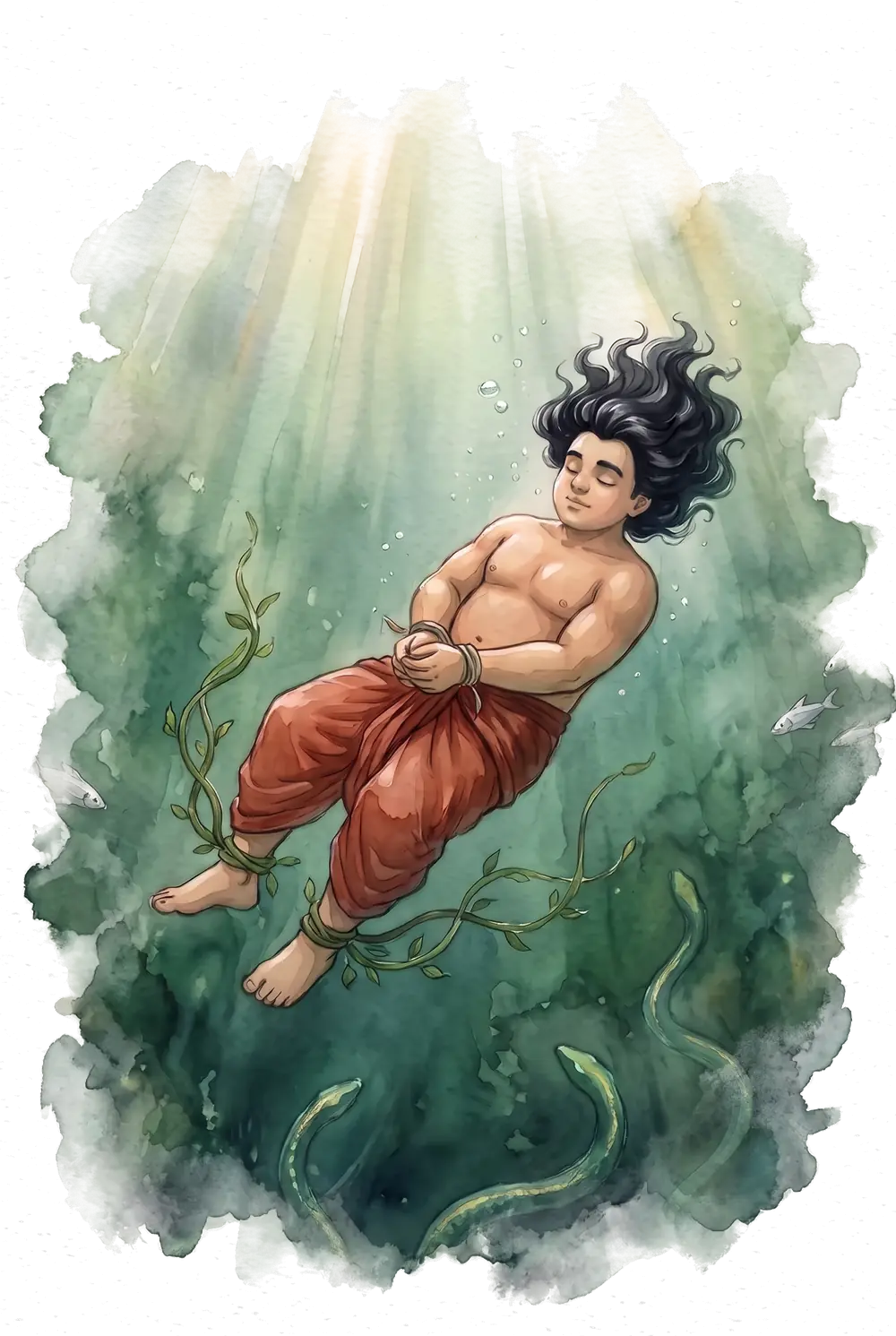
Weeks later Duryodhana invited the Pandavas to a water house on the Ganga at Pramanakoti. He fed Bhima a whole plate of sweets with his own hands. The sweets were poisoned. While Bhima slept on the riverbank, Duryodhana tied him with creepers and pushed him into the river.
Bhima sank to the kingdom of the Nagas, the serpent people. Their bites drove the poison out of his blood, and an old Naga named Aryaka knew him as family. The Nagas gave him eight great bowls of their drink of strength. He slept for eight days and woke with the strength of ten thousand elephants. Back home, the next morning, he sat down to eat right across from Duryodhana and asked for a second helping of everything.
The mace and the tournament
Bhima and Duryodhana both fought with the mace, a heavy club with a metal head. At the great tournament where the princes showed their skills, the two of them came out with their maces and the crowd took sides, roaring for one or the other, until Drona's son had to pull them apart.
Later that day Duryodhana made a stranger named Karna king of Anga. When Karna's father, an old charioteer, came through the crowd to hug him, Bhima laughed out loud. He told Karna to go and pick up a whip like the rest of his family. It is the cruelest thing Bhima says in Book One, and Duryodhana rose to defend his new friend.
When their teacher Drona asked for his fee, the princes rode against King Drupada of Panchala. Bhima ran at the war elephants with his mace and drove them before him like cattle, until Arjuna shouted at him to spare the king's people.
The house of lac
Duryodhana tried again. He sent the Pandavas to the town of Varanavata, where his man Purochana had built them a fine house meant to burn, its walls plastered with lac. Their uncle Vidura warned them in a secret language and sent a miner to dig a tunnel. Each night Bhima hauled away the baskets of earth.
After a year, on a windy night, Bhima set the fire himself, starting with the room where Purochana slept. The family escaped through the tunnel. His mother and the twins could hardly walk, so Bhima carried all five. Kunti rode on his shoulder, a twin sat on each hip, and Yudhishthira and Arjuna were in his arms. He ran through the dark forest, snapping branches with his chest.
A Nishada woman and her five sons had fallen asleep in the house after a feast, and they died in the fire. Even the old poem does not say whether the brothers knew they were still inside. Everyone in Hastinapura believed the Pandavas were dead.
Hidimba, Hidimbi and Ghatotkacha
In the forest Bhima kept watch while his family slept. The rakshasa Hidimba smelled them and sent his sister Hidimbi to kill them. She saw Bhima and wanted him for her husband instead. When her brother came himself, Bhima dragged him away so his family could sleep. The fight woke everyone anyway. Bhima whirled the giant over his head and dashed him down, and the forest went still.
Hidimbi asked to marry Bhima, and Kunti and Yudhishthira agreed. Every day she carried him off through the sky, over lotus lakes and snowy peaks, and every evening she brought him home. Their son was born with a bald head as round as a water pot, a ghata, so they named him Ghatotkacha. Rakshasa children grow up fast, and within the hour he was a young man. He promised to come whenever his father thought of him.
Baka and the cartload of rice
Later the family hid as poor brahmins in the town of Ekachakra, living on alms. Kunti gave Bhima half of everything, and the rest of them shared the other half. A rakshasa named Baka made the town send him his dinner, one house at a time. It was a cartload of rice pulled by two buffaloes, and the person who drove it. When their host's turn came, Kunti offered Bhima instead.
Bhima drove the cart into the forest, eating the rice as he went. When Baka came crashing out of the trees and pounded him on the back, Bhima kept eating. He finished the rice, rinsed his fingers, and then he fought. Ekachakra woke to find Baka dead at its gate, and the town never learned who had done it.
The tree at the swayamvara
At Princess Draupadi's swayamvara, the contest for her hand, the brothers sat among the brahmins in disguise. When Arjuna hit the target and the angry kings rushed at him, Bhima pulled a tree out of the ground, stripped off its leaves and stood beside his brother, holding it like a club. Back at the potter's house where they lodged, Bhima's voice came booming up the lane, calling to Kunti to see the alms they had brought. Without turning around, she told them to share it equally. That is how Draupadi became the wife of all five brothers.
Jarasandha and the Rajasuya
Yudhishthira wanted to hold the Rajasuya, the great sacrifice that makes a king an emperor. Krishna said it could not be done while King Jarasandha of Magadha lived. Jarasandha kept eighty-six kings locked in his fortress. Krishna, Bhima and Arjuna went to him dressed as priests, and Jarasandha chose to wrestle Bhima. They fought for thirteen days and nights without food. On the fourteenth night Krishna split a twig and tossed the halves apart, and Bhima understood the signal and ended the fight.
At the Rajasuya, when King Shishupala insulted Krishna, Bhima jumped up with his teeth bared. Bhishma, whom the princes call Grandsire, held his arm and talked to him until he sat down again.
The laugh in the hall
In the hall of wonders that Maya built for the Pandavas, Duryodhana took a pool for a polished floor and walked straight into it. The first thing he heard when he came up was Bhima laughing. When Duryodhana walked into a closed crystal door, Bhima laughed again and called across the hall to show him the way out. Duryodhana rode home to Hastinapura without a word.
Questions about Bhima
Who were Bhima's parents?
His mother was Queen Kunti, and her husband was King Pandu of Hastinapura. A sage's curse meant Pandu could never have a son of his own, so Kunti used sacred words she had learned as a girl to call a god. Bhima was born by the blessing of Vayu, the wind, on the same day as his cousin Duryodhana.
How strong was Bhima?
Stronger than anyone in Hastinapura. As a baby he rolled off his mother's lap and broke the rock he landed on. Under the river the Nagas gave him eight bowls of their drink of strength, and he woke with the strength of ten thousand elephants. Later he carried his mother and all four brothers through a forest at once.
Who was Bhima's wife?
In Book One he marries twice. In the forest he marries Hidimbi, a rakshasa woman who fell in love with him, and their son is Ghatotkacha. Later Princess Draupadi of Panchala becomes the wife of all five Pandava brothers, after their mother tells them to share what they have brought home.
Why did Duryodhana hate Bhima?
The two boys were born on the same day, and Bhima beat Duryodhana's brothers at every game. He dunked them in the river and shook them out of trees, laughing. Bhima thought it was play. His cousins went home with cut heads and sore knees. Duryodhana also wanted the throne, and the strongest Pandava stood in his way.
What does the name Bhima mean?
Bhima means terrible or fearsome in Sanskrit. His fuller name is Bhimasena, and the old poem often calls him Vrikodara, which means wolf-belly. In Hindi and other modern Indian languages the final a is usually dropped, so you will also see him written Bhim or Bheem.
In Book Two: The Dice
When Yudhishthira stakes Draupadi and Duhshasana drags her into the hall, Bhima has to be held back from his own brother. He swears two vows that day, to kill Duhshasana in battle and to break the thigh Duryodhana bared at Draupadi (chapter 2). Through the forest years he argues that a month, or even a day, can stand in for a year. "It's no sin to cheat a cheat," he says, and Yudhishthira will not call thirteen days thirteen years (chapters 4 and 5).
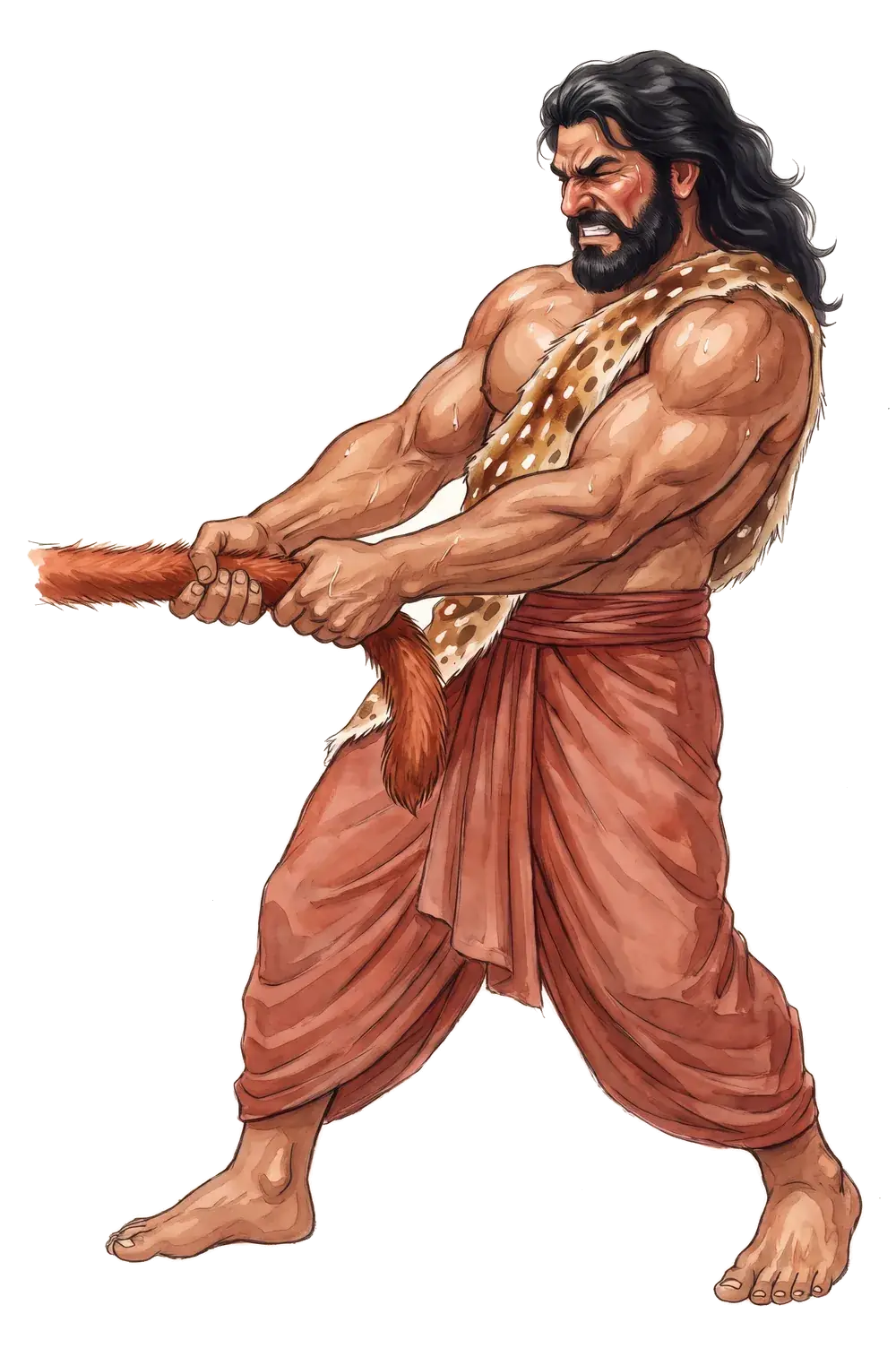
Climbing the mountain Gandhamadana to find golden lotuses for Draupadi, he finds an old monkey lying across the path and cannot move its tail. The monkey is Hanuman, his brother, a son of the wind like him, and he promises to roar with Bhima from the flagstaff of Arjuna's chariot (chapter 6, The Monkey in the Path). When King Jayadratha carries Draupadi off, Bhima and Arjuna ride him down and shave his head to five tufts (chapter 7).
During the year of hiding Bhima is Ballava, King Virata's cook. When the queen's brother Kichaka kicks Draupadi in front of the court and the king does nothing, Draupadi goes to Bhima in the night. He waits for Kichaka in the dark dance hall and kills him there (chapter 10, The Year of Disguises).
In Book Three: The War
When the war begins, Bhima roars, and from the top of Arjuna's flagstaff the great monkey roars with him, as Hanuman promised (chapter 1). Later Karna has him on the ground with no weapon left, and only taps him with his bow and laughs at him (chapter 4). To stop Drona, Bhima kills an elephant named Ashwatthama and shouts to Drona that Ashwatthama is dead (chapter 6).
On the seventeenth day Bhima keeps his first vow and kills Duhshasana. "Somebody tell Draupadi it's paid," he shouts. "She can wash her hair and tie it up" (chapter 8). After the last battle he fights Duryodhana with the mace. When Arjuna slaps his own thigh as a sign, Bhima strikes Duryodhana across the thighs, below the navel, where the rules of the mace forbid. He has kept his second vow, and Balarama calls it shameful (chapter 9, The Lake and the Mace).
After the war the blind king reaches out to embrace Bhima and crushes an iron figure Krishna has put in his place (chapter 11). Bhima admits to Gandhari that he was afraid of her son. When Kunti leaves for the forest, he asks her why she made them fight (chapter 13). Walking the road to heaven, he is the last to fall before Yudhishthira. Told that he ate too much and bragged of his strength, he laughs and thinks of an old monkey's tail (chapter 15).
Where this comes from: Adi Parva §123 (Bhima's birth), §128–129 (the poison and the Nagas), §136–140 (the tournament and Drupada), §141–152 (the house of lac), §152–170 (Hidimba and Baka) and §191–193 (the swayamvara) in the Ganguli translation of the Mahabharata, then Sabha Parva §20–44 (Jarasandha and the Rajasuya) and §46 (the laugh in the hall). Ganguli says Duryodhana fed Bhima poisoned food, and this retelling makes it sweets. In Ganguli, Bhima whirls Jarasandha around and breaks him with no signal from Krishna. The split twig comes from popular tellings. Many retellings have Draupadi laugh at Duryodhana in the hall. Ganguli has the four younger Pandavas and the servants laughing, and Draupadi is not there, so the book follows Ganguli. In Book Two, Hanuman is Vana Parva §142–154 and Kichaka is Virata Parva §1–24. Book Three follows Karna Parva §10–91 for Duhshasana and Shalya Parva §4–61 for the fight with the mace. More about the sources.