Similar Indian epics and stories · The Ramayana
Ramayana Summary for Kids: The Story of Rama and Sita
The Ramayana is the sage Valmiki's epic poem about Prince Rama of Ayodhya, about 24,000 verses long, in seven books called kandas. Sent into the forest for fourteen years, Rama loses his wife Sita to Ravana, the ten-headed king of Lanka. With the monkey hero Hanuman and an army of monkeys and bears, he crosses the sea on a bridge of stones and defeats Ravana, and Sita comes home with him to Ayodhya.
- Composed by
- The sage Valmiki, remembered as the first poet
- Length
- About 24,000 verses in seven kandas
- Where
- From Ayodhya in the north, through the great forests of the south, to Lanka across the southern sea
- In the Mahabharata
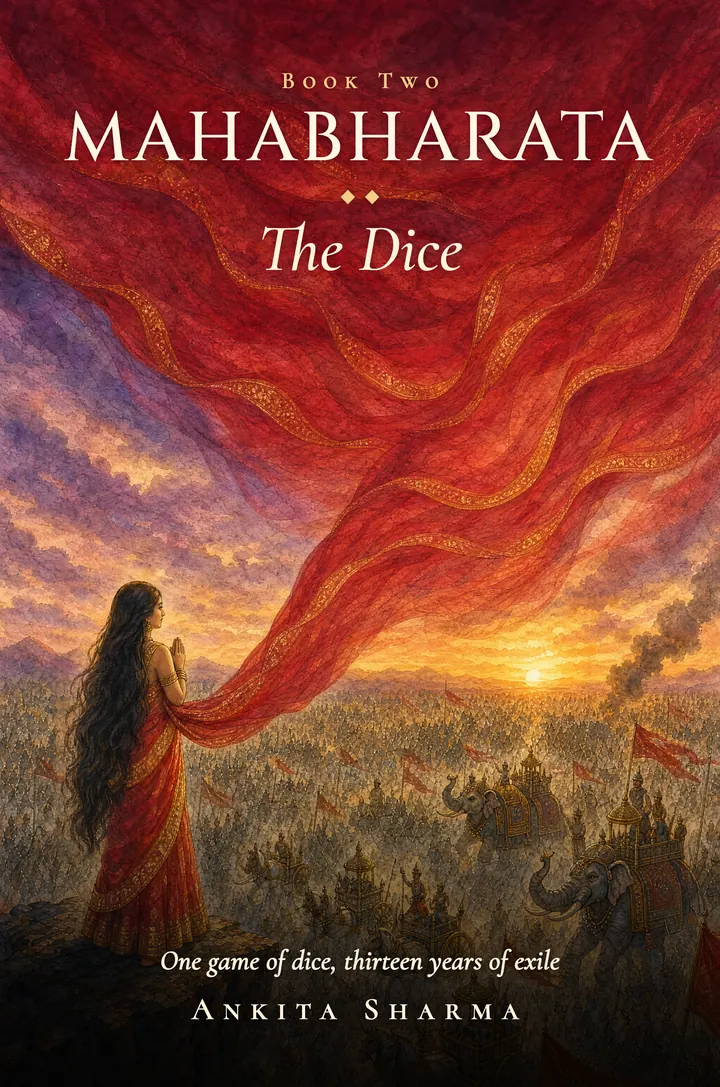
- Bhima meets Hanuman in the mountains, in Book Two, The Dice, chapter 6, The Monkey in the Path
- RamaRAA-maरामalso Ram
- SitaSEE-taaसीताalso called Janaki
- LakshmanaLAKSH-ma-naलक्ष्मणalso Lakshman, Laxman
- HanumanHA-nu-maanहनुमान्also called Anjaneya
- RavanaRAA-va-naरावणalso Ravan
- BharataBHA-ra-taभरतalso Bharat
The story in seven books
Bala Kanda: the prince and the bow
King Dasharatha of Ayodhya had three queens and no son. In heaven the gods had a worry of their own. Ravana, king of the rakshasas, had won a boon from the god Brahma that no god or demon could ever kill him. But he had never thought to ask for safety from men. So the god Vishnu agreed to be born on earth as a man.
The sage Rishyashringa led the king's great sacrifice, and from the fire rose a shining messenger carrying a golden vessel of food from the gods. The king shared it among his queens. Kausalya's son was Rama. Kaikeyi's son was Bharata. Sumitra had twins, Lakshmana and Shatrughna, and from the start Lakshmana went wherever Rama went.
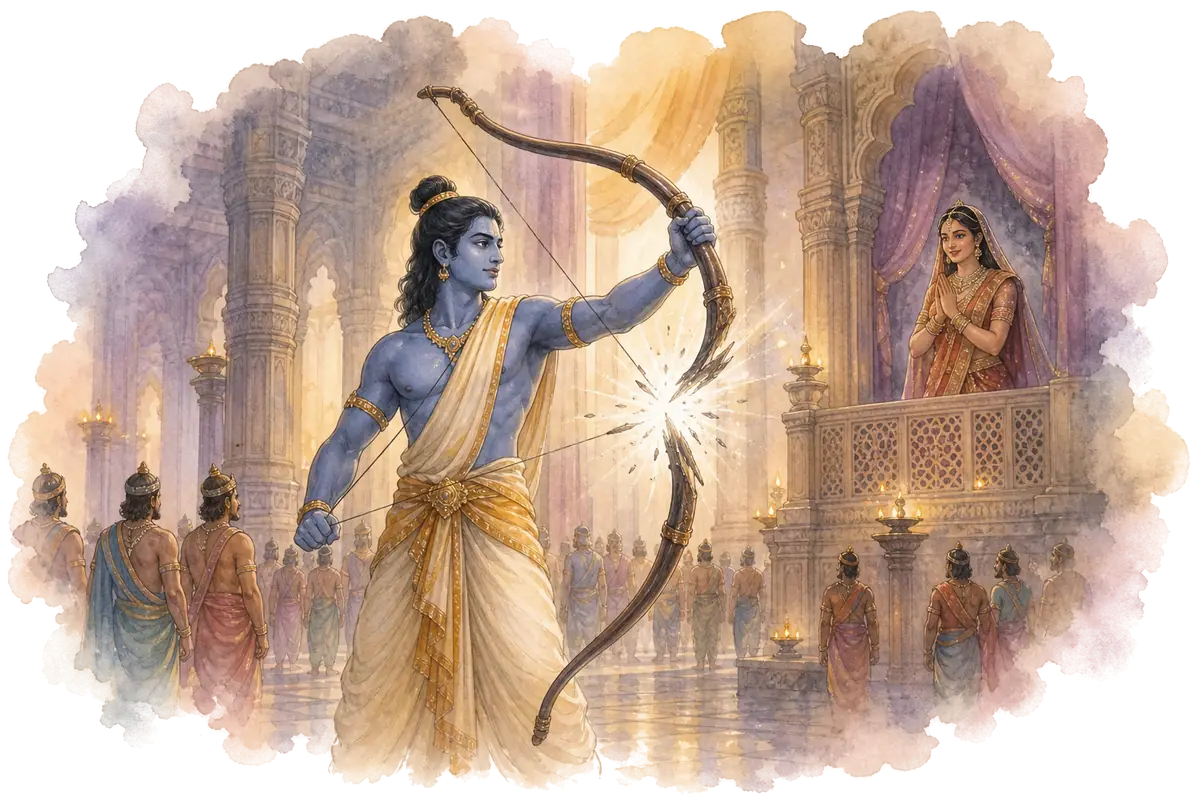
When Rama was barely sixteen, the sage Vishvamitra took him and Lakshmana into the forest to guard a sacrifice from rakshasas. From there he led them to Mithila. King Janaka of Mithila had found a baby girl in the earth while he was plowing a field, and he named her Sita. Janaka had promised her to whoever could string the great bow of the god Shiva, and none of the kings who came could even lift it.
Rama picked it up as if it were a toy and drew the string. The bow snapped in two with a crash like a mountain splitting. Rama and Sita were married, and his three brothers were married at the same time. On the road home the warrior-sage Parashurama stopped them, angry about the broken bow, and held out the bow of Vishnu. Rama strung that one too. Parashurama bowed and went back to his mountain.
Ayodhya Kanda: two boons and a pair of sandals
Years later the old king decided to make Rama heir to the throne, and the city hung out its flags. That night Queen Kaikeyi's maid, Manthara, filled her ears with fear. Long ago, Kaikeyi had carried Dasharatha off a battlefield and nursed him back to life, and he had promised her two boons. Now she asked for them. Bharata must be crowned, and Rama must go to live in the forest for fourteen years.
The king begged her to change her mind. She would not. Rama heard the news without a word of anger. His father's promise had to be kept, he said, and he put on a hermit's coat of bark. Sita refused to stay behind. So did Lakshmana. The three of them walked out of Ayodhya with the whole city weeping after them, and soon afterward Dasharatha died of grief.
Bharata had been away at his grandfather's court. When he came home and learned what his mother had done, he turned on her in fury and refused the throne. He followed Rama to the hill of Chitrakuta to bring him home. Rama would not break his father's word. So Bharata asked for Rama's sandals. He carried them home on his head and set them on the throne, and for fourteen years he ruled from the village of Nandigrama as Rama's servant, waiting for him to come back.
Aranya Kanda: the golden deer
Rama, Sita and Lakshmana lived for years among the hermits of the forest, and at last built a hut of leaves at Panchavati, by the Godavari river. There Ravana's sister Shurpanakha saw Rama and wanted him for her husband. He laughed her off, and she sprang at Sita. Lakshmana wounded her and drove her away, and in the end she went to her brother Ravana for revenge.
Ravana made a plan. His follower Maricha changed himself into a deer of gold with silver spots, studded with jewels. Sita had never seen anything so lovely, and she asked Rama to catch it for her. Rama chased it deep into the woods and shot it. As it fell, Maricha cried out in Rama's own voice, "Ho, Sita. Ho, Lakshmana."
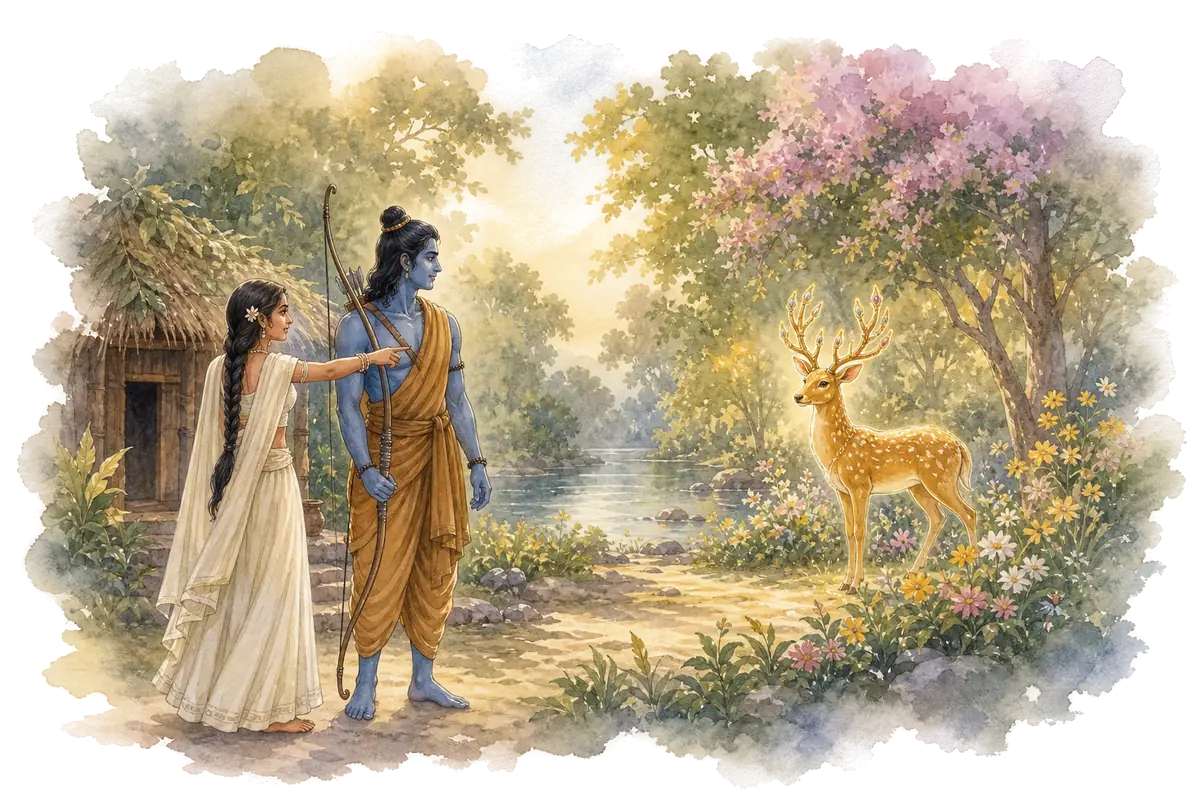
Sita begged Lakshmana to run to his brother. He did not want to leave her, and at last he went. Then a wandering holy man in red robes came to the hut and asked for food. It was Ravana. He seized Sita and carried her off through the sky in his flying chariot. The old vulture king Jatayu, a friend of Rama's father, flew at him and fought until Ravana struck him down with his sword. Over the mountains Sita dropped her scarf and her jewels to five monkeys on a hilltop, to show the way she had gone.
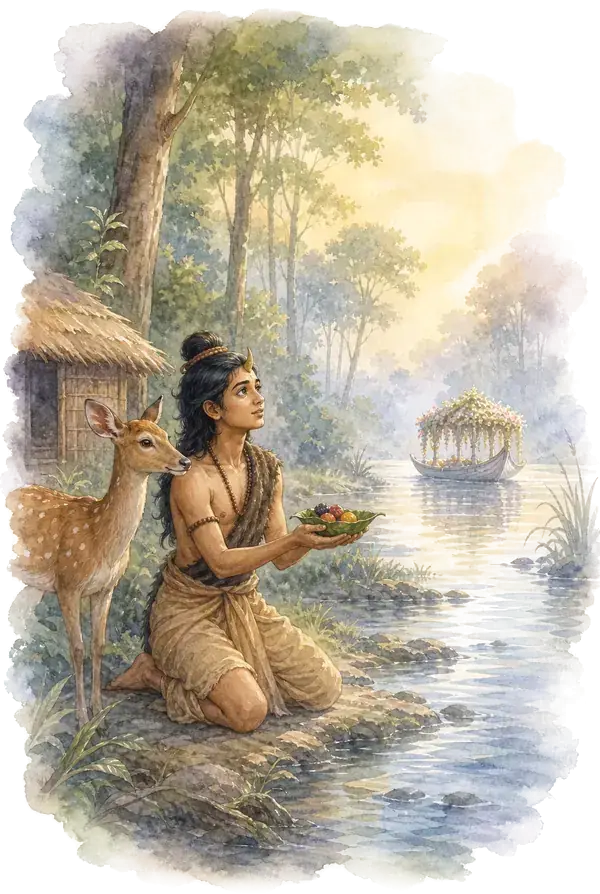
Rama and Lakshmana came back to an empty hut. They searched until they found Jatayu, and with his last breath the old bird told them who had taken her. Farther on, an old holy woman named Shabari welcomed them with fruits she had kept for them and sent them on toward Lake Pampa.
Kishkindha Kanda: Hanuman and the monkey king
By Lake Pampa lived Sugriva, a monkey driven from his kingdom. Afraid of the two armed strangers, he sent his minister to find out who they were. That was Hanuman, son of Vayu the wind. He loved Rama from the first moment.
Sugriva showed them a bundle that had fallen from the sky, and Rama knew Sita's scarf and jewels at once. Sugriva had a trouble of his own. His older brother Bali had taken his kingdom and his wife. Rama promised to help, and while the two brothers fought, Rama shot Bali with an arrow. Sugriva became king.
When the rainy season ended, Sugriva sent search parties of monkeys to every corner of the earth. Rama gave Hanuman his ring, so that Sita would know who had sent him. The southern party reached the sea and met Sampati, Jatayu's old brother, who could see very far. Sita was in Lanka, he told them, a hundred leagues across the water. None of the monkeys believed they could jump so far. Then the old bear Jambavan reminded Hanuman that as a baby he had leaped up into the sky to catch the rising sun, thinking it was a fruit.
Sundara Kanda: the leap and the ring
Hanuman climbed Mount Mahendra and grew huge. Then he jumped. He flew over the sea and came down outside Lanka, a city of gold. That night he made himself the size of a cat and searched its palaces one by one. At last, in a grove of ashoka trees, he found a thin, pale woman in a neglected dress, guarded by rakshasa women. Ravana came and gave her two months to agree to marry him. She would not even look at him.
When Ravana had gone, Hanuman spoke softly from the branches, telling Rama's story. Then he came down and gave her the ring. Sita wept when she saw it. Hanuman offered to carry her home on his back. She would not go with him. Rama must come for her himself, she said. She gave Hanuman a jewel from her hair to carry back to Rama.
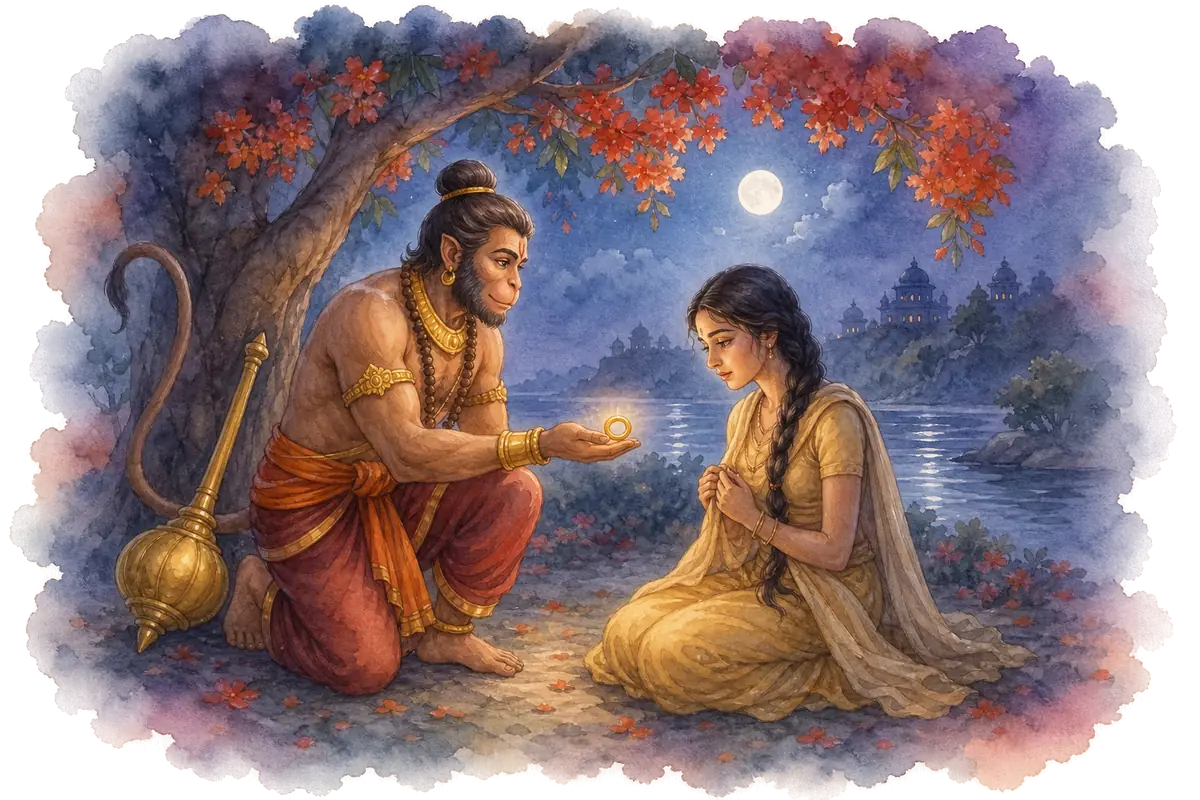
Before he left, Hanuman smashed the grove until Ravana's son Indrajit captured him. The rakshasas tied rags to his tail and set them on fire. Hanuman broke free and bounded from roof to roof until Lanka was burning. The fire never hurt him, and Sita was safe. Then he leaped back across the sea with the news.
Yuddha Kanda: the bridge and the war
Rama marched the monkey army to the southern shore. In Lanka, Ravana's younger brother Vibhishana told him to give Sita back. Ravana drove him out, and Vibhishana came over to Rama's side. For three days Rama lay on a bed of grass by the water and prayed to the ocean to let them cross. No answer came, and he raised his bow in anger. Then the god of the ocean rose from the waves and told him that a monkey named Nala, son of Vishvakarma the builder of the gods, could build a bridge. The monkeys threw in trees and rocks and whole hilltops, and in five days the bridge reached Lanka.
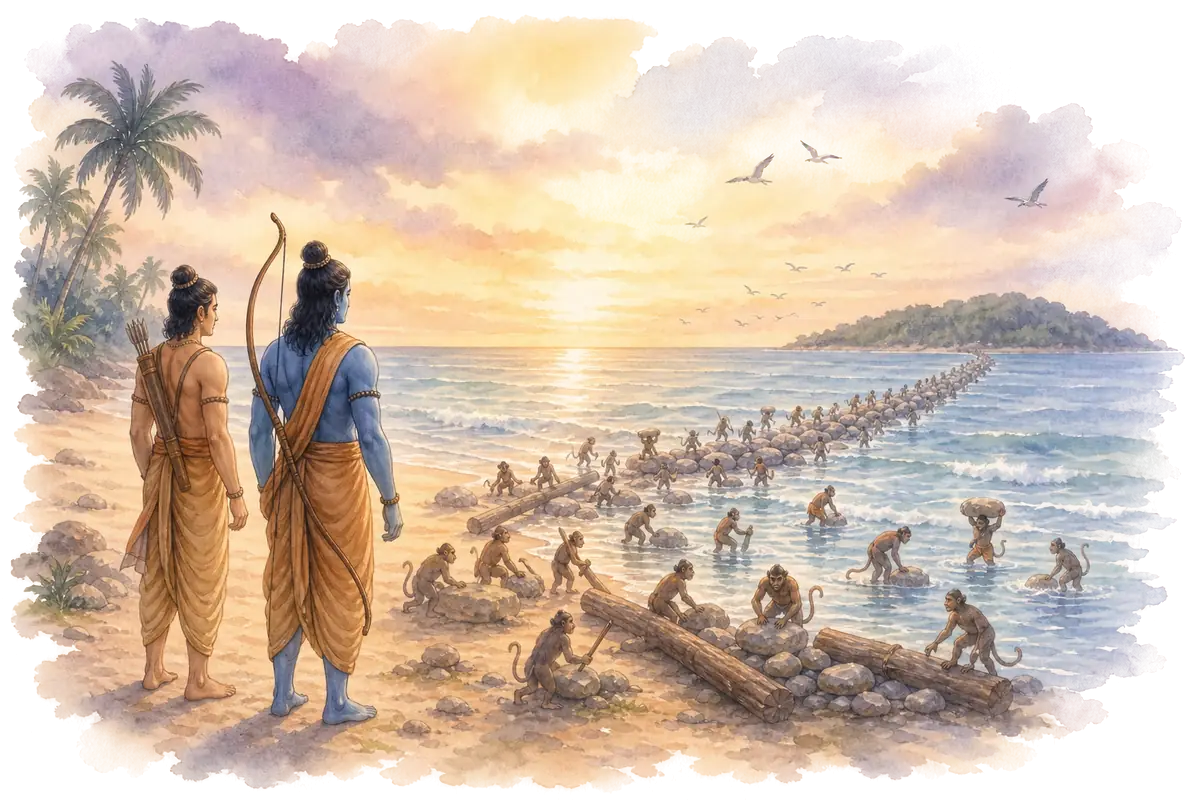
The war was long. Ravana's giant brother Kumbhakarna, who slept for months at a time, was woken to fight and fell in battle. Indrajit, hidden by magic, brought down both Rama and Lakshmana with his arrows. Hanuman flew to the Himalayas for four healing herbs. When the herbs hid from him, he tore off the top of the mountain and carried the whole peak back, and its scent healed them.
At last Rama faced Ravana himself. Indra, king of the gods, sent his own chariot, driven by his charioteer Matali. Every head Rama cut off grew back. In the end Rama fired the arrow of Brahma that the sage Agastya had given him, and Ravana fell. Rama made Vibhishana king of Lanka.
Then he sent for Sita, and in front of the whole army he spoke to her harshly. She had lived for months in another man's house, he said, and he had fought to clear his own name. Sita answered him with dignity and asked Lakshmana to build a fire. Praying that the fire would protect her if she had always been true, she stepped into the flames. Agni, the god of fire, carried her out unharmed. Rama said he had never doubted her, and now the whole army had seen that she was true.
The return to Ayodhya
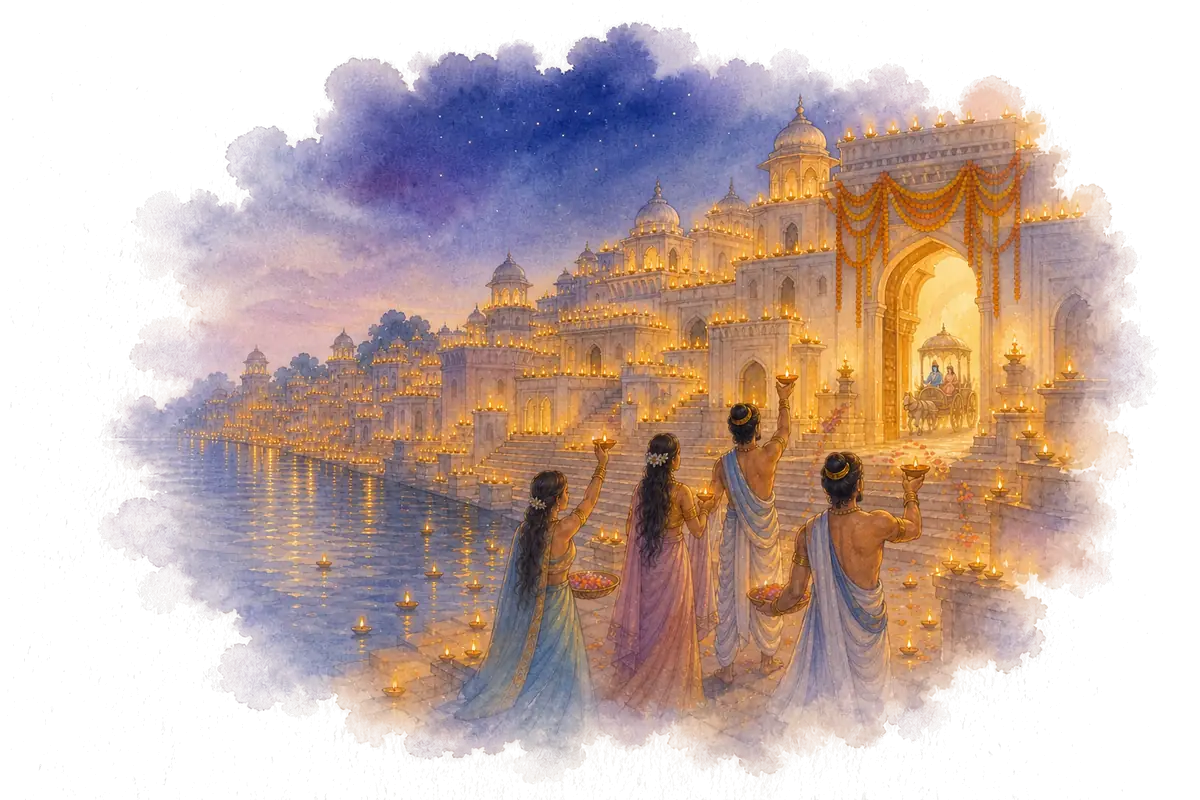
When the fourteen years were over, Rama, Sita and Lakshmana flew home in Ravana's flying chariot, the Pushpaka, and Hanuman went ahead to tell Bharata. Bharata came out to meet them still carrying Rama's sandals on his head, and he put them back on his brother's feet. Ayodhya hung flags from every tower and strewed the road with flowers, and Rama was crowned king with Sita beside him.
Many families light rows of little lamps at Diwali, the festival of lights, in memory of the night Rama came home.
Uttara Kanda: Sita and the twins
The seventh book, which many scholars think was added later, ends the story in sorrow. People in Ayodhya whispered about the months Sita had spent in Ravana's palace. Rama knew she was true, but as king he could not bear the talk, and he had Lakshmana take her to the forest while she was expecting a child. The sage Valmiki took her into his hermitage, and there she had twin sons, Lava and Kusha.
Valmiki taught the boys his poem, the Ramayana. Years later they sang it at Rama's great horse sacrifice, and Rama learned that the two young singers were his sons. Sita was asked to swear to her truth before everyone. She prayed that if she had never thought of anyone but Rama, the goddess of the Earth would give her a home. The ground opened, the goddess rose on a throne and took Sita in her arms, and Sita went back into the earth she had come from.
Ramayana and Mahabharata
India's two great epics are often read side by side. They differ in almost every way that can be measured, and the Ramayana and Mahabharata guide for parents sets them out in full, with which to read first.
| Ramayana | Mahabharata | |
|---|---|---|
| Composed by | The sage Valmiki | The sage Vyasa, who also appears in the story |
| Length | About 24,000 verses in seven kandas | About 100,000 verses in eighteen parvas |
| The age it is set in | The Treta yuga, the second of the four ages of the world | The end of the Dvapara yuga, the third age |
| Its hero | Rama, prince of Ayodhya | The five Pandava brothers, Arjuna above all |
| Vishnu's avatar | Rama | Krishna |
| The war | Rama's army of monkeys and bears against Ravana's rakshasas, to win back Sita | Cousin against cousin for eighteen days at Kurukshetra, over a kingdom |
| How it ends | Rama is crowned; in the last book Sita returns to the earth | The Pandavas win, lose almost everyone they love and at last walk toward heaven |
The Ramayana is the easier story to love at first meeting. Its hero is good from the first page and its villain plainly in the wrong, so a reader always knows whom to cheer for. The Mahabharata is a family quarrel where good people make terrible mistakes and even Krishna's choices are argued over, so it keeps asking what the right thing really is.
Where the Ramayana meets the Mahabharata
Hanuman and Bhima
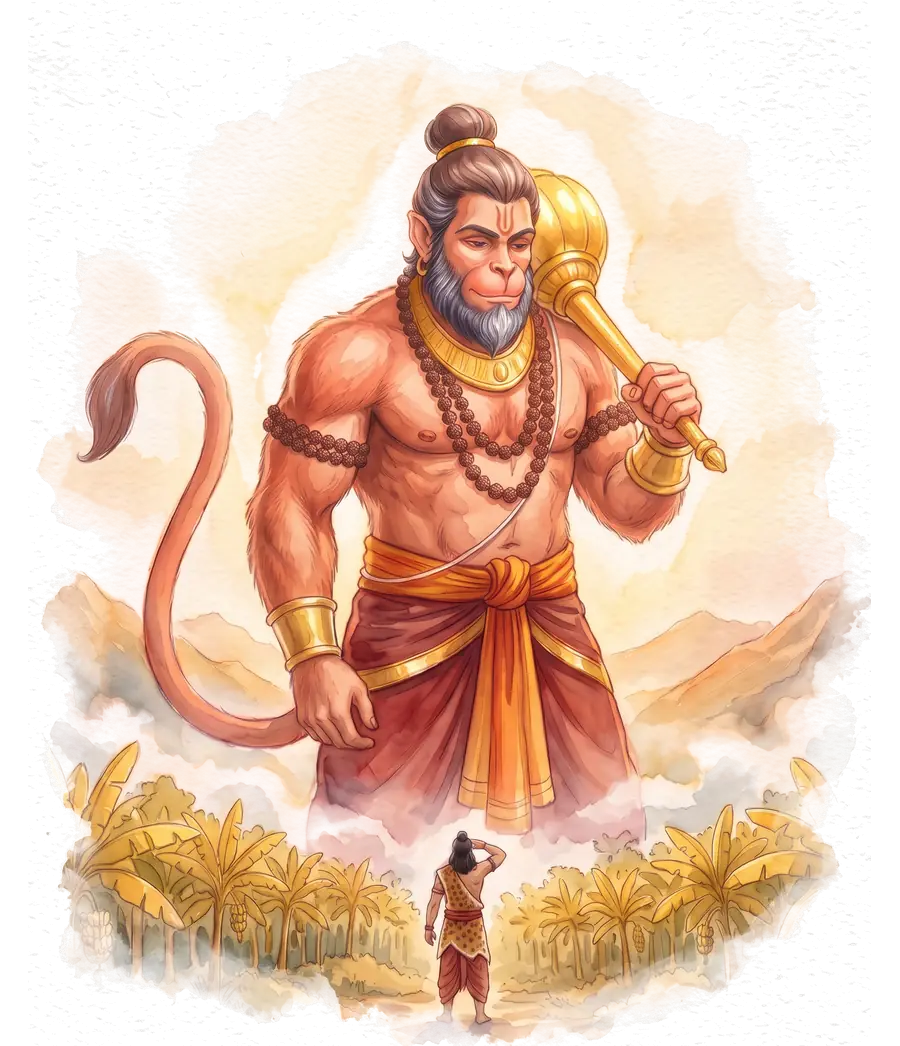
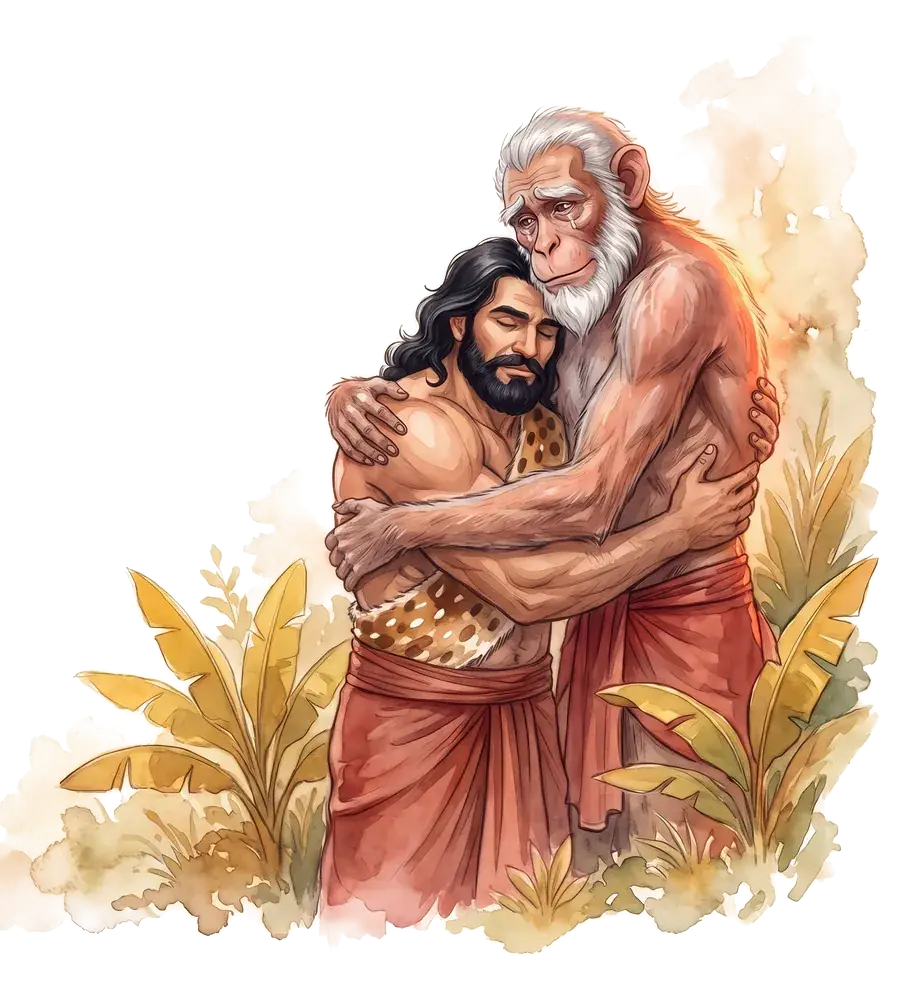
Hanuman lives on into the Mahabharata. During the Pandavas' years in the forest, Bhima climbs the mountain Gandhamadana to find golden lotuses for Draupadi and comes upon an old monkey lying across the path. He brags that he could leap the way his brother Hanuman leaped the sea for Rama's queen. Both are sons of Vayu, the wind. The old monkey asks him to move his tail aside, and Bhima cannot lift it with one hand or with both. The monkey is Hanuman himself.
Hanuman tells Bhima how he leaped the sea to find Sita. When Bhima says he could have finished Ravana alone, Hanuman agrees. "But then the glory would have been mine, and it was Rama's." Then he promises to roar with Bhima in battle from the flagstaff of Arjuna's chariot. Book Two of the series, The Dice, tells the meeting in chapter 6, The Monkey in the Path.
The Rama story inside the Mahabharata
The Mahabharata also tells the whole Ramayana itself, in a shorter form. After Draupadi is carried off by King Jayadratha and rescued, Yudhishthira asks the sage Markandeya whether anyone has ever been more unlucky than he is. Markandeya answers with the story of Rama, who lost his kingdom and his wife and won them both back. This telling inside the epic is called the Ramopakhyana. The books leave it out and stay with the Pandavas.
The same people in both
Parashurama, the warrior-sage who bows to Rama after the broken bow, is still alive in the Mahabharata. There he is Bhishma's teacher, and years later Drona and Karna learn his weapons too. Matali, who drives Indra's chariot for Rama in the last battle with Ravana, drives Arjuna up to heaven in Book Two. Rama and Krishna are both avatars of Vishnu, who is born on earth in different ages when the world needs him. Rama comes in the Treta age and Krishna at the end of the Dvapara age, which is why the Pandavas hear about Rama as a story from long ago.
Questions about the Ramayana
Who wrote the Ramayana?
The sage Valmiki, who is remembered as the first poet. The Ramayana itself tells how he saw a hunter shoot one of a pair of birds by the river Tamasa, and his grief came out of him as a verse. The god Brahma then told him to tell the story of Rama in that same kind of verse. Valmiki taught the poem to Rama's twin sons, Lava and Kusha, who sang it aloud.
How long is the Ramayana?
About 24,000 verses, divided into seven books called kandas: Bala, Ayodhya, Aranya, Kishkindha, Sundara, Yuddha and Uttara. That is about a quarter of the length of the Mahabharata. Many scholars think the seventh book, the Uttara Kanda, was added after the first six.
What is the moral of the Ramayana?
The story shows a prince who keeps his father's word even when it costs him his kingdom, and a wife who stays true to him through her long captivity in Lanka. It shows friends and brothers who stay loyal, and a proud king brought down by his own wrongdoing. Many families read it as the victory of good over evil, which is part of why Rama's homecoming is remembered at Diwali.
Which came first, the Ramayana or the Mahabharata?
In the stories' own order, the Ramayana comes first. Rama lives in the Treta age, long before the Pandavas, and in the Mahabharata the sage Markandeya tells Rama's story to Yudhishthira as a tale of long ago. As for when the poems were composed, scholars date both to overlapping centuries, roughly from a few hundred years before the Common Era to a few hundred years after, and both kept growing as they were retold.
Should my child read the Ramayana or the Mahabharata first?
Many families start with the Ramayana because it follows one hero and keeps good and evil clearly apart. The Mahabharata has a bigger cast and harder questions, where good people get things wrong. From about ten, a child can enjoy either one. The three books of this series tell the Mahabharata for readers aged 10 to 16, and Hanuman appears in the second.
Is Hanuman in the Mahabharata?
Yes. During the Pandavas' exile, Bhima finds an old monkey lying across a mountain path and cannot lift his tail. The monkey is Hanuman, who like Bhima is a son of Vayu, the wind. He promises to roar from the flagstaff of Arjuna's chariot when the Pandavas go to war. Book Two, The Dice, tells it in chapter 6.
Where can I read the Ramayana free?
Ralph T. H. Griffith's English translation, The Rámáyan of Válmíki, published between 1870 and 1874, is in the public domain and free on Project Gutenberg at gutenberg.org/ebooks/24869, as an ebook and as plain text. It is in old-fashioned rhyming verse, it skips some cantos, and it sums up the seventh book in a few pages of prose.
Where this comes from: The story follows Valmiki's Ramayana in Ralph T. H. Griffith's verse translation, The Rámáyan of Válmíki (1870–1874). Griffith translates the first six books and gives the Uttara Kanda as a summary in prose, which is where Sita's last days come from here. Canto numbers differ from edition to edition. Valmiki has no line drawn by Lakshmana around the hut before he leaves Sita, no Shabari tasting each berry before she gives it to Rama, and no squirrel helping to build the bridge. All three come from later tellings. In Valmiki, Ayodhya welcomes Rama with flags and flowers; the Diwali lamps belong to the festival's own tradition. Bhima's meeting with Hanuman is Vana Parva §145–150 in Kisari Mohan Ganguli's translation of the Mahabharata, and Markandeya's telling of the Rama story is Vana Parva §272–290. Our sources page lists the books' sources chapter by chapter.