Krishna asks · You decide
Mahabharata Moral Questions for Kids: What Would You Decide?
These are fifteen of the questions Krishna asks readers in an illustrated Mahabharata for ages 10 to 16, five from each book: The Vow, The Dice and The War. Each comes after a hard scene, such as Bhishma's vow, Draupadi's question or Yudhishthira's whisper. Tap the answer you would choose. It is anonymous, and there is no wrong answer.
After key scenes in all three books, Krishna steps out of the story and asks the reader what they think. He says what he thinks too, and sometimes he isn't sure. You are free to argue with him.
Tap an answer to see what Krishna says. Children can disagree with each other, and with Krishna, as long as they can say why.
Book One · Chapter Two · The Terrible Vow
Was Bhishma's vow right?
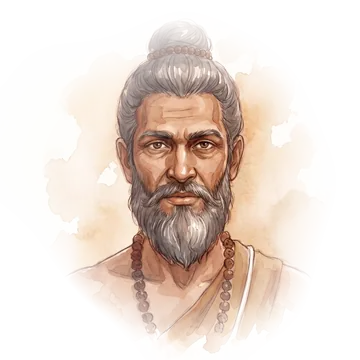
Devavrata saw his father sick with longing for Satyavati, the fisher chief's daughter. In one afternoon he gave up the throne and swore never to marry, so that her sons could be kings. The gods showered him with flowers, and from that day the world called him Bhishma, the terrible one. His father got his wish. The vow held Bhishma for the rest of his life.
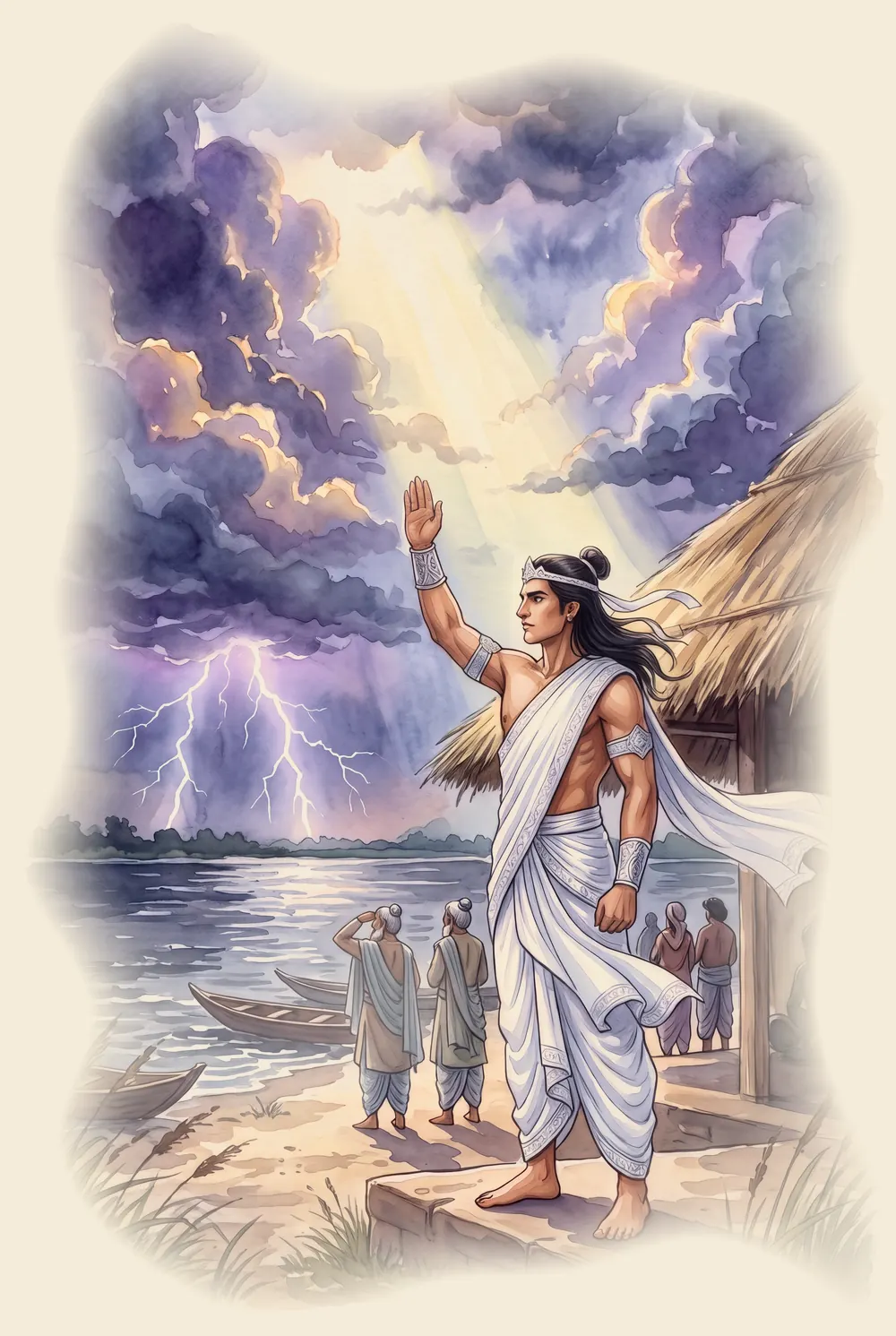
Devavrata gives up his claim to the throne, and swears never to marry, so his father can marry the woman he loves.
Krishna asksWas his promise an act of great love, a terrible mistake, or both?
“A promise does not know what tomorrow will bring. Keeping your word is right, and so is protecting the people around you.”
Book One · Chapter Four · Three Princes and a Blindfold
Was Gandhari right to wear a blindfold?
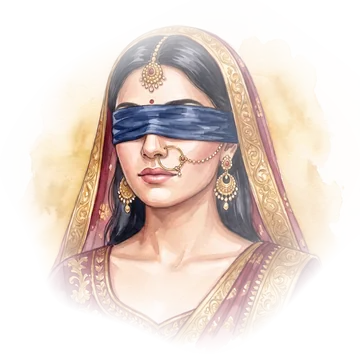
Gandhari, a princess of Gandhara, heard that the prince she was to marry, Dhritarashtra, had been born blind. She tied a cloth over her own eyes, out of love and respect for him, and kept it there all her life. The old story praises her for it. Krishna wonders who would be her husband's eyes now.
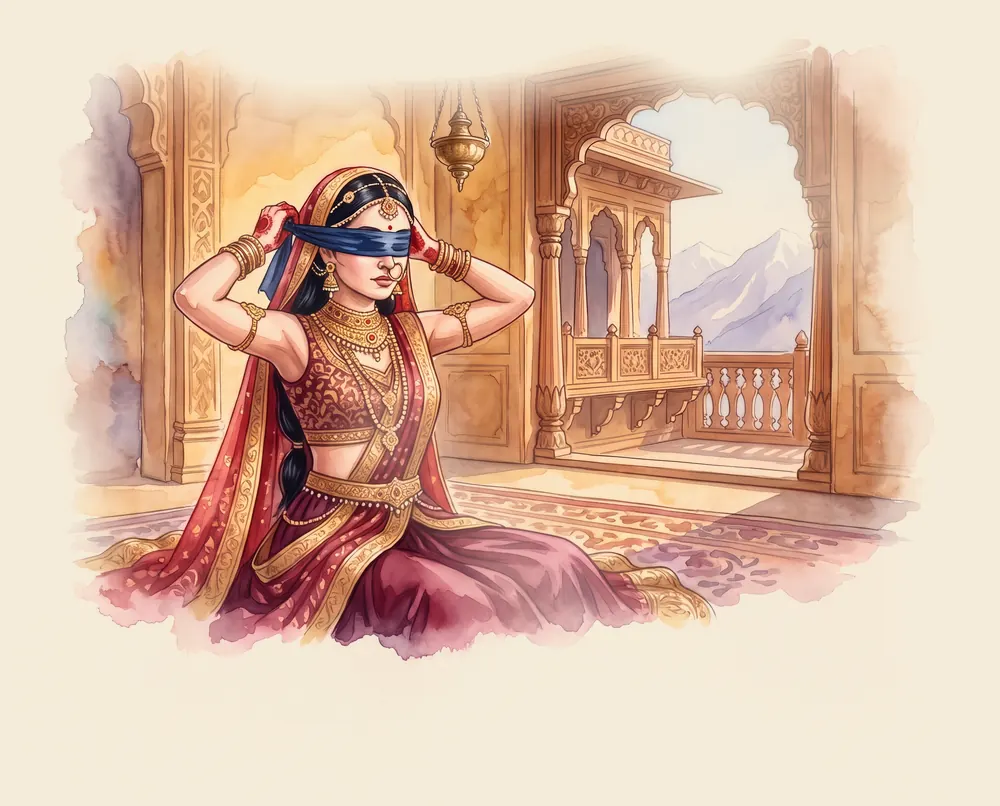
Princess Gandhari learns that the prince she will marry cannot see. She ties a cloth over her own eyes, for the rest of her life.
Krishna asksIs sharing someone's suffering always the most loving choice, or can love sometimes mean keeping your strength to help where they cannot?
“Her husband, who most needed someone to be his eyes, now had a wife who had given hers away.”
Book One · Chapter Nine · The Bird's Eye
How should the teacher's favorite treat everyone else?
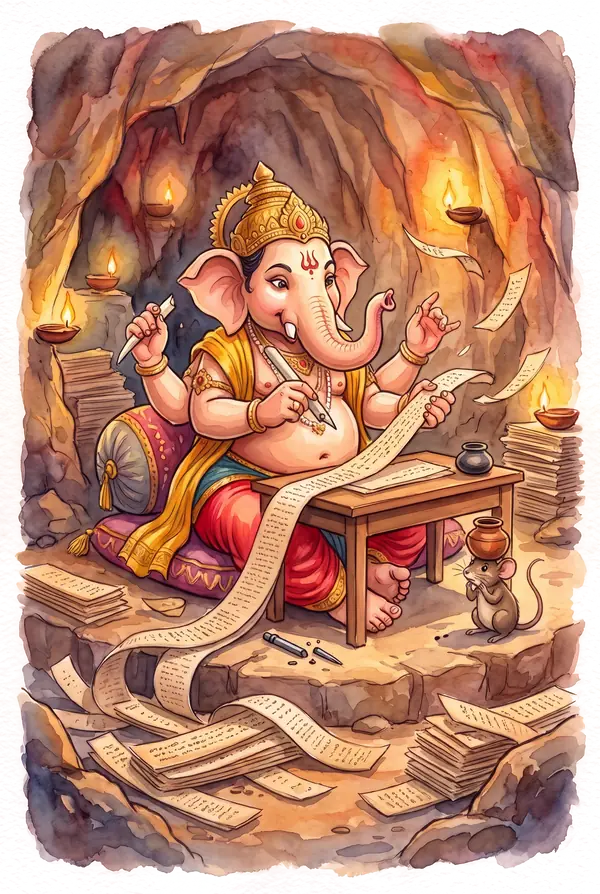
Drona set a wooden vulture in a tree and told his pupils to shoot it in the eye. Only Arjuna saw nothing but the eye, and his arrow went through it. He had earned his place, practicing in the dark after the others went to sleep. Drona's own son, Ashwatthama, saw his father pick Arjuna over him.
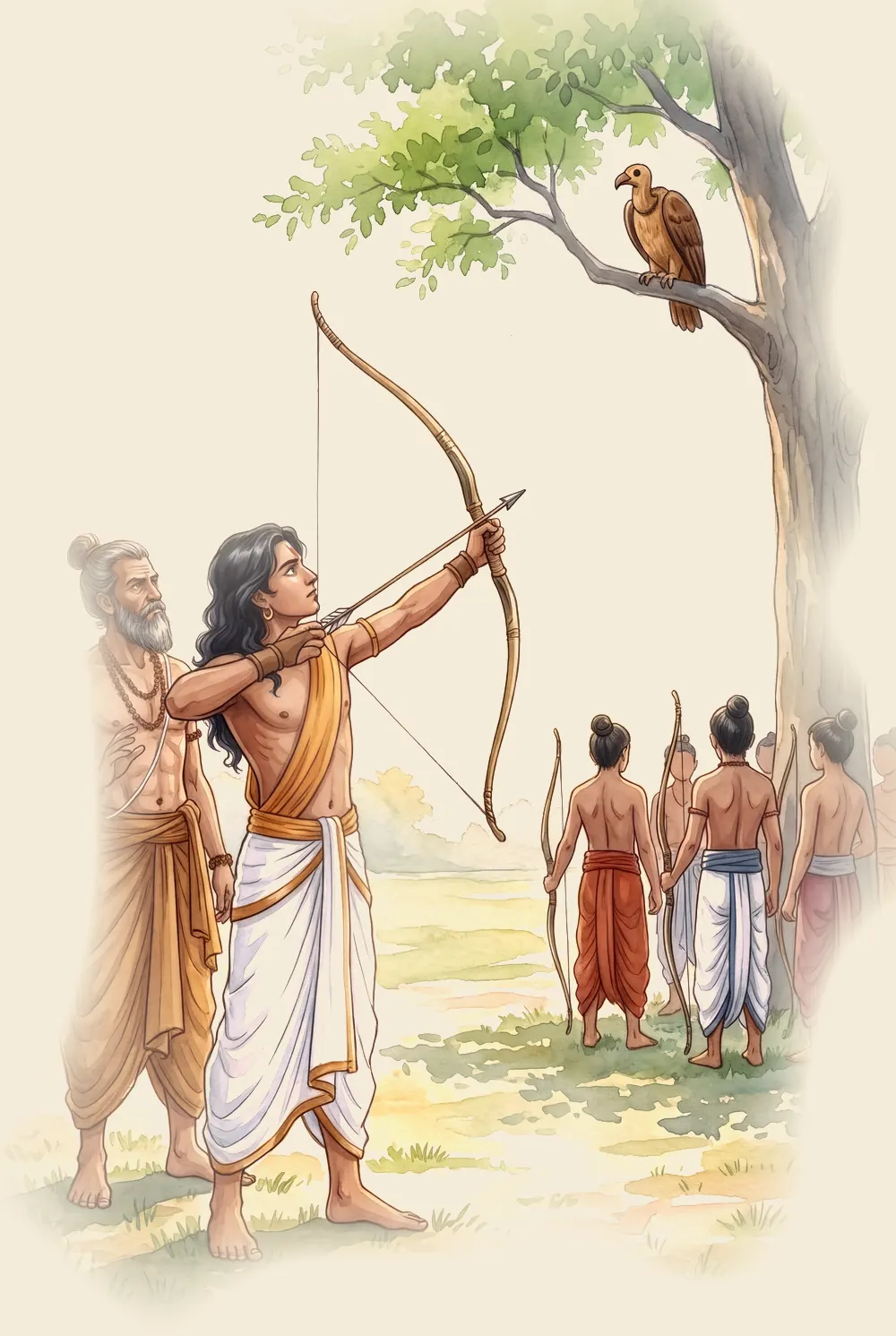
Drona asks each of his pupils what he can see. The others see the tree, the sky, their cousins. Arjuna sees only the bird's eye.
Krishna asksWhen you become the teacher's favorite, how should you treat everyone else?
“Now Arjuna is the favorite. And Ashwatthama heard every word.”
Book One · Chapter Ten · The Thumb
Was Drona fair to Ekalavya?
Drona turned Ekalavya away from his school because he was a Nishada, a boy of a forest people, who might one day beat the princes. Ekalavya went home to the forest, made a Drona out of clay and taught himself in front of it. When Drona found out how good he had become, he came for a teacher's fee. He asked for the boy's right thumb, and Ekalavya gave it.
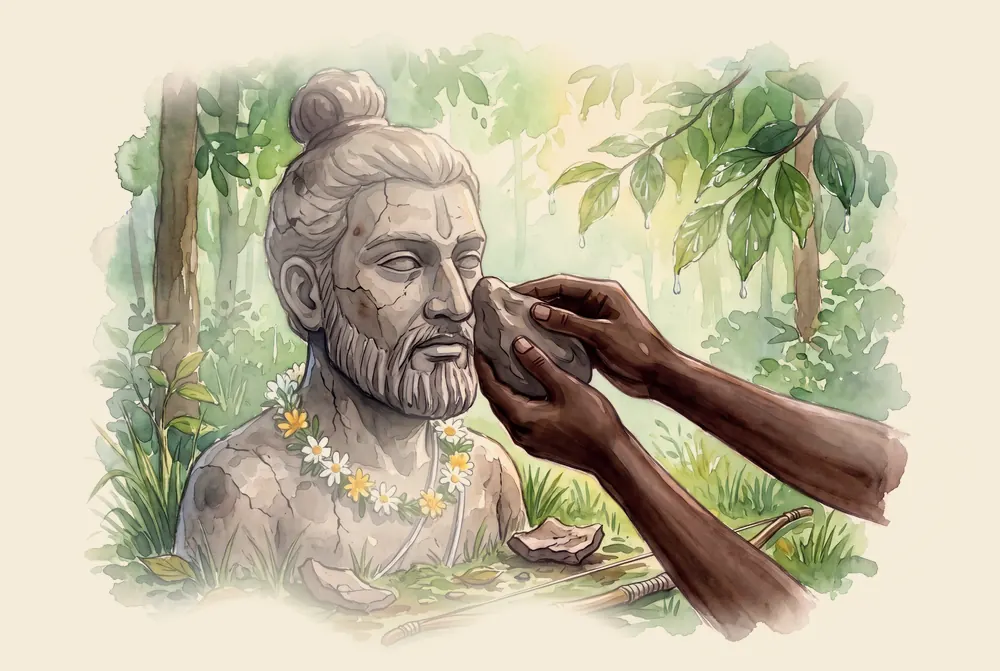
Turned away from Drona's school, Ekalavya taught himself in the forest before a clay statue of the teacher. Now Drona has found him, and asks for his fee.
Krishna asksCan a teacher ask for a fee from a boy he refused to teach?
“Arjuna got his place back. Ekalavya paid for it.”
Book One · Chapter Nineteen · Water That Was Floor
Was it fair to laugh when Duryodhana fell in the water?
In the Palace of Illusions, Duryodhana walked onto what looked like a polished floor and fell into a pool. Bhima laughed, and so did the servants, and soon Arjuna and the twins were laughing too. Krishna admits he might have laughed as well. Duryodhana went home sick with shame, and his uncle Shakuni had an idea that needed a pair of dice.
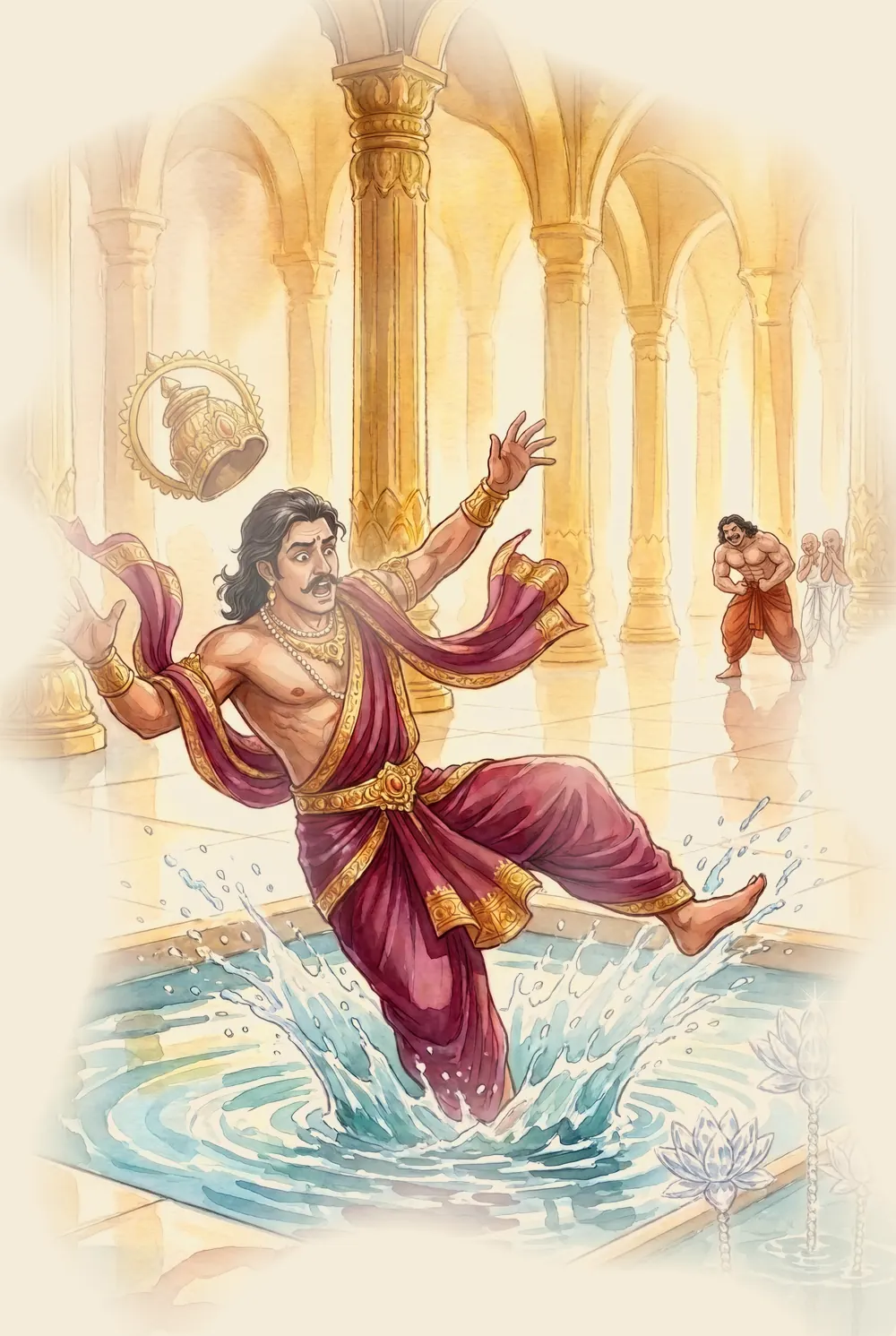
In the Palace of Illusions, Duryodhana steps onto a polished floor that turns out to be water. His cousins laugh.
Krishna asksIs it fair to laugh at someone when you'd laugh the same way at your own brother?
“Duryodhana's hands still ached from holding the treasure of the world, and all of it was his cousin's. To him that laugh landed like a blow.”
Book Two · Chapter Two · Draupadi's Question
Why didn't the kings answer Draupadi?
Playing dice against Shakuni, Yudhishthira lost his kingdom, then his brothers and himself, and last of all Draupadi. When she was brought into the hall, she asked the kings a question. If he had already lost himself, how could he stake her? The elders said nothing. Vikarna, one of Duryodhana's own brothers, stood up and said Draupadi was never won, and the hall broke into cheers. When Vidura begged the kings for answers of their own, not one of them looked back.

Draupadi asks the kings in the dice hall whether Yudhishthira could stake her after he had lost himself. Only Vikarna answers her.
Krishna asksWhy was it easier for the kings to cheer for Vikarna than to answer Draupadi themselves?
“Some of those kings truly didn't know the law, and many were afraid of Duryodhana. Then Vidura asked the kings for answers of their own, and the same men sat silent.”
Book Two · Chapter Six · The Monkey in the Path
Should the strongest take what they want?
Draupadi found a golden lotus blown down from the mountains and asked Bhima to bring her more. On the way an old monkey too sick to stand lay across his path, and Bhima couldn't move its tail. It was his brother Hanuman, and he told Bhima not to take Kubera's flowers by force. At the lake Bhima wouldn't ask the guards' leave. Warriors don't beg, he said. More than a hundred guards fell before he took the flowers, and Kubera only smiled.
Bhima reaches Kubera's lake of golden lotuses. He won't ask the guards' leave, and more than a hundred of them fall.
Krishna asksIf you're strong enough to take what you want, what should make you stop and ask?
“Hanuman could have finished Ravana alone, but he left the glory to Rama. And he told Bhima not to take Kubera's flowers by force.”
Book Two · Chapter Eight · The Armor of the Sun
Was Karna's gift really generous?
Karna had sworn in front of all the Kurus that if anyone asked him for anything, he would never say, “I don't have it.” The sun god came to him in a dream and warned him that Indra would come dressed as a brahmin and beg for the armor and earrings Karna was born with. While he wore them, no one could kill him. Karna gave them anyway. In return he asked Indra for his spear, the one that never misses.
The sun god warns Karna in a dream that Indra will come in disguise to beg for his armor. Karna gives it anyway.
Krishna asksIf you give something away partly so that people will praise you, is it still generous?
“Karna saw the trap. His own father had warned him in a dream. He walked into it anyway, smiling, for the sake of his good name, and struck a hard bargain on the way.”
Book Two · Chapter Nine · The Lake of Questions
Who should you save first?
In the forest, Yudhishthira's four brothers went to a lake for water, and none of them came back. He found them lying still on the bank. The spirit of the lake asked him question after question, and he answered every one. Then it offered him one brother's life. He chose Nakula, Madri's son, over Bhima and Arjuna, so that both his mothers would have a son alive. The spirit was his father Dharma, who had come to test him. All four brothers woke.

The spirit of the lake offers to bring back one of Yudhishthira's four brothers. He chooses Nakula.
Krishna asksWhen you can save only one, how should you decide who comes first?
“Yudhishthira picked Nakula. Kunti still had a son alive, Yudhishthira himself, so he wanted Madri to have one too.”
Book Two · Chapter Fourteen · A Mother at the River
Must you stand by a friend who is wrong?
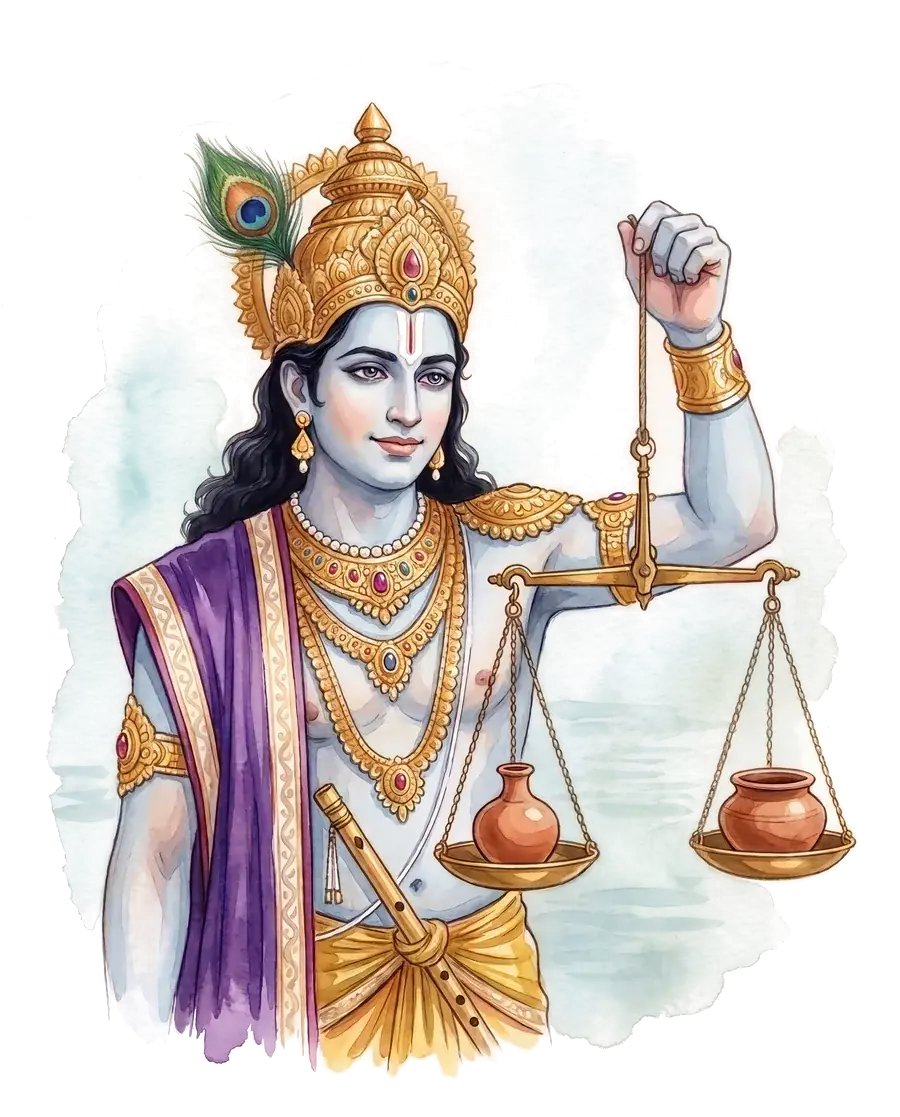
Before the war, Krishna told Karna that he was Kunti's son, born before she married, and the eldest of the Pandavas. If he came back with Krishna, all five brothers would touch his feet. Karna said no. Duryodhana had made him a king, and he would not betray him. Then Kunti came to him at the river. He still said no, but he promised that Arjuna was the only one of her sons he would fight to the death.
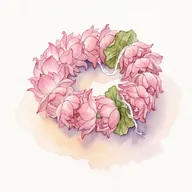
Krishna tells Karna who his mother is and offers him the throne. Karna stays with Duryodhana, the friend who made him a king.
Krishna asksIf someone stood by you when no one else would, must you stand by them when you believe they're wrong?
“I offered Karna the whole earth, and his five brothers at his feet. He said no to me, and then to his own mother.”
Book Three · Chapter One · The Bhagavad Gita
Can you fight someone and still honor them?
On the first morning at Kurukshetra, Arjuna looked across the field at Bhishma, who had raised him, and at his teacher Drona. He laid his arrows down and sat on the floor of his chariot. Krishna answered him with the song people call the Bhagavad Gita, and Arjuna picked up his bow again. Then Yudhishthira took off his armor and walked across to the other army with his hands joined. Bhishma, Drona, Kripa and Shalya each blessed him, and each went back to his place to fight him.
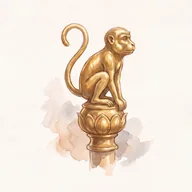
On the first morning at Kurukshetra, Arjuna sees his grandsire and his teachers across the field and lowers his bow.
Krishna asksCan you stand against someone and still honor them?
“Arjuna put down his bow because he loved the people across the field. He still loved them when he picked it up again.”
Book Three · Chapter Two · The Grandsire's Ten Days
Was Krishna right to break his promise?
Before the war, Krishna promised he would not fight. For days the Pandava soldiers ran from Bhishma, while Arjuna fought gently against the man who had raised him. Twice Krishna jumped down from the chariot and ran at Bhishma, once with his discus and once with only his whip. Bhishma did not raise his bow. He called Krishna Lord of the world and bowed to him. Both times Arjuna caught Krishna, and the second time he reminded him of his promise.

Krishna promised not to fight. Twice he jumps down from Arjuna's chariot and runs at Bhishma, and twice Arjuna stops him.
Krishna asksWas I right to break my promise, or should I have stayed with the reins?
“When I ran at him, Bhishma didn't shoot. He called me Lord and asked me to strike. Arjuna begged me to stop, so that no one could call me a liar.”
Book Three · Chapter Six · “Ashwatthama Is Dead”
Was Yudhishthira's whisper a lie?
Drona had said he would put down his weapons if he heard something terrible from someone whose word he trusted. Bhima killed a war elephant named Ashwatthama, the name of Drona's son, and shouted that Ashwatthama was dead. Drona searched the whole army for Yudhishthira and asked him if it was true. Yudhishthira said, “Ashwatthama is dead,” loud enough for Drona to hear, and added “the elephant” under his breath. Drona laid down his bow, and Dhrishtadyumna killed him.
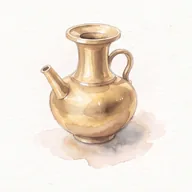
Drona will not stop fighting while his son lives. Yudhishthira says, “Ashwatthama is dead,” and whispers, “the elephant.”
Krishna asksWhen Yudhishthira whispered “the elephant,” were his words a lie?
“Every word Yudhishthira said was true. An elephant named Ashwatthama was dead. He said the name clearly and the last word under his breath. But Drona was asking about his son, and Yudhishthira knew it.”
Book Three · Chapter Eleven · The Mothers' Grief
Should Kunti have kept her secret?
After the war, the whole household went down to the Ganga, and the women poured out water for the men they had lost. There Kunti told her sons to pour water for Karna too. He had been their eldest brother, her son by the sun god, born before she was married. “If we had known, none of this would have happened,” said Yudhishthira. Krishna had known, and so had Karna, who asked him to keep it secret.
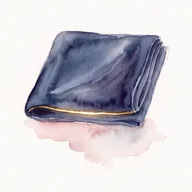
After the war, Kunti tells her sons that Karna was their eldest brother.
Krishna asksIs there ever a secret that should be kept from the person it belongs to?
“Kunti kept her secret from her sons all Karna's life. I kept it too. When I told Karna who his mother was, he asked me to say nothing.”
Book Three · Chapter Fifteen · The Road to Heaven
What do we owe the ones who follow us?
Long after the war, Yudhishthira, his brothers and Draupadi left Hastinapura on foot for the last time, and a dog nobody knew followed them. One by one, Draupadi and his brothers fell on the road. Only Yudhishthira and the dog reached the top of the mountain. Indra came down in a golden chariot to take him to heaven, and told him to leave the dog behind. Yudhishthira would not. The dog was his father Dharma, who had come to test him.
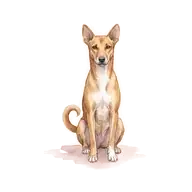
A dog follows Yudhishthira all the way up the mountain to the gate of heaven.
Krishna asksWhat do we owe to someone who has followed us all the way?
“On the mountain, Indra offered him heaven if he would leave a dog behind. It wasn't even his dog. It had only followed him out of Hastinapura. He wouldn't leave it.”
Questions parents ask
Is there a right answer to Krishna's questions?
No. Each question comes after a scene where people have good reasons on both sides, and Krishna himself is often unsure. In the books he says what he thinks, and readers may disagree with him. What matters is the reason a child gives, so ask why after every answer, and let them change their mind.
Are the answers anonymous?
Yes. There is nothing to type and no sign-in. When you tap an answer, Krishna's thoughts appear on your screen, and your choice is not sent or saved anywhere. The site has no accounts and collects nothing personal from children. Reload the page and every question is fresh again.
Was Bhishma's vow right?
The Mahabharata never says, which is why it makes a good question. Devavrata gave up the throne and swore never to marry so his father could marry Satyavati, and the gods showered him with flowers. But the vow held him for life. In the very next chapter it is the reason he will not marry Amba, the princess he carried off for his half-brother.
How can I use these questions with kids?
Read the story first, or tell it in your own words. Then ask the question and let each child pick an answer before anyone talks. Ask them to argue for an answer they did not pick. Each story page has three more questions to keep the talk going, and the teachers' page has ideas for class.
Where this comes from: Krishna's questions are written for the three books and are not part of the old text. The scenes follow the Ganguli translation of the Mahabharata. Book One: Bhishma's vow, Adi Parva §100; Gandhari's blindfold, Adi Parva §110; the bird and Ekalavya, Adi Parva §134–135; Duryodhana's fall, Sabha Parva §46. In Ganguli, Drona tells his pupils to cut off the bird's head, and Arjuna sees only the head. The Vow follows the popular telling, where he sees the eye. Book Two: Draupadi's question, Sabha Parva §66–72; Bhima and Hanuman, Vana Parva §142–154; Karna's armor, Vana Parva §298–308; the lake, Vana Parva §309–312; Karna and Kunti, Udyoga Parva §137–146. In Ganguli, Karna already knows who his mother is; in The Dice he learns it from Krishna. Book Three: the Gita, Bhishma Parva §25–43; Krishna and Bhishma, Bhishma Parva §43–124; Drona and Yudhishthira, Drona Parva §154–200; Kunti's secret, Stri Parva §9–27; the dog, Mahaprasthanika Parva §1–3. More on each chapter's sources is on the sources page.