Stories · The sage and the scribe
Who Wrote the Mahabharata? Vyasa and Ganesha's Story
The sage Vyasa composed the Mahabharata (महाभारत), about a hundred thousand verses. The epic's own opening tells how the elephant-headed god Ganesha wrote it down as Vyasa spoke. Vyasa is also in the story he told, as the grandfather of both the Pandavas and the Kauravas.
People in India often call him Ved Vyas, and many know him by his birth name, Krishna Dvaipayana. A poem this long grew over centuries, most scholars agree, with many storytellers adding to it, and they treat Vyasa as the author the tradition gives it. In the three books of this series, Ganesha tells the story himself, since he was the one holding the pen.
Who was Vyasa?
Vyasa's mother was Satyavati, the daughter of a fisher chief, who rowed a ferry on the Yamuna river. His father was the wandering sage Parashara. Vyasa was born on an island in the Yamuna, so he was named Dvaipayana, the island-born. He was dark, and Krishna means dark, so his full name became Krishna Dvaipayana, often spelled Krishna Dwaipayana.
The epic says he grew up the moment he was born and went away to live as a hermit in the forest. Before he left, he made his mother a promise. Whenever she thought of him, he would come.
Later he took the Vedas, the oldest sacred hymns, and divided them into four parts. Vyasa means the arranger, and that work gave him the name. He is also called Veda Vyasa, and Ved Vyas in Hindi. Many families remember him on Guru Purnima, the full-moon day for honoring teachers, which is also called Vyasa Purnima.
Vyasa in his own story
Satyavati grew up and married King Shantanu of Hastinapura. Their son became king and died young without children, and the royal line was about to end. So Satyavati thought of her first son, and Vyasa came, as he had promised. By his blessing, two princes were born to the young widows. Dhritarashtra was born blind, and Pandu was born pale. A third son, the wise Vidura, was born to a maid of the palace.
That makes Vyasa the grandfather of both sides of the quarrel. The five Pandavas are Pandu's sons, and the hundred Kauravas are Dhritarashtra's. He walks back into the story at its hardest moments. When Gandhari's child is born as a hard, cold lump, he turns it into her hundred sons. When the world thinks the Pandavas have burned to death, he finds them on the road. The Mahabharata is the story of his own grandsons.
How did Ganesha come to write the Mahabharata?
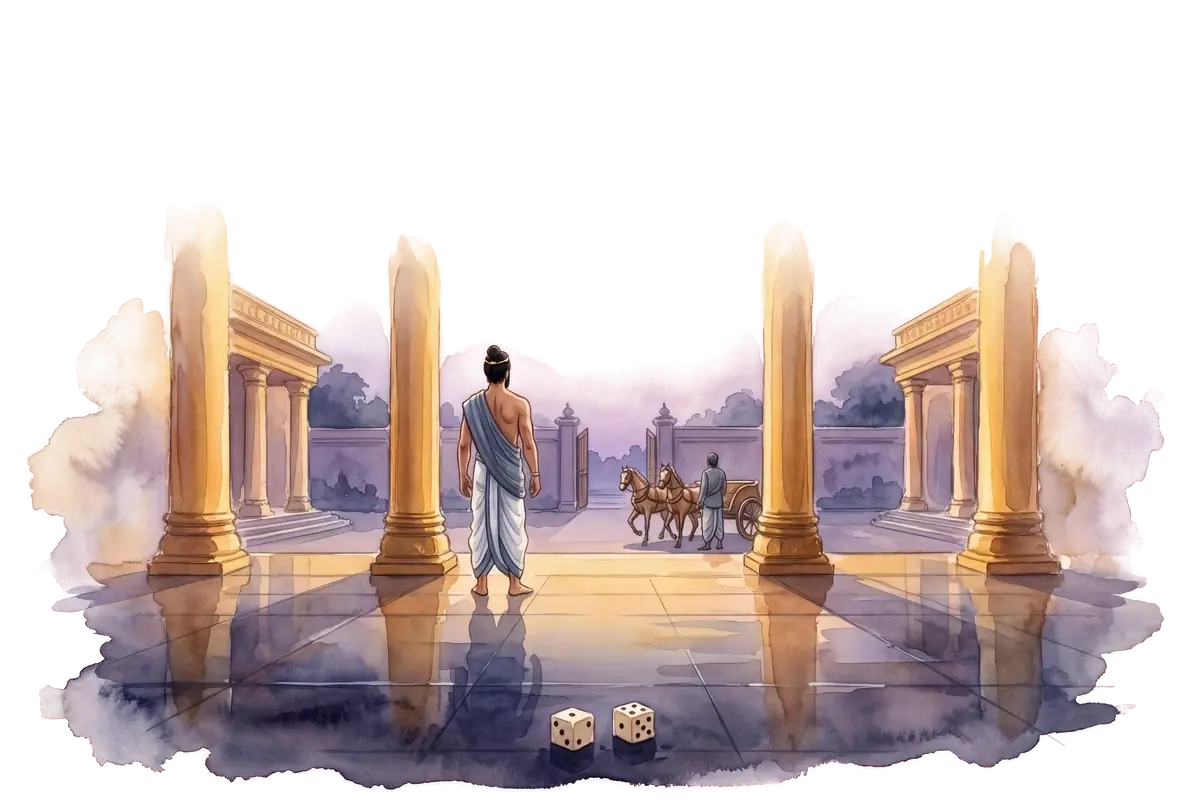
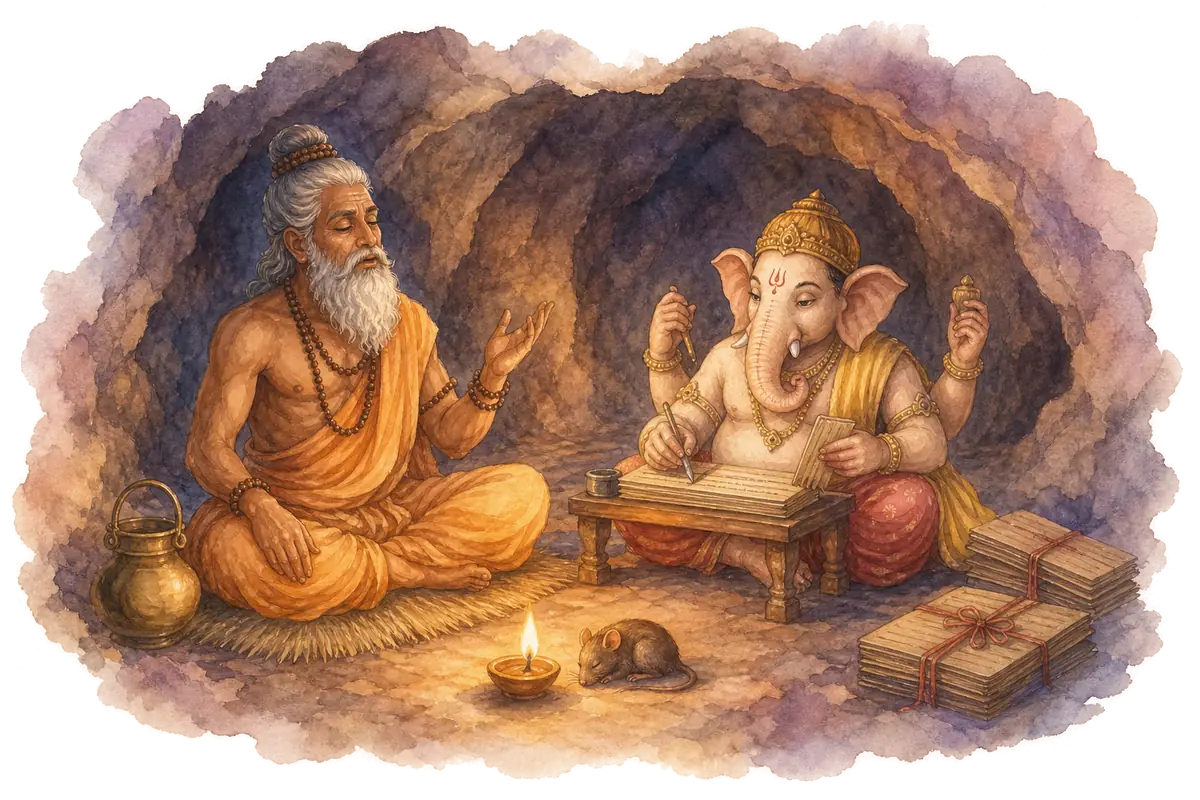
The epic opens with this story. Vyasa had composed the whole poem in his mind, and he had a problem. He told the god Brahma that it held everything from the mysteries of the Vedas to the sizes of the sun and the moon, and that no one on earth could write it down. Brahma told him to think of Ganesha.
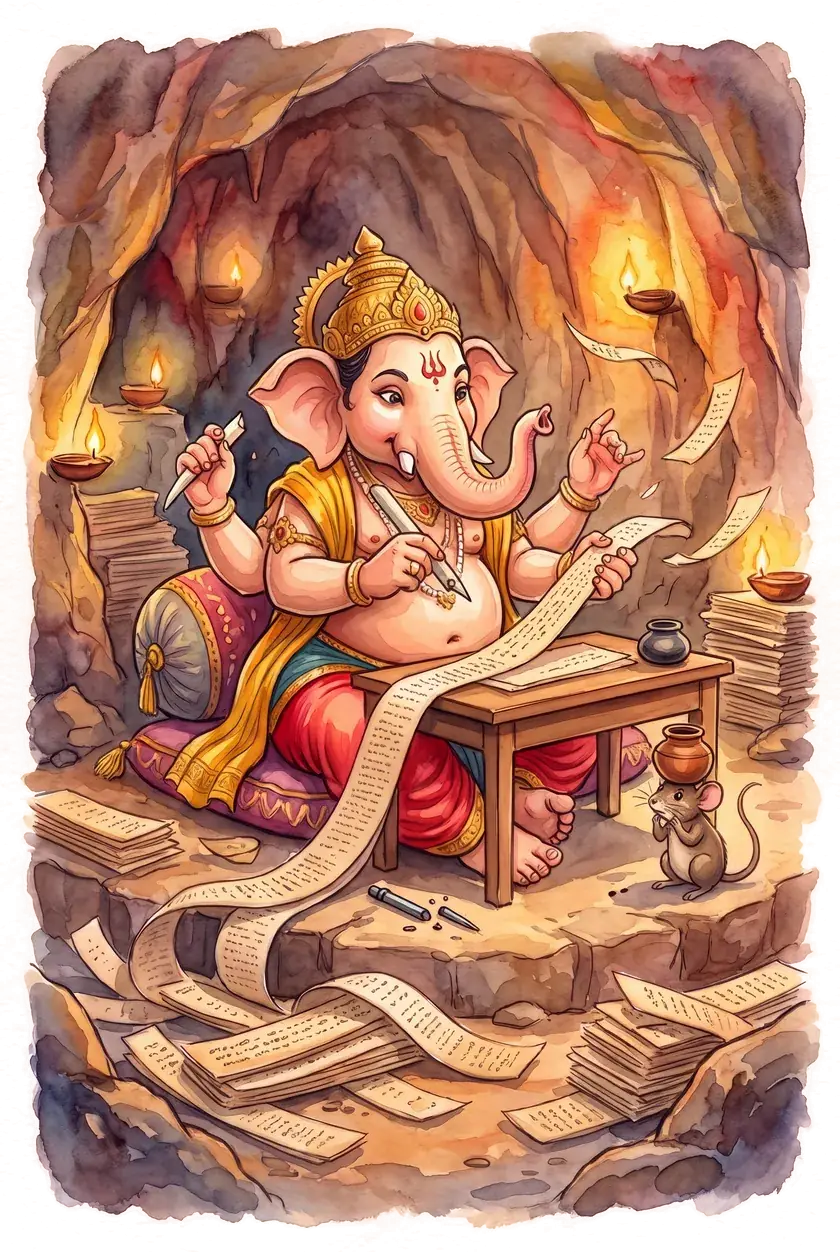
Vyasa thought of Ganesha, and Ganesha came. Vyasa asked him to be the writer of the poem, and Ganesha agreed on one condition. His pen must never stop, even for a moment. Once Vyasa began, he could not pause.
Vyasa agreed, and he added a condition of his own. Ganesha must not write down anything he did not understand. Ganesha said "Om" and began to write.
The knotted verses
Vyasa found a clever way to rest. Every so often he made a verse so tightly knotted that even Ganesha had to stop and think it through. While Ganesha puzzled over it, Vyasa composed the next lines in his head. The storyteller who tells the epic says there are 8,800 of these knotted verses. He knows them, and so does Vyasa's son Shuka, and perhaps Sanjaya. No one else, he says, can work them out to this day.
In Book One's Prologue, Ganesha tells the same bargain from his side of the desk. He saw what Vyasa was up to, Vyasa knew he saw, and neither of them said a word about it.
The Critical Edition, the version scholars made by comparing hundreds of old manuscripts, leaves the scene with Ganesha out of its main text, because many manuscripts do not have it. Most families in India know it anyway, and it is how the series begins.
Why is Ganesha's tusk broken?
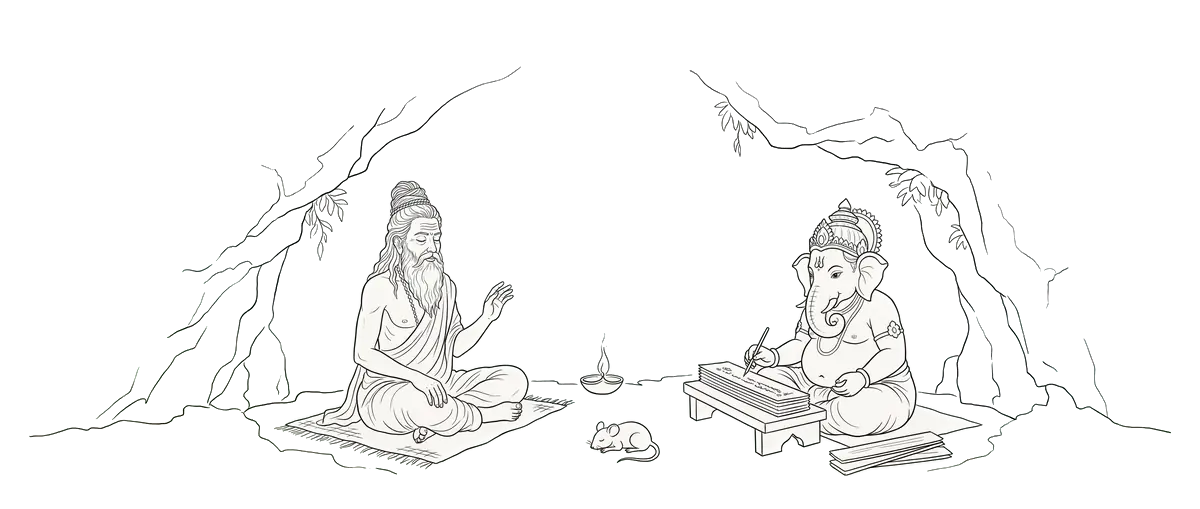
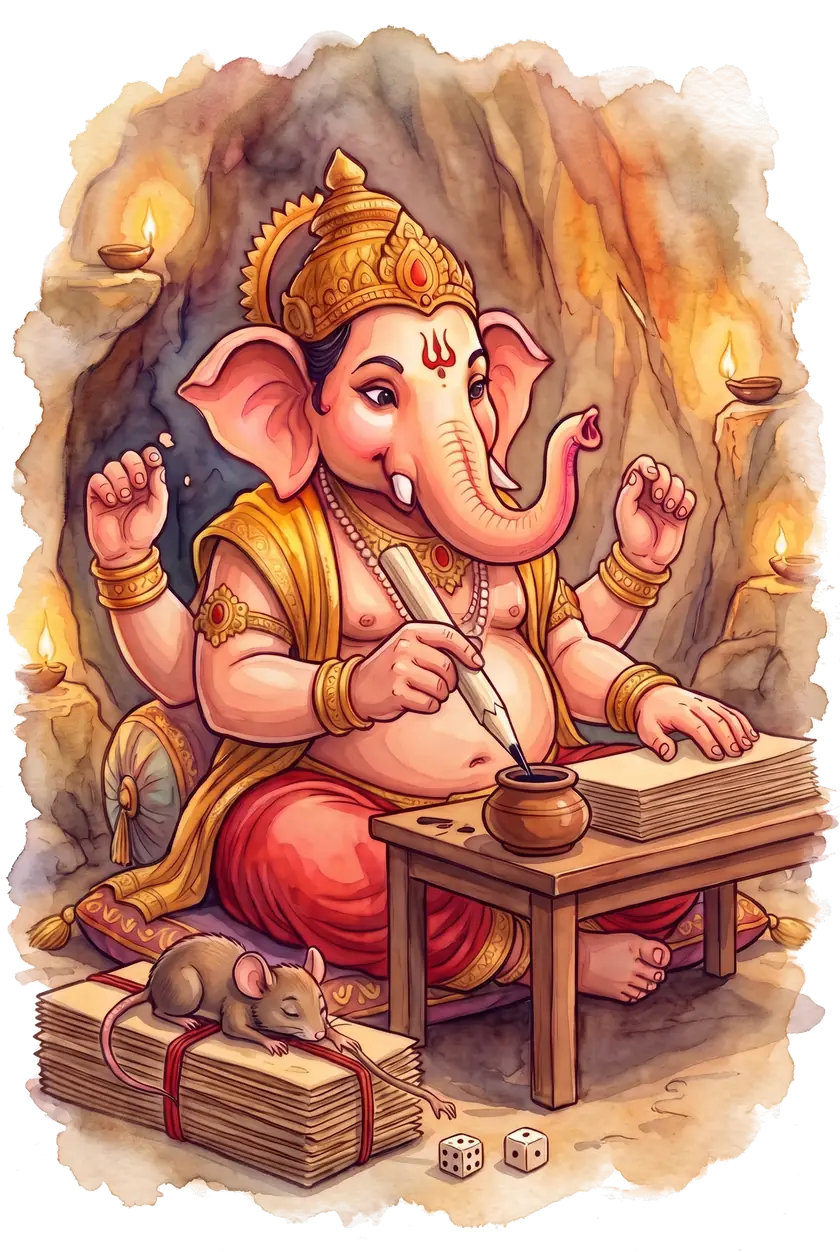
The best-known answer comes from a popular later telling. It is not in Ganguli's translation of the epic. In the middle of the dictation, Ganesha's pen broke. Vyasa did not stop, because the promise was Ganesha's. So Ganesha snapped off one of his own tusks and wrote on with its sharp end dipped in ink.
That is why so many pictures show him with one tusk whole and the other broken short, often with the broken piece in his hand. Older stories explain the tusk in other ways. In one of them it was broken in a fight with the warrior sage Parashurama.
The books use the popular telling, because it suits a scribe who keeps his word. Ganesha tells it himself in Book One. "It hurt," he says. "I would like that on the record." Book Two opens with him back in the cave, dipping the broken tusk into his ink pot.
How was the Mahabharata first told?
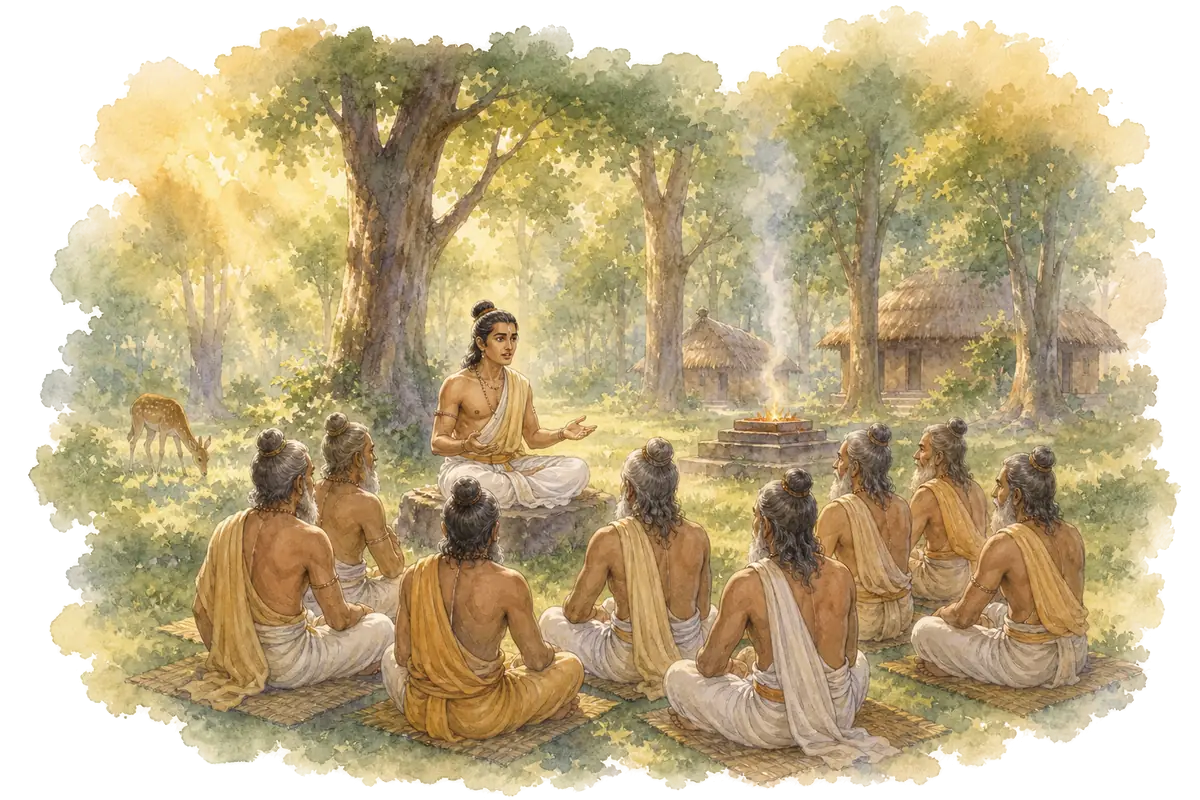
The Mahabharata is a story inside a story inside a story. Vyasa taught the poem to his pupils, among them his son Shuka and a pupil named Vaishampayana.
Years after the war, Arjuna's great-grandson Janamejaya was king. He held a great sacrifice to burn every snake in the world, because a serpent had killed his father, Parikshit. Vyasa came to the sacrifice, and the king asked him why his great-grandfathers had fought such a war. Vyasa turned to Vaishampayana and told him to tell the king all of it, just as he had heard it from him. So the first people ever to hear the whole story heard it at the snake sacrifice. Book Three ends there, with Ganesha telling how it happened.
A bard named Ugrashravas heard it there too. He was the son of the storyteller Lomaharshana, and people called him Sauti. Later he came to the Naimisha forest, where the sage Shaunaka and many others were holding a sacrifice that lasted twelve years. The sages asked him for a story, and he told them what he had heard. The poem begins with that morning in the forest. Ugrashravas tells the sages what Vaishampayana told the king, and Vaishampayana told what Vyasa composed.
Jaya, Bharata, Mahabharata
The poem has had three names. The epic calls itself Jaya, which means victory. It also says Vyasa first made the Bharata, the story of King Bharata's descendants, in 24,000 verses without its side stories. Its last name comes with a story of its own. The gods put the four Vedas on one side of a scale and the Bharata on the other, and the Bharata was heavier. From then on it was called the Mahabharata, the great Bharata.
Many scholars read the three names as stages, with a shorter war poem growing over time into the great epic. Nobody knows for sure, and the epic does not say so.
How long is the Mahabharata, and how old?
About a hundred thousand verses, as the epic itself counts them. Most are shlokas, couplets of two lines each. It is often called the longest poem ever composed, about seven times as long as the Iliad and the Odyssey put together. Its eighteen books are called parvas, and the Bhagavad Gita sits inside the sixth, the Bhishma Parva.
The epic says Vyasa composed it in three years. Scholars think it grew over many centuries, roughly from 400 BCE to 400 CE, as generations of storytellers added to it. Nobody can date it exactly, and some of the stories in it may be older still.
Between 1919 and 1966, scholars at the Bhandarkar Oriental Research Institute in Pune compared hundreds of handwritten manuscripts from all over India and made the Critical Edition. It keeps the verses most of them share, so it is shorter than the version Ganguli translated.
How can you read the Mahabharata in English?
Kisari Mohan Ganguli made the first complete English translation, published between 1883 and 1896. The translation is in the public domain, free to read online at Project Gutenberg and at mahabharata-online, with the same section numbers. The three books of this series follow it, and the sources list where each chapter comes from.
Bibek Debroy translated the whole Critical Edition into plain modern English, in ten volumes from Penguin, published between 2010 and 2014. That is the one for a reader who wants every word.
For readers aged 10 to 16, the series tells the whole epic in three illustrated books, with Ganesha as the storyteller and a painting on every page. Book One begins with a king who meets a goddess by the river Ganga.
Questions about who wrote the Mahabharata
Who wrote the Mahabharata?
The sage Vyasa, also called Veda Vyasa or Krishna Dvaipayana, composed it. The epic's opening tells how the elephant-headed god Ganesha wrote it down as Vyasa spoke, on the condition that Vyasa never stop. Scholars think the poem grew over many centuries, roughly from 400 BCE to 400 CE, as generations of storytellers added to it, and they treat Vyasa as the author the tradition names.
Did Ganesha really write the Mahabharata?
That is how the epic's own opening tells it, in the version Ganguli translated, and it is how most families in India know the story. The Critical Edition, made in Pune from hundreds of old manuscripts, leaves the scene out of its main text, because many manuscripts do not have it. Long before anyone wrote it down, the poem was most likely recited aloud.
Why did Ganesha break his tusk?
In a popular later telling, his pen broke while Vyasa was dictating. He had promised never to stop writing, so he snapped off one tusk and wrote on with it. Ganguli's translation does not have this part. Other old stories give other reasons, and in one of them the tusk was broken in a fight with the sage Parashurama.
How long is the Mahabharata?
About a hundred thousand verses, most of them two-line couplets, divided into eighteen parvas. Many call it the longest poem ever composed, about seven times as long as the Iliad and the Odyssey together. The Critical Edition is shorter, because it keeps only the verses most old manuscripts share.
Is Vyasa the same person as Krishna?
No. Vyasa's birth name is Krishna Dvaipayana, the dark one born on an island, because Krishna means dark. The Krishna who drives Arjuna's chariot is a different person, named for the same dark color. Both of them are in the story.
Is the Bhagavad Gita part of the Mahabharata?
Yes. The Gita is the talk between Krishna and Arjuna on the field of Kurukshetra, just before the war begins, and it sits inside the Bhishma Parva, the sixth of the eighteen parvas. Vyasa composed it as part of the epic, though it is often printed and read on its own. The Bhagavad Gita for kids tells it simply.
Who wrote the Ramayana?
The sage Valmiki, who is remembered as the first poet. The Ramayana tells the story of Rama and Sita in about 24,000 verses. The Mahabharata tells that story too, when the sage Markandeya tells it to Yudhishthira during the exile. The Ramayana summary tells the whole of it.
Where this comes from: Brahma's advice and Ganesha's condition are in section 1 of the Adi Parva in Kisari Mohan Ganguli's translation, along with the knotted verses. That section opens with Ugrashravas in the Naimisha forest, and it gives the Bharata's 24,000 verses and the weighing on the scale. Vaishampayana's telling at the snake sacrifice is Adi Parva section 60. Section 62 calls the poem Jaya and gives its hundred thousand verses and Vyasa's three years. Vyasa's birth and his names come from section 63. The broken tusk is a popular later telling, and the books use it. The sources list the rest, chapter by chapter.