Similar Indian epics and stories · For parents
Ramayana and Mahabharata: What's the Difference?
The Ramayana and the Mahabharata are India's two great epics, both composed in Sanskrit and both still told and acted out every year. The Ramayana is the sage Valmiki's story of Prince Rama, who wins back his wife Sita from Ravana, the demon king of Lanka. The Mahabharata is the sage Vyasa's much longer story of two families of cousins, the Pandavas and the Kauravas, who go to war over a kingdom at Kurukshetra, with Krishna at Arjuna's side.
The two epics side by side
| Ramayana | Mahabharata | |
|---|---|---|
| In Sanskrit | रामायण, Rama's journey | महाभारत, the great story of the Bharatas |
| Also spelled | Ramayan | Mahabharat |
| Composed by | The sage Valmiki, remembered as the first poet | The sage Vyasa, who also appears in the story |
| Length | About 24,000 verses in seven books, called kandas | About 100,000 verses in eighteen books, called parvas |
| The age it is set in | The Treta age, the second of the four ages of the world | The end of the Dvapara age, the third |
| Its hero | Rama, prince of Ayodhya | The five Pandava brothers, Arjuna above all |
| Its heroine | Sita, princess of Mithila | Draupadi, princess of Panchala |
| Vishnu on earth | Rama himself | Krishna, the Pandavas' cousin and friend |
| The war | Rama's army of monkeys and bears against Ravana's rakshasas, to win back Sita | Cousin against cousin for eighteen days at Kurukshetra, over a kingdom |
| How it ends | Rama is crowned in Ayodhya; in the last book Sita returns to the earth | The Pandavas win, lose almost everyone they love and at last walk toward heaven |
| Its best-known teaching | Rama's example, keeping his father's word at any cost | The Bhagavad Gita, Krishna's talk with Arjuna before the battle |
| Festivals | Dussehra, Rama's victory over Ravana, and Diwali, his homecoming | Gita Jayanti, the day the Gita was spoken |
Who is in each
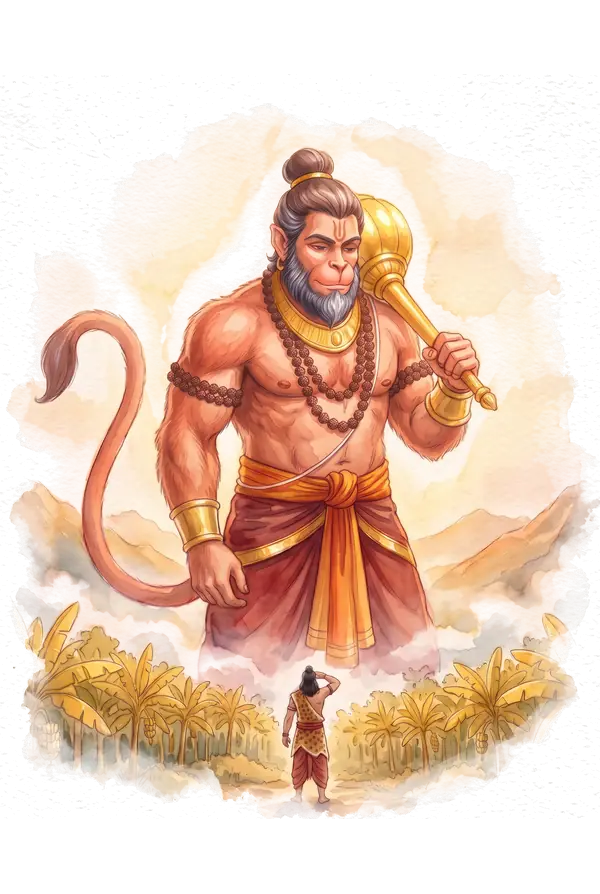
The Ramayana keeps to one family and its friends. Rama is sent into the forest for fourteen years when his stepmother Kaikeyi claims two old promises from his father, King Dasharatha. His wife Sita and his brother Lakshmana go with him, and his brother Bharata rules in his place without ever sitting on the throne. In the forest Ravana carries Sita off to Lanka, and Hanuman, the monkey hero, leaps the sea to find her. The whole story is on the Ramayana summary.
Hundreds of people crowd the Mahabharata. At its center are the five Pandava brothers, Yudhishthira, Bhima, Arjuna, Nakula and Sahadeva, their mother Kunti and their wife Draupadi. Against them stand their cousin Duryodhana and his uncle Shakuni, and with him, out of loyalty, the great archer Karna. The old warrior Bhishma loves both sides and fights for one. The family tree shows how they are all related.
How they feel different
The Ramayana is the easier story to love at first meeting. Its hero is good from the first page and its villain plainly in the wrong, so a reader always knows whom to cheer for. Its subject is ideals, what a good son, brother, husband and king should be, and Rama lives up to them even when it costs him everything.
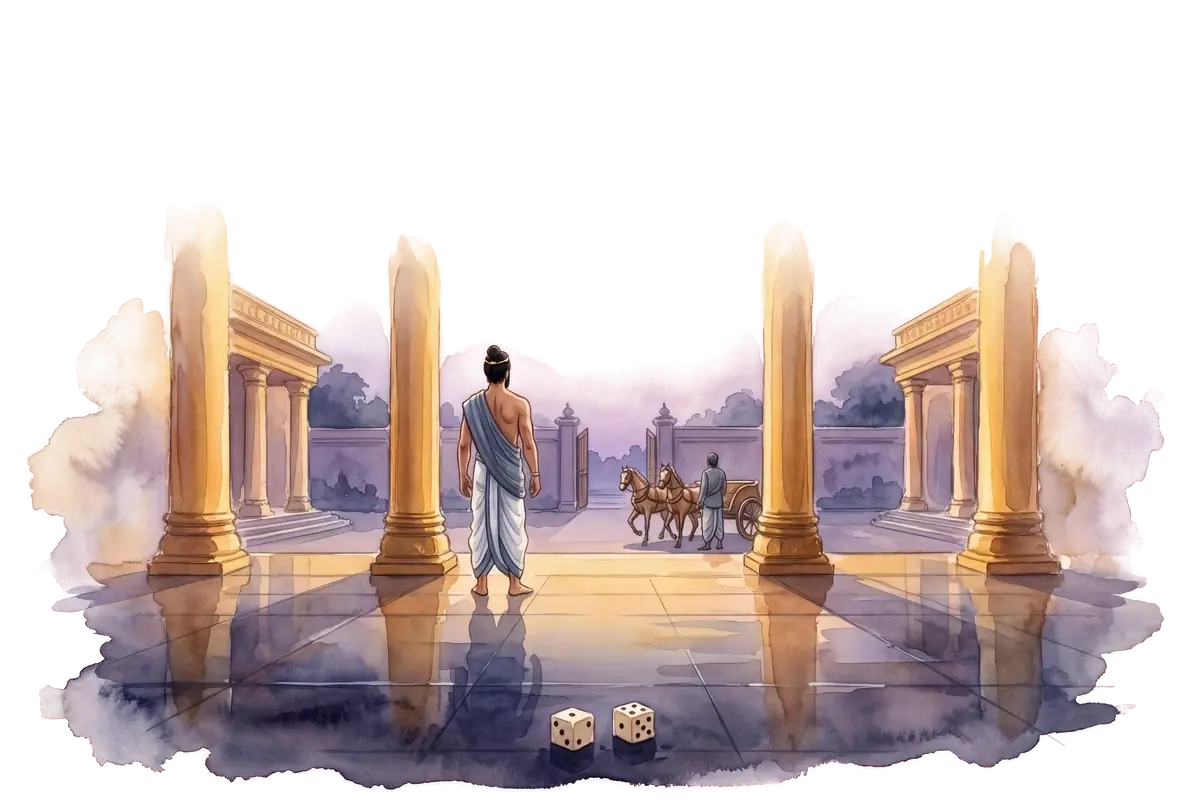
The Mahabharata is a family quarrel where good people make terrible mistakes. Bhishma keeps a vow that harms the family he swore it for. Yudhishthira, who never lies, gambles away his brothers. Karna, generous to anyone who asks, fights on the wrong side because Duryodhana was the only one who stood by him. Even Krishna's choices are argued over. So the Mahabharata keeps asking what the right thing really is when two duties pull against each other, and the illustrated books end key scenes with Krishna putting that question to the reader in Krishna asks.
Where the two stories meet
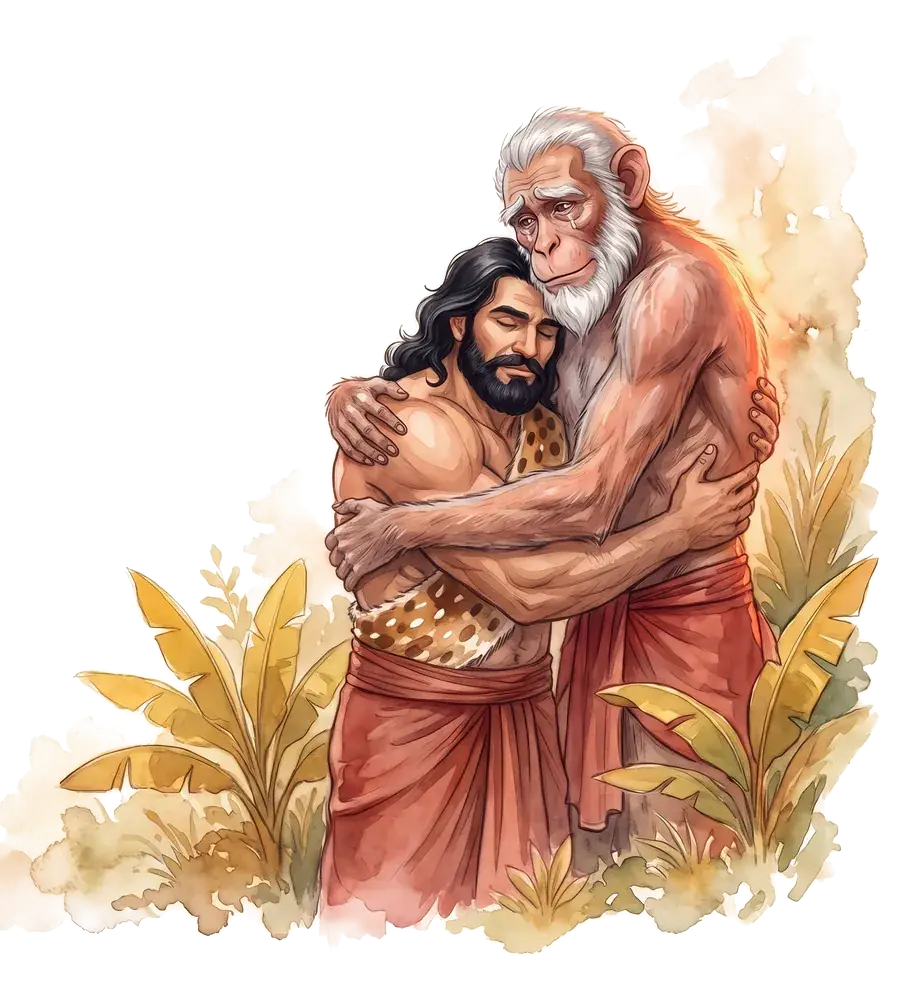
The two epics share more than a god. Hanuman lives on into the Mahabharata, where Bhima meets him on a mountain path during the Pandavas' exile and cannot lift his tail. The warrior-sage Parashurama, who bows to Rama in the Ramayana, is Bhishma's teacher in the Mahabharata, and Karna learns from him too. The Mahabharata even tells the whole Rama story again, when the sage Markandeya comforts Yudhishthira with it in the forest. All three meetings are told on the Ramayana summary.
Which should my child read first?
Many families start with the Ramayana, often read aloud to children of six to nine. It follows one hero from start to end, and good and evil stay clearly apart. From about ten, children are ready for the Mahabharata, a story where people they like do wrong and the ending is not simply happy.
There is no rule, though. A child who loves big casts and arguing about who was right may well start with the Mahabharata and come to the Ramayana later through Hanuman. For the Mahabharata, the parents' guide says how to begin, the age guide lists every hard moment and how the books tell it, and the Mahabharata summary tells the whole story in simple English.
Questions about the two epics
Which is older, the Ramayana or the Mahabharata?
In the stories' own order, the Ramayana comes first. Rama lives in the Treta age, long before the Pandavas, and in the Mahabharata the Pandavas hear Rama's story as a tale of long ago. As for when the poems were composed, scholars date both to overlapping centuries, roughly from a few hundred years before the Common Era to a few hundred years after, and both kept growing as they were retold.
Is the Ramayana part of the Mahabharata?
No. They are two separate epics by two different poets. The Mahabharata does retell the Rama story in a shorter form, though. During the Pandavas' exile the sage Markandeya tells it to Yudhishthira, and that telling is called the Ramopakhyana.
Are Rama and Krishna the same?
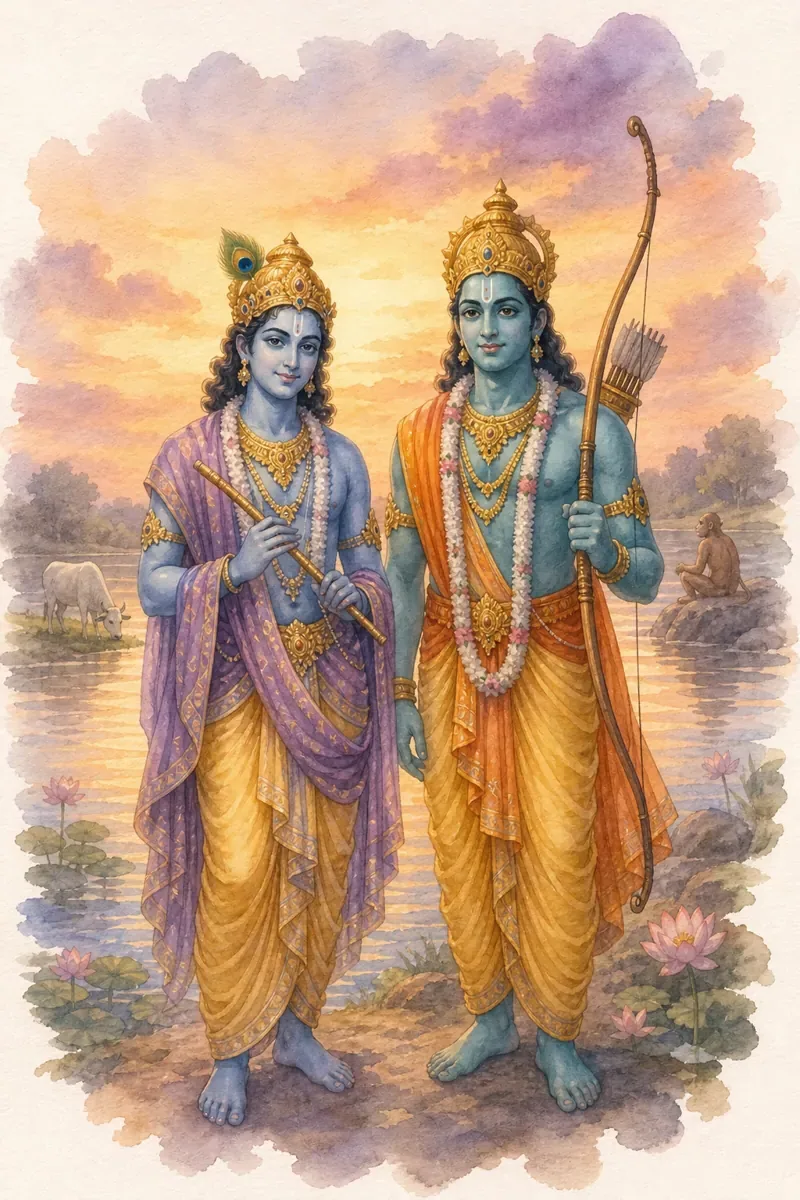
Hindus see both as avatars of Vishnu, born on earth in different ages when the world needed him. Rama comes in the Treta age and Krishna at the end of the Dvapara age. In the common list of Vishnu's ten avatars, Rama is the seventh and Krishna the eighth.
Is Hanuman in the Mahabharata?
Yes. During the Pandavas' exile, Bhima finds an old monkey lying across a mountain path and cannot lift its tail. The monkey is Hanuman, his elder brother, since both are sons of the wind god Vayu. Hanuman promises to roar from the banner of Arjuna's chariot in the war, and Arjuna's flag carries a monkey from then on.
Which is longer?
The Mahabharata, by far. It has about a hundred thousand verses in eighteen books, roughly four times the Ramayana's 24,000 verses in seven books. That makes it one of the longest poems ever composed.
Are the Ramayana and Mahabharata true stories?
Hindu tradition calls both itihasa, which means "so it was," and many families believe the events really happened. Historians read them as great poems that grew over many centuries. Either way, families read them for what they teach about doing the right thing.
Where this comes from: The Ramayana follows Valmiki's poem in Ralph T. H. Griffith's verse translation, The Rámáyan of Válmíki (1870–1874). The Mahabharata follows Kisari Mohan Ganguli's translation (1883–1896): Bhima's meeting with Hanuman is Vana Parva §145–150, Markandeya's telling of the Rama story is Vana Parva §272–290, and Parashurama teaching Bhishma is Udyoga Parva §178. The festival days come from living tradition, not from either poem. More about the sources.