Shakuni is Duryodhana's uncle, the brother of his mother, Queen Gandhari, from the mountain kingdom of Gandhara. In Book One of the Mahabharata he brings his sister to Hastinapura to marry a blind prince, and years later he is the one who shows his jealous nephew a way to beat the Pandavas without a battle. In Book Two he throws the dice for Duryodhana and wins every throw, and in Book Three Sahadeva kills him on the last day of the war, as he swore in the dice hall.
- Family
- Son of King Subala of Gandhara · brother of Gandhari · uncle of Duryodhana and the other Kaurava princes
- Known for
- Saying that nobody in the three worlds plays dice the way he does, then winning both games of dice against Yudhishthira
- First appears
- Book One, chapter 4, Three Princes and a Blindfold
Shakuni's story in Book One
Shakuni is in only three chapters of The Vow, and he doesn't say much. Each time he turns up, though, something in the family is about to change.
He brings his sister to Hastinapura
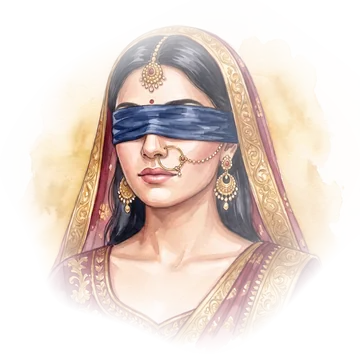
Bhishma chose Princess Gandhari of Gandhara as a bride for Dhritarashtra, the blind elder prince of the Kurus. When Gandhari heard that her groom could not see, she tied a cloth over her own eyes. Her brother Shakuni drove her to Hastinapura, and she stepped down from the chariot with one hand on his arm.
The courtyard went silent. Shakuni was the only one who had something light to say. “My sister makes up her own mind,” he told them, and a pair of ivory dice clicked in his fingers. “In Gandhara we stopped arguing with her years ago.”
Beside Duryodhana at the Rajasuya
Many years pass before we see him again. The Pandavas have built their own city, Indraprastha, and Yudhishthira holds the great Rajasuya sacrifice that makes him emperor. As the kings come one by one to hail him, Sahadeva looks along the line of faces. Duryodhana is standing beside Shakuni, gazing up at the golden pillars of the hall as if he were counting them.
The ride home from the palace
After the other guests leave, Duryodhana and his uncle stay on to walk through the hall. Duryodhana steps onto a floor that turns out to be a pool and goes under. Bhima laughs, and so do the servants. All the way home to Hastinapura, Shakuni talks to him, and Duryodhana does not say a word.
When he finally speaks, it pours out. The whole earth bows to Yudhishthira, he says. He knows he shouldn't be jealous, and he is anyway. He tried to get rid of his cousins more than once, and every time they came up again like a lotus out of the water. Shakuni lets him finish. Then he tells him not to be jealous, because the Pandavas earned what they have by their luck and their own strength.
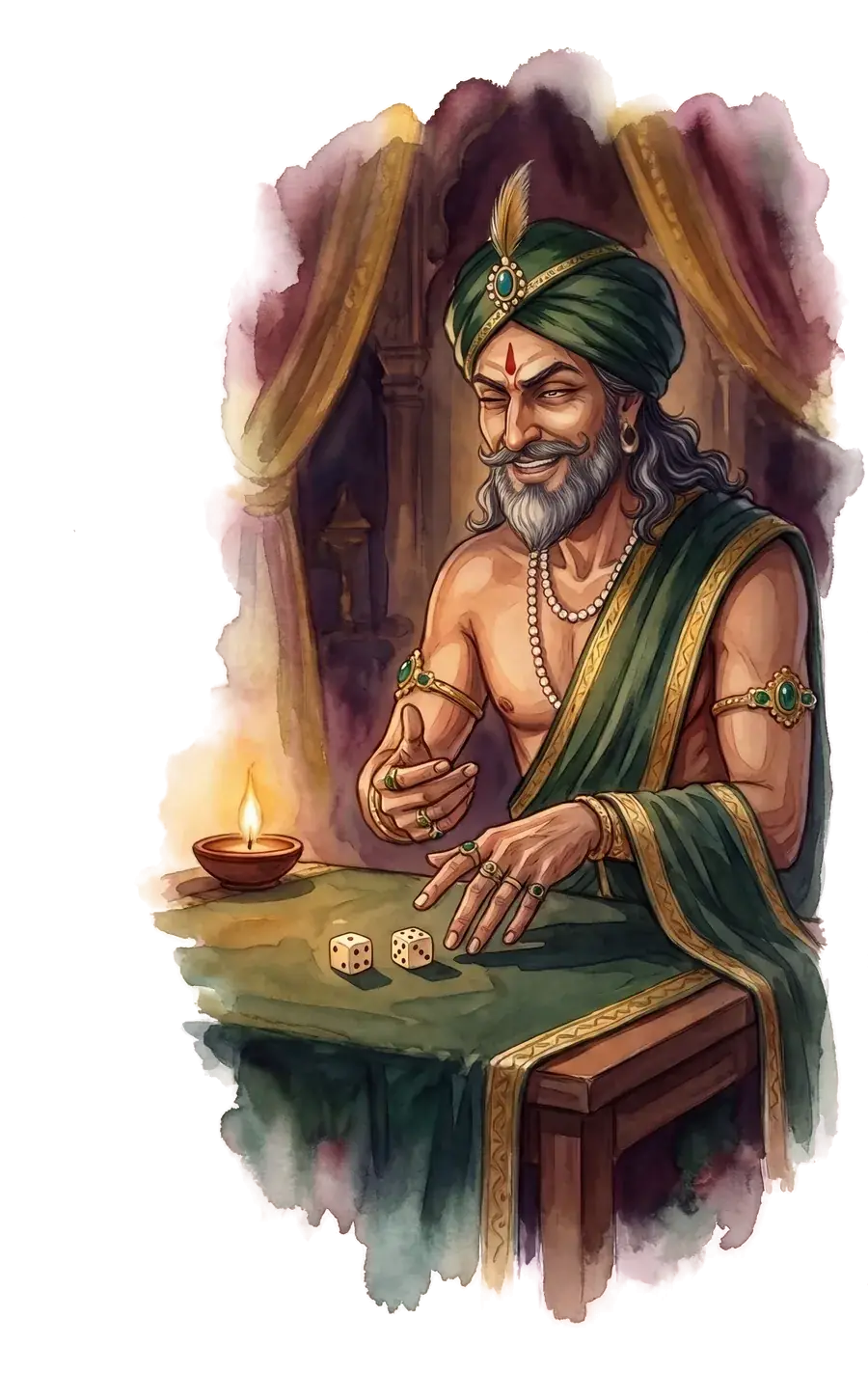
Two ivory dice
Duryodhana wants to fight the Pandavas. Shakuni shakes his head. With Arjuna and Bhima and Krishna on their side, he says, the gods themselves couldn't beat them in battle. “But Yudhishthira himself can be beaten.” Yudhishthira loves to play dice and plays badly, and he cannot say no to a challenge. “And nobody in the three worlds plays dice the way I do.”
He opens his hand, and two ivory dice lie on his palm. Duryodhana can't bring himself to ask his father, so Shakuni takes him to the blind king and does the talking for him. Dhritarashtra gives in and builds a new hall. He sends Vidura to Indraprastha to invite the Pandavas to a friendly game.
The invitation
Yudhishthira asks who they will be playing. “Shakuni, and a few others,” Vidura says. “Gamblers and cheats, all of them.” Yudhishthira doesn't want to play. He has sworn never to refuse a challenge, though, and Book One ends as he sends word that they will come.
What is Shakuni like?
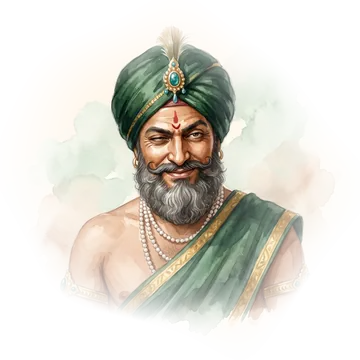
In the book's paintings Shakuni wears a dark green turban with a jewel and a single plume. His beard is going gray, and his left eye is always half-closed while the other one watches you. He carries a pair of ivory dice wherever he goes.
He never lifts a weapon in Book One. He listens and waits, and then he talks. His first advice to his angry nephew is good advice. The dice come after.
In Book Two: The Dice
Shakuni throws the dice for Duryodhana and wins every throw. "I have won," he says, again and again, until Yudhishthira has lost his kingdom, his brothers and himself. Then Shakuni tells him to stake Draupadi and win himself back with her (chapter 1, Shakuni's Dice).
Nobody in Hastinapura knows why he never loses. The tale "A Handful of Rice" tells the story people tell in Gandhara. The Kurus shut his father and brothers in a prison with one handful of rice a day, and the family gave it all to Shakuni, the youngest, so that he would live and remember. His dying father blessed his throws (chapter 1).
When the Pandavas are called back for one more game, Shakuni sets the stake, twelve years in the forest and a thirteenth in hiding, and wins it with one throw. Sahadeva swears that day to kill him in battle (chapter 3). At the peace mission Krishna asks the elders to tie up Duryodhana with Karna, Shakuni and Duhshasana and hand them to the Pandavas, and nobody does (chapter 13).
In Book Three: The War
Shakuni fights for Duryodhana to the last day of the war. On the eighteenth day Sahadeva goes after him, as he swore in the dice hall. With no one of his own left beside him, Shakuni weeps as he fights. "You laughed in the dice hall," Sahadeva shouts, and his last arrow kills the man who never lost a throw (chapter 9, The Lake and the Mace). After the war Gandhari names her brother first among the people who brought ruin on her house (chapter 11).
Where this comes from: Shakuni bringing Gandhari to Hastinapura is in Adi Parva §110 of the Ganguli translation, where his father is called Suvala. There he goes home to his own city after the wedding. His time with Duryodhana at the Rajasuya, the ride home and his plan are in Sabha Parva §44–48, and Vidura's invitation in §57. His claim that no one in the three worlds equals him at dice is Ganguli's (§47). The ivory dice in his hand in chapters 4 and 19 are the book's own touch, and so is his line about his sister. The dice games in Book Two follow Sabha Parva §57–79, where Ganguli says only that Shakuni wins by unfair means. "A Handful of Rice" comes from a later popular telling. His death in Book Three follows Shalya Parva §4–61. See where the stories come from.