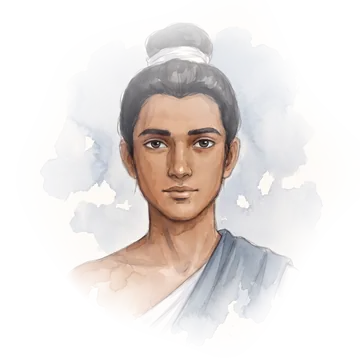
Yudhishthira is the eldest of the five Pandava brothers in the Mahabharata, the son of Queen Kunti, born by the blessing of Dharma, the god who judges right and wrong. He is known for never telling a lie. He becomes emperor in Book One, loses everything at dice in Book Two, and in Book Three wins the war and walks to the gate of heaven with a dog.
- Family
- Son of Kunti and King Pandu, born by the blessing of Dharma. Eldest brother of Bhima, Arjuna, Nakula and Sahadeva, and, as he learns after the war, younger brother of Karna. Cousin of Duryodhana and his ninety-nine brothers. With his brothers, husband of Draupadi.
- Known for
- Keeping his word, and never telling a lie, even a small one. His love of dice, which he plays badly.
- First appears
- Book One, chapter 6, The Hunter's Curse
Yudhishthira's story in Book One
"The best of men"
King Pandu lived high in the mountains under a sage's curse that meant he could never have a son of his own. Queen Kunti knew sacred words that could call a god, and for her first son she called Dharma. When Yudhishthira was born, a voice from the sky said, "This child will be the best of men."
In Hastinapura, Queen Gandhari had been carrying her child for two whole years. When news came that Kunti had a son, she wept. Kunti's son was now the eldest, and the throne would be his. Her own eldest, Duryodhana, was born soon after, and the two cousins grew up wanting the same throne.
The boy who saw the whole tree
When Bhima vanished after Duryodhana's feast by the river, Yudhishthira searched every garden and wood along the bank. Bhima came home eight days later and told them about the poisoned sweets. "Say nothing about this," said Yudhishthira. "Not to anyone. From today we guard each other."
At Drona's school, the teacher set a bird in a tree and asked each prince what he saw. Yudhishthira went first. He had never told a lie in his life, and he did not start now. "I see the tree," he said, "and you, and my brothers, and the bird." Drona asked again, and then again, and the answer did not change. Only Arjuna saw nothing but the bird's eye.
The heir and the house of lac
A year after the princes captured King Drupada, the blind King Dhritarashtra named Yudhishthira his heir. Soon people in the market squares were saying his name the way they said the names of kings. Duryodhana could not bear it, and the king sent the Pandavas away to the town of Varanavata. As they left, their uncle Vidura warned Yudhishthira in a foreign tongue that hardly anyone in Hastinapura knew. "I understand," said Yudhishthira.
In Varanavata he walked through the painted rooms of their new house and smelled ghee, fat and lac under the fresh paint. The house was built to burn. "Dig," he said, and a miner dug them a tunnel. For a whole year Yudhishthira smiled at Purochana, the man who meant to burn them, and thanked him every morning for the beautiful house. On the night the brothers set the fire, he sent his mother and brothers down into the tunnel and came last, pulling the planks shut over his head.
Hidimbi, Ekachakra and a wedding
In the forest, when Bhima turned on the rakshasa woman Hidimbi, Yudhishthira stopped him. "Never kill a woman," he said. "Not even to save your own life." When she asked to marry Bhima, Yudhishthira set the terms. Each morning Bhima could go with her, and each evening she must bring him home. Later, in the town of Ekachakra, Kunti offered Bhima to the rakshasa Baka to save their host's family. Yudhishthira was not so sure. To him, Bhima was the wall they all slept behind.
At Princess Draupadi's swayamvara, the contest for her hand, Arjuna hit the target and won her. At the potter's house where the family lodged, Kunti told her sons to share what they had brought home before she saw it was a bride. Arjuna would not marry first. "You are the eldest," he said. Yudhishthira saw his brothers' faces, and he knew what was in them, because it was in his own. "All five of us will marry her," he told King Drupada. When the king said that no one had ever heard of a woman with many husbands, Yudhishthira answered, "What's right is hard to see sometimes. My tongue has never told a lie, and my heart says this is right."
Emperor of Indraprastha
Dhritarashtra gave the Pandavas half the kingdom, a wilderness called Khandavaprastha, and Yudhishthira bowed and thanked his uncle. There the brothers built the city of Indraprastha. When Arjuna broke their rule and walked in on Yudhishthira and Draupadi to fetch his bow, Yudhishthira was not angry. "I know why you came in," he said. Arjuna went into exile anyway, to keep the rule.
Later Yudhishthira held the Rajasuya, the great sacrifice that made him emperor, and the kings of the earth brought their treasures to his hall. Before the sage Vyasa went home, he warned Yudhishthira of a great war to come, thirteen years away. Yudhishthira swore to obey his elders and quarrel with no one.
Duryodhana went home sick with envy, and his uncle Shakuni knew Yudhishthira's weakness. "He loves to play dice, and he plays badly," Shakuni said. "If someone challenges him, he can't say no." When the invitation came from Hastinapura, Yudhishthira knew what it meant. Still, his fingers itched for the dice.
Questions about Yudhishthira
Who were Yudhishthira's parents?
His mother was Queen Kunti, and her husband was King Pandu of Hastinapura. A sage's curse meant Pandu could never have a son of his own, so Kunti used sacred words she had learned as a girl to call a god. Yudhishthira was born by the blessing of Dharma, the god who judges right and wrong. In Book Three, Dharma calls him "child" and tells him, "I am your father."
Did Yudhishthira ever tell a lie?
Once, in Book Three. Drona would not stop fighting while he believed his son Ashwatthama was alive. Bhima killed an elephant named Ashwatthama, and Drona asked Yudhishthira, the one man whose word he trusted, if his son was dead. Yudhishthira said, "Ashwatthama is dead," and under his breath he added, "the elephant." His chariot had always ridden four fingers above the ground. Now its wheels came down to the earth.
Why did Yudhishthira gamble away Draupadi?
He had sworn never to refuse a challenge, and he loved the game. Once he began to lose, every new stake felt like a way to win back his gold, his kingdom, his brothers and himself. When nothing else was left, he staked Draupadi, hoping one last throw would set them all free. He lost her too.
What did the yaksha ask Yudhishthira?
At a lake in the forest, a spirit called a yaksha asked him question after question before he could drink. "What is heavier than the earth?" it asked. "A mother is heavier than the earth," said Yudhishthira. "A father is higher than the sky." Asked which enemy no one can defeat, he answered, "Anger. And greed." The yaksha offered him one brother's life, and he chose Nakula, so that Madri would have a son alive too. The yaksha was Dharma, his father, and he brought all four brothers back.
Why wouldn't Yudhishthira leave the dog?
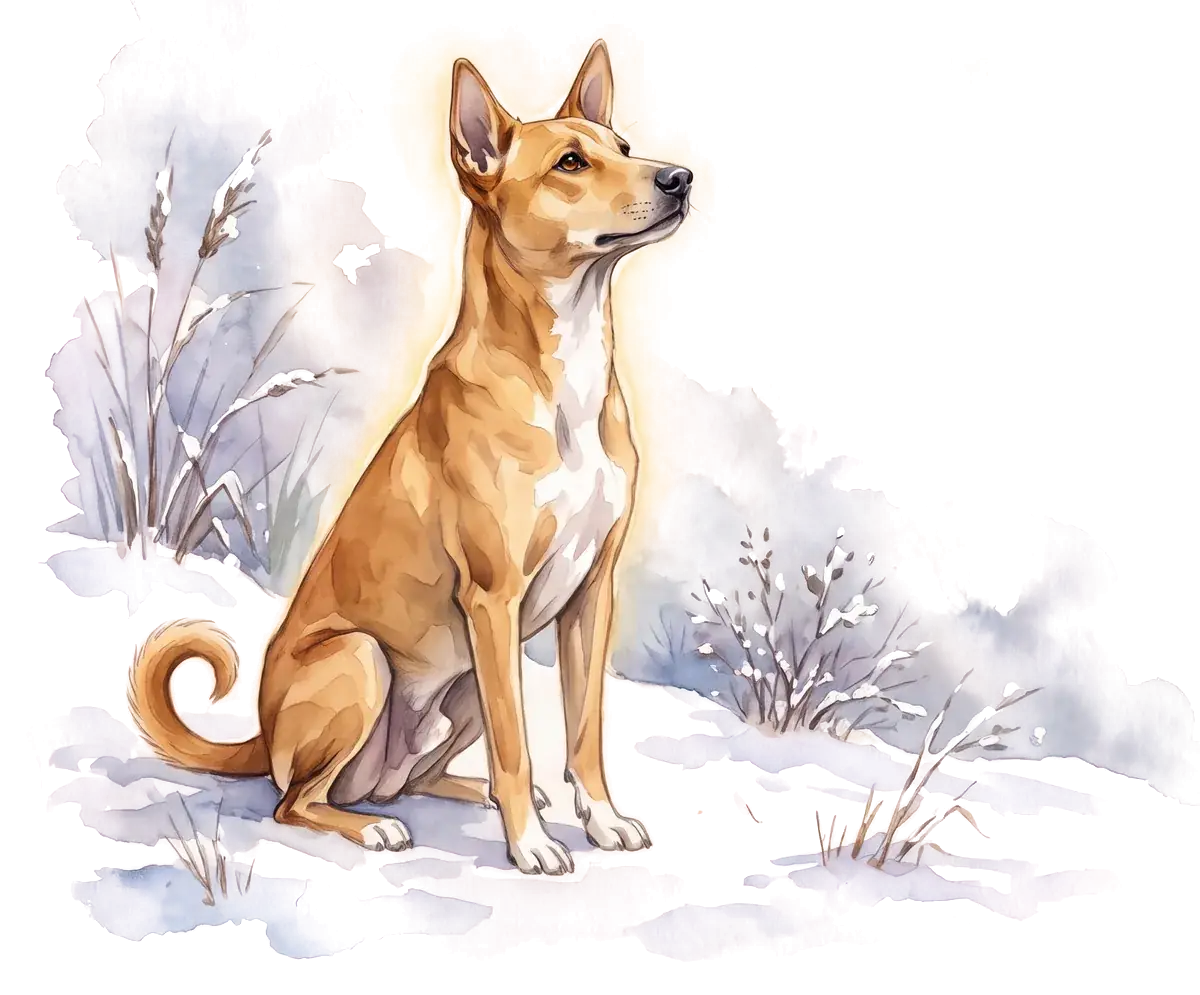
A dog followed Yudhishthira all the way up the mountain on the road to heaven. When Indra came to take him up in a golden chariot and told him to leave the dog behind, he refused. "I don't want any happiness that means turning away someone who trusts me," he said. The dog turned out to be Dharma, testing him one last time.
What does the name Yudhishthira mean?
Yudhishthira means "firm in battle" in Sanskrit. In Book Two, when the Pandavas hide for a year at King Virata's court, he calls himself Kanka, a brahmin who plays dice with the king. In Hindi and other modern Indian languages you will also see the name written Yudhisthir.
In Book Two: The Dice
In Shakuni's new hall Yudhishthira sits down at the board. "Cheating at dice is a sin," he tells Shakuni, but he will not walk away. "I was challenged," he says. "I don't walk away. That is my vow." Shakuni throws for Duryodhana and wins every time. Yudhishthira loses his treasure, his chariot, his herds and his kingdom, then his brothers one by one, then himself, and last of all Draupadi (chapter 1, Shakuni's Dice). When Draupadi asks the hall whether a man who has lost himself can stake his wife, Yudhishthira sits like a man made of stone, and he holds Bhima back with both arms (chapter 2). The old king gives everything back, then calls the brothers to one more game. "How can a king refuse when he's called to play?" says Yudhishthira. He loses again, and the Pandavas go to the forest for twelve years, with a thirteenth to be spent in hiding (chapter 3, The Second Game).
In the forest Draupadi asks him why his anger never blazes up. "Because anger burns the one who carries it," he says. "The earth carries all of us, and it forgives us every day." He sends Arjuna north to ask the gods for weapons (chapter 4). The sage Brihadashva tells him the tale of Nala and Damayanti, a king who lost everything at dice and won it back, and then teaches Yudhishthira how the dice fall (chapter 5, Arjuna in Heaven).
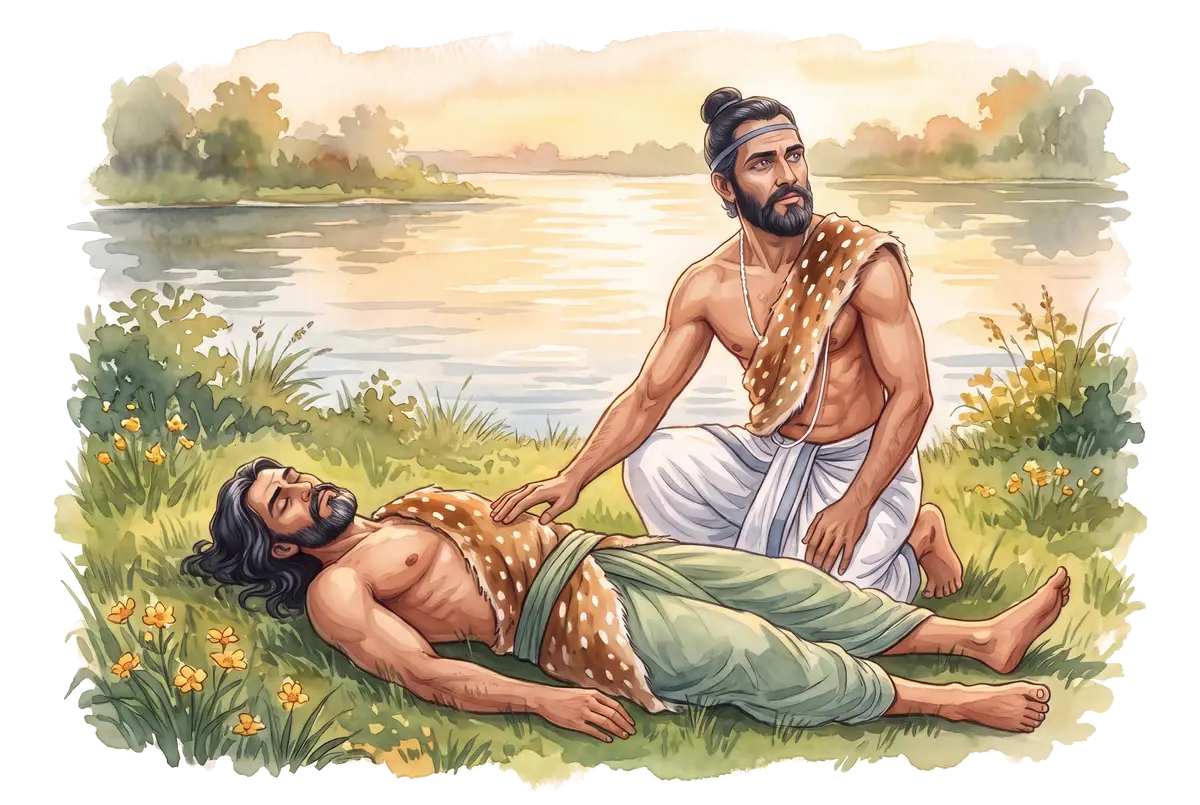
At a lake in the Dwaita woods his four brothers drink without answering the yaksha's questions and fall dead on the grass. Yudhishthira answers every question, and when the yaksha offers him one brother back, he chooses Nakula. "My father had two wives, Kunti and Madri," he says. "I'm Kunti's son, and I'm alive. Let Madri have a son alive too." The yaksha is Dharma, and all four brothers wake (chapter 9, The Lake of Questions). In the year of hiding he is Kanka, a brahmin who plays dice with King Virata (chapter 10, The Year of Disguises). When the year is over, he asks the Kauravas for five villages, one for each brother, and gets nothing (chapter 13, The Peace Mission).
In Book Three: The War
Before the first arrow, Yudhishthira takes off his armor, lays down his bow and walks across the empty ground to the Kaurava army with his hands joined. He bows to Bhishma, Drona, Kripa and Shalya, and each of them blesses him and goes back to his place to fight him. Then he calls out, loud enough for both armies to hear, that the Pandavas will welcome anyone who chooses them, and Yuyutsu, the blind king's son by a maid of the palace, crosses over (chapter 1, The Bhagavad Gita).
On the fifteenth day, Krishna tells the Pandavas that Drona will stop fighting only if he hears that his son is dead. Drona asks Yudhishthira, the one man he trusts. "Ashwatthama is dead," says Yudhishthira, and under his breath, "the elephant." His chariot, which has always ridden above the ground, comes down onto the earth (chapter 6, "Ashwatthama Is Dead"). Not long after, when Karna beats him in front of the army, Yudhishthira tells Arjuna to give his bow to someone braver. The brothers quarrel worse than ever before, and Krishna brings them back together (chapter 7, Give Away Your Bow).
On the last day, with no horses and no driver, Yudhishthira throws a golden spear and kills Shalya. When Duryodhana hides in a lake and offers him the kingdom, he answers, "You wouldn't give us as much land as the point of a needle would cover. Now you want to give me the whole earth? I won't take it as a gift from you. I'll win it." After Bhima's last blow, Yudhishthira kneels beside his cousin. "We did this to each other," he says (chapter 9, The Lake and the Mace).
After the war he stands before Gandhari and asks her to curse him, and she holds him the way a mother holds a son (chapter 11). When Kunti tells her sons that Karna was her first child, Yudhishthira cannot bear to be king. "I had my own brother killed," he says. "For a kingdom." He is crowned all the same, and learns how to rule from Bhishma on his bed of arrows (chapter 12, Lessons from a Bed of Arrows). Years later he crowns Abhimanyu's son Parikshit and walks toward the mountains with his brothers, Draupadi and a dog. One by one the others fall. At the top he refuses to enter heaven without the dog, and then without his brothers, and when he finds them in a dark and dreadful place he chooses to stay. "While I'm here, my brothers hurt a little less," he says. "That's enough for me" (chapter 15, The Road to Heaven).
Where this comes from: Adi Parva §113–127 (Yudhishthira's birth), §134–135 (the bird in the tree), §141–152 (the house of lac) and §193–214 (the wedding and Indraprastha) in the Ganguli translation of the Mahabharata, then Sabha Parva §1–44 (the Rajasuya) and §45–79 (the two games of dice). Book Two follows Vana Parva §309–312 for the yaksha's questions and Virata Parva §1–24 for Kanka. Book Three follows Drona Parva §154–200 for Drona's death, Shalya Parva §4–61 for Shalya and the lake, Shanti Parva for the crowning and Bhishma's lessons, and the Mahaprasthanika and Svargarohana Parvas for the road to heaven. The bird's eye comes from popular tellings; in Ganguli, Drona asks the princes to cut off the bird's head. More about the sources.