Similar Indian stories · Animal fables
Panchatantra Stories for Kids: The Famous Fables and Their Lessons
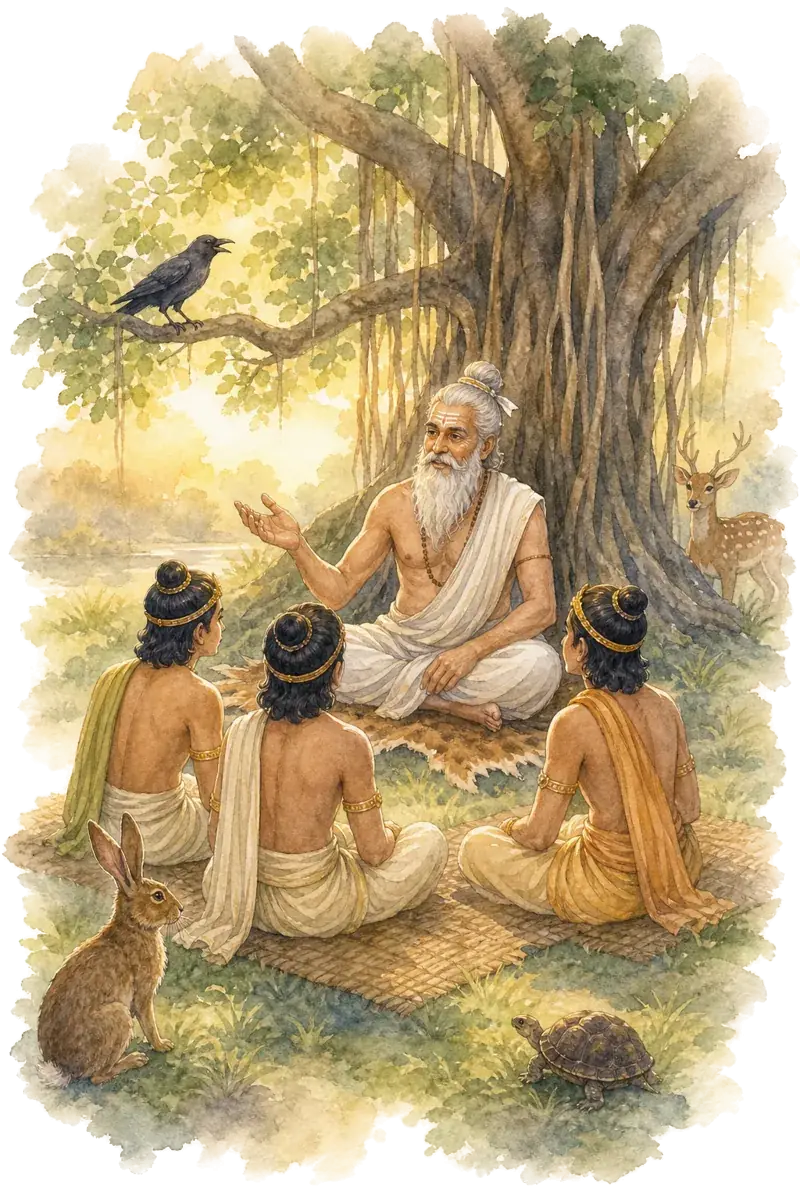
The Panchatantra is a book of animal fables in Sanskrit, traditionally the work of an old teacher named Vishnusharma. He made it to teach three slow princes how to live wisely, and he promised their father, the king, that he would do it in six months. Its name means "five books," and in its stories jackals and lions, crows and monkeys trick one another and save one another, each story with a lesson about friendship and keeping your wits.
- The name
- Panchatantra (पञ्चतन्त्र, PAN-cha-tan-tra) is Sanskrit for "five books" or "five treatises."
- Who made it
- Tradition names the teacher Vishnusharma. Many of the fables are older than any book, and nobody knows who first told them.
- How old
- Scholars think it was put together in Sanskrit about two thousand years ago. The exact date is unknown.
- How far it went
- A Persian version was made in the sixth century, and from it an Arabic one, Kalila and Dimna, named after the book's two scheming jackals. From there the fables reached Europe, where the French poet La Fontaine borrowed some of them.
- Vishnusharmavish-nu-SHAR-maविष्णुशर्मा
- Amarashaktia-ma-ra-SHAK-tiअमरशक्ति
- DamanakaDA-ma-na-kaदमनक
- KaratakaKA-ra-ta-kaकरटक
- Chitragrivachit-ra-GREE-vaचित्रग्रीव
- Hiranyakahi-RAN-ya-kaहिरण्यक
The frame story: an old teacher and three princes
In a city called Mahilaropya, in the south of India, there lived a king named Amarashakti. He was wise and generous, and kings from far away came to bow at his feet. His three sons were another matter. They hated their lessons, and the king could hardly bear to look at them.
He called his counselors together. "How can we wake up their minds?"
"Grammar alone takes twelve years," said one of them. "After that come the books on law and on how to live."
Another counselor had a better idea. There was an old brahmin named Vishnusharma who knew every science there was. Let him teach the princes.
The king sent for him and offered him a hundred grants of land if he could make the boys wise. Vishnusharma would not take them. "I'm eighty years old," he said. "I have no use for money. But if I don't make your sons masters of the art of living within six months, I'll give up my own name. Write down the date."
He took the boys home and taught them five books of stories that he had made himself. The stories were full of animals who argued and schemed and made friends, and in the middle of one story an animal would often say, "How was that?" and tell another. Each story began with a little verse, and each verse held something worth knowing.
In six months the princes knew them all.
The five books
Each of Vishnusharma's five books has one main story, and the other stories sit inside it, told by its characters to one another.
| Book | Its name | The main story |
|---|---|---|
| 1. Mitra-bheda | The Loss of Friends | A lion king and a bull become close friends. A jealous jackal, Damanaka, whispers lies to each of them until the lion kills the bull. |
| 2. Mitra-samprapti | The Winning of Friends | A crow, a mouse, a tortoise and a deer become friends, and together they save one another from hunters. |
| 3. Kakolukiya | Crows and Owls | The crows win a long war with the owls when one old crow pretends to change sides and goes to live among the enemy. |
| 4. Labdha-pranasha | Loss of Gains | A monkey talks his way off a crocodile's back. |
| 5. Aparikshita-karaka | Rash Deeds | People act before they think, and are sorry. Its best-known story is the brahmin and the mongoose. |
The famous fables
The best-known fables come from all five books. Inside the book, an animal usually tells one of them to another animal to win an argument.
The lion and the hare
A lion lived in a forest and killed far more animals than he could ever eat. At last the animals came to him with their heads bowed. "Stay at home, King," they said, "and every day one of us will come to you for your dinner."
The lion agreed. "But if one day nobody comes, I'll eat you all."
So it went, until the day it was the hares' turn. The hare who had to go took his time. He sat down. He nibbled some grass. He thought.
The sun was low when he reached the lion, who was lashing his tail with hunger. "You're late," roared the lion, "and you're tiny."
"Master, it isn't my fault," said the hare. "Five other hares set out with me. On the way another lion jumped out of a hole in the ground. He says this forest is his, and he calls you a thief. He told me to bring you to him."
The lion's mane bristled. "Show him to me."
The hare led him to an old well. "He's hiding down there, in his fort."
The lion looked over the edge. A lion looked back up at him, glaring. He roared, and from the bottom of the well came a roar twice as loud. With one leap he went down to fight, and he never came out.
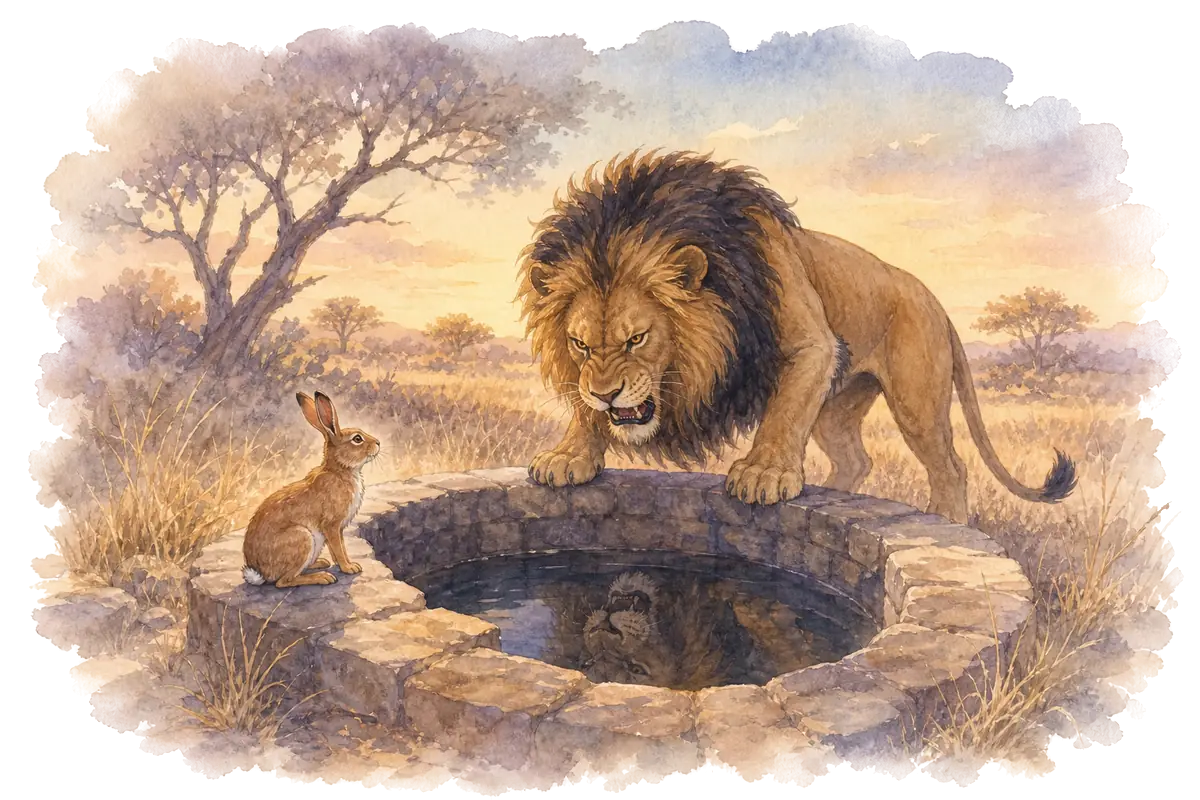
The hare went home with the news, and the animals of the forest lived in peace.
The lesson: Quick wits can beat great strength.
The crane and the crab
An old crane lived beside a pond full of fish, but he had grown too slow to catch them. So one day he stood at the edge of the water and ate nothing, not even the fish that swam right past his feet.
A crab came up to him. "Uncle, why aren't you eating?"
"I heard some fishermen talking," said the crane sadly. "Tomorrow or the next day they're bringing their nets to this pond. You'll all be caught, and I'll starve."
The fish were terrified. "You know about it, so you must know what to do. Save us."
"I'm only a bird," said the crane. "But I could carry you to a deep lake I know, one at a time."
Every fish wanted to go first. Each day the crane took one in his beak and flew off with it, and each day he came back alone, a little fatter.
At last the crab asked for his turn. The crane was tired of fish and thought a crab would make a nice change. Off they flew, but they passed over no lake at all. Below them lay a flat rock in the sun, white with fish bones.
The crab understood. Before the crane could land, he took hold of the crane's neck with his claws and held on until the crane fell dead. Then he went home to the pond and told the fish the truth.
The lesson: Before you trust a helper, ask what he gains from helping you.
The blue jackal
A hungry jackal wandered into a town one night, and the town dogs chased him through the streets. He dashed into a dyer's yard and tumbled into a huge vat of indigo. When he crawled out, he was blue from his ears to the tip of his tail.
He ran back to the forest. The animals had never seen such a creature, and they fled from him in fright. The jackal saw his chance.
"Don't be afraid," he called. "The god Indra has sent me to be your king."
The lions and tigers bowed down to him. He made the lion his chief minister and the elephant his doorkeeper. The other jackals he drove away, because they might know him.
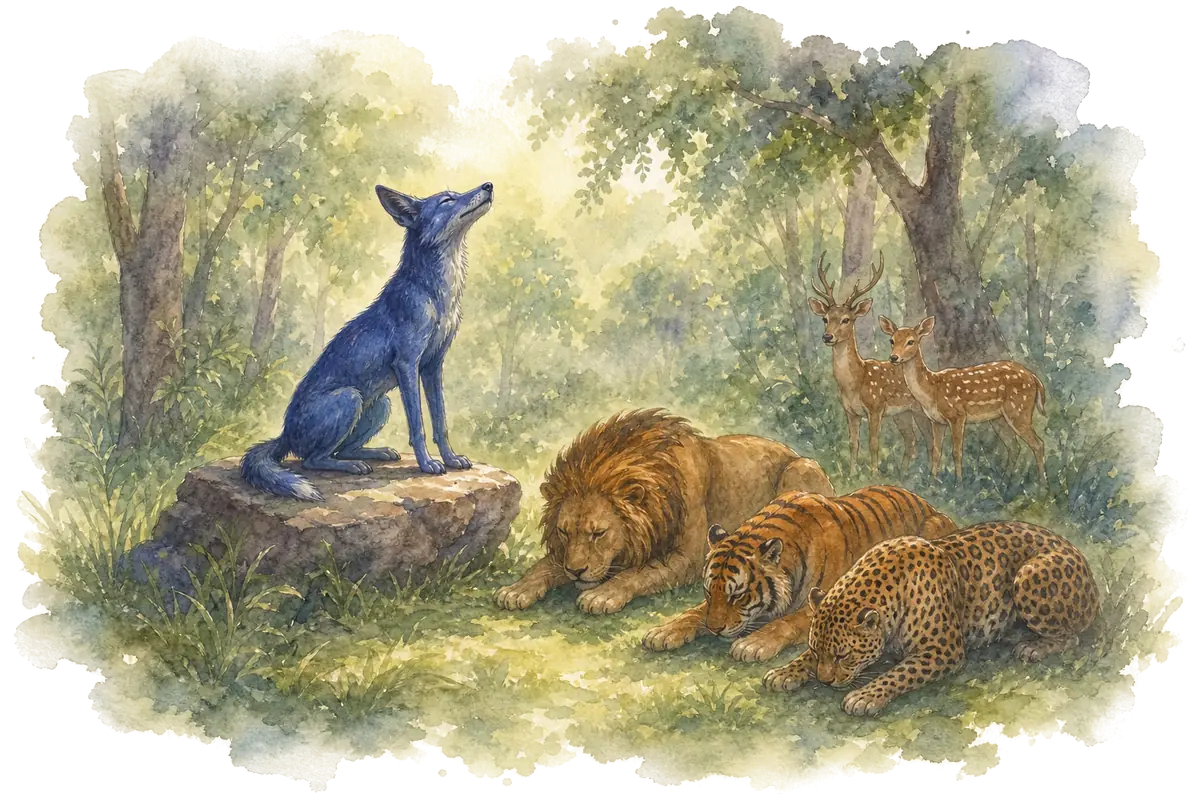
Every day the great hunters laid their kills before him, and he shared out the meat like a king. Then one evening a pack of jackals began to howl nearby. The blue king's whole body shivered, and his eyes filled with happy tears. Before he could stop himself, he stood up and howled with them.
The lions and tigers stared at him. "He's only a jackal," they said. "He fooled us." He ran for the trees, and a tiger caught him.
The lesson: A disguise lasts only until your real self speaks up.
The tortoise and the geese
A tortoise lived in a lake with two geese for friends. Then came a drought that lasted twelve years, and the lake began to dry up.
"We have to find another lake," said the geese. "We've come to say goodbye."
"Goodbye?" said the tortoise. "For you a dry lake means less to eat. For me it means death. Take me with you."
"How? You have no wings."
The tortoise had an idea. "Bring a stick. I'll hold the middle in my mouth, and you'll each take one end in your beaks."
The geese thought it over. "If you say a single word on the way, you'll let go of the stick, and you'll fall."
"I won't say a thing," said the tortoise. "Not one word until we land."
Up they went, the two geese flapping hard and the tortoise swinging between them. They flew over a town, and the people in the streets looked up and pointed. "What's that?" they shouted. "Two birds are carrying a cartwheel through the sky."
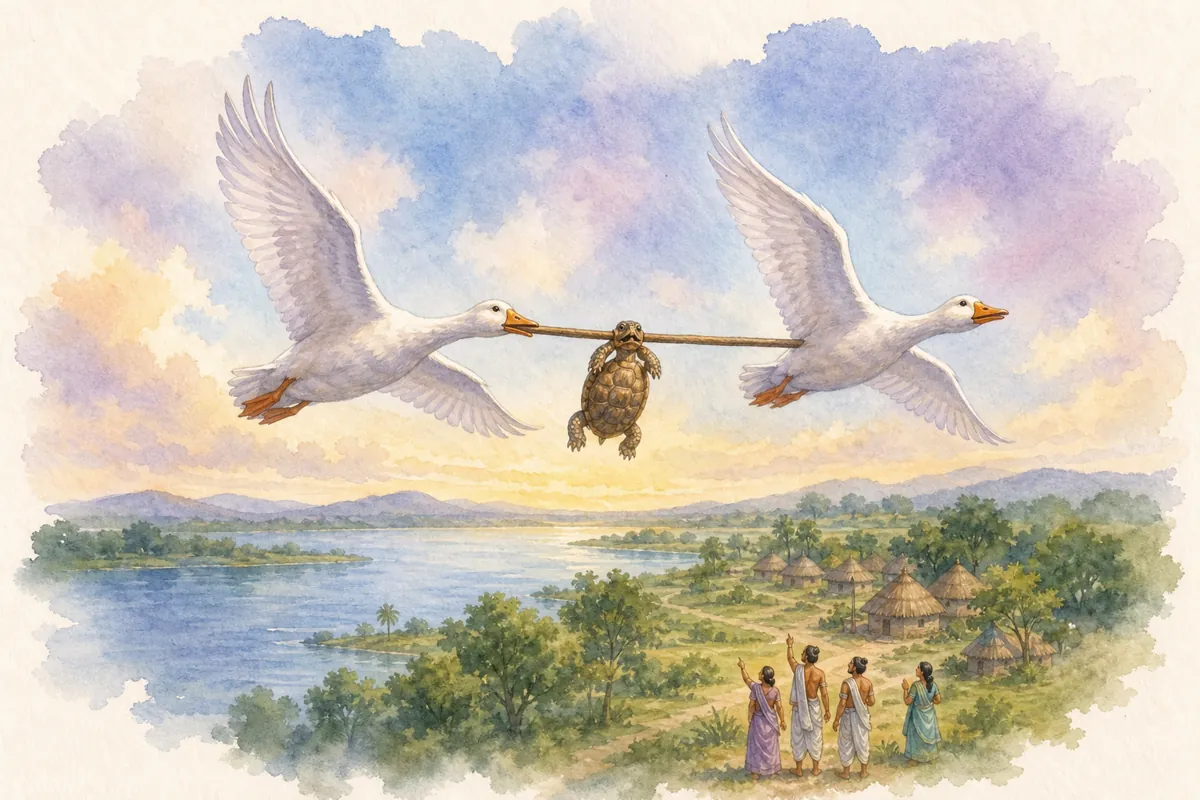
The tortoise couldn't bear it. "What are all those people chattering about?" he said.
The stick was no longer in his mouth. He fell all the way down to the ground, and that was the end of him.
The lesson: When good friends warn you to keep quiet, keep quiet.
The doves and the hunter's net
A great banyan tree stood near the city of Mahilaropya, and a crow lived in it. One morning the crow watched a hunter spread a net under the tree, scatter rice over it and hide. The birds of the banyan listened to the crow's warning and stayed away.
Then a flock of doves came flying over with their king, Chitragriva, at their head. They saw the rice and came down to eat it, and the net fell over them all.
The doves flapped and struggled, and the hunter came running with his club. "Don't be afraid," said Chitragriva. "Alone, none of us can get free. Together we can carry the net away. Fly up, all of you at once."
They did. The whole flock rose into the air with the net, spread above the trees like a canopy. The hunter ran after them until hills and thickets blocked his way. Then he gave up and went home without his net.
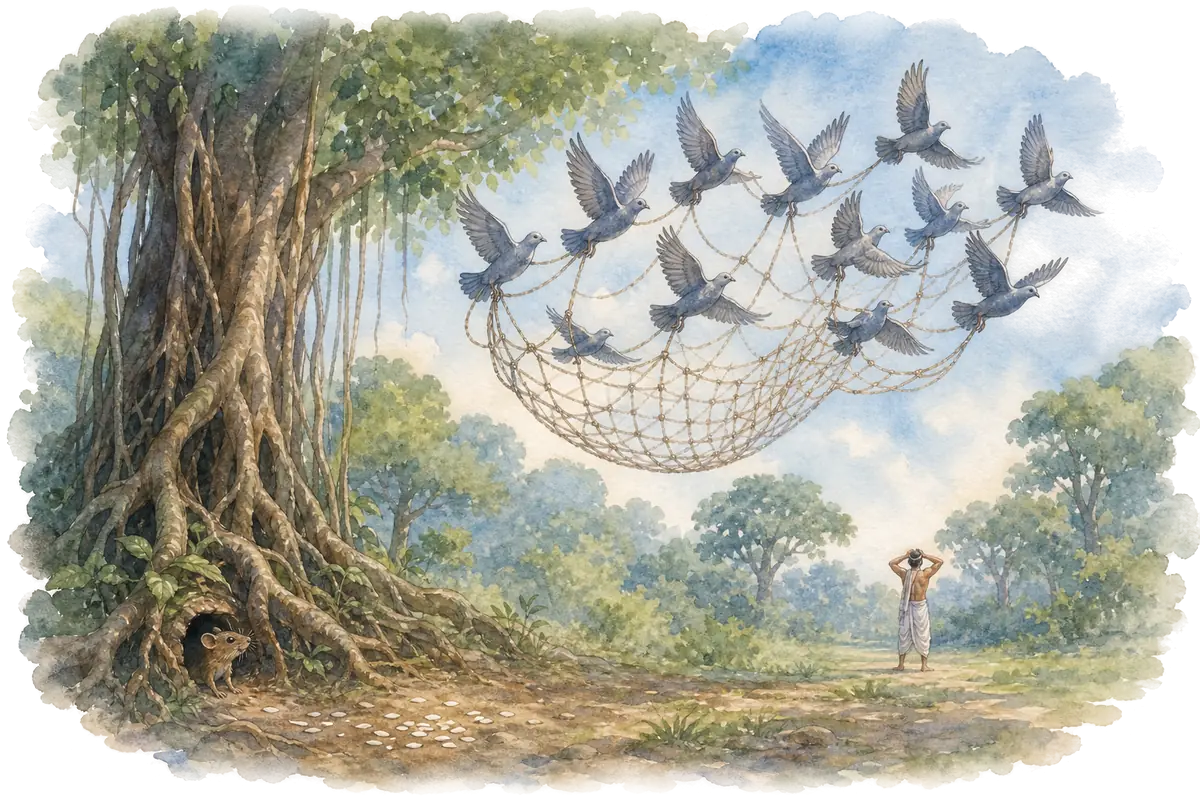
Chitragriva led his doves to his old friend Hiranyaka, a mouse who lived in a hole with a hundred doors. The mouse began by gnawing the king free. "No," said Chitragriva. "Free my doves first, and me last."
"I only wanted to see what kind of king you were," said the mouse, and he cut every cord.
The crow had followed and seen everything. That day he decided he wanted the mouse for a friend too.
The lesson: Pull together, and you can lift what none of you could lift alone.
The monkey and the crocodile
A monkey lived in a rose-apple tree on the bank of a river, and the tree was never without fruit. One day a crocodile came out of the water to rest in its shade. The monkey threw him down some fruit. "You're my guest," he said. "Eat."
The crocodile came back the next day, and the next, and they became friends. Every evening the crocodile carried some of the fruit home to his wife.
"These are as sweet as nectar," she said. "Think how sweet the heart of a monkey who eats them every day must be. Bring me his heart."
The crocodile didn't want to. She wept and said she would starve herself, so at last he went to the monkey. "My wife wants to thank you for all that fruit," he said. "Come home with me for dinner. You can ride on my back."
Halfway across, in the deepest water, the crocodile told him the truth. "My wife wants to eat your heart."
The monkey kept calm. "My friend, why didn't you tell me on the bank? I keep my heart up in the rose-apple tree. Take me back, and I'll fetch it for her."
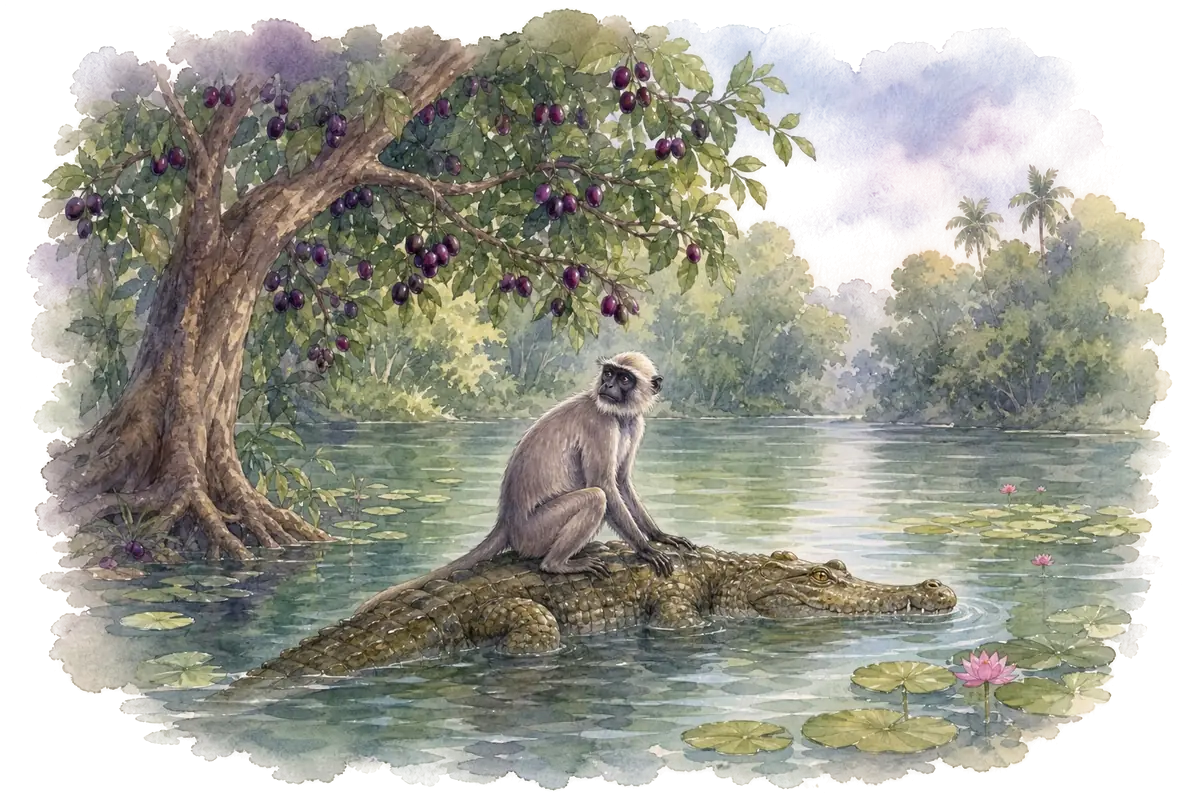
The crocodile swam back. The moment they reached the bank, the monkey leaped off and ran up to the highest branch.
"Fool," he called down. "Who has two hearts? Go home, and never come back to my tree."
The lesson: Keep calm in danger, and never trust a friend twice once he has tried to trick you.
The brahmin and the mongoose
A poor brahmin and his wife had a baby boy, and the brahmin had also raised a little mongoose as if it were his son. One day his wife went down to the river and left the baby in his care.
Soon a maid came from the palace. The queen needed a brahmin to read the holy texts at a ceremony that day, and whoever came would get a gift. The brahmin was too poor to say no, and there was nobody to watch the baby. So he left the mongoose to guard the cradle and hurried off.
While he was gone, a cobra slid out of a hole in the ground and moved toward the baby. The mongoose sprang at it and killed it.
He was so proud of himself that he ran out to meet the brahmin coming home. His face and paws were still smeared from the fight.
The brahmin saw him and thought the worst. "He's eaten my son." Before he could think again, he struck the mongoose with his stick, and the mongoose died.
Then he went inside. The baby lay asleep in the cradle, safe, and beside it lay the cobra, dead. The brahmin sat down on the floor and wept.
When his wife came home and heard what he had done, she said, "This is what comes of acting before you understand."
The lesson: Look before you act, most of all when you're angry or afraid.
The lion-makers
Four brahmins had been friends since they were small boys. Three of them were great scholars who knew everything in the books. The fourth had learned very little, but he had good sense.
They set off together to win money and fame at the courts of kings. On the way the eldest said, "Our friend here has no learning. Why should he share what we earn?" The third scholar shook his head. "We played together when we were children. Let him come."
In a forest they found the bones of a dead lion. "Here's a chance to test our learning," said one of the scholars. "Let's bring it back to life."
"I can put the bones together," said the first. "I can give it skin and flesh," said the second. "And I can give it breath," said the third.
"Wait," said the man of sense. "That's a lion. If you bring it to life, it'll kill us all."
"Fool," said the third scholar. "Do you want my learning to go to waste?"
"Then wait a moment," said the man of sense, "while I climb this tree."
The scholars went to work. The lion opened its eyes and got to its feet, and it killed all three of them. When it had gone, the man of sense climbed down and walked home.
The lesson: Learning is worth less than good sense.
Fables in the Mahabharata
The Mahabharata is a separate book, and its people tell fables too, the way Vishnusharma's animals do, to win an argument.
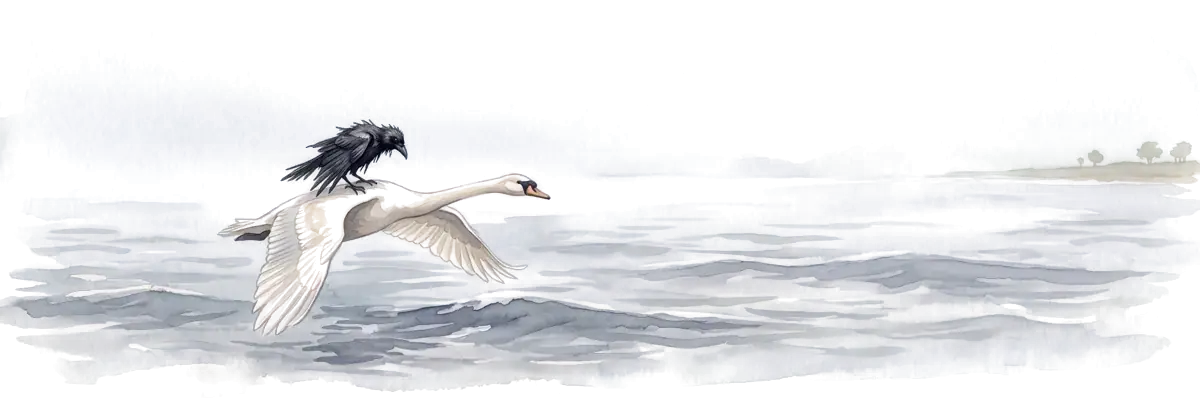
On the seventeenth day of the war at Kurukshetra, King Shalya is driving Karna's chariot, and he hates every minute of it. When Karna brags that he'll find Arjuna and beat him, Shalya tells him about a crow. The crow had grown fat and proud on a rich man's scraps, and he challenged a swan from Lake Manasa to a race. He showed off a hundred and one ways of flying, and the swan knew only one, until the swan turned out over the open sea and the crow's wings gave out above the waves. The swan lifted him onto his back and carried him home. "You," Shalya tells Karna, "are that crow."
In the Shanti Parva, the Mahabharata's long book of advice on how to rule, Yudhishthira hears a fable that any Panchatantra reader would know at once. A mouse named Palita, with a mongoose below him and an owl above, makes a pact with his old enemy, a cat named Lomasha who is caught in a hunter's net. He gnaws the cat free, and he leaves the last cord until the hunter is in sight, so that the cat has to run for his tree and has no time to eat him.
The borrowing runs both ways. Arthur Ryder's translation of the Panchatantra stops the story of the doves for a little verse. It asks how Rama could believe in a golden deer, and how Yudhishthira could fail to see the trouble that gambling brings.
Questions about the Panchatantra
Who wrote the Panchatantra?
Tradition says the teacher Vishnusharma, an old brahmin who made the five books to teach three princes. Nobody knows for sure. Many of the fables are older than any one author. Scholars think the book was put together in Sanskrit about two thousand years ago, and it was rewritten many times after that.
What does Panchatantra mean?
Pancha means "five" in Sanskrit, and tantra here means a book or treatise, so Panchatantra means "five books." The five are The Loss of Friends, The Winning of Friends, Crows and Owls, Loss of Gains and Rash Deeds.
How many stories are in the Panchatantra?
It depends on the version. Each of the five books has one main story with other stories told inside it. The oldest form, as the scholar Franklin Edgerton rebuilt it in 1924, has about forty. Arthur Ryder's 1925 translation of a later, longer version has more than eighty.
What age is the Panchatantra for?
Children of five or six enjoy the fables read aloud, and from about eight they can read a retelling alone. The full Panchatantra was made for young princes, and its verses and stories within stories suit readers of 10 to 16 and adults. A few of its inner tales are about grown-up matters, so most families start with a retelling.
Is the Panchatantra part of the Mahabharata?
No. It is a separate book with its own frame story and its own author. The Mahabharata has fables of its own, though. In the Karna Parva, King Shalya tells Karna about a crow who raced the swans, and in the Shanti Parva, Yudhishthira hears about a mouse who saves a cat from a hunter's net.
What is the difference between the Panchatantra, the Hitopadesha and the Jataka tales?
The Panchatantra is the Sanskrit book of fables credited to Vishnusharma, in five books. The Hitopadesha, which means "good advice," is a later Sanskrit book by Narayana that retells many of the same fables in four books, again with Vishnusharma teaching princes. The Jataka tales are Buddhist stories in Pali about the Buddha's earlier lives, when he was often born as an animal. A few fables turn up in more than one of them, the talkative tortoise among them.
Where this comes from: The frame story and the fables are checked against Arthur W. Ryder's translation, The Panchatantra (1925), made from a Sanskrit version of 1199, and Franklin Edgerton's The Panchatantra Reconstructed (1924), which rebuilds the oldest form of the book. The versions differ. Ryder calls the hare a rabbit and the crane a heron. In Edgerton the brahmin himself kills the mongoose and the fifth book is named after the story, while in Ryder the brahmin's wife drops her water jar on the mongoose and the fifth book opens with a barber's story. The blue jackal and the lion-makers are in Ryder's later version and not in the oldest form. Ryder's rose-apple tree stands on the seashore and Edgerton's is a fig tree. Most retellings put the rose-apple tree on a riverbank, as here, and end the story at the tree, where Ryder's goes on with more tales and bad news for the crocodile. The Mahabharata's fables are in Kisari Mohan Ganguli's translation, Karna Parva §41 (the crow and the swans) and Shanti Parva §138 (the cat and the mouse). Our sources page lists the books' sources chapter by chapter.