For teachers and homeschoolers
Mahabharata Lesson Plans for Middle School
This illustrated Mahabharata comes in three books for readers aged 10 to 16, about grades 5 to 10: The Vow, The Dice and The War. Each book has its own unit, with a reading plan, chapter summaries, Krishna's questions by chapter and discussion questions. The chapters are short, with a painting on every page, so a class has time to read and to talk.
Why teach the Mahabharata to middle schoolers
The Mahabharata is one of the longest stories in the world, told in India for more than two thousand years and sacred to many families. It is also a family story about cousins who grow up as rivals, full of choices that are hard to judge. That makes it good for a class. Students argue about it without being asked.
- Promises. Bhishma swears never to marry so his father can. Years later Yudhishthira keeps a vow never to refuse a challenge, and sits down to a game of dice he knows is crooked.
- Fairness. Ekalavya is turned away for his birth, and Karna is asked to name his parents before he may fight. In the dice hall, Draupadi asks the kings a question about the law, and they sit silent.
- Rivalry. Bhima's rough games, Duryodhana's poison, and a laugh in a palace that leads straight to the dice.
- Duty. Arjuna keeps a family rule after his brother has let him off. Karna keeps faith with the friend who made him a king, even after he learns who his mother is.
The three books, one unit each
Start with Book One if your class is new to the story. Books Two and Three each open with Ganesha retelling the story so far, so a class can also begin there.
| Book | What happens | Chapters | The unit |
|---|---|---|---|
| The Vow, Book One | Bhishma's vow, the cousins' childhood, Drona's school, Draupadi's swayamvara, the Palace of Illusions | Prologue and 19 | Teaching The Vow |
| The Dice, Book Two | The game of dice, thirteen years of exile, the year in disguise, and the road to war | Prologue and 15 | Teaching The Dice |
| The War, Book Three | The Bhagavad Gita, the eighteen days at Kurukshetra, and what came after | Prologue, 15 and Epilogue | Teaching The War |
How each book is built
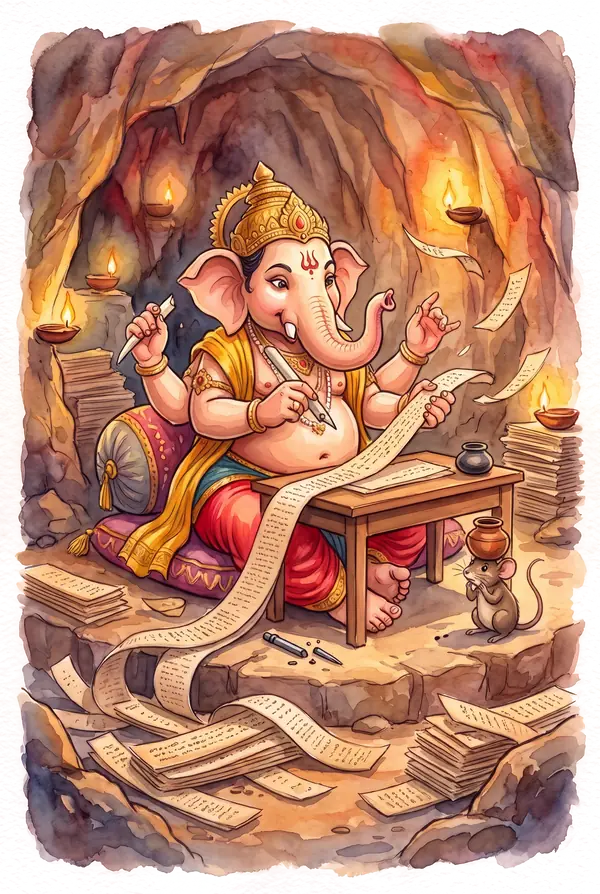
Ganesha, who wrote the epic down, tells each book's Prologue and talks to the reader now and then. Some chapters pause for A Tale Within the Tale, an older story that explains a curse or a blessing, such as Nala and Damayanti or Savitri and the god of death. After key scenes, Krishna asks: he holds up a balance scale, says what he thinks of a hard choice, and asks the reader one question. There are no model answers, and students may argue with him.
Every book also has a list of everyone in it, a glossary, and discussion questions for parents and teachers.
Classroom ideas for a Mahabharata lesson plan
These work with any of the books. Each book's unit says where they fit week by week.
Grow the family tree
The family runs to five generations. Put up a blank tree and let students add each person as they meet them. Check against our Mahabharata family tree.
A names warm-up
Before each chapter, say three or four names aloud together, with the loud part in capitals (BHEESH-ma, gaan-DHAA-ree, KAR-na). Let a different student lead each day. The full list is on how to say the names.
A Krishna asks debate
Read one of Krishna's questions aloud. For Book One's chapter 2, label three corners "great love", "terrible mistake" and "both". Students pick a corner and give one reason from the chapter. Anyone persuaded may move, and says why. Each book's unit lists Krishna's questions chapter by chapter, and the question cards print them with a talking point for every chapter.
The heroes and villains list
In Book One's Prologue, Ganesha warns that by the end "you will have crossed out names on both sides." Have each student keep one and update it after every chapter. In Book Two he asks readers to get the list out again.
Put a character on trial
Older classes can hold a mock trial, with Drona tried for Ekalavya's thumb or Shakuni for his dice. The mock trial kit has the roles, a step-by-step plan, a rubric and ready cases from each book. More to print and play is on the activities page and in all our resources.
Handling the hard moments
Book One has deaths, curses, a poisoning, a house set on fire and a boy who gives up his thumb. Book Two has the dice hall, where Draupadi is dragged in by her hair, and later a king who tries to carry her off and a powerful man at a royal court who harasses her. Book Three is the war itself, with many deaths and a night raid on a sleeping camp. The books tell these honestly and without graphic detail, and keep the reader's eye on who speaks up and who stays silent. Our age guide lists the hard moments so you can read ahead and plan the talk.
Which version of the Mahabharata it follows
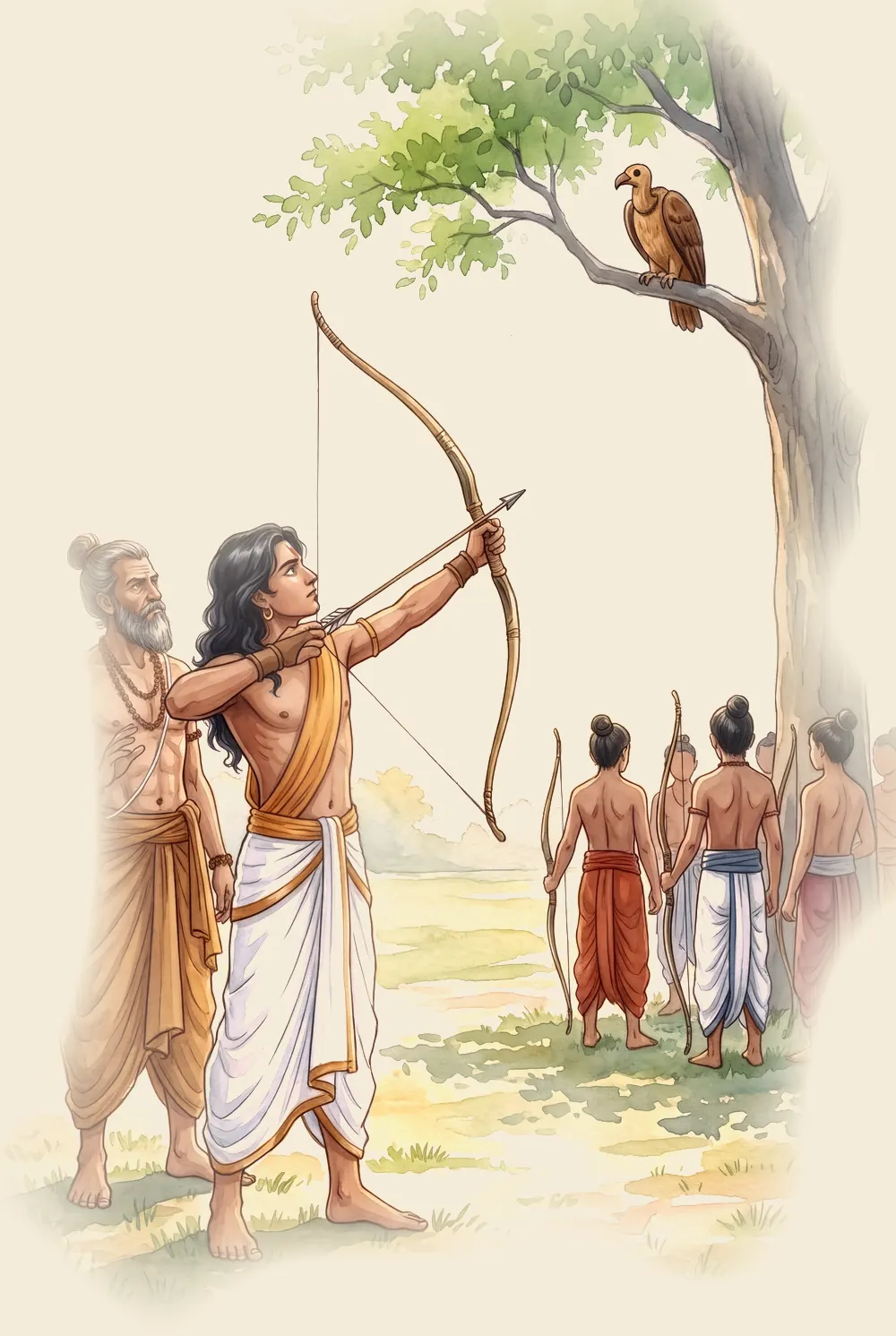
The events follow the English translation by Kisari Mohan Ganguli (1883 to 1896). In a few places the books choose a popular telling many readers know, such as the arrow through the bird's eye. Most dialogue is imagined, and Krishna's questions belong to this retelling. Our sources page has the details for every chapter.
Questions teachers ask
What grade is the Mahabharata for?
These books are written for readers 10 to 16, about grades 5 to 10. Most teachers use them in grades 6 to 8, in a unit on world myths or ancient India. The chapters are short, with a painting on every page, so stronger and weaker readers can work through the same text together.
Which book should a class start with?
Start with The Vow, Book One, if the class doesn't know the story. It begins before the cousins are born, so every rivalry has its roots in the reading. The Dice and The War each open with a short retelling of the books before, so a class that already knows the beginning can start there.
How long does a Mahabharata unit take?
About four weeks for each book, reading four or five chapters a week in two or three class periods. Each book's unit has a week-by-week plan and a shorter two-week route through the chapters that matter most.
Is the Mahabharata appropriate for middle school?
Yes. The books have deaths, curses and battles, and they tell each one honestly but without graphic detail. Krishna's questions after key scenes turn the hard moments into talk about fairness and promises. The age guide lists each hard moment and how the book handles it.