Similar Indian stories · Krishna's childhood
Krishna Stories for Kids: Tales of Krishna's Childhood
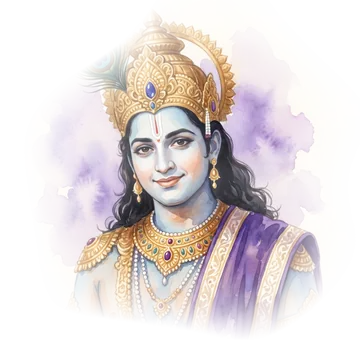
Krishna is one of the best-loved figures in Indian stories, and Hindus worship him as God, as Vishnu born on earth. He was born in Mathura and raised by the cowherd chief Nanda and his wife Yashoda among the cowherds of Gokul and Vrindavan. The tales of his childhood come from the Bhagavata Purana and the Harivamsa, the Mahabharata's own appendix, while the Mahabharata's main story meets him later, as a grown man.
- Born
- In Mathura, to Devaki and Vasudeva, on the eighth night of the waning moon. Hindus keep that night as Janmashtami, his birthday.
- Raised
- By Nanda and Yashoda among the cowherds of Gokul, and later Vrindavan, on the Yamuna river, with his elder brother Balarama.
- Childhood names
- Gopala, the cowherd boy · Govinda, the protector of the cows · Damodara, the one with a rope around his belly · Makhan Chor, the butter thief
- Where the stories come from
- The Bhagavata Purana, Book 10, and the Harivamsa, Vishnu Parva
Four stories of young Krishna
Four of the best-known stories of Krishna's childhood, retold for readers of 10 to 16 with new watercolor paintings. Each one says where it comes from and where the two old books tell it differently.
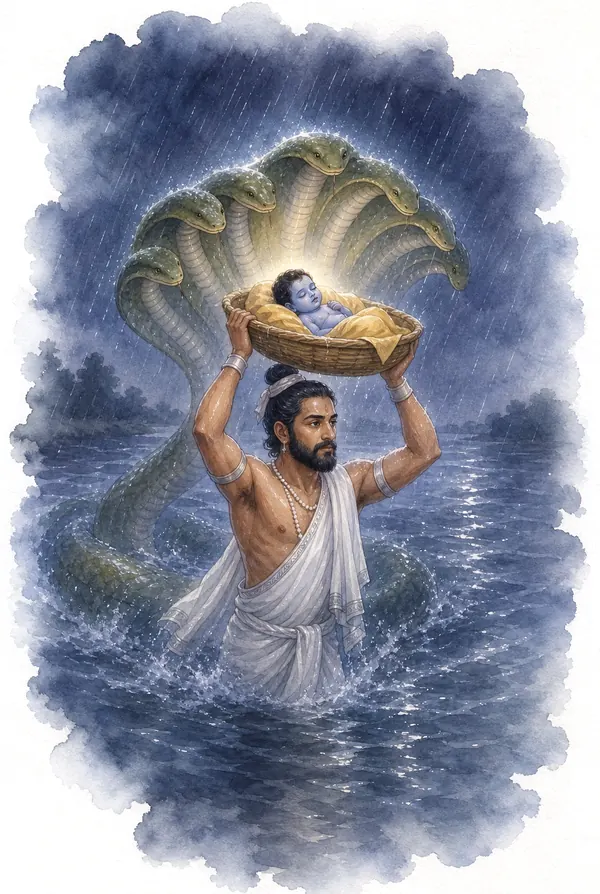
Krishna's childhood
The Night Krishna Was Born
Krishna is born at midnight in King Kamsa's prison, and his father carries him through a storm to Gokul.
Read the story
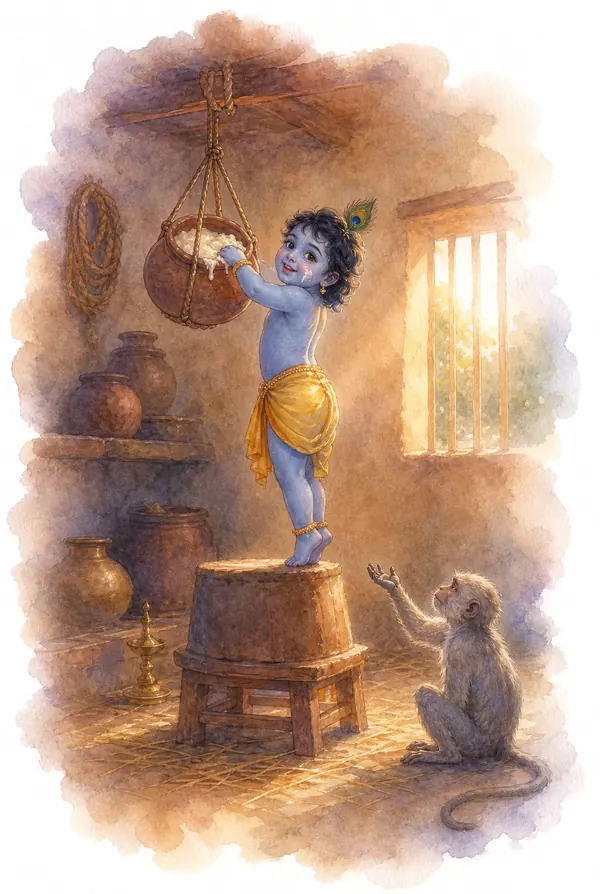
Krishna's childhood
The Butter Thief
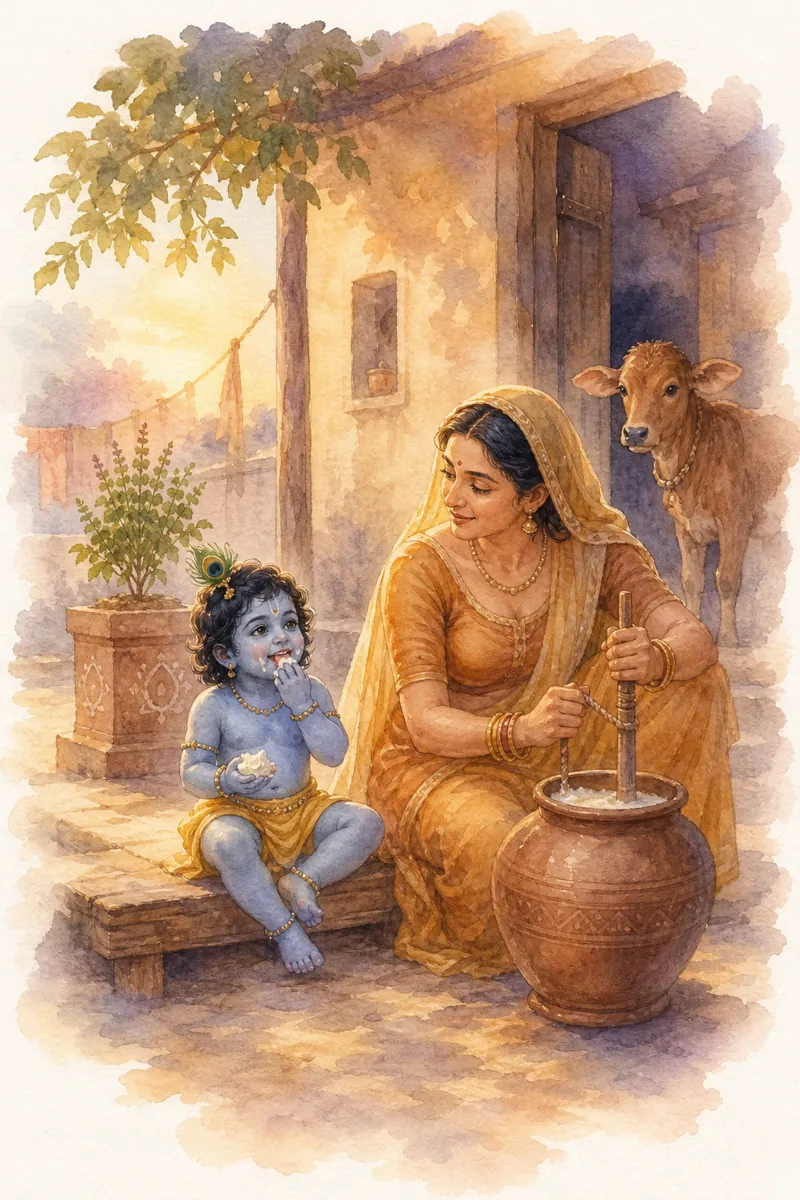
Little Krishna raids the butter pots of Gokul, and his mother's rope keeps coming up two fingers short.
Read the story
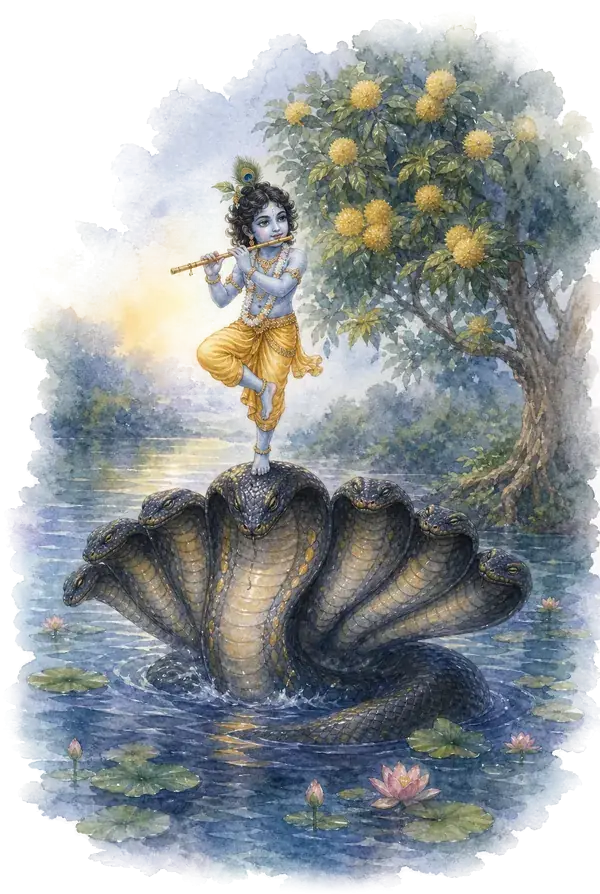
Krishna's childhood
Kaliya the Serpent
A serpent king poisons a pool in the Yamuna, and young Krishna dances on his hoods until he leaves.
Read the story
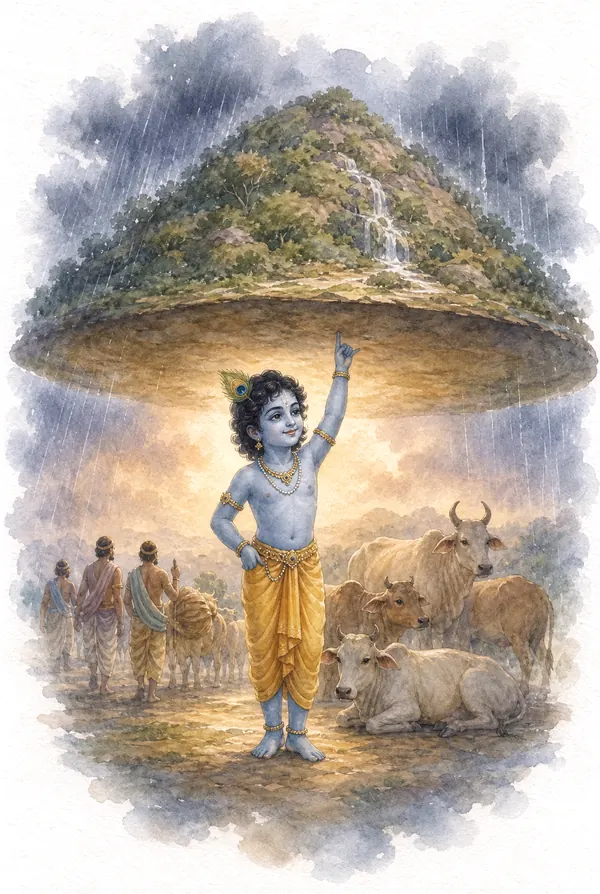
Krishna's childhood
Lifting Govardhan Hill
Indra sends a week of storms on the cowherds, and seven-year-old Krishna holds a hill over their heads.
Read the story
More stories of young Krishna
- Putana. A demoness comes to Gokul disguised as a lovely woman to harm the baby, and the baby overcomes her.
- The calf and the crane. Two demons, one disguised as a calf and one as a giant crane, slip in among the cowherd boys, and Krishna sees through them both.
- Brahma and the stolen calves. To test him, the god Brahma hides the calves and the cowherd boys for a whole year, and Krishna takes the shape of every one of them so that no family misses them.
- Dahi Handi. On Janmashtami, teams of young people climb onto one another's shoulders to break a pot of curds hung high over the street, the way little Krishna climbed to reach the butter.
- Sudama. Years later, a poor friend from Krishna's school days walks all the way to Dwaraka with a handful of flattened rice as his only gift, and Krishna welcomes him like a king.
Krishna in the Mahabharata
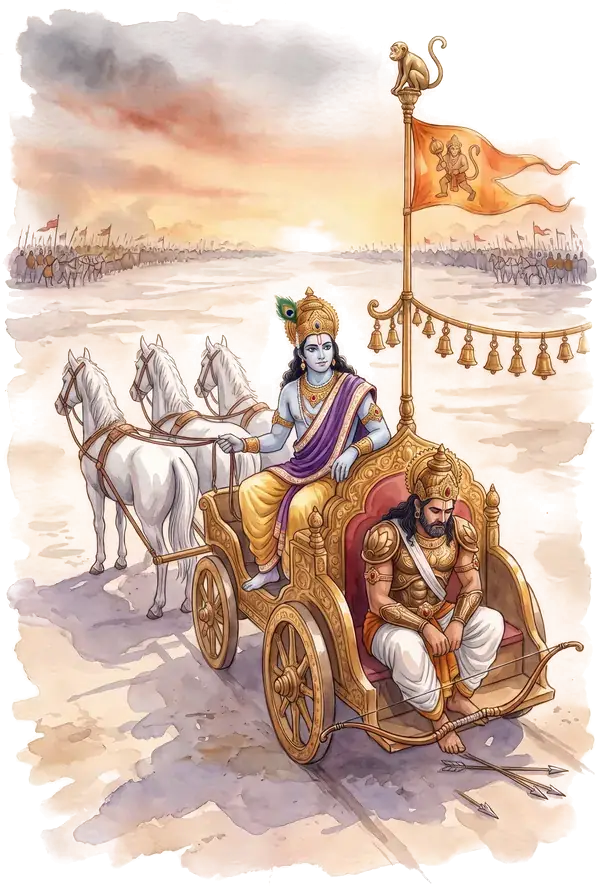
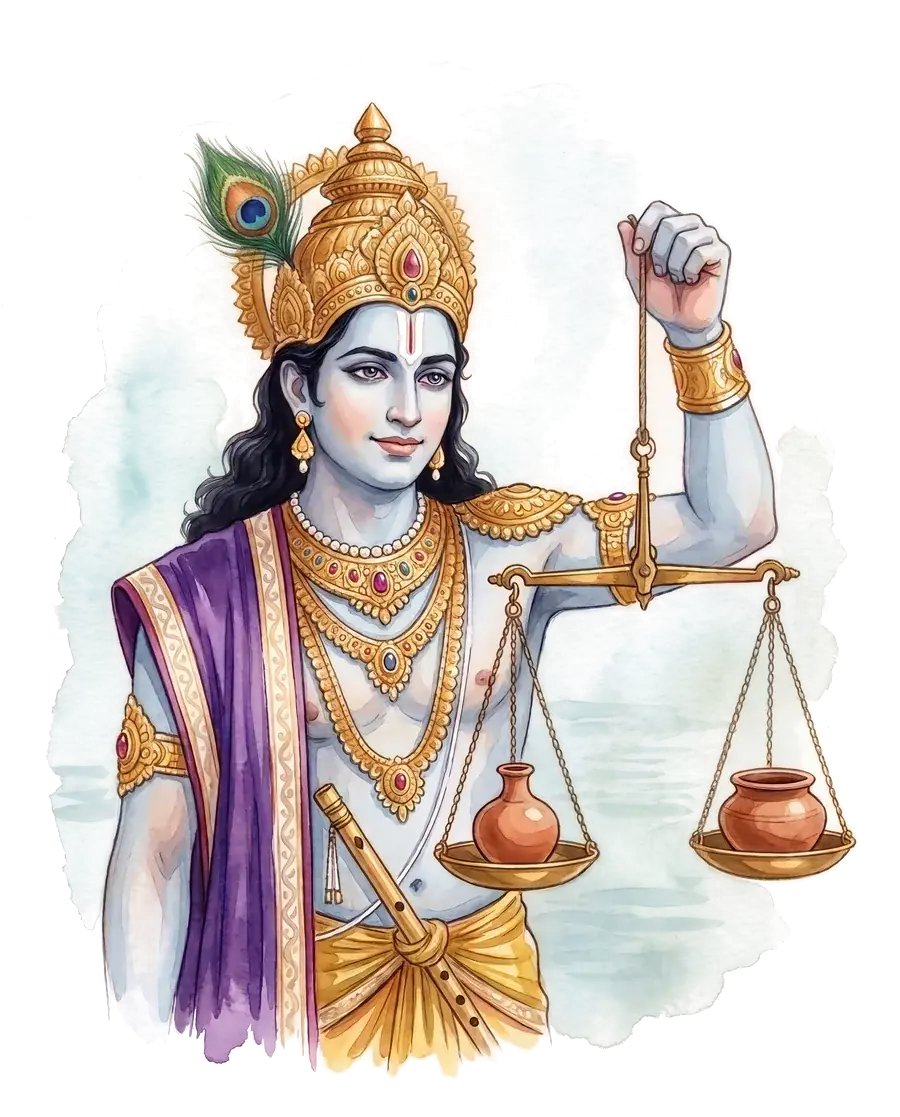
In the Mahabharata's main story, Krishna is grown up. He is a prince of the Yadavas, ruling from Dwaraka on the western sea, a cousin of the five Pandava brothers and the dearest friend of Arjuna. In the three illustrated books he first walks into the story at Draupadi's swayamvara in The Vow, and in The War he drives Arjuna's chariot and speaks the Bhagavad Gita. After key scenes in all three books he holds up a brass balance scale and asks the reader a hard question, and fifteen of those questions are collected in Krishna asks.
The grown man still remembers the cowherd boy. "When I was a boy, I could not keep my eyes shut through a single prayer," he says in The Vow. "There was always a pot of butter somewhere that needed watching." And in The Dice, thinking of Karna, he says, "I had two mothers myself, the one who bore me and the cowherd's wife who raised me." His whole part in the books is on Krishna in the Mahabharata.
Questions about Krishna's childhood
Where do the stories of baby Krishna come from?
Most come from the Bhagavata Purana, a Sanskrit book of stories about the god Vishnu, whose tenth book tells Krishna's whole life. Many are also in the Harivamsa, a long supplement that the Mahabharata carries as its own appendix. Later poets told them again in the languages people spoke every day, among them Surdas, who sang of the little butter thief in Braj Bhasha in the sixteenth century.
Is Krishna's childhood in the Mahabharata?
Not in the main story, which meets Krishna as a grown prince of Dwaraka. The Mahabharata knows the stories, though. At Yudhishthira's great sacrifice, King Shishupala sneers at them and says that holding up Govardhan hill for a week was nothing much. The childhood itself is told in the Harivamsa, the Mahabharata's appendix.
Why is Krishna blue?
In Sanskrit, Krishna means dark, and the old poems compare his skin to a dark rain cloud. Painters show that dark color as a deep or soft blue, the color of rain clouds and the night sky. Vishnu, whom Hindus see born on earth as Krishna, is painted blue too.
Why is Krishna called Makhan Chor, the butter thief?
Makhan Chor is Hindi for butter thief. As a little boy in Gokul, Krishna climbed up to the pots of butter that the cowherd women hung from their rafters and shared what he took with his friends and the monkeys. The women complained to his mother Yashoda and laughed while they did it. Another of his names, Damodara, comes from the day Yashoda tied a rope around his waist to stop him.
Who were Krishna's parents?
Krishna was born in Mathura to Devaki and Vasudeva. Devaki's brother, King Kamsa, had been told that her eighth child would kill him, so he kept them in prison. On the night Krishna was born, Vasudeva carried him across the Yamuna to Gokul, and the cowherd chief Nanda and his wife Yashoda raised him as their own son, with his elder brother Balarama.
What age are these stories for?
Children of four or five love them read aloud, and in many families they are the first Krishna stories a child hears. Fuller retellings, with the sages' curses and the gods' quarrels kept in, suit readers of about 8 to 16. Nothing in them stays frightening for long, and most end in laughter or a festival.
Where this comes from: The stories follow the Bhagavata Purana, Book 10, as rendered in English in Purnendu Narayana Sinha's A Study of the Bhagavata Purana (1901), and the Harivamsa, Vishnu Parva, in M. N. Dutt's translation (1897). Shishupala's sneer is in the Mahabharata, Sabha Parva §40 in the Ganguli translation. In the Bhagavata, Krishna's poor school friend is simply a brahmin, and the name Sudama comes from later tellings. Dahi Handi is a festival custom found in neither book. More about the sources.