A story of Krishna's childhood
The Night Krishna Was Born: The Janmashtami Story
Krishna was born at midnight in a prison in Mathura, where King Kamsa kept his parents, Devaki and Vasudeva, because a voice had warned him that Devaki's eighth child would kill him. That same night Vasudeva carried the baby across the flooded Yamuna river to Gokul, where the cowherd Nanda and his wife Yashoda raised him as their own. Hindus celebrate that night as Janmashtami.
- KrishnaKRISH-naकृष्णalso called Kanha, Kanhaiya
- DevakiDAY-va-keeदेवकी
- Vasudevava-su-DAY-vaवसुदेवalso Vasudev
- KamsaKAM-saकंसalso Kansa, Kans
- Yashodaya-SHO-daaयशोदा
- NandaNAN-daनन्दalso Nand
Kamsa was the king of Mathura. He had pushed his own father off the throne, and the Yadava people were afraid of him. But he loved his little sister Devaki, and on the day she married a Yadava prince called Vasudeva, Kamsa drove their wedding chariot himself.
Halfway through the city, a voice spoke out of the empty sky. "Fool," it said. "The eighth child of the girl you are driving will kill you."
Kamsa dropped the reins. He grabbed Devaki by the hair and drew his sword.
"Stop," said Vasudeva. "She is your own sister, and this is her wedding day. She can't hurt you. It's her children you're afraid of, so I'll bring you every one of them as soon as it's born. I give you my word."
Kamsa knew that Vasudeva never broke his word. He put away his sword.
Vasudeva kept his promise. When their first son was born, he carried the baby straight to the palace. Kamsa only laughed. "Take him home," he said. "It's the eighth one I'm afraid of."
But Kamsa's fear grew. He locked Devaki and Vasudeva in a prison and put chains on their ankles, and after that he took each baby as soon as it was born. Six sons were born in that prison, and not one of them came back.
The seventh child never reached Kamsa at all. Vishnu sent his goddess of sleep and wonder, Yogamaya, and she gently moved the unborn child from Devaki to Rohini, Vasudeva's other wife, who was hiding among the cowherds of Gokul. That child grew up to be Balarama. In the prison, everyone thought Devaki had lost her baby.
Then Devaki was expecting her eighth child, and she began to glow. A soft light filled the dark prison room. Kamsa came to look at her and went cold. "This is the one," he said. After that he couldn't eat or sleep, and wherever he looked he seemed to see Vishnu.
The eighth child was born at midnight, on a black night of heavy rain. He wasn't like other babies. He had four arms, and in his hands he held a conch, a discus, a mace and a lotus. A jeweled crown shone on his head. Devaki and Vasudeva knew him at once, and they folded their hands.
"Please," whispered Devaki, "hide that form. If my brother sees it, he will know you."
So the shining figure became an ordinary newborn boy, crying like any other. And he told his father what to do.
Vasudeva stood up. The chains fell from his ankles. The great prison gates swung open by themselves, and the guards slumped against the walls, fast asleep. Vasudeva wrapped his son up warm, laid him in a basket and walked out into the storm.
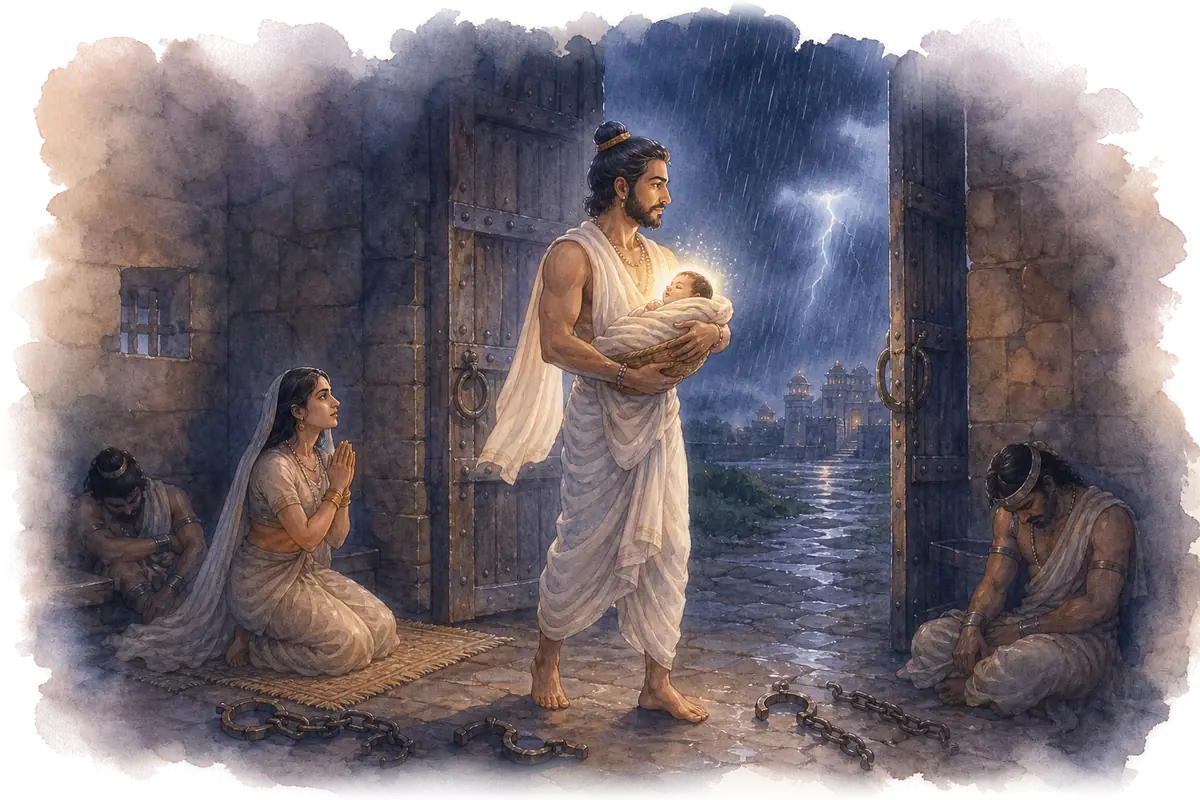
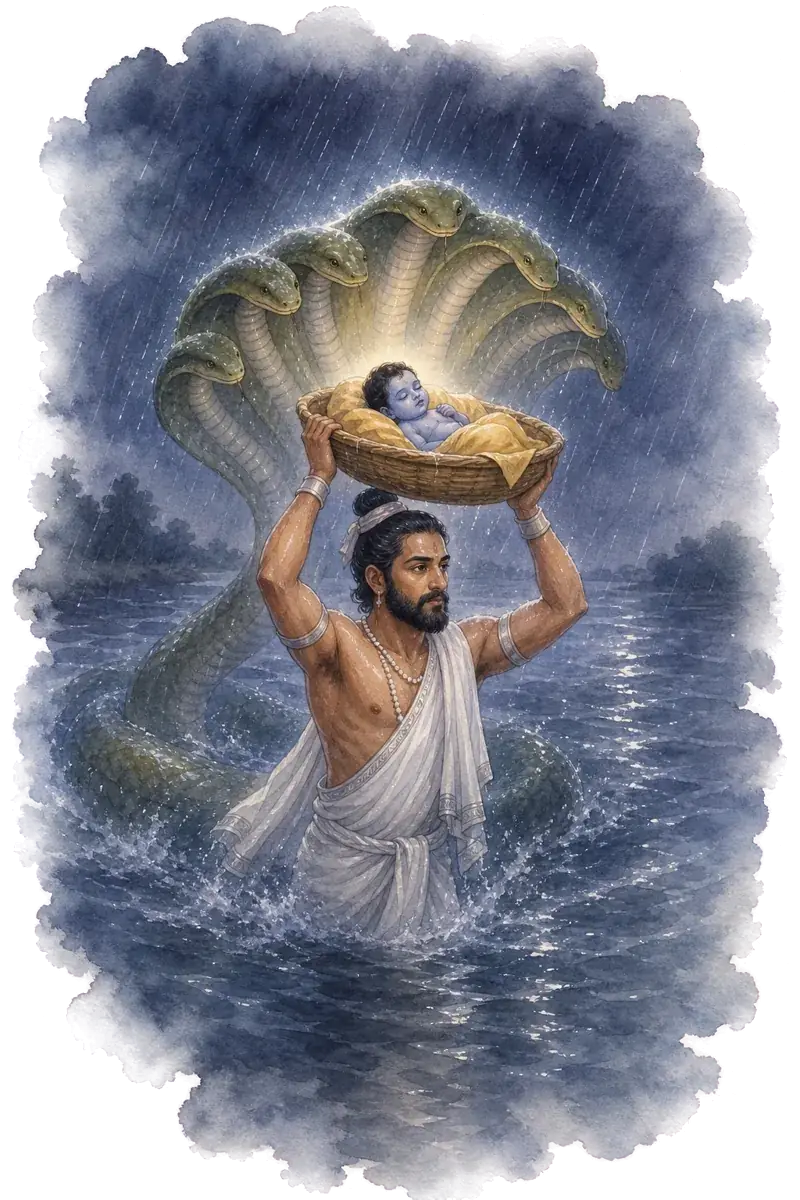
The rain lashed down. Behind him came the great serpent Shesha, on whom Vishnu rests, and he spread his thousand hoods over the baby to keep him dry. At the edge of the city the Yamuna river was in flood, wide and roaring. Vasudeva stepped in anyway, and the river made way for him. People say the water rose until it touched the baby's foot, and then it sank back down.
On the far bank was Gokul, where the cowherds lived, and everyone there was asleep. In the house of Nanda, the cowherd chief, his wife Yashoda lay asleep with a baby girl born that same night. Vasudeva laid his son beside her and picked up the little girl. He carried her back across the river and through the open gates, and he put her in Devaki's arms. Then he sat down, and the chains closed on his ankles again.
The gates swung shut. The guards woke up, heard a baby crying and ran for the king.
Kamsa came in the dark with his hair wild. He snatched the baby from Devaki.
"She's a girl," Devaki begged. "Let me keep just this one."
Kamsa didn't listen. He swung the baby up high to dash her against the stone floor. She slipped out of his hands and rose into the air, and above him she became a goddess with eight arms, a weapon in every hand, shining with jewels and garlands.
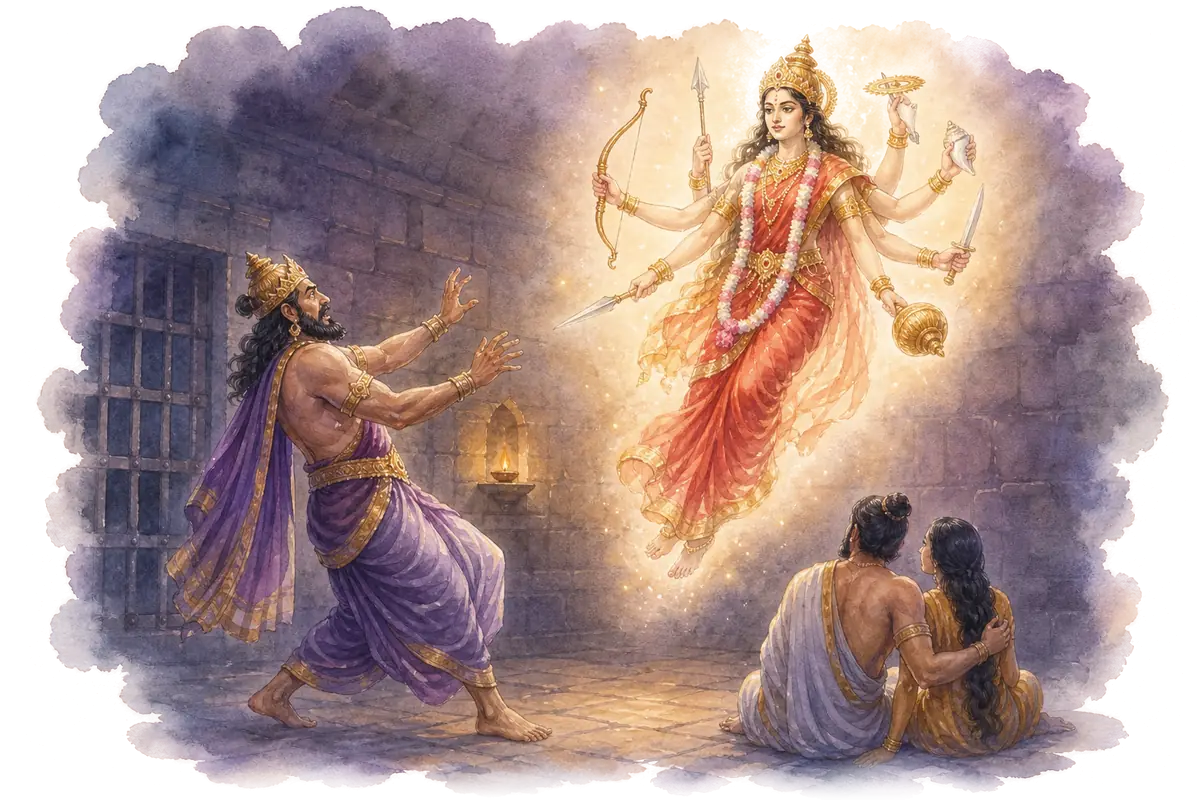
"Fool," she said. "Killing me won't save you. The one who will kill you has already been born somewhere else."
Then she was gone. Kamsa stood there shaking. For once he was sorry. He took the chains off Devaki and Vasudeva and begged them to forgive him. But by the next morning his demon advisers had talked him round, and he sent them out to hunt for the child.
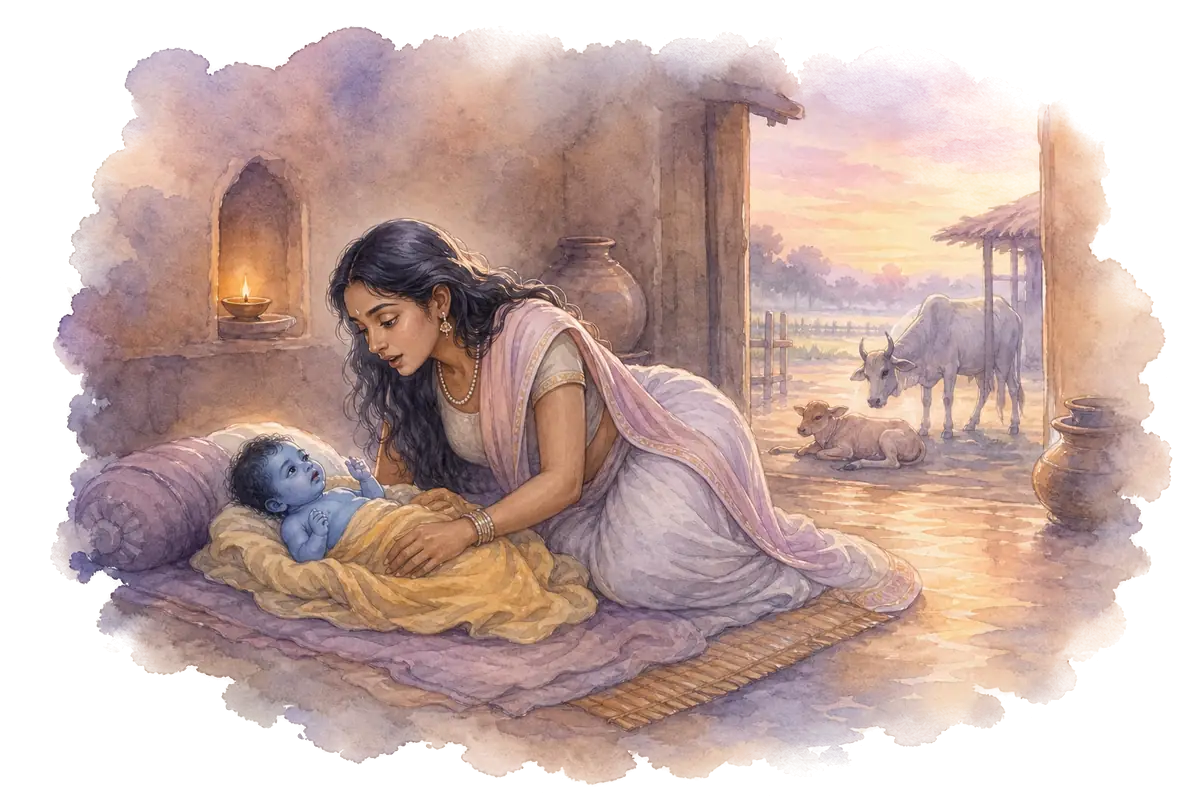
In Gokul, Yashoda woke and found a baby boy beside her, dark as a rain cloud. Nanda gave away cows and gold to everyone who came, and the whole village sang and danced and splashed one another with milk and curds and butter for joy. Nobody in Gokul knew where the baby had really come from, and Yashoda loved him as her own.
Why it matters
Hindus keep the night of Krishna's birth as Janmashtami, in August or September. Many families fast all day and stay awake until midnight, when temples ring their bells and rock a little cradle with a baby Krishna in it. Some celebrate Nanda's festival the next morning, the way Gokul did, and Krishna's birthplace in Mathura is still a place of pilgrimage.
Where this comes from: The Bhagavata Purana, Book 10, chapters 1 to 5 (the wedding chariot and the voice in chapter 1, Balarama moved to Rohini and Devaki's glow in chapter 2, the birth and the crossing in chapter 3, the goddess in chapter 4, Nanda's festival in chapter 5), as rendered in English in Purnendu Narayana Sinha's A Study of the Bhagavata Purana (1901). The Harivamsa tells the story too, in the opening chapters of the Vishnu Parva (M. N. Dutt's translation, 1897). The basket and the river rising to touch the baby's foot come from the popular telling. The Bhagavata says only that Vasudeva took the child and that the flooded river made way for him. More about the sources.
Keep reading
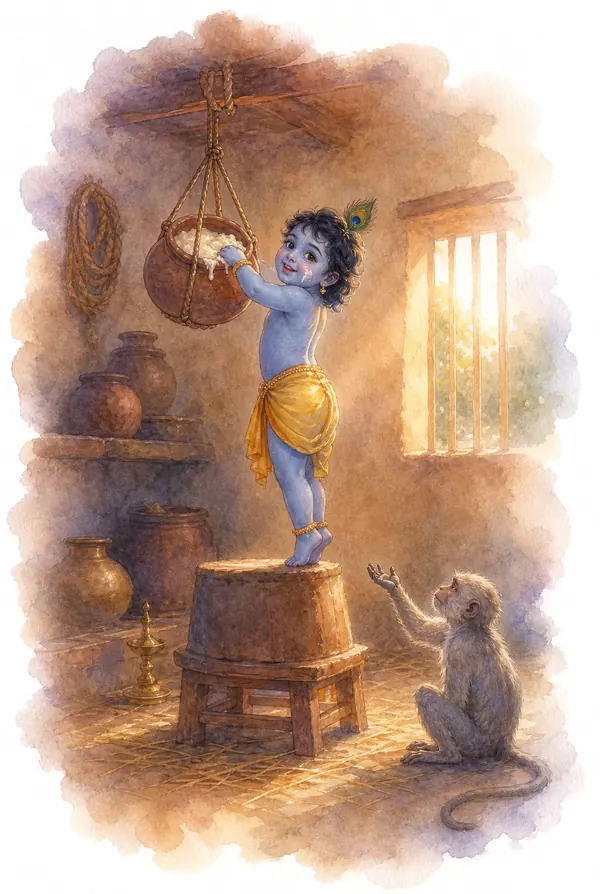 The Butter ThiefLittle Krishna raids the butter pots of Gokul, and his mother's rope keeps coming up two fingers short.
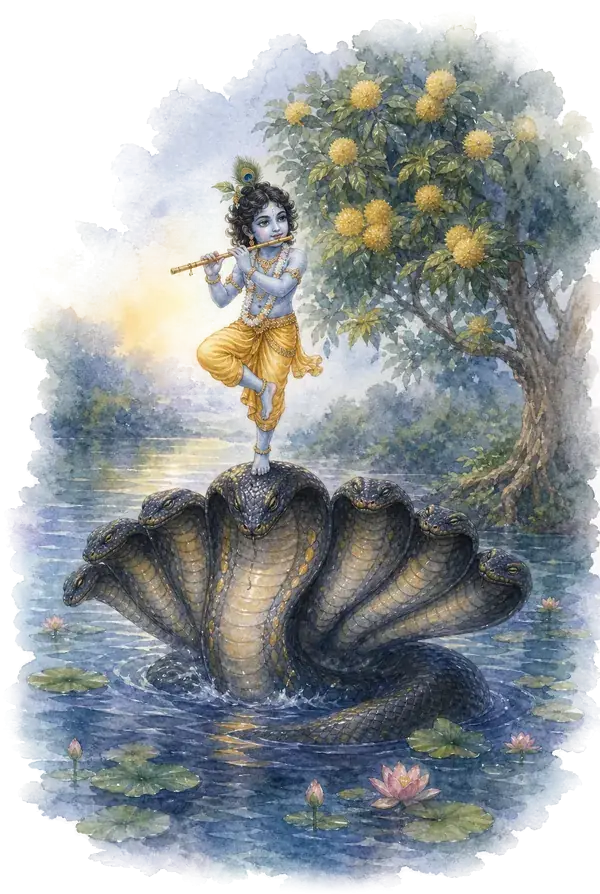 Kaliya the SerpentA serpent king poisons a pool in the Yamuna, and young Krishna dances on his hoods until he leaves.
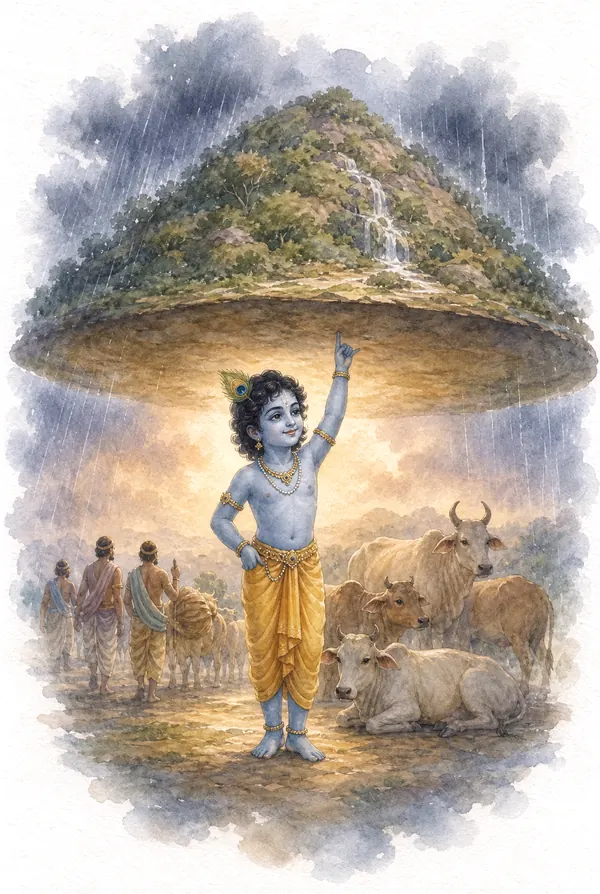 Lifting Govardhan HillIndra sends a week of storms on the cowherds, and seven-year-old Krishna holds a hill over their heads.
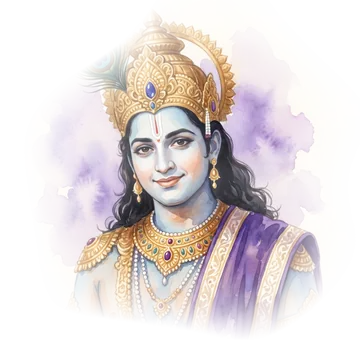 Krishna in the MahabharataThe grown-up Krishna, Arjuna's friend and charioteer, in all three books.