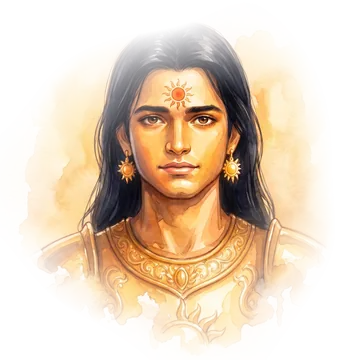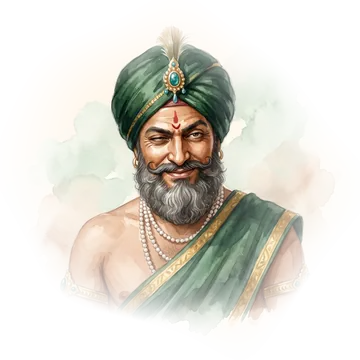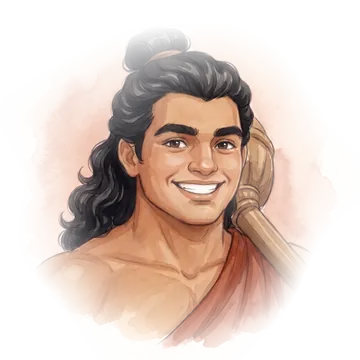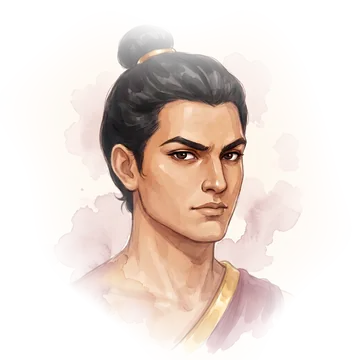
Duryodhana is the eldest of the hundred Kaurava princes in the Mahabharata, the son of blind King Dhritarashtra and Queen Gandhari. In Book One his jealousy of his cousins, the five Pandavas, drives him to poison Bhima as a boy, and after they laugh at him in the Palace of Illusions, he lets his uncle Shakuni plan a game of dice to win everything they own. In Book Two he wins that game and will not give the Pandavas even five villages, and in Book Three he goes to war and loses his last fight, with Bhima at the lake.
- Family
- Son of Dhritarashtra and Gandhari · eldest of a hundred brothers, with Duhshasana next, and one sister, Duhshala · nephew of Shakuni · cousin of the five Pandavas
- Known for
- Poisoning Bhima · making Karna king of Anga · falling into the pool in the Palace of Illusions · refusing the Pandavas even five villages · his last fight with Bhima
- First appears
- Book One, chapter 6, The Hunter's Curse
Duryodhana's story in Book One
Born after his cousin
Duryodhana's mother, Queen Gandhari, carried her child for two whole years. Before he came, news arrived from the mountains that Kunti, the wife of Dhritarashtra's brother Pandu, had a son. Gandhari wept. Kunti's boy, Yudhishthira, was now the eldest of the family's sons, and the throne would go to him.
What Gandhari bore at last was a hard, cold lump. The sage Vyasa divided it and sealed the pieces in jars of ghee, and two years later the jars gave her a hundred sons and a daughter. The eldest son was Duryodhana. Far away on the mountain, on that very day, Kunti had her second son, Bhima.
When the baby first cried, it sounded like a donkey braying, and jackals howled all around the city. His uncle Vidura looked down at the small face and told the king to give the child up to save the family. Dhritarashtra had already been passed over for the throne because he was blind. He held his son tighter and could not do it. In the book, Krishna takes the baby's side: "a newborn has done nothing wrong, whatever the jackals say."
Years later Kunti brought her five sons home to Hastinapura. Duryodhana stood at the front of his brothers at the city gate and looked hard at Bhima, the boy born on his own birthday. Bhima grinned at him. Duryodhana did not grin back.
The cousin who always won
Bhima beat the Kaurava boys at everything. He ran faster and threw farther, and in the river he held ten cousins under the water at once while he counted. To Bhima it was a game. Duryodhana's brothers went home with cut heads and sore knees. One afternoon Duhshasana crawled out of the river shaking and crying, and Duryodhana came down the steps and led his brother away without a word.
Weeks later Duryodhana invited the Pandavas to a new water house on the Ganga. He sat down beside Bhima and fed him sweets with his own hands. The sweets were poisoned. While Bhima slept, Duryodhana tied him with creepers and pushed him into the river. Bhima sank to the kingdom of the Nagas, the serpent people, and came home eight days later stronger than ever.
Krishna is fair to both boys. Bhima's cousins had real bruises, he says, and Duryodhana had a real reason to be angry. "He could have gone to the elders. He could have trained until he beat Bhima fairly. Instead he smiled, and fed his cousin poison with his own hands."
Drona's school
Duryodhana learned to fight beside his cousins under the teacher Drona, and his weapon was the mace, a heavy club with a metal head. At Drona's test with the wooden bird, he saw the tree and the teacher and his cousins and the bird, so Drona sent him to stand aside with everyone except Arjuna. When Drona asked his pupils to capture King Drupada as his fee, Duryodhana rode out in front with his brother Duhshasana, and Drupada's arrows found him. Arjuna was the one who brought Drupada back.
A friend for Karna
At the tournament where the princes showed what they had learned, Duryodhana and Bhima came out with their maces, and the crowd roared for one or the other until Drona's son pulled them apart. Then a young man in golden armor walked in and matched Arjuna feat for feat. When he challenged Arjuna to a duel, the teacher Kripa asked him to name his father and mother first, since princes fought only princes. The young man, Karna, went pale.
Duryodhana answered for him. "If Arjuna will only fight a king," he said, "then I will make Karna a king. Now. King of Anga." Karna was crowned on the spot. When Bhima mocked him as a charioteer's son, Duryodhana stood up for him in front of everyone. "Nobody knows where a great warrior comes from," he said, "any more than they know where a great river begins." Karna asked what he could give in return for a kingdom, and Duryodhana asked only for his friendship.
Krishna calls it a big-hearted thing to do, and a clever one, because Duryodhana had found the one warrior who might match Arjuna.
The house of lac
A year later Dhritarashtra named Yudhishthira his heir, and people in the market squares began to say that Pandu's son should be king now. Duryodhana and his brothers had lately been handing out silver in those same squares, and Duryodhana went to see his father alone. Soon the king sent the Pandavas and their mother to a festival in the town of Varanavata.
There Duryodhana's man Purochana had built them a new house of hemp and bamboo soaked in ghee, its walls plastered with lac, the sticky resin that lacquer is made from. One spark would set it alight. Warned in secret by their uncle Vidura, the Pandavas had a tunnel dug under the floor, set the house on fire themselves with Purochana inside, and escaped. In Hastinapura everyone believed they were dead.
The bow at the swayamvara
Duryodhana went with a crowd of his brothers to the swayamvara of Princess Draupadi, where the man who could string a huge bow and hit a target high in the air would win her hand. He heaved at the bow until the veins stood out on his neck, and it tossed him flat on his back. A young brahmin won her, and the news soon spread that the brahmin was Arjuna and that the sons of Pandu were alive. Dhritarashtra called them home and gave them half the kingdom, a wilderness at the edge of the Khandava forest, where they built their own city of Indraprastha.
The Palace of Illusions
At Indraprastha the builder Maya made the Pandavas a hall that no builder on earth could copy, and Yudhishthira held a great ceremony, the Rajasuya, to be hailed as emperor. He honored his cousin with the task of receiving the gifts. For days the kings of the earth put their treasures into Duryodhana's hands, gold in tall jars and heaps of pearls and elephants in golden girdles, and all of it went into Yudhishthira's treasury. Every night Duryodhana took off his own rings and looked at them. They seemed smaller each time.
After the other guests went home, he stayed on to walk through the hall. He lifted his robe to cross a floor that shone like water, and it was dry crystal. Farther on he stepped onto what looked like crystal, and it was water. He went under, robe and rings and all. Bhima laughed, and so did the servants. While he changed into the dry clothes Yudhishthira sent him, Bhima and Arjuna and the twins stood together and laughed out loud. On his way out he walked into a crystal door he took for an open doorway.
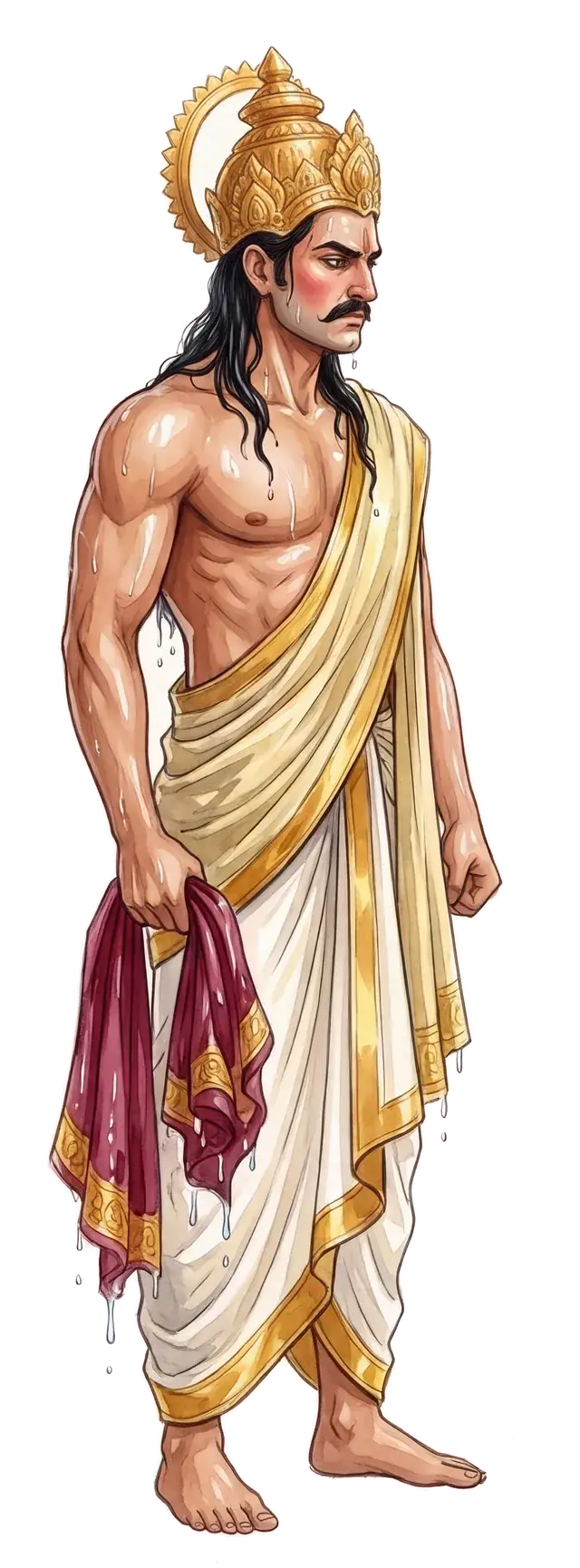
On the ride home he said nothing until his uncle Shakuni asked why. Then it all came out. "I know I shouldn't be jealous. I am anyway." Shakuni had an answer ready. Yudhishthira loved dice and played badly, and nobody in the three worlds played the way Shakuni did. Duryodhana could not bring himself to ask his father, so Shakuni asked for him, and the blind king, who could rarely say no to his son, gave in. Vidura was sent to invite the Pandavas to a friendly game, and Book One ends as Yudhishthira agrees to come.
Is Duryodhana the villain?
He does terrible things in Book One. He poisons a cousin, and the house his man builds at Varanavata is meant to burn with five boys and their mother inside. The book never pretends otherwise.
It also shows where his anger comes from. He was born after his cousin, so the throne was never going to be his by birth, and on his first day the elders talked of giving him up. He grew up beside a cousin who beat him at everything and laughed while he did it. His father gave him whatever he asked for, and almost nobody told him no. And when the whole arena turned on Karna, Duryodhana was the one who stood up. Many readers end up understanding him and still disagreeing with what he chooses.
In Book Two: The Dice
With his uncle Shakuni throwing the dice for him, Duryodhana wins everything Yudhishthira owns, down to his brothers and Draupadi (chapter 1). He sends for Draupadi to sweep his floors, and when she asks the hall whether she is a slave, he bares his thigh at her. That is the thigh Bhima swears to break (chapter 2). When his father gives the Pandavas everything back, Duryodhana talks him into one more game, and the Pandavas lose thirteen years (chapter 3).
When the thirteen years are over, he will not give back the kingdom. He rides to Dwaraka and takes the seat at the head of Krishna's bed, and when Krishna offers his army or himself unarmed, Duryodhana is delighted to get the army (chapter 12). He wins King Shalya with a road of rich pavilions. At the peace mission he plans to take Krishna prisoner and refuses even five villages. "As long as I live, they won't get as much land as the point of a needle would cover." He turns his back on his own mother and walks out of the hall (chapter 13, The Peace Mission).
In Book Three: The War
His son Lakshmana is killed by Abhimanyu in Drona's wheel (chapter 3). His army passes from Bhishma to Drona to Karna, and he tells Karna that the Grandsire spared the Pandavas for ten days and Drona spared his pupils (chapter 8). When Karna is dead, old Kripa begs him to make peace. "My friends died for me. Karna died for me. I owe them" (chapter 9).
On the last day his army is gone. He hides at the bottom of a lake, then comes up to fight any one of the Pandavas with the mace, and Bhima steps forward. For a while Duryodhana has the better of it, until Arjuna makes a sign and Bhima strikes him across the thighs, below the navel, against the rules of the mace. Lying on the ground, Duryodhana names every trick that brought down Bhishma, Drona and Karna, and asks who has been as lucky as he is (chapter 9, The Lake and the Mace).
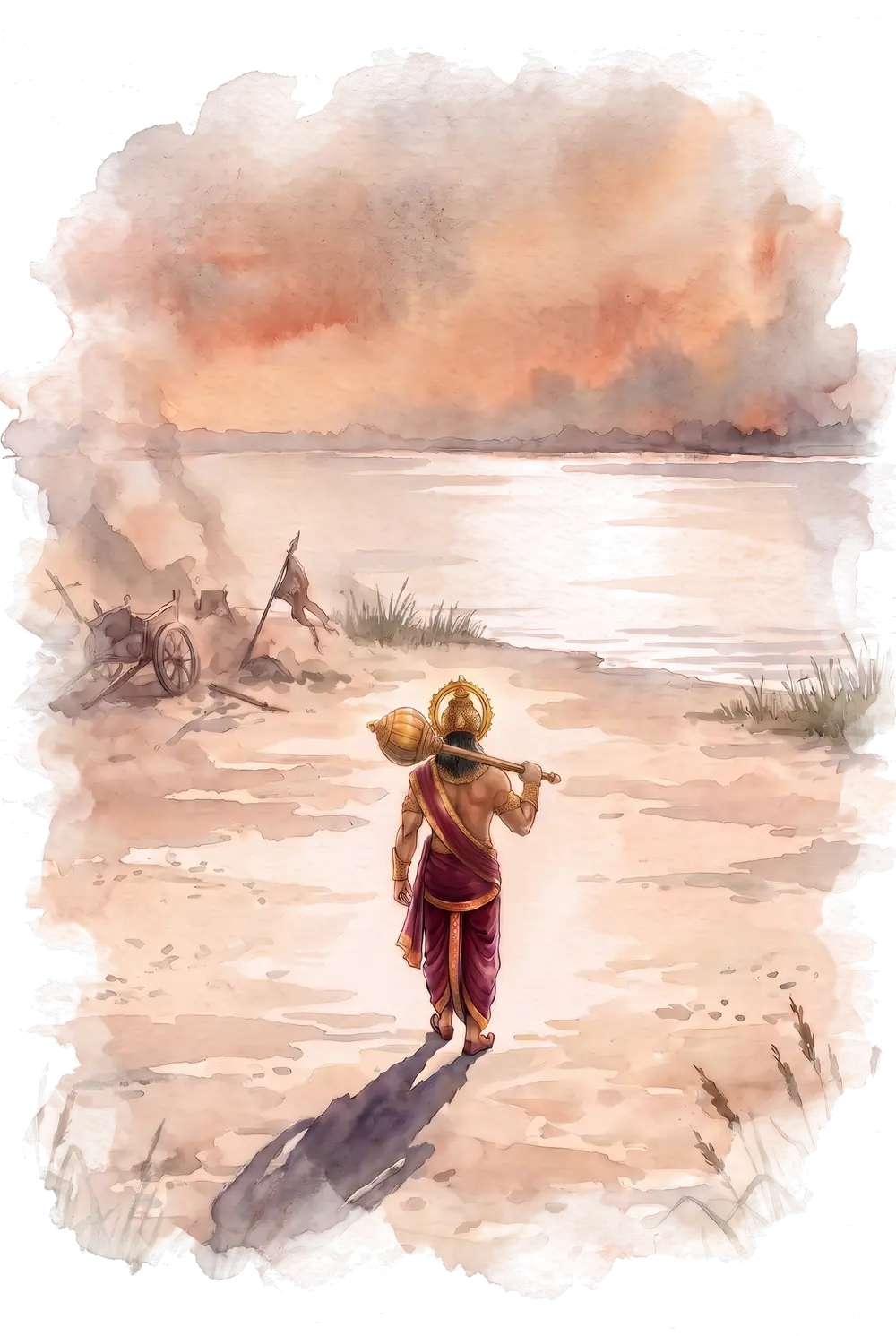
He lives through that night, long enough to hear from Ashwatthama about the raid on the sleeping Pandava camp, and then he dies (chapter 10). On the battlefield Gandhari sees her son's face for the first time (chapter 11). In heaven Yudhishthira finds Duryodhana on a high seat among the gods, because at the end, with everything to fear, he was not afraid (chapter 15).
Questions about Duryodhana
Is Duryodhana evil?
Duryodhana does cruel things. In Book One he poisons his cousin Bhima, and his man builds a house at Varanavata meant to burn with the Pandavas inside. In Book Two he wins everything the Pandavas own with his uncle's dice and sends for Draupadi to sweep his floors. When the thirteen years are over, he will not give them even five villages, and the war comes. He is also a loyal friend to Karna when nobody else will stand up for him. When Kripa begs him to make peace in Book Three, he says, "My friends died for me. Karna died for me. I owe them." Bhima wins their last fight only by breaking the rules of the mace, and in heaven Yudhishthira finds Duryodhana on a high seat among the gods, because at the end, with everything to fear, he was not afraid. The books show why he feels what he feels, and leave readers to judge his choices for themselves.
Why did Duryodhana hate the Pandavas?
He was the eldest son of the king, yet his cousin Yudhishthira was born first, so the throne was meant to go to Pandu's sons. Bhima, born on the same day as Duryodhana, beat him and his brothers at everything and hurt them in rough games. Later the Pandavas grew rich and famous at Indraprastha, and they laughed when he fell into a pool.
Who laughed at Duryodhana in the Palace of Illusions?
In the Ganguli translation, Bhima laughs first, with the palace servants, and Arjuna and the twins join in while Duryodhana changes into dry clothes. Many retellings have Draupadi laugh and call him a blind man's son. In Ganguli she is not in the scene at all, and she laughs only in Duryodhana's own telling of it later. The Vow follows Ganguli.
Why was Duryodhana Karna's friend?
At the tournament in Hastinapura, Karna matched Arjuna feat for feat, and then Kripa asked him to name his parents, since princes fought only princes. Duryodhana made Karna king of Anga on the spot and defended him when Bhima mocked his birth. The two promised each other their friendship. Duryodhana also knew he had found a warrior who might match Arjuna.
Where this comes from: the Ganguli translation of the Mahabharata, Adi Parva §115 and §123 (the births), §128–129 (the poisoning), §134 and §136–140 (Drona's school, the tournament and the fee), §141–152 (the house of lac) and §187–190 (the swayamvara), and Sabha Parva §34 and §45–58 (the gifts, the pool and the dice plan). Ganguli says Duryodhana poisoned Bhima's food, and this retelling makes it sweets. Who laughs at the pool follows Ganguli's own telling. Book Two follows Sabha Parva §57–79 for the dice and Udyoga Parva §1–8 and §124–137 for Krishna's bedside and the peace mission. Book Three follows Shalya Parva §4–65 for the lake and the mace, and Svargarohana Parva §1–4 for heaven. More about the sources.