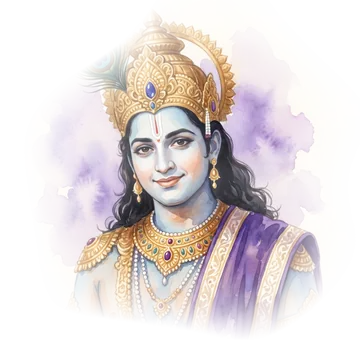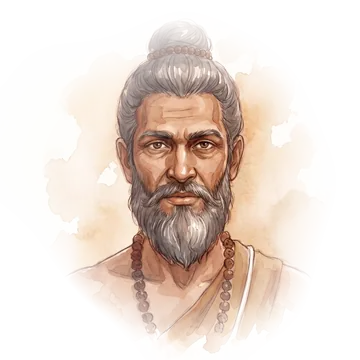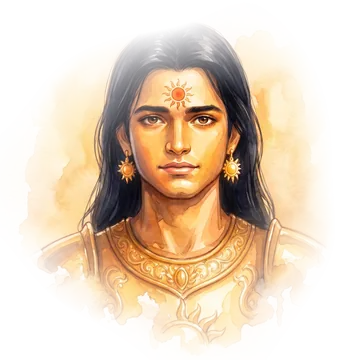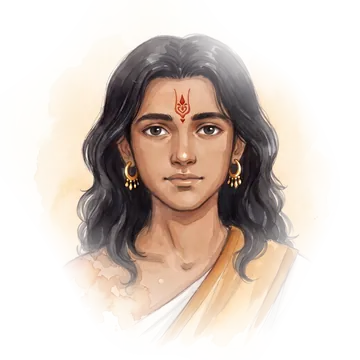
Arjuna is the third of the five Pandava brothers in the Mahabharata, a son of Queen Kunti born by the blessing of Indra, king of the gods. He grows up to be his teacher Drona's finest archer, the boy who sees only the bird's eye and the young man who wins Princess Draupadi with five arrows. In Book Two he wins the god Shiva's own weapon, and in Book Three Krishna drives his chariot and speaks the Bhagavad Gita to him before the war.
- Family
- Son of Kunti and King Pandu. Brother of Yudhishthira and Bhima, and half-brother of the twins Nakula and Sahadeva. Cousin of the hundred Kaurava princes, and of Krishna. Married Draupadi with his four brothers, and on his travels married Ulupi and Chitrangada, then Krishna's sister Subhadra. Father of Abhimanyu.
- Teacher
- Drona
- Known for
- His bow. Drona promised to make him an archer with no equal in all the world, and the god Varuna gave him the great bow Gandiva. His friendship with Krishna, who drives his chariot in the war and speaks the Bhagavad Gita to him.
- First appears
- Book One, chapter 6, The Hunter's Curse
Arjuna's story in Book One
A son of Indra
King Pandu was under a curse and could have no children of his own. His wife Kunti knew sacred words that could call a god to give her a son. For a whole year Pandu stood on one leg from morning to evening, praying to Indra, and Indra promised him a son whom all three worlds would honor. When Arjuna was born on the mountain of Shatashringa, a voice like thunder filled the sky and flowers fell out of the empty air.
Arjuna was seven when his father died. The sages of the mountain walked Kunti and her five boys home to Hastinapura, where their cousins, the Kauravas, were growing up.
The lamp and the bird's eye
In Hastinapura the princes went to school with the teacher Drona. On the first day Drona asked them to promise to do something for him once they could fight, and he would not say what it was. Nobody answered except Arjuna. "I will," he said. "Whatever it is."
One windy night the lamp blew out while Arjuna was eating his supper, and his hand still found his mouth in the dark. If it could do that, he thought, it could find a target. He went out and practiced with his bow until the moon went down. Drona found him there and promised to make him an archer with no equal in all the world.
When the lessons were finished, Drona fixed a wooden vulture high in a tree and asked each pupil what he could see. The others saw the whole tree and everyone under it. Arjuna saw only the bird's eye, and his arrow went straight through it. Later, when a crocodile seized Drona in the Ganga, Arjuna's five arrows set him free, and Drona gave him a secret weapon called the Brahmashira. Ashwatthama, Drona's own son, heard every word.
The archer in the forest
One day the princes came home talking about a boy in the forest who could shoot better than any of them. He was Ekalavya, son of the Nishada king. Drona had turned him away, so he had taught himself in front of a clay statue of Drona. Arjuna hardly said a word in front of the others. He waited until he could find his teacher alone, and asked why another pupil of his was better than him.
Drona went into the forest and asked Ekalavya for a teacher's fee, the thumb of his right hand. Ekalavya gave it, and Arjuna had his place back.
The uninvited champion
At the princes' tournament, Drona called out to the whole city, "Now see Arjuna, who is dearer to me than my own son." Arjuna made fire and water with his arrows, and sent five shafts at once into the mouth of a moving iron boar. Then a young man in golden armor walked in through the gate and matched him feat for feat. His name was Karna.
Karna asked for a duel. Arjuna had been there years before, when Drona sent Karna away as a charioteer's son, and his face went dark. Kripa told Karna to name his father and mother before he could fight a prince, and Duryodhana made Karna king of Anga on the spot. The sun went down before the two of them could fight. More about that day at the tournament.
The teacher's fee
At last Arjuna found out what he had promised on his first day. Drona wanted King Drupada of Panchala, who had once laughed at him, brought to him alive. The Kaurava princes rode in first and were driven back. Then Bhima charged with his mace, and Arjuna came behind him, shooting so fast that no one could see a gap between his arrows. He cut Drupada's bow apart, leaped from his own chariot into the king's and took him prisoner.
When Bhima went on smashing his way toward the palace, Arjuna stopped him. "We only came to pay our teacher," he said. Drupada lost half his kingdom that day, and he never forgot the young archer who had leaped into his chariot.
The house that burned
Duryodhana's man built the five brothers and their mother a house of lac, made to burn. A miner sent by their uncle Vidura dug them a tunnel, and on the night the house burned Bhima carried the whole family into the forest. For a long time afterward they lived as poor brahmins, with no name they dared to use. How they got out of the house of lac.
The fish in the sky
King Drupada held a swayamvara for his daughter Draupadi. A huge bow lay on the floor, and high above it a golden fish hung over a turning wheel. Whoever could string the bow and send five arrows through the opening in the wheel would win her. King after king failed. Karna strung the bow, but Draupadi would not choose a charioteer's son.
Then a young brahmin in a deerskin stood up at the back of the hall. It was Arjuna in disguise. He strung the bow in the blink of an eye, five arrows hissed, and the golden fish fell. Draupadi walked the length of the hall and hung her garland around his neck. When the angry kings attacked, Arjuna held them off with his bow while Bhima swung a tree.
"Share it equally"
When the brothers brought Draupadi home, Kunti was at the hearth with her back to the door. Thinking they had brought alms, she called out, "Share it equally, all of you." Yudhishthira told Arjuna to marry the princess, since he had won her. Arjuna would not marry before his elder brothers. In the end Draupadi married all five, as the sage Vyasa said she was meant to.
The family came home to half a kingdom, a wilderness at the edge of the Khandava forest, and built the city of Indraprastha there. The brothers swore a rule. When one of them was alone with Draupadi, no other brother would come in, and whoever broke the rule would live in the forest for twelve years. More on Kunti's words and the wedding.
Twelve years away
One day thieves stole a brahmin's cows, and Arjuna's bow was in the room where Yudhishthira sat with Draupadi. Arjuna went in, took the bow and brought the cows home by evening. Yudhishthira forgave him at once. Arjuna went anyway, because he did not believe duty should have clever excuses.
On his travels he married Ulupi, a Naga princess who pulled him down to her palace under the river, and Chitrangada, the princess of Manipur. In Dwaraka his friend Krishna told him to carry off Subhadra, Krishna's own sister. She took the reins of the chariot herself. Their son was Abhimanyu, a fierce, fearless baby.
The Gandiva and the burning forest
Arjuna and Krishna were resting by the Yamuna one summer when a huge brahmin with skin like melted gold asked them for food. It was Agni, the fire. Twelve years of offerings had made him sick, and the only cure was to eat the Khandava forest, which Indra guarded with rain. Arjuna had no bow strong enough for his arms, so Varuna, lord of the waters, rose from the river and gave him one.
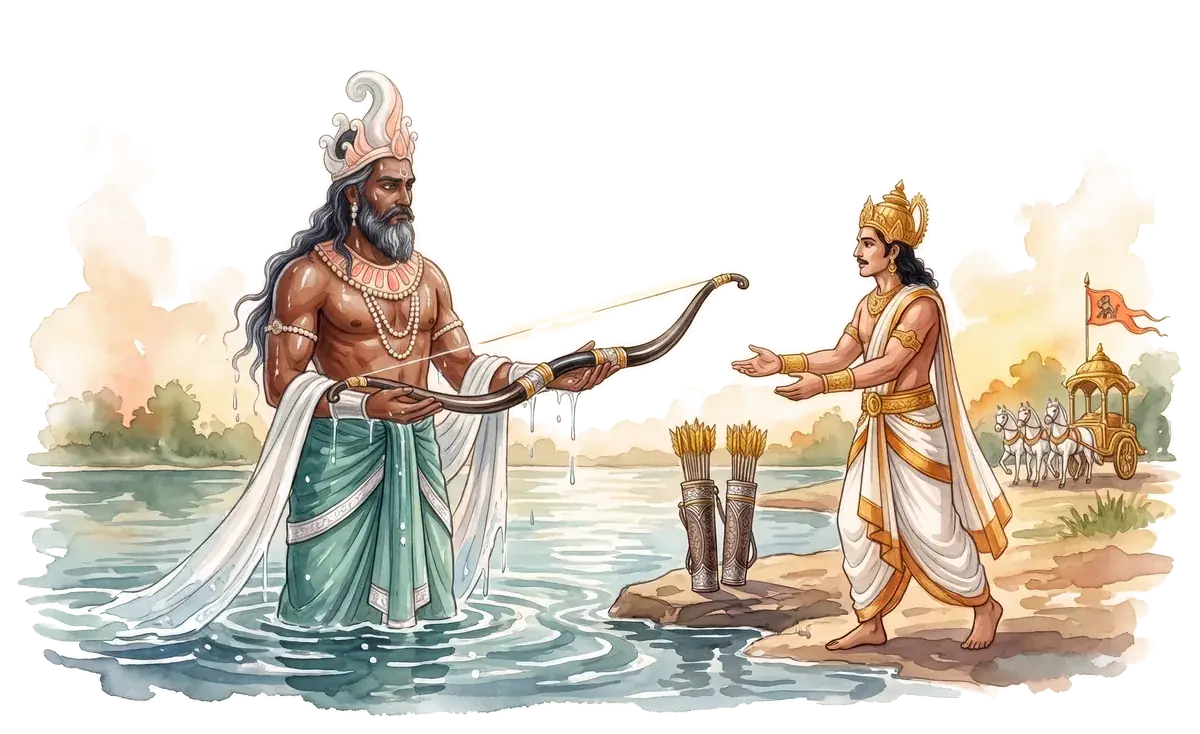
That bow was the Gandiva. Varuna gave him a chariot with a monkey on its banner as well. For fifteen days the forest burned. Arjuna spread a roof of arrows over it to keep Indra's rain away, and almost nothing got out alive. One who did was Maya, the master builder of the asuras. He ran to Arjuna and begged for his life. "Don't be afraid," Arjuna told him.
A voice from the sky told Indra that he could not beat these two, because they were Nara and Narayana, two ancient sages born again. When it was over, Indra, Arjuna's father, offered each of them a gift. Krishna asked that his friendship with Arjuna would never end.
The Palace of Illusions
Maya wanted to repay Arjuna, but Arjuna wanted nothing for himself. "Do something for Krishna," he said, and Krishna asked for a hall for Yudhishthira that no builder on earth could copy. Later Arjuna rode north to bring back gifts for his brother's great ceremony, and came home with silks of the gods and horses the color of parrots and peacocks. See the Palace of Illusions.
When their cousin Duryodhana walked through the hall, he stepped onto a floor that turned out to be water. Bhima and Arjuna and the twins laughed out loud. Duryodhana did not look at them. What that laugh cost is the last story in Book One.
In Book Two: The Dice
At the dice board Yudhishthira stakes Arjuna and loses him (chapter 1). Arjuna holds Bhima back when Bhima wants to burn their brother's hands (chapter 2), and after the second game he swears to kill Karna. "The Himalayas will move before I break this promise" (chapter 3).
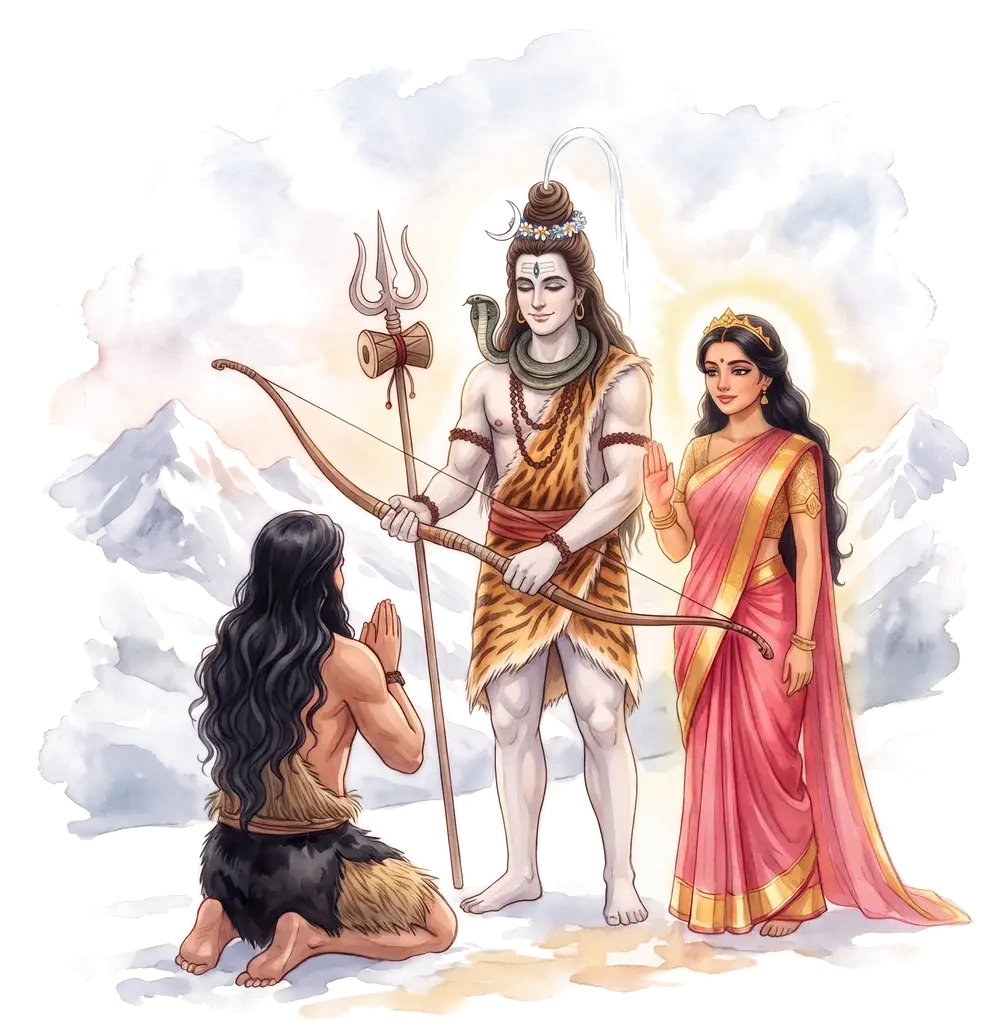
In the forest, Yudhishthira sends him north alone to ask the gods for weapons. High on the mountain Indrakila he fasts for months, then fights a huge hunter whom none of his arrows can touch. The hunter is Shiva, and he gives Arjuna his own weapon, the Pashupata (chapter 4, The Hunter on the Mountain). Arjuna spends five years in Indra's heaven learning the weapons of the gods, and music and dancing from Chitrasena (chapter 5). There he turns away the apsara Urvashi because she is the mother of his family line, and her curse to live as a dancer becomes his disguise (chapter 10).
In the year of hiding he is Brihannala, dance teacher to Princess Uttara at King Virata's court (chapter 10). When the Kurus raid Virata's cattle, he takes the Gandiva down from the shami tree, tells young Bhuminjaya who he is and beats the whole Kuru army, dropping arrows at the feet of his teachers as a greeting (chapter 11). When both cousins come to Krishna for help, Krishna offers a hundred million warriors or himself unarmed. Arjuna does not stop to think. "I choose you," he says, and Krishna will drive his chariot in the war (chapter 12).
In Book Three: The War
Between the two armies on the first morning, Arjuna sees his teachers, his grandsire and his cousins, and he lays down his bow. Krishna's answer is the Bhagavad Gita. He shows Arjuna his true form, and Arjuna picks up the Gandiva again (chapter 1). For ten days he fights Bhishma gently, and on the tenth he shoots from behind Shikhandi and brings the Grandsire down (chapter 2).
While the Samshaptakas, warriors sworn to kill him, draw him to the far end of the field, his son Abhimanyu is killed inside Drona's wheel (chapter 3). Arjuna swears to kill Jayadratha, who held the gap shut, before the next sunset or walk into a fire. Krishna hides the sun, Jayadratha steps out to watch, and Arjuna keeps his vow (chapter 4, Before Sunset). He refuses any part in the half-truth that makes Drona put down his bow (chapter 6). When Yudhishthira tells him to give his bow to someone else, Arjuna draws his sword on his brother, until Krishna finds a way to keep both the vow and the brother (chapter 7).
He faces Karna on the seventeenth day. Karna's chariot wheel sinks into the earth, and while Karna is on the ground trying to free it, Arjuna shoots him at Krishna's word (chapter 8, The Sinking Wheel). Thirty-six years later, when Krishna has left the world, Arjuna can barely string the Gandiva, and his weapons will not come when robbers attack the Yadava women he is guarding. "Time gives a man his strength, and Time takes it back," Vyasa tells him (chapter 14). Walking the road to heaven, he throws the Gandiva into the sea, and he falls on the mountain before Bhima and Yudhishthira. In heaven Yudhishthira finds him beside Krishna (chapter 15).
Where this comes from: Adi Parva §113–236 and Sabha Parva §1–58 in the Kisari Mohan Ganguli translation. In a few places the book follows a popular telling. In Ganguli, Arjuna sees only the bird's head, where most retellings say the eye. Ganguli's swayamvara target is a mark on a machine high in the air, and the wheel and golden fish come from later tellings. In Ganguli, Karna learns from Drona alongside the princes, and the book follows the television telling where Drona turns him away. Subhadra taking the reins herself also comes from a later telling. In Book Two, Shiva and Indra's heaven follow Vana Parva §12–79 and the cattle raid Virata Parva §30–72. Book Three follows Bhishma Parva §25–43 for the Gita, Drona Parva §72–145 for Jayadratha, Karna Parva §10–91 for Karna, and the Mausala and Mahaprasthanika Parvas for the end. More on the sources.