Drona, also called Dronacharya, is the poor brahmin warrior who becomes the teacher of the Pandava and Kaurava princes in the Mahabharata. In Book One he pulls a ball out of a well with blades of grass, makes Arjuna his finest archer, asks Ekalavya for his thumb, and takes his old friend King Drupada prisoner as his teacher's fee. In Book Three he leads the Kaurava army after Bhishma falls, until Yudhishthira tells him, "Ashwatthama is dead," and he lays down his bow and is killed.
- Family
- Son of the sage Bharadwaja · married to Kripi, sister of the princes' teacher Kripa · father of Ashwatthama
- Known for
- Teaching the Kuru princes every weapon · the bird's eye test · Ekalavya's thumb · taking King Drupada as his fee · leading the Kaurava army after Bhishma falls
- His name
- Drona means a wooden vessel; the epic says he was born in one. Acharya means teacher.
- First appears
- Book One, chapter 8, The Ball in the Well
Drona's story in Book One
Two boys and a promise
Drona grew up in his father's hermitage, where the Ganga comes down out of the mountains. A young prince named Drupada came there every day to study with him, and the two boys learned the bow side by side. "When I am king of Panchala," Drupada used to tell him, "the kingdom will be yours."
Drona grew up learned, and very poor. One day his little son Ashwatthama cried for milk. There was no cow, so the other children stirred rice flour into water and told him that was milk, and the boy danced around the yard. Grown men laughed at Drona for it. He took his wife and son to his old friend, who was now King Drupada.
The king laughed too. "Friendship can only be between equals," he said, and offered Drona a bed for one night. Drona walked out and never forgot a word.
The ball in the well
Drona went on to Hastinapura and stayed with Kripa, his wife's brother, who taught the young princes. One hot day he found the boys crowded around a dry well. Their ball was at the bottom. Drona dropped his own ring in after it. Then he spoke sacred words over a handful of grass and threw the blades one by one, each sticking into the last, until a green chain reached the ball and he drew it up. One arrow brought back the ring.
The princes ran to tell their Grandsire, Bhishma, who knew at once who the stranger was and asked him to teach them. Drona said yes. He kept one thing to himself. A pupil whose training was done paid his teacher whatever fee the teacher asked, and Drona already knew what his fee would be.
The bird's eye
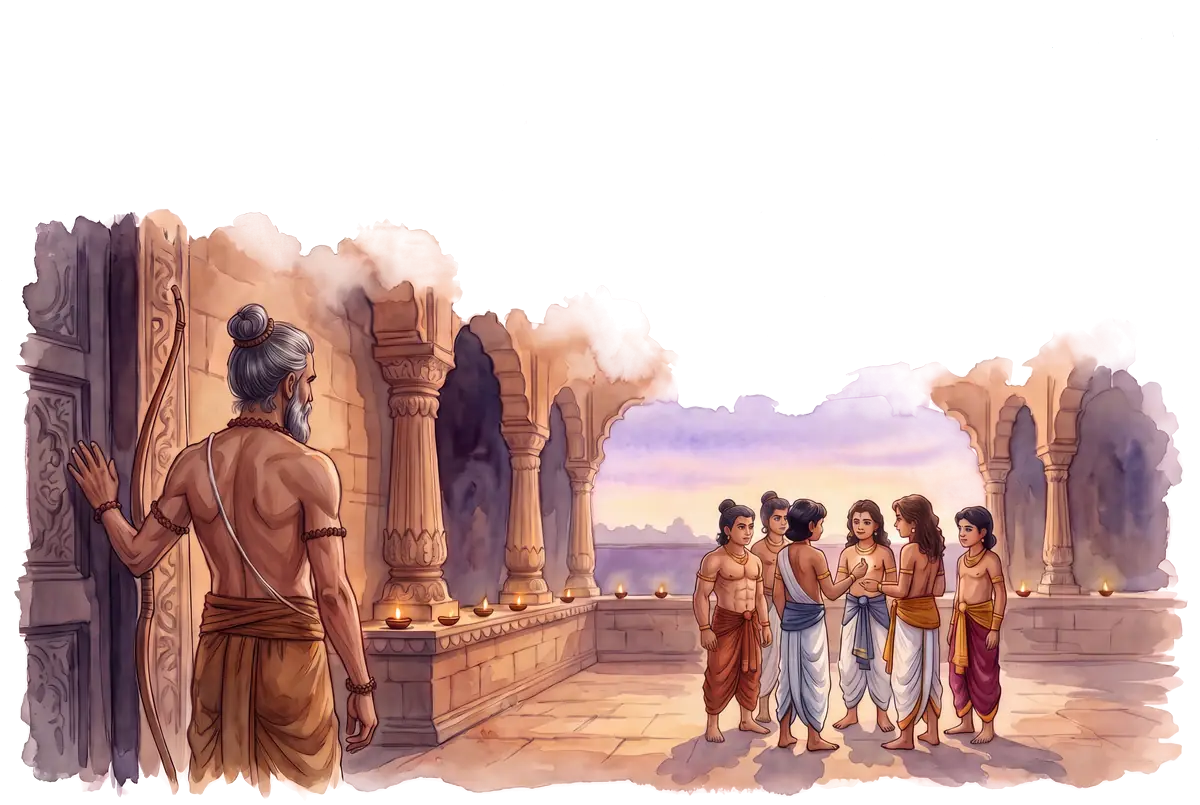
Drona trained the princes of Hastinapura in every weapon, along with princes who came from other kingdoms to learn from him. Arjuna worked hardest of all. When Drona caught him practicing alone in the dark, he hugged the boy and promised to make him an archer with no equal in the world.
For the great test, Drona set a wooden bird high in a tree and asked each pupil what he could see. They all saw the tree and the teacher and their brothers. Arjuna saw only the bird's eye, and his arrow brought the bird down. Later a crocodile seized Drona in the Ganga, and Arjuna was the only pupil who moved. In return Drona taught him the Brahmashira, a weapon of the gods, and warned him never to use it against a human enemy.
Drona had favorites. In the early days he gave his own son a wide pot to fill at the river and everyone else a jar with a narrow neck, so that Ashwatthama came back first and got lessons nobody else did.
Ekalavya's thumb
Ekalavya, son of the king of the Nishadas, the hunting people of the forest, walked to Hastinapura to learn archery from Drona. Drona sent him away. "I do not teach Nishadas," he said. So Ekalavya made a Drona of his own out of clay, bowed to it every morning, and taught himself until he could shoot better than any of the princes.
Arjuna found out, and went to his teacher. You promised me, he said. Drona walked with him into the forest. "If you are really my pupil," he told Ekalavya, "then give me my fee." He asked for the thumb of the boy's right hand, and Ekalavya gave it to him gladly.
The tournament
When the training was over, all Hastinapura came out to watch Drona's pupils show what they had learned. Drona called out that Arjuna was dearer to him than his own son. Then a young stranger in golden armor walked in and matched Arjuna feat for feat. It was Karna, a charioteer's son. In this telling, years before, Karna had asked to learn with the princes, and Drona had sent him away.
The teacher's fee
At last Drona named his fee, his guru dakshina. His pupils were to bring him King Drupada, alive. Duryodhana and his brothers attacked Panchala first and were driven back. Then Bhima and Arjuna went in, and Arjuna leaped into the king's chariot and took him prisoner.
Drona smiled at his old friend. You told me once that friendship can only be between equals, he reminded him. So he kept the half of Panchala north of the Ganga and gave Drupada the south. Now they were both kings, and could be friends. Drupada agreed, and went home and asked the priests for a fire sacrifice. He wanted a son who would kill Drona. Out of the fire stepped a young warrior in armor, and after him rose a girl, Draupadi.
In Book Two: The Dice
Drona sits with Bhishma, Kripa and Vidura behind the blind king while Yudhishthira loses everything, and none of them smiles (chapter 1). When Draupadi and Vikarna call on the elders to answer her question, Drona says nothing (chapter 2). After the second game, as the sage Narada foretells the fall of the Kauravas, Drona speaks. "I will stand by your sons," he tells the king, and he warns that in the fourteenth year this will come back on Duryodhana (chapter 3).
At the cattle raid Arjuna greets his old teacher with two arrows dropped at his feet and two more past his ears. "That's me touching his feet," Arjuna tells Bhuminjaya (chapter 11). At the peace mission Drona begs Duryodhana to make peace, and he is one of the few Krishna lets see his true form (chapter 13). Before the war he agrees with Bhishma that Karna should count as only half a warrior (chapter 15).
In Book Three: The War
On the first morning Drona blesses Yudhishthira and tells him how he can be beaten. He will put down his weapons if he hears something terrible from someone whose word he trusts (chapter 1). After Bhishma falls, Drona leads the Kaurava army. He draws it up like a great wheel, and young Abhimanyu breaks into it. Drona cannot help admiring the boy, and then he tells Karna to cut his bow first (chapter 3, The Wheel of Death). When Drona will not let Arjuna through, Arjuna drives around him, keeping his teacher on his right (chapter 4).
On the fifteenth day Drona kills King Drupada, his boyhood friend, and King Virata. He turns the Brahma weapon on soldiers who never learned it, and the sages come to tell him his time is over. He calls out to Yudhishthira, the one man he trusts, to ask if his son is dead. "Ashwatthama is dead," says Yudhishthira, and under his breath, "the elephant." Drona lays down his bow, sits and says his son's name, and Dhrishtadyumna kills him while Arjuna shouts to bring him alive (chapter 6, "Ashwatthama Is Dead").
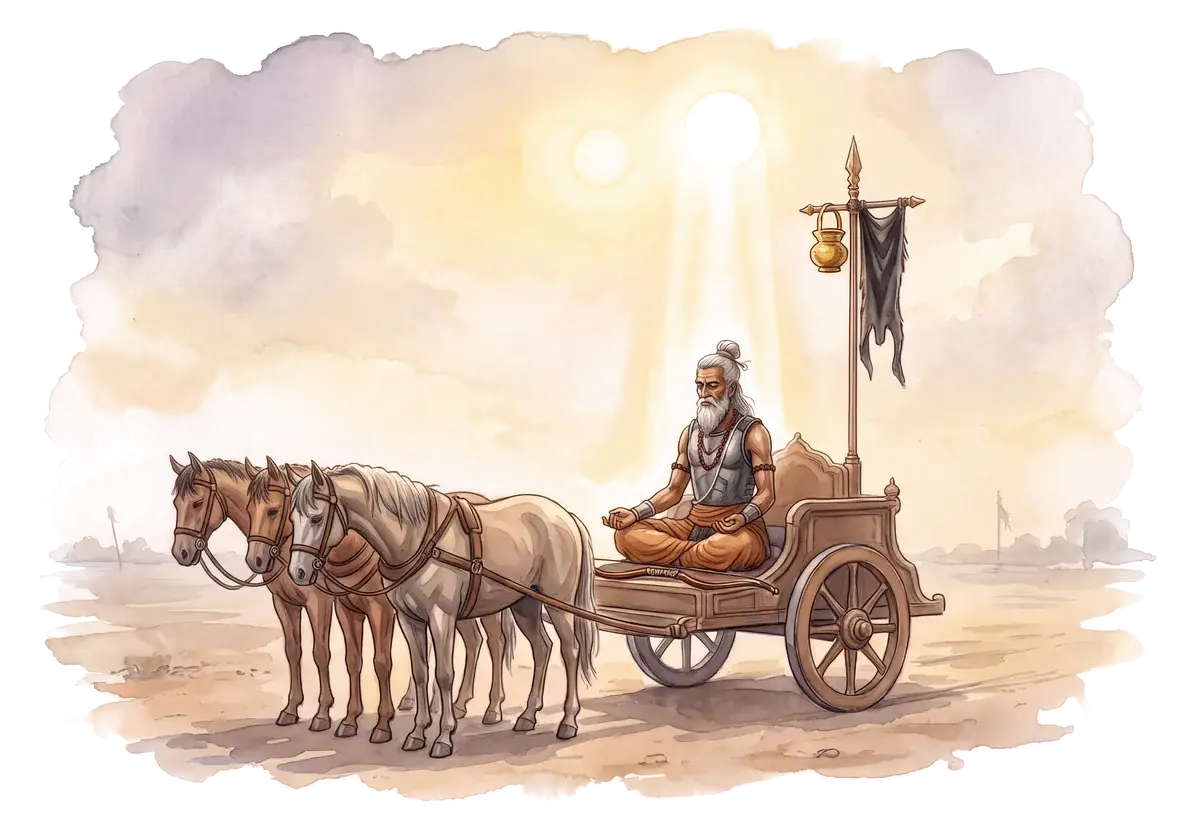
His son never forgives it, and on the last night of the war Ashwatthama goes into the sleeping Pandava camp to pay them back for his father (chapter 10). In heaven Yudhishthira sees Drona sitting beside the teacher of the gods (chapter 15).
Questions about Drona
Why is Drona called Dronacharya?
Acharya means teacher, so Dronacharya means Drona the teacher. It is the name people give him as the master who trained the Pandava and Kaurava princes. His own name, Drona, means a wooden vessel. The epic says he was born in one, and in The Vow Duryodhana reminds a whole arena that their teacher was born in a water pot.
Why did Drona ask for Ekalavya's thumb?
Drona had promised Arjuna that no archer in the world would be his equal. Then he learned that Ekalavya, a Nishada prince he had turned away, shot better than Arjuna. So he asked for the thumb of the boy's right hand as his teacher's fee, and Ekalavya gave it. The book leaves readers to decide whether Drona had any right to ask.
Why did Drona want revenge on Drupada?
As boys they studied together, and Prince Drupada promised to share his kingdom one day. Years later Drona came to him poor, with a hungry son, and King Drupada laughed and said friendship can only be between equals. Drona never forgot it. When his pupils had finished their training, he asked them to bring him Drupada as a prisoner.
Who is Drona's son?
His only son is Ashwatthama, said ash-wat-THAA-maa. His mother is Kripi, the sister of Kripa, who taught the princes before Drona came. Ashwatthama grows up among the princes. It was his hunger, on the day other children fed him rice flour stirred into water and called it milk, that first sent Drona to ask King Drupada for help.
Where this comes from: Drona's story follows the Adi Parva, §131–140, in K. M. Ganguli's English translation. His birth and boyhood are told in §131 and the ball in the well in §133. The bird test and Ekalavya both come in §134, and the teacher's fee in §140. Ganguli's Drona pierces the ring with his arrow and brings it up, and the book has the arrow fly back up into his hand. In Ganguli Arjuna sees only the bird's head, while many retellings say the eye, and so does the book. Ganguli also has Karna learn from Drona with the princes. The book follows the well-known television telling, where Drona turns him away as a charioteer's son. Book Two follows Sabha Parva §57–79 and Virata Parva §30–72. Book Three follows Drona Parva §5–49 for the wheel and §154–200 for his death. About the sources.