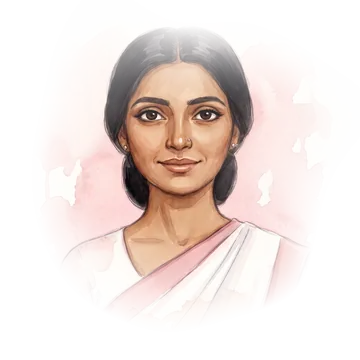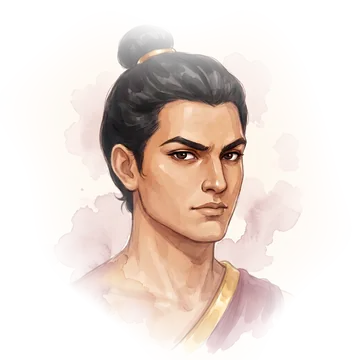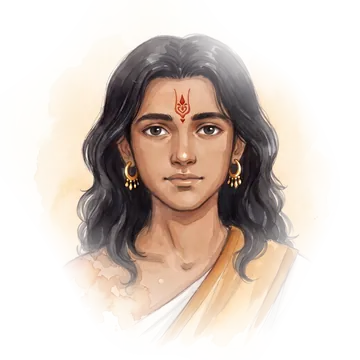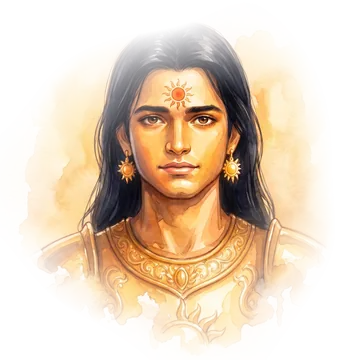
Karna is the first son of Princess Kunti and the sun god Surya, born in golden armor and set afloat on a river in a basket because his young mother was afraid. Raised by a charioteer, he grows into an archer who can match Arjuna, and Duryodhana makes him king of Anga. In Book Two he gives his armor away and learns from Krishna that Kunti is his mother, and in Book Three he fights for Duryodhana until he falls to Arjuna on the seventeenth day of the war.
- Family
- Mother: Kunti, before her marriage. Karna does not know it until Krishna tells him in Book Two. Father: Surya, the sun god. Raised by the charioteer Adhiratha and his wife, Radha. Kunti's later sons, the Pandava princes Yudhishthira, Bhima and Arjuna, are his half-brothers.
- Known for
- The golden armor and earrings he was born with, and gave away. Matching Arjuna feat for feat. His friendship with Duryodhana. His last fight with Arjuna, when his chariot wheel sank into the earth.
- First appears
- Book One, chapter 5, The Basket on the River
Karna's story in Book One
How was Karna born?
Long before she married King Pandu, Kunti was a girl in King Kuntibhoja's palace. For a whole year she looked after a hot-tempered sage, Durvasa, without giving him one thing to complain about. As a gift, he taught her sacred words that would call any god to give her a son.
She tried them one dawn on the rising sun, just to see if they worked. The sun god Surya stepped into her room and would not go home with nothing. So Kunti asked that her son be born in armor, with earrings like Surya's, so that no weapon could pierce him. The baby came with golden armor grown over his chest like skin. Kunti was unmarried and frightened of what people would say about her and her father. With her old nurse, she sealed the baby in a waxed wicker basket and let it go on the river at night.
Who raised Karna?
The basket floated down into the great Ganga, all the way to Champa in the land of Anga. A charioteer named Adhiratha and his wife, Radha, pulled it ashore. They had no son, and they raised the shining baby as their own. They named him Vasusena, which means "born with riches." Later the world would call him Karna.
He grew up among horses, with a whip in his hand. Every morning he waded into the Ganga and prayed to the sun until his back was hot, and Radha had to call him again and again to come in and eat.
Does Karna know who his mother is?
No. In Book One, Karna does not know that Kunti is his mother or that the sun god is his father. Kunti knows. Her spies told her the boy was alive in Anga, and she said nothing about the river when she married Pandu. Readers know it too, which makes every meeting between Karna and the Pandavas hard to watch. Karna learns the truth in Book Two, chapter 14, when Krishna tells him.
Why did Drona turn Karna away?
As a boy, Karna went to Drona, the princes' teacher, and asked to learn archery with them. Drona looked at his charioteer's clothes and sent him away while the princes watched. After that Karna worked at the bow with any teacher who would have him, and alone long after they had gone home.
What happened at the tournament?
The whole of Hastinapura came out to see what Drona's students had learned. Arjuna made fire and water with his arrows, and the crowd roared for him. Then a young man in golden armor walked out from the gate and said he would do everything Arjuna had done, only better. Karna did it all, feat for feat.
Duryodhana threw his arms around him. Karna asked for his friendship, and for a duel with Arjuna. Before the duel could begin, the teacher Kripa asked Karna to name his father and mother and his royal line, because the sons of kings did not fight men of no family. Karna went pale. Duryodhana answered for him and crowned him king of Anga on the spot. Up in the ladies' stand, Queen Kunti fainted. No one wondered why.
Karna and his father
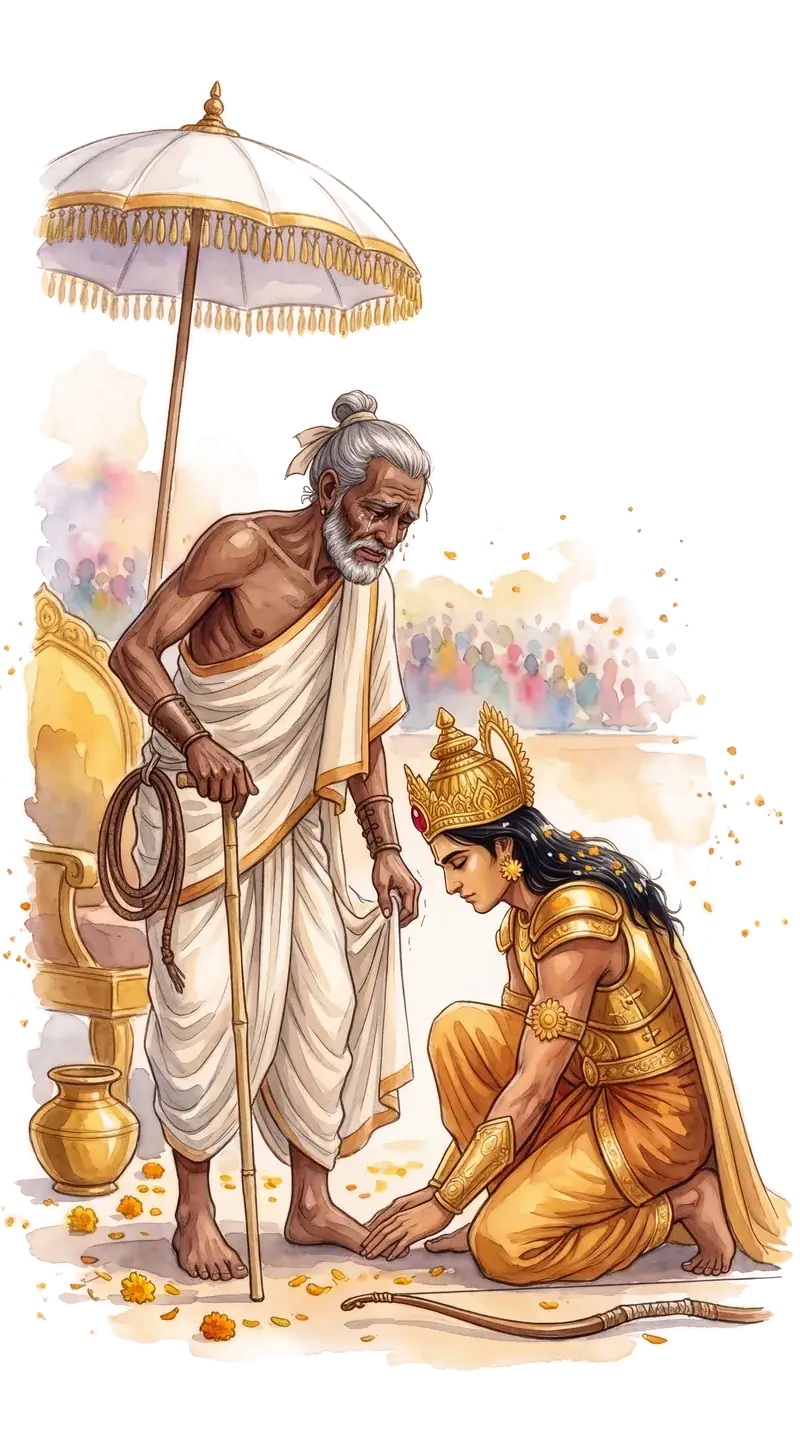
Moments after the crowning, old Adhiratha came pushing through the crowd, leaning on a stick. Karna laid down his bow and bent his head to his father's feet in front of the whole city. The old man called him his son and cried into his hair.
Bhima laughed out loud and told Karna to go and pick up a whip like the rest of his family. Duryodhana stood up for his new friend. Nobody knows where a great river begins, he said, or where a great warrior comes from. The sun went down before there could be a duel, and Karna walked out of the arena hand in hand with Duryodhana.
Why did Draupadi refuse Karna?
At Princess Draupadi's swayamvara, the man who strung a huge bow and shot five arrows through a turning wheel into a small golden fish would win her. King after king was thrown about by the bow. Karna lifted it and strung it, and he had an arrow on the string before anyone had finished whispering his name.
Draupadi spoke so the whole hall could hear. "I will not choose a suta, a charioteer's son." Karna laughed one short laugh, glanced up at the sun and threw the bow down. Nobody told her she was wrong.
A young man from among the brahmins won the contest instead. When the angry kings attacked him, Karna fought the stranger arrow for arrow, then lowered his bow. "No one can beat a brahmin's power," he said. The stranger was Arjuna in disguise.
In Book Two: The Dice
In the dice hall Karna laughs with Duhshasana while Yudhishthira loses everything. When Vikarna says Draupadi was never won, Karna tells him to sit down, mocks Draupadi for having five husbands and tells Duhshasana to take her cloth (chapters 1 and 2). Years later he tells Krishna that the cruel things he said that day "burn me now" (chapter 14).
Karna has vowed never to refuse anyone who asks him for anything. In a dream the sun god warns him that Indra will come dressed as a brahmin to beg for his armor and earrings, and that without them he can be killed. Karna gives them anyway, and trades them for Indra's spear, which will kill one enemy, only one (chapter 8, The Armor of the Sun). A tale in the same chapter tells of three curses he carries, from his teacher Parashurama, from a brahmin whose cow he killed by mistake, and from the Earth goddess.
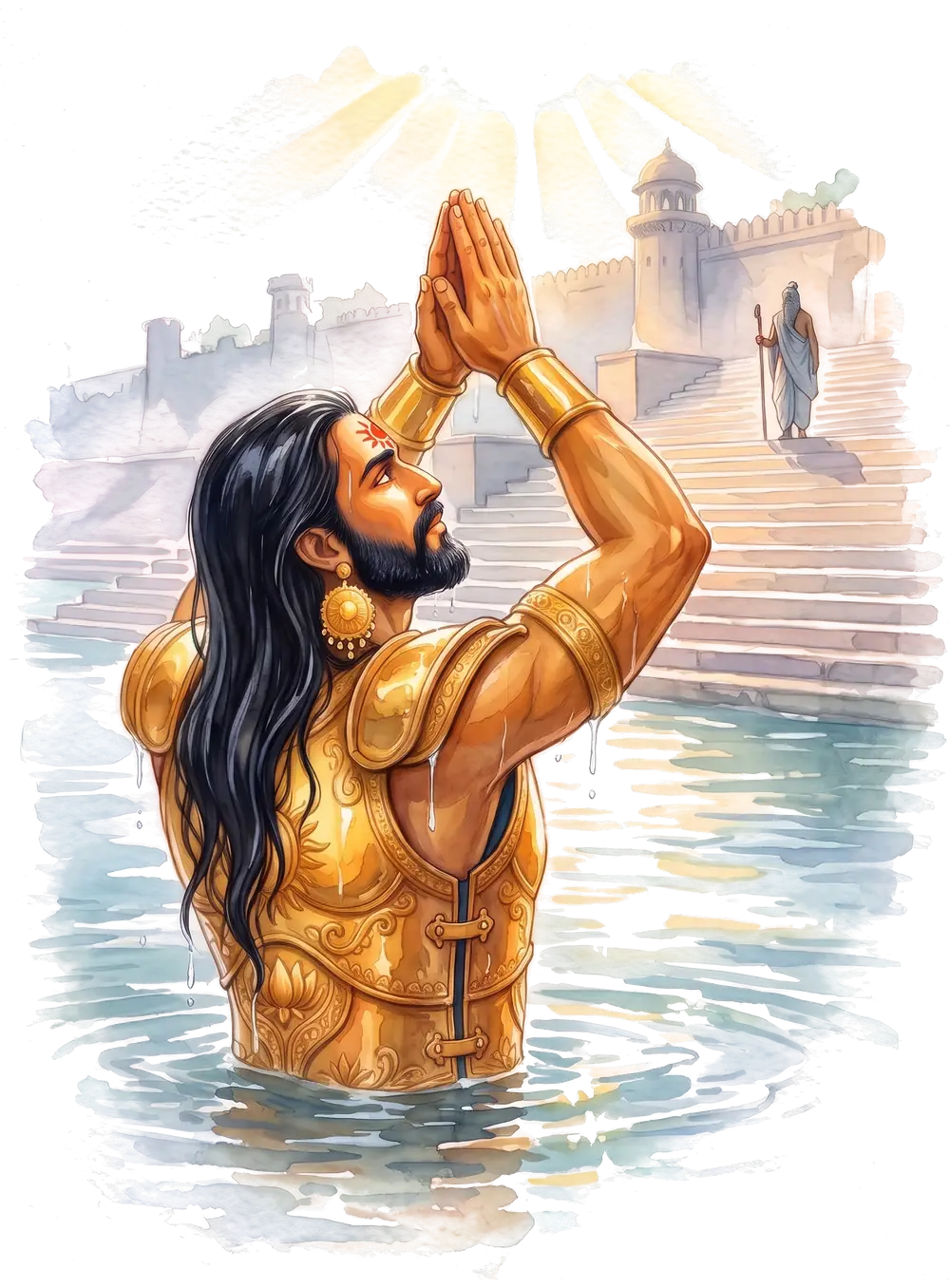
After the peace mission, Krishna takes Karna up into his chariot and tells him he is Kunti's eldest son. He offers him the whole earth, with his five brothers at his feet. Karna says no. "My heart is tied to them, Krishna," he says of the charioteer's family who raised him, and he will not betray Duryodhana. At dawn Kunti comes to him at the river. He refuses her too, and promises to kill none of her sons but Arjuna (chapter 14, A Mother at the River).
In Book Three: The War
Karna stays out of the war for ten days, as he swore he would while Bhishma lived. When Bhishma falls, Karna goes to him alone, and the old man tells him he knows Karna is Kunti's son and asks him to join his brothers. Karna asks leave to fight instead (chapter 2). He is one of the six warriors who close around Abhimanyu, and he breaks the boy's bow (chapter 3). In the night battle he has to throw Indra's spear, the weapon he was saving for Arjuna, at Bhima's son Ghatotkacha (chapter 6).
As commander of the Kaurava army he beats Nakula, Sahadeva and Yudhishthira and lets each one go, keeping his promise to Kunti (chapters 7 and 8). On the seventeenth day he faces Arjuna, with King Shalya driving his chariot and mocking him all the way. A serpent hides in the arrow he has saved for Arjuna, and Krishna presses Arjuna's chariot into the earth so that it takes only Arjuna's crown. When the serpent asks to be shot again, Karna refuses. "I'm not going to win this fight with someone else's strength," he says.
Then his chariot wheel sinks into the earth, as the brahmin's curse said it would, and the Brahma weapon goes from his mind. While he is on the ground trying to free the wheel, he asks Arjuna to wait. Krishna reminds him of the dice hall and of Abhimanyu, and Arjuna shoots him. Karna dies beside his wheel, and a light leaves his body and goes into the sun (chapter 8, The Sinking Wheel). After the war Kunti tells her sons who he was, and Yudhishthira pours water for him with his own hands (chapter 11). In heaven Yudhishthira sees him blazing like twelve suns (chapter 15).
Questions about Karna
How did Karna die?
Karna died on the seventeenth day of the war, in Book Three, chapter 8, The Sinking Wheel. He faced Arjuna at last, with King Shalya driving his chariot. In the middle of the fight his chariot's left wheel sank into the earth, as a brahmin's curse had said it would, and the Brahma weapon his teacher Parashurama had given him went from his mind. While he was on the ground trying to free the wheel, he asked Arjuna to wait, because a brave man does not shoot someone on the ground with his weapon down. Krishna answered by reminding him of the dice hall and of Abhimanyu. When Karna jumped down to the wheel a second time, Krishna told Arjuna to shoot, and Karna fell beside his wheel. Both armies watched a light leave his body and go into the sun. Afterward Krishna asks the reader whether Arjuna should have waited.
When does Karna learn that Kunti is his mother?
In Book Two, chapter 14, A Mother at the River. After the peace mission fails, Krishna takes Karna up into his chariot, tells him he is Kunti's eldest son and offers him the whole earth. Karna says no. At dawn Kunti comes to him at the river herself, and the sun god's voice tells him it is true. He will not leave Duryodhana, and he promises her to kill none of her sons but Arjuna. In Book Three, when Bhishma lies on his bed of arrows, he tells Karna that he knows the secret too.
Where this comes from: Karna's birth follows Adi Parva §111 and the fuller telling in Vana Parva §301–307 of the Ganguli translation. The tournament is Adi Parva §136–139, and Draupadi's swayamvara is Adi Parva §187–192, where Draupadi says, "I will not select a Suta for my lord." In Ganguli, Karna learns archery from Drona alongside the princes. This book follows the well-known television telling, where Drona turns him away as a charioteer's son. In Book Two, the armor follows Vana Parva §298–308, the curses Shanti Parva §2–3, and the river Udyoga Parva §137–146. In Ganguli, Karna already knows the story of his birth when Krishna tells him, and the Earth goddess's curse comes from later tellings. Book Three follows Karna Parva §10–91 for his last battle. More on the sources page.