Mock trial · Book Two
Mock Trial Cases from The Dice
Five ready cases for a classroom mock trial, from The Dice, Book Two of an illustrated Mahabharata for readers 10 to 16: Shakuni's dice, Yudhishthira's last stake, the blind king and the second game, Indra and Karna's armor, and the five villages. Each has the charge, the evidence with chapter numbers, witnesses and questions for both teams. The roles, the plan and the rubric are in the mock trial kit.
Chapter numbers are the book's own. The dice hall in chapter 2 is a hard scene, and these cases stay on the choices people made there: who staked what, who spoke, and who stayed silent.
The cases
Case 1: Shakuni and the dice
The charge. Shakuni, prince of Gandhara and Duryodhana's uncle, is charged with cheating at dice. He threw for Duryodhana and won Yudhishthira's kingdom, his brothers, Yudhishthira himself and Draupadi, and his dice fell the way he wished every time.
Evidence from the book
- Before the first throw, Yudhishthira told him, "Cheating at dice is a sin," and "Beat us fairly, Shakuni. Don't beat us like a thief." (Chapter 1)
- Shakuni smiled and answered, "A good player knows how to win, that's all." Then he said, "But if you're afraid, don't play." Every king in the hall heard him say it. (Chapter 1)
- Duryodhana put up the stakes, and Shakuni threw for him. Yudhishthira said one man playing for another was "against the rules," and then agreed to begin. (Chapter 1)
- After the first throw, Yudhishthira was sure it was crooked. "You won that by a trick," he said. Shakuni answered every stake after that with "I have won." (Chapter 1)
- When the twins were lost, Shakuni said Bhima and Arjuna must be dearer to Yudhishthira. "They're Kunti's sons, like you." When Yudhishthira had lost himself, it was Shakuni who named the next stake: "Stake Draupadi, the princess of Panchala. Win yourself back with her." (Chapter 1)
- In the middle of the game, Vidura begged the king, "Send Shakuni home." (Chapter 1)
- Later Bhima told Duhshasana that "Shakuni's tricks won you everything," and Vidura told Yudhishthira, "When a man is beaten by cheating, there's no shame in it for him." (Chapter 3)
- In Gandhara people told a story about Shakuni, "though he never told it himself." Soldiers from Hastinapura shut his father and brothers in a prison with one handful of rice a day, and every handful went to Shakuni. His dying father told him, "From this day on, whatever you throw will fall the way you need it to." (Chapter 1, A Tale Within the Tale)
- The same story says each side told the quarrel between the two houses differently. Of the years after his father's blessing, it says, "The dice spun in the air and came down as he wished, every time, as if a hand were guiding them." (Chapter 1, A Tale Within the Tale)
Witnesses
Yudhishthira, who sat across the board and called the first throw a trick. Vidura, who asked the king to send Shakuni home. Duryodhana, who let his uncle throw for him. A storyteller from Gandhara, who knows the story of the handful of rice.
Questions for the prosecution
- Yudhishthira called the first throw a trick. Did Shakuni ever say it wasn't?
- Why did Duryodhana need someone else to throw the dice for him?
- Who first named Draupadi as a stake? Why would a fair player push for that?
Questions for the defense
- Shakuni told Yudhishthira he didn't have to play. Who chose every stake after that?
- Nobody in the book shows how the dice were crooked. Is a player who always wins a cheat?
- If the story from Gandhara is true, the dice fell by his father's blessing. Is a blessing a trick? Does what happened to his family change how the jury sees him?
A note for the teacher. "A Handful of Rice" comes from a later popular telling, and the book tells it as a story people told in Gandhara. The Ganguli translation says only that Shakuni won by unfair means (Sabha Parva §60), with no prison and no blessing. The defense may use the tale, and the judge decides how much it counts.
Case 2: Yudhishthira's last stake
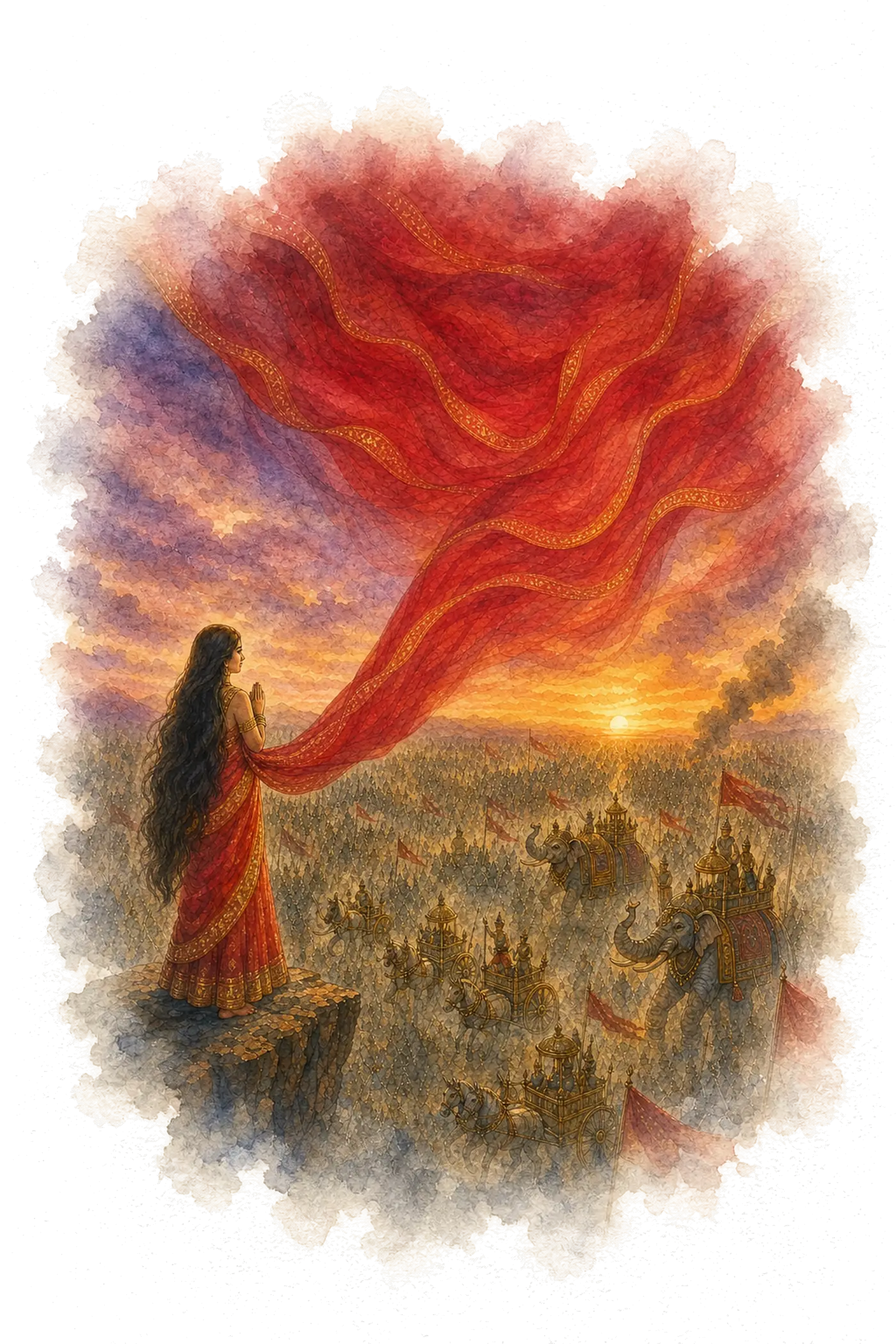
The charge. Yudhishthira, eldest of the five Pandava brothers, is charged with staking his wife Draupadi in a game of dice. He had already lost himself, and the charge says she was never his to stake.
Evidence from the book
- When Shakuni said "if you're afraid, don't play," Yudhishthira answered, "I was challenged. I don't walk away. That is my vow." (Chapter 1)
- He was sure the first throw was crooked, and he kept playing. He staked his treasure, his kingdom, each of his brothers and then himself. (Chapter 1)
- Shakuni told him, "You staked yourself while you still had something else to stake. That was wrong of you, King." Then Shakuni named Draupadi, and Yudhishthira "heard his own voice answer." (Chapter 1)
- As he staked her, the old men of the court cried shame. Vidura sat with his head in his hands. (Chapter 1)
- Draupadi sent the usher back to the hall with a question: "Whom did he lose first, himself or me?" The usher came back and told her, "He didn't say a word, good or bad." (Chapter 2)
- Bhishma told the hall, "A man who has lost himself owns nothing, so he can't stake what isn't his. Yet a wife is under her husband's command." He ended, "I can't decide it." (Chapter 2)
- Draupadi answered that Yudhishthira "was called here to play against cheats, men who know every trick there is," and asked, "How was that his own free choice?" (Chapter 2)
- Vikarna, one of Duryodhana's own brothers, said she was the wife of all five brothers, and that Yudhishthira had already lost himself. "I say Draupadi was never won." (Chapter 2)
- Bhima said, "Even the worst gamblers don't bet the women of their houses." Arjuna answered for their brother: "He was challenged, and a warrior doesn't refuse." (Chapter 2)
- When Draupadi asked the elders whether she was a slave, Bhishma said, "Yudhishthira must answer that." Yudhishthira "sat like a man made of stone." (Chapter 2)
Witnesses
Pratikami, the usher who carried Draupadi's question into the hall. Bhishma, who said he couldn't decide. Vikarna, who said she was never won. Arjuna, who stood up for his brother's choice to play.
Questions for the prosecution
- Draupadi asked whom he lost first, himself or her. Why does the order matter, and why didn't he answer?
- He thought the very first throw was crooked. Why did he keep raising the stakes?
- Vikarna gave two reasons why she was never won. Which is the stronger one?
Questions for the defense
- He had sworn never to walk away from a challenge, and every king in the hall was watching. What would walking away have cost him?
- Draupadi herself asked how playing against cheats could be a free choice. Who pushed him toward this stake?
- Bhishma, who knew the law better than anyone in the hall, couldn't decide. Can the jury decide it for him?
A note for the teacher. Keep this case on the stake and the question Draupadi asked. The book tells the rest of the scene through who spoke up and who stayed silent, and the court can do the same. Chapter 1 ends with Krishna explaining why Yudhishthira sat down at the board, and it gives Krishna's own view of this stake, so save it until the jury has voted.
Case 3: The blind king and the second game
The charge. King Dhritarashtra of Hastinapura is charged with letting a crooked game go on in his own hall, and with calling the Pandavas back for a second game after he had set them free.
Evidence from the book
- The game was played in Dhritarashtra's new hall. He sat at its head, with Bhishma, Drona, Kripa and Vidura behind him. (Chapter 1)
- Vidura told him, "Your son is on that cliff now," and "Send Shakuni home." Dhritarashtra said nothing. He was listening to the dice. (Chapter 1)
- When Yudhishthira staked Draupadi, the whole hall was in an uproar. Only Dhritarashtra leaned forward. "Has it been won?" he kept asking. (Chapter 1)
- After a jackal howled in the room where the king's sacred fire burned, Vidura and Gandhari spoke into his ear. He called Duryodhana a wretch, freed the five brothers when Draupadi asked, and gave them back everything they had lost. "Go home to Indraprastha," he said, "and forget my son's harsh words." (Chapter 2)
- The Pandavas had been gone for an hour when Duryodhana came to him. "We need time, to win the other kings to our side and raise an army," he said. "Let them play us once more." The king answered, "Then bring them back. Even if they've gone a long way." (Chapter 3)
- Bhishma, Drona, Kripa and Vidura all said, "Let there be peace." So did Vikarna, one of the king's own sons. The king only shook his head. (Chapter 3)
- Gandhari asked him, "Who mends a dam and then breaks it open again?" (Chapter 3)
- At last he said, "If the end of our family has come, let it come. I can't stop it. Let my sons play them again." (Chapter 3)
- When the Pandavas had gone into exile, he begged Vidura, "Tell me everything, Vidura. I can't see them." (Chapter 3)
Witnesses
Vidura, who warned him during the game. Gandhari, who begged him to give up their son. Duryodhana, who asked for the second game. Yudhishthira, who said of the king's call, "it comes from the old king. I can't refuse."
Questions for the prosecution
- It was his hall, and he was the king. Who else could have stopped the game?
- What does "Has it been won?" tell the jury about what he wanted?
- An hour after he set the Pandavas free, he called them back. What changed his mind?
Questions for the defense
- He was blind and could only listen. How much could he know about what Shakuni was doing with the dice?
- In Chapter 2 he set the brothers free and gave back all they had lost. Does that count for him?
- He said, "I can't stop it." Did he believe fate had already decided? Can a king blame fate?
Case 4: Indra and Karna's armor
The charge. Indra, king of the gods, is charged with tricking Karna out of the armor and earrings he was born with. He came disguised as a brahmin because he knew Karna never refused one.
Evidence from the book
- At a feast in front of all the Kurus, Karna had vowed that "if anyone asks me for anything, I will never tell him, 'I don't have it.'" (Chapter 8)
- Karna had been born in his golden armor. "Nothing had ever gone through it." People said Yudhishthira could not sleep at night for thinking about it. (Chapter 8)
- In a dream, the sun god warned Karna that Indra would come "dressed as a brahmin" and beg for the armor and earrings "to help the sons of Pandu. He knows you never refuse anyone." (Chapter 8)
- Karna answered, "I'd rather die with a good name than live with a bad one." The sun god told him to trade, and to ask for Indra's spear that never misses. (Chapter 8)
- At noon a tall old brahmin at the top of the river steps said, "Give me." He turned down necklaces and villages and asked for the armor and earrings. When Karna offered land instead, the brahmin waited with his hand out. "He asked for nothing else." (Chapter 8)
- Karna said, "I knew you from the start, lord of the gods," and asked for a trade. The brahmin stopped pretending, and Indra told him to ask for "anything but my thunderbolt." (Chapter 8)
- Indra gave him the spear, but it would kill one enemy only and then come home to Indra. He promised, "There will be no scar." (Chapter 8)
- Karna cut the armor away himself and held it out "still warm." Indra rose into the sky "smiling as he went, like a man whose work was done." (Chapter 8)
- When Duryodhana heard, he asked Karna, "Indra? Arjuna's own father?" (Chapter 8)
Witnesses
Karna, who gave the gifts. The sun god, who warned him in a dream. Duryodhana, who heard what Karna had done. A bather on the river steps, who watched the whole trade.
Questions for the prosecution
- Why did the king of the gods need a disguise to ask for something?
- Indra is Arjuna's father. Did he come for the Pandavas or for his own son? Does it matter?
- He asked for the one thing that kept Karna alive, knowing Karna's vow wouldn't let him say no. Is that asking, or taking?
Questions for the defense
- Karna knew who he was from the start, because the sun had warned him. Can you trick someone who sees through you?
- Indra gave a spear that never misses and left no scar. Was it a fair trade in the end?
- Karna said he would rather die with a good name. Whose choice was it to give?
A harder case for older students
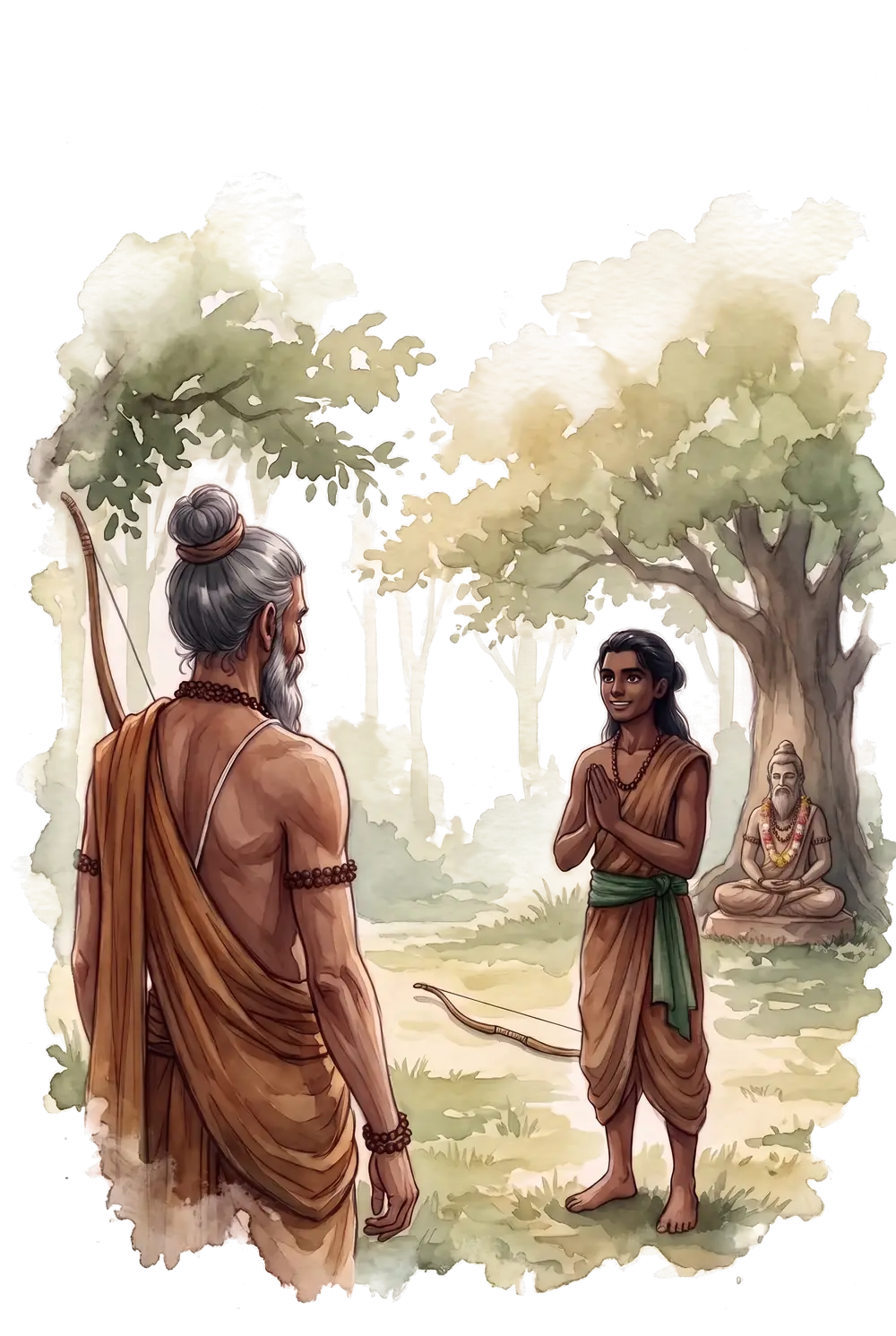
Put Karna on trial instead, for the lie in the chapter's Tale Within the Tale. Drona would not teach him the Brahma weapon, so he went to Parashurama and said, "I am a brahmin, of Bhrigu's family." When a stinging insect bit into his thigh, he sat still so his teacher could sleep, and Parashurama said no brahmin could bear pain like that. "A teacher is a father," Karna told him, "so I said I was of your family." Parashurama can take the stand, and so can the brahmin whose cow Karna killed by mischance and then confessed to.
Case 5: Duryodhana and the five villages
The charge. Duryodhana, eldest son of King Dhritarashtra, is charged with refusing to give the Pandavas back their kingdom after they had kept every term of their exile, and with refusing even the five villages they asked for instead.
Evidence from the book
- At the second game, Shakuni set the stake. The losers would spend twelve years in the forest and the thirteenth in hiding. "Stay hidden, and you get your kingdom back." (Chapter 3)
- Bhishma counted the years and said the Pandavas had served their thirteen, with five months and twelve nights over. "I will not give them back their kingdom," Duryodhana told him. (Chapter 12)
- While Drupada's old priest was on his way to Hastinapura to talk peace, Duryodhana rode to Dwaraka to ask Krishna for help in the war. (Chapter 12)
- Yudhishthira sent word with Sanjaya: "Give us back our kingdom. If you won't, give us five villages, one for each of us, and let there be peace." One of the five was Varanavata. (Chapter 13)
- Before Krishna arrived, Duryodhana planned to take him prisoner. His father told him never to say that again, because Krishna came as an envoy. (Chapter 13)
- In the hall, Krishna said of the Pandavas, "They kept their word, twelve years in the forest and the thirteenth in hiding. Now keep yours." Bhishma and Drona begged Duryodhana too. (Chapter 13)
- Duryodhana answered, "Yudhishthira chose to play dice, and he lost. He lost a second time. Where's my fault in that?" He added, "My father gave them that land when I was young and couldn't stop him." (Chapter 13)
- "Five villages? As long as I live, they won't get as much land as the point of a needle would cover." (Chapter 13)
- His brother Duhshasana warned him, "If you don't make peace, the old men will tie us up and hand us over." After Duryodhana walked out, Krishna told the elders to do it. (Chapter 13)
- His mother told him, "Half the earth is enough for you and your friends." Duryodhana turned his back on her and walked out again. (Chapter 13)
Witnesses
Bhishma, who counted the years. Sanjaya, who carried Yudhishthira's offer of five villages. Gandhari, who asked her son to be content with half the earth. Karna, who shared Duryodhana's seat in the hall.
Questions for the prosecution
- What did Shakuni promise at the second game, and did the Pandavas keep their side of it?
- One of the five villages was Varanavata. Why might that village matter to the brothers?
- His father, his mother, Bhishma and Drona all asked for peace. Whose advice did he follow?
Questions for the defense
- Duryodhana says his father gave the land away when he was too young to stop it. Was the kingdom ever fairly the Pandavas' to ask for?
- Yudhishthira chose to play, and he lost twice. Does Duryodhana have a point?
- His own brother feared the elders would tie them up and hand them over. Could Duryodhana trust any deal made in that hall?
After the verdict, you can tell the class what the old text adds. In the Ganguli translation, Yudhishthira's offer of five villages goes to Hastinapura with Sanjaya (Udyoga Parva §31), and in the hall Krishna asks for the Pandavas' fair share. Krishna asking for the five villages himself comes from a well-loved later telling.
Debate topics from The Dice
For a shorter lesson, use one of these as a debate. One team argues for the statement and one against, and the rest of the class votes at the end. Every topic comes from The Dice, Book Two.
- A king who is challenged to dice should never refuse to play. (Chapter 1, Yudhishthira's vow)
- Bhishma was wrong to say he couldn't decide Draupadi's question. (Chapter 2, "I can't decide it")
- Draupadi was right to refuse the blind king's third gift. (Chapter 2, the two gifts)
- Bhima was right that thirteen months in the forest could stand in for thirteen years. (Chapter 4, the pot-herb and the soma)
- Bhima was right to take Kubera's lotuses by force. (Chapter 6, the lake under Kailasa)
- Yudhishthira was right to let Jayadratha go free. (Chapter 7, the king who stole a queen)
- Karna should have listened to the sun god's warning. (Chapter 8, the dream)
- Yudhishthira was right to bring back Nakula at the lake. (Chapter 9, the yaksha's choice)
- Bhuminjaya was right to tell the court he had run. (Chapter 11, the cattle raid)
- Shalya was right to keep his promise to Duryodhana. (Chapter 12, the pavilions on the road)
- Karna was right to say no to his mother. (Chapter 14, Kunti at the river)
- Rules can make a war fair. (Chapter 15, the rules of war)
Verdict sheet for the jury
Print one for each group of jurors. They fill it in while they listen and finish it together before they vote.
| The case | |
|---|---|
| The charge | |
| The prosecution's strongest evidence | |
| The defense's strongest evidence | |
| Our verdict (circle one) | Guilty · Not guilty · Guilty, with reasons the court should weigh |
| Why we decided | |
| What would have changed our minds |
Book details for ordering
| Title | The Dice |
|---|---|
| Series | Mahabharata, Book Two of three |
| Author | Ankita Sharma |
| Pages | 205 |
| Format | Paperback, 6 × 9 in, full color |
| ISBN | 979-8-9828468-1-5 |
| Publisher | Sharma Ink |
| Ages | 10 to 16 (about grades 5 to 10) |
| Release | December 7, 2026 |
Where this comes from: The cases follow The Dice, which follows the English translation of the Mahabharata by Kisari Mohan Ganguli (1883 to 1896). The game of dice and the hall are Sabha Parva §57–72, and the second game §73–79. Karna's armor is Vana Parva §298–308. The five villages and the peace mission are Udyoga Parva §31, §83–95 and §124–137. "A Handful of Rice" and Krishna asking for the five villages in the hall come from later popular tellings. Krishna's questions were written for the book. The mock trial and its questions were written for these lessons.