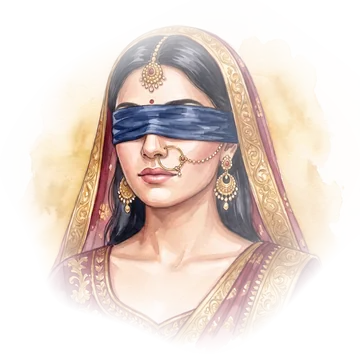
Gandhari is a princess of Gandhara who marries Dhritarashtra, the blind eldest prince of Hastinapura, and ties a cloth over her own eyes when she hears that he cannot see. In time she becomes the mother of the hundred Kaurava princes, with Duryodhana the eldest, and of their sister Duhshala. In Book Two she begs her husband to give up Duryodhana, and in Book Three, when all her sons have died in the war, she holds back her curse from the Pandavas and curses Krishna instead.
- Family
- Daughter of King Subala of Gandhara · sister of Shakuni · wife of Dhritarashtra · mother of Duryodhana and his ninety-nine brothers, and of their sister Duhshala
- Known for
- The blindfold she chose to wear for life, and her hundred sons, born from jars of ghee. After the war, the curse she lays on Krishna.
- First appears
- Book One, chapter 4, Three Princes and a Blindfold
Gandhari's story in Book One
A princess promised a hundred sons
Gandhari grew up in Gandhara, a mountain kingdom far to the northwest of Hastinapura. As a girl she prayed to the god Shiva, and he promised her a hundred sons. That promise is why Bhishma, the old guardian of the Kuru family, chose her as the bride for Prince Dhritarashtra. Her father, King Subala, hesitated when he heard the prince was blind. In the end he agreed.
Why did Gandhari wear a blindfold?
When word reached Gandhari that her groom was blind, she took a cloth and tied it over her own eyes. The old story gives her reason in a few words. It was love and respect for the man she was going to marry. From then on she would never see anything he could not. All this happened at home in Gandhara, before she had ever met him, and she meant never to take the cloth off.
Readers have argued about her choice for centuries. Some call it the most loyal thing a bride ever did. Others point out what it cost. She would never watch her children's faces as they grew up. And as Krishna says in the book, her husband, who most needed someone to be his eyes, now had a wife who had given hers away.
Arriving in Hastinapura
Her brother Shakuni brought her to Hastinapura in a chariot. Prince Vidura, Dhritarashtra's wise younger brother, watched her step down with one hand on Shakuni's arm and the cloth already over her eyes. The whole courtyard went silent.
Dhritarashtra asked what had happened, and Vidura told him that his bride had covered her eyes when she heard he was blind. Shakuni said that in Gandhara they had stopped arguing with his sister years ago. Dhritarashtra stood very still. Then he reached toward the sound of her anklets.
Two years of waiting
Years before, the sage Vyasa had come to Gandhari's door tired and hungry, and she had looked after him herself. He too promised her a hundred sons. When at last she was with child, she carried it for two whole years.
Then news came down from the mountains that Pandu's wife Kunti had a son. Gandhari wept. If Kunti's boy was the eldest of the young princes, one day the throne would be his.
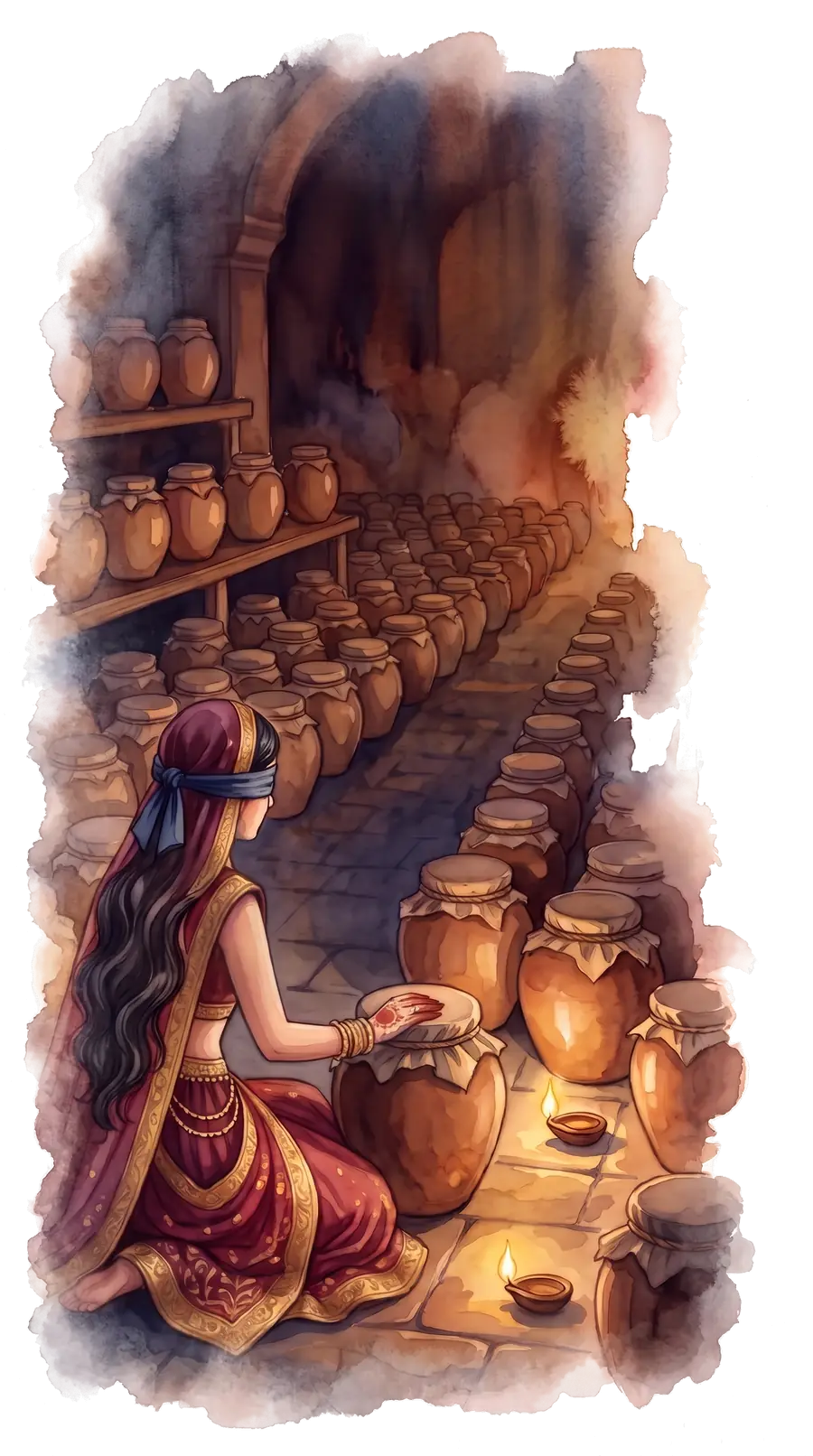
A hundred jars of ghee
At last her time came. What was born was a hard, cold lump, like a ball of iron. She was about to have it thrown away when Vyasa arrived. She told him he had promised her a hundred sons, and this was all she had.
Vyasa answered that he had never spoken a false word, not even in jest. He had a hundred jars of ghee hidden in a secret room and sprinkled the lump with cool water. It divided into a hundred pieces, each the size of a thumb, and then one more, because Gandhari had wished for a daughter too. So he sent for another jar.
Two years later the jars were opened. Within a month Gandhari had a hundred sons and a daughter, Duhshala. The eldest son was Duryodhana. At his birth the jackals howled all around the city. Vidura begged the king to give the baby up. Dhritarashtra held his son tighter and could not do it.
At the city gate
Years later, after Pandu died in the mountains, sages brought Kunti and her five sons home to Hastinapura. At sunrise the whole city came out to meet them. Gandhari stood at the gate beside her husband, with her hundred boys in their best jewels in front of them. Duryodhana looked hard at Bhima, the cousin born on the same day as he was. Bhima grinned at him. Duryodhana did not grin back.
Questions about Gandhari
Why did Gandhari blindfold herself?
The oldest telling gives one reason. When Gandhari heard that the prince she was to marry was blind, she covered her own eyes out of love and respect for him. She would never see anything her husband could not. This happened at home in Gandhara, before she had met him, and she meant to keep the cloth on for life.
Did Gandhari ever take off her blindfold?
No. She tied the cloth on as a young bride, meaning to wear it for the rest of her life, and every painting of her in The Vow shows the dark blue cloth over her eyes. In Book Three, The War, she has worn it for fifty years. After the war she glimpses Yudhishthira's toe through a gap at its lower edge, and by a gift from the sage Vyasa she sees the battlefield, and her dead son's face, with the cloth still on.
How many children did Gandhari have?
A hundred sons and one daughter. The sons are the Kauravas, and the eldest is Duryodhana. Her daughter is Duhshala, born from the hundred-and-first jar because Gandhari had wished for a girl too. Dhritarashtra also had a son, Yuyutsu, with a palace maid during Gandhari's long wait, so he was not hers.
Who is Gandhari's brother?
Shakuni, a prince of Gandhara. He brought his sister to Hastinapura for her wedding, a pair of ivory dice clicking in his fingers, and told everyone that nobody in Gandhara argued with her. He stays on at the Kuru court, close to his nephew Duryodhana, and he becomes one of the most important people in the story.
In Book Two: The Dice
Gandhari sits beside her husband with her blindfold on when the Pandavas arrive for the dice game (chapter 1). As jackals howl around the palace, she and Vidura go to the blind king and speak into his ear. He turns on Duryodhana and offers Draupadi any gift she likes, and she asks for her husbands' freedom (chapter 2).
When Duryodhana wants to call the Pandavas back for a second game, Gandhari reminds her husband of the jackals on the day their son was born. "Who mends a dam and then breaks it open again?" she asks, and she begs him to give their son up. He will not (chapter 3).
Years later, during Krishna's peace mission, Vidura leads her into the hall to speak to Duryodhana. She tells him that greed and anger are like wild horses, and that half the earth is enough for him. He turns his back on his mother and walks out (chapter 13).
In Book Three: The War
Gandhari has worn the cloth over her eyes for fifty years when the war ends and all her sons are dead. When the Pandavas come to her, a curse is already on her tongue. Vyasa reminds her that every morning of the war she told Duryodhana, "Where right is, there victory is," and she holds the curse back. Through a gap at the edge of her cloth she sees the tip of Yudhishthira's toe, and the nail goes dark as if a coal had touched it. Then she holds him the way a mother holds a son (chapter 11, The Mothers' Grief).
By a gift from Vyasa she sees the battlefield with the cloth still on, and for the first time she sees her son's face. Then she turns to Krishna. He could have stopped the war, she says, and she curses him. Thirty-six years from that day, his own kinsmen will kill one another. Krishna smiles a little and accepts it (chapter 11). The curse comes true at Prabhasa (chapter 14).
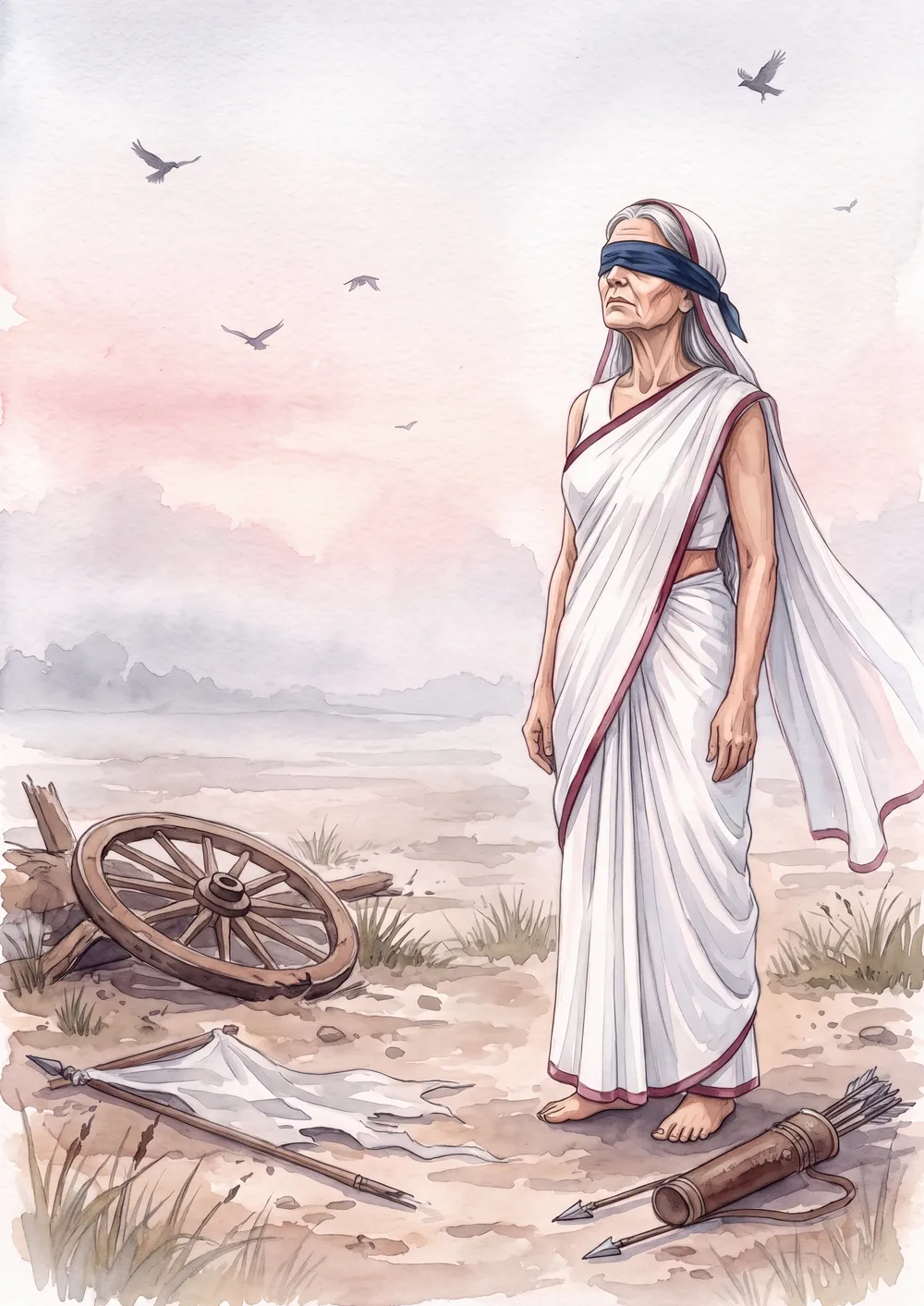
Fifteen years after the war she goes into the forest with Dhritarashtra and Kunti, her hand on Kunti's shoulder. One night Vyasa calls the dead up out of the Ganga, and Gandhari sees her sons. Two years after that, when a forest fire comes through the trees, she sits down with her husband and Kunti to meet it (chapter 13, The Last Walk into the Forest).
Where this comes from: Adi Parva §110 in the Ganguli translation for Shiva's promise and the blindfold, §115–116 for the jars of ghee, and §126 for the homecoming. As in Ganguli, Gandhari ties the blindfold at home when she hears the news; many retellings have her tie it when she arrives in Hastinapura. Shakuni's dice and his words in the courtyard are the book's own touch. The book tells the birth more gently than Ganguli does. Her pleas in Book Two are in Sabha Parva §66–79 and Udyoga Parva §124–137. Book Three follows the Stri Parva, §9–27, for her grief and her curse, and Ashramavasika Parva §1–37 for the forest. More about the sources.