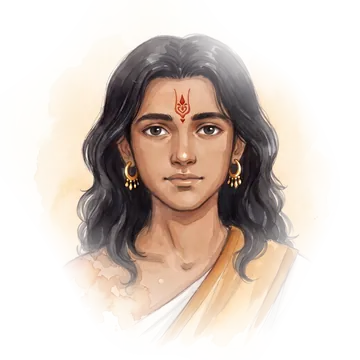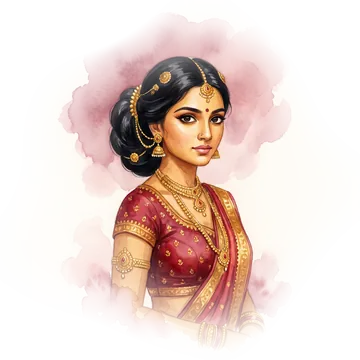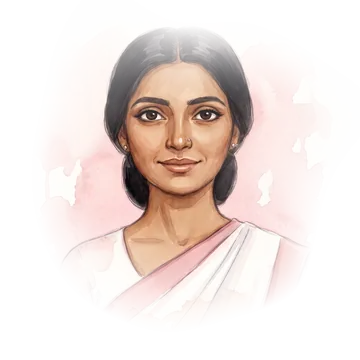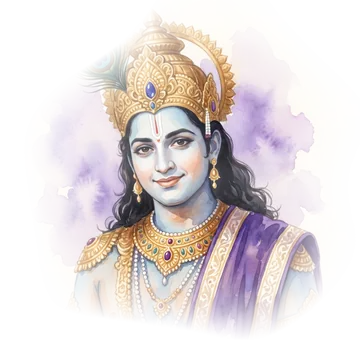
Krishna is a prince of the Yadavas of Dwaraka, the Pandavas' cousin and Arjuna's dearest friend. Hindus worship him as God. In Book Three he drives Arjuna's chariot in the war and speaks the Bhagavad Gita, and in all three books he is also the friend who asks the reader hard questions.
- Family
- Son of Kunti's brother, so cousin to the five Pandavas · elder brother Balarama · sister Subhadra, who marries Arjuna · cousin Shishupala, king of Chedi
- Home
- Dwaraka, the Yadava city on the western sea
- Known for
- The peacock feather in his crown · his flute · a blazing discus · his friendship with Arjuna · driving Arjuna's chariot and speaking the Bhagavad Gita · answering a question with another question
- First appears
- His questions begin in Book One, chapter 2, The Terrible Vow. In the story itself, Book One, chapter 15, The Fish in the Sky
God, and a friend
Many readers of these books have grown up with Krishna at home. Hindus worship him as God, as Vishnu born on earth, and his name is sung in temples and at family prayers all over the world. Children often know him first as the little boy who stole butter, or the cowherd with a flute.
In the Mahabharata he is also a grown man with cousins and friends. He laughs and makes plans. He makes choices, and he answers for them. The books show him that way, with care. They also let the larger truth show through. When he and Arjuna fight together at the Khandava forest in Book One, a voice from the sky says they are Nara and Narayana, two ancient sages born again. And when Bhishma gives him the first honor at the Rajasuya, he says Krishna is like the sun among lamps. On the battlefield in Book Three, he shows Arjuna who he really is.
The one who asks the questions
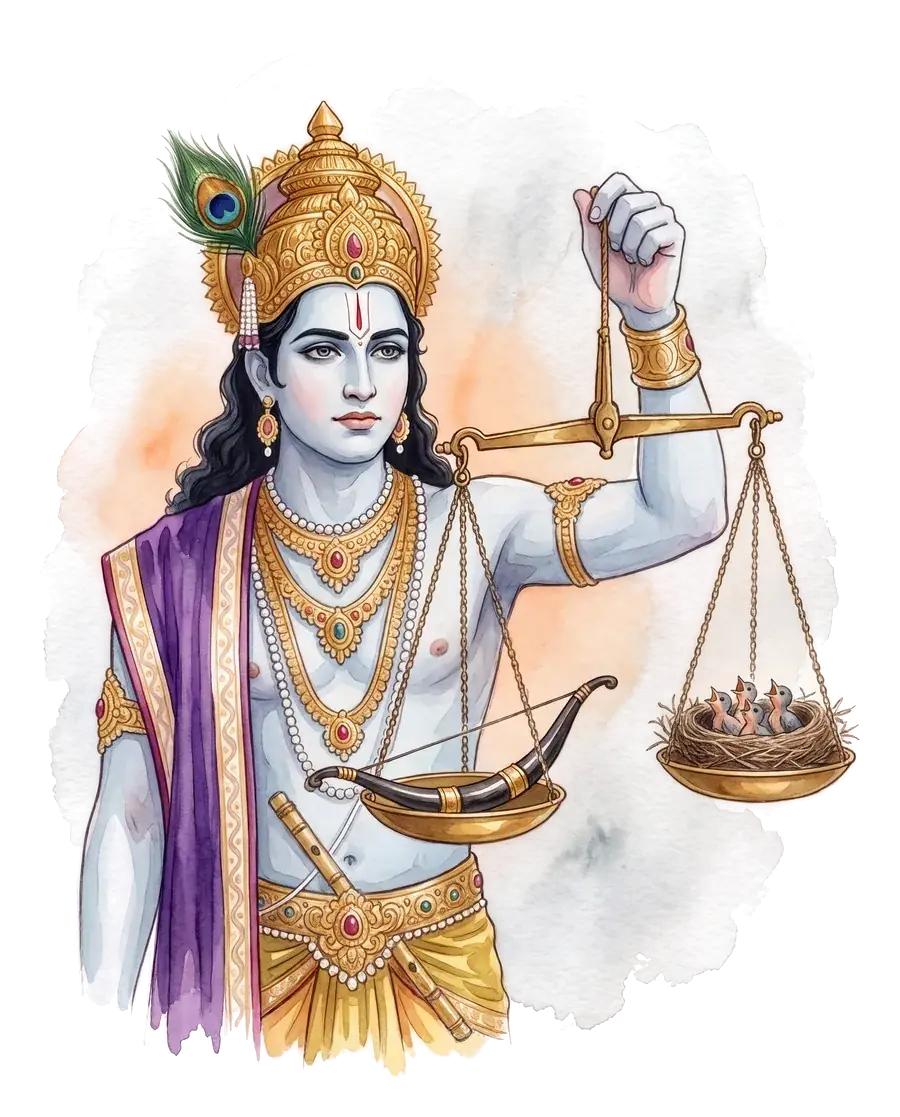
Krishna is in Book One long before he walks into the story. After key scenes in all three books, he holds up a brass balance scale and asks the reader about a hard choice someone has just made. He tells you what he saw, and often what he thinks. Then he asks what you think.
The first time is in Book One, chapter 2, after Bhishma's vow. "Was his promise an act of great love, a terrible mistake, or both?" Later his own choices go on the scale too. He was there when the Khandava forest burned, and he asks whether he and Arjuna were right to help. During the war in Book Three he hides the sun so that Jayadratha will step into the open, then asks whether that was fair.
His questions were written for these books, and you are free to argue with him. The books print no answers. Fifteen of them, five from each book, are in Krishna asks, where you can tap an answer. There is no wrong answer.
Krishna's story in Book One
He sees through a disguise (Chapter 15)
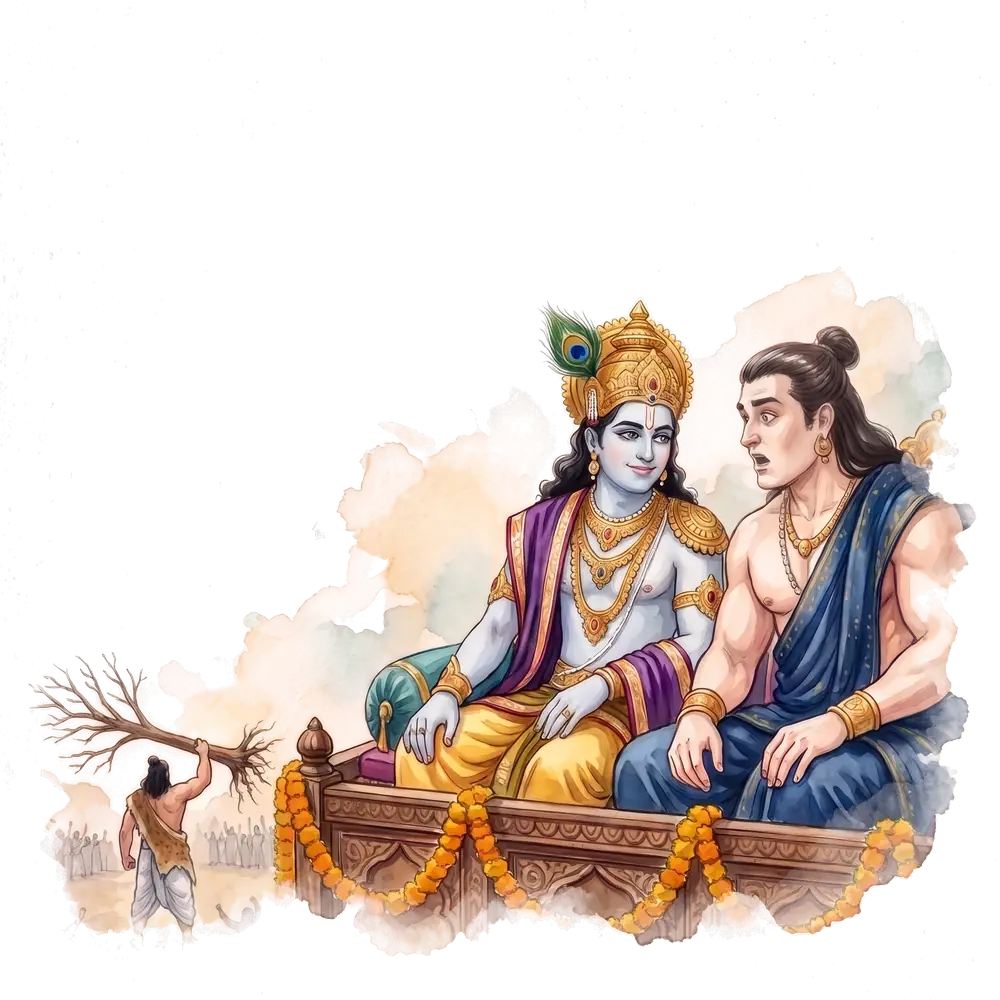
At Draupadi's swayamvara, king after king fails to string the great bow. Then a young man in a brahmin's deerskin strings it and shoots the golden fish. When the angry kings attack, his big friend pulls up a tree to fight with. Krishna does not leave his seat. He smiles, nods at the tree, then at the archer, and says something to his brother Balarama, whose mouth falls open. Krishna has guessed who they are. Then he stands and tells the kings the princess was won fairly, and they put down their bows.
He finds his cousins (Chapter 16)
That evening Krishna and Balarama find the Pandavas at a potter's house, where they have been hiding. Krishna touches Yudhishthira's feet and his aunt Kunti's. When Yudhishthira asks how he found them, Krishna says, "You can cover up a fire, cousin, and people still feel the heat." He stays while the brothers build their new city, Indraprastha, and makes Draupadi laugh with his stories of stolen butter.
He helps Arjuna win a bride (Chapter 17)
During Arjuna's twelve years away from home, Krishna takes him to Dwaraka. There Arjuna falls for Krishna's sister Subhadra. Krishna grins and tells him to carry her off, since a warrior may do that, and then he talks the angry Yadavas round to a proper wedding.
He burns the Khandava forest (Chapter 17)
A huge brahmin comes to Krishna and Arjuna by the Yamuna. He is Agni, the god of fire, sick from too much butter, and only the Khandava forest will cure him. Agni gives Krishna a blazing discus that always flies back to his hand. For fifteen days the two friends drive around the burning forest so fast that they look like one chariot with one man in it. When the god Indra offers each of them a gift, Krishna asks only that his friendship with Arjuna never end.
He brings down Jarasandha (Chapter 18)
Yudhishthira wants to hold the Rajasuya, the great sacrifice that makes a king an emperor. Krishna says it cannot be done while Jarasandha of Magadha lives, because he keeps eighty-six kings locked up and means to sacrifice them. So Krishna, Bhima and Arjuna go to him dressed as priests. Bhima and Jarasandha wrestle for thirteen days. When Jarasandha tires, Krishna splits a twig and tosses the halves apart, and Bhima understands. The captive kings walk free, and Krishna makes Jarasandha's son king of Magadha.
A hundred pardons (Chapter 18)
At the Rajasuya, Krishna gives himself the humblest job and washes the feet of the arriving brahmins. When Bhishma says the first honor should go to Krishna, his cousin Shishupala, king of Chedi, calls him a cowherd and stirs the kings to stop the sacrifice. Long ago Krishna promised Shishupala's mother he would pardon a hundred of her son's offenses. He has kept that promise through every wrong, even the burning of Dwaraka. Now the hundred are used up. His discus flies, and a light rises out of Shishupala, bows to Krishna and goes into him.
Afterward Krishna asks the reader, "Should patience ever run out, and if it does, who gets to decide when?" He says the choice was his, and that he answers for it.
Krishna and Arjuna
Their friendship is one of the great friendships in any story. In Book One it starts at the swayamvara, where Krishna recognizes Arjuna in his brahmin's deerskin. It grows on the road to Dwaraka, and it is sealed in the fire of Khandava, where the two of them stand side by side against the king of the gods.
The book tells why they fit together so well. In an older age, the story goes, they were the sages Nara and Narayana, one soul in two bodies. Nara was born again as Arjuna, and Narayana as Krishna. They are also cousins, and once Arjuna marries Subhadra, they are brothers-in-law too. Their friendship carries on through all three books. In Book Two, Arjuna chooses Krishna over his whole army, and in Book Three, The War, Krishna drives his chariot.
In Book Two: The Dice
Krishna is far away, fighting a war of his own, when the dice game is played. In the hall Draupadi calls on him, and her cloth never ends. Once she tore a strip from her own cloth to bind his cut finger, and he had not forgotten (chapter 2). He visits the Pandavas in the forest and promises Draupadi she will be a queen again (chapter 4). The sage Durvasa arrives with ten thousand hungry disciples, and Krishna eats one grain of rice from Draupadi's empty pot, and the sages run off full (chapter 7).
When Duryodhana and Arjuna both come to his bedside to ask for help, Krishna offers one of them his army of a hundred million and the other himself, unarmed. Arjuna chooses Krishna, who will drive his chariot in the war (chapter 12). Krishna goes to Hastinapura to ask for peace, or only five villages. He eats at Vidura's house after refusing Duryodhana's feast, and when Duryodhana's friends plan to seize him, he lets the hall see who he is (chapter 13, The Peace Mission). On the road out of the city he tells Karna who his mother is and offers him the whole earth (chapter 14).
After the rules of war are agreed, Krishna puts the rules themselves on his scale. "Do fair rules make a war fairer, or only easier to fight?" (chapter 15).
In Book Three: The War
On the first morning Arjuna lays down his bow between the armies, and Krishna answers him with the Bhagavad Gita. He tells Arjuna to do his work without fighting for the prize, then shows him his true form. "I am Time, which destroys the worlds," he says (chapter 1). Twice he breaks his promise not to fight and runs at Bhishma, and twice Arjuna stops him (chapter 2).
Krishna's plans win the war, and in his own questions he asks readers whether they were fair. He hides the sun so that Jayadratha will step into the open (chapter 4). He sends Ghatotkacha against Karna, so that Karna must use the spear he saved for Arjuna, and he asks Yudhishthira to tell Drona that Ashwatthama is dead (chapter 6). When Karna's wheel sinks, he tells Arjuna to shoot (chapter 8).
After the war Gandhari blames him for not stopping it and curses his people, and he accepts the curse (chapter 11). He brings Abhimanyu's son Parikshit to life on the day he is born dead (chapter 13). Thirty-six years after the war the Yadavas kill one another at Prabhasa. A hunter named Jara takes Krishna for a deer and shoots him in the heel, and Krishna rises out of his body into the sky (chapter 14, The Fall of the Yadavas). In heaven Yudhishthira sees him in his own true form, with Arjuna at his side (chapter 15).
Questions about Krishna
Who is Krishna in the Mahabharata?
Krishna is a prince of the Yadavas, who rule from Dwaraka on the western sea. His father is Kunti's brother, so the five Pandava brothers are his cousins. He becomes Arjuna's closest friend and helps the Pandavas at every turn. In Book One he first steps into the story at Draupadi's swayamvara, in chapter 15, and in Book Three he drives Arjuna's chariot in the war and speaks the Bhagavad Gita.
Is Krishna God in the Mahabharata?
For millions of Hindus, yes. They worship Krishna as God, as Vishnu born on earth. The Mahabharata shows him both ways, as a cousin and a friend who laughs and makes choices, and as someone far greater. In Book One a voice from the sky names him Narayana, and at the Rajasuya a light rises and goes into him. Before the war in Book Three, he shows Arjuna who he really is.
How are Krishna and Arjuna related?
They are cousins, since Arjuna's mother Kunti is the sister of Krishna's father. They become brothers-in-law too, when Arjuna marries Krishna's sister Subhadra. Above all they are friends. They fight side by side at the Khandava forest in Book One, and Krishna asks the god Indra for one gift only, that his friendship with Arjuna never end. Through the war in Book Three, Krishna drives Arjuna's chariot.
Why does Krishna ask questions in the books?
After key scenes in all three books, Krishna holds up a brass scale and asks the reader about a hard choice someone has just made. Sometimes the choice is his own, as when he hides the sun in Book Three. The questions were written for these books and have no printed answers. They are meant for talking over at home or in class, and readers are free to disagree with him.
Where this comes from: Krishna's part in Book One follows the Ganguli translation, Adi Parva §187–236 (the swayamvara, the potter's house, Subhadra and the Khandava forest) and Sabha Parva §1–44 (Maya's hall, Jarasandha, the Rajasuya and Shishupala). In Ganguli, Bhima breaks Jarasandha in two with no signal from Krishna, and the split twig comes from popular tellings. Krishna's stories about stolen butter come from later tales of his childhood. His questions to the reader were written for these books. In Book Two the cloth follows popular retellings (in Ganguli, Sabha Parva §66–72, the god Dharma covers Draupadi), and the bedside and the peace mission follow Udyoga Parva §1–8 and §83–146. Book Three follows Bhishma Parva §25–43 for the Gita and Mausala Parva §1–8 for the end of the Yadavas. More on each chapter's sources is on Where the stories come from.