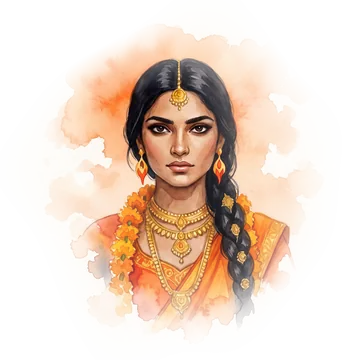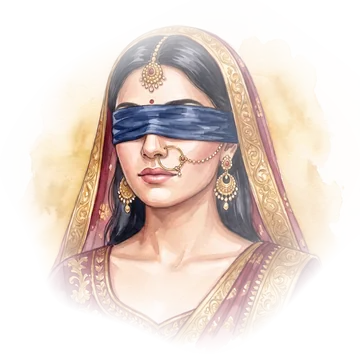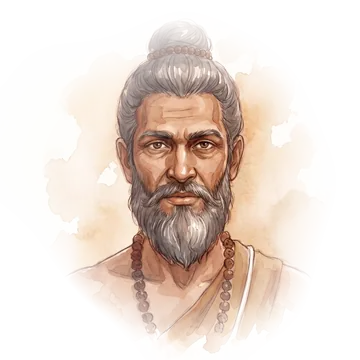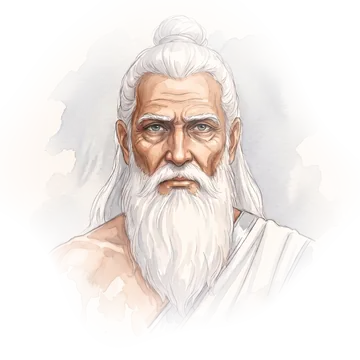
Bhishma is the prince who gave up a throne with a single vow. The son of King Shantanu and the river goddess Ganga, he was first named Devavrata, and he promised never to marry or have children so that Satyavati's son could be king. In Book Three he leads Duryodhana's army for the first ten days of the war, and after Arjuna brings him down he teaches Yudhishthira how to rule from a bed of arrows.
- Family
- Son of King Shantanu and the river goddess Ganga. Queen Satyavati is his stepmother, and her son Vichitravirya is his half-brother. He has no wife and no children.
- Known for
- His terrible vow. He is the greatest warrior of his day, and even his own teacher, Parashurama, cannot beat him. The bed of arrows he lies on after he falls in the war.
- Called
- Devavrata as a boy. Bhishma, the terrible one, after his vow. The young princes call him Grandsire.
- First appears
- Book One, chapter 1, The River Goddess
Bhishma's story in Book One
A son of the river
King Shantanu's queen carried seven newborn sons down to the river and let the current take them. At the eighth, the king cried out. She told him she was the goddess Ganga, and that the boys were gods under a curse, now set free. She took the last baby with her, to raise him herself.
Years later, Shantanu found the river running shallow. A young man had shot a wall of arrows across it, so close together that the water could not get through. Ganga rose from the river holding his hand. This was their son, Devavrata. He had learned the Vedas from the sage Vasishtha and every weapon that Parashurama knew. The king took him home and made him crown prince.
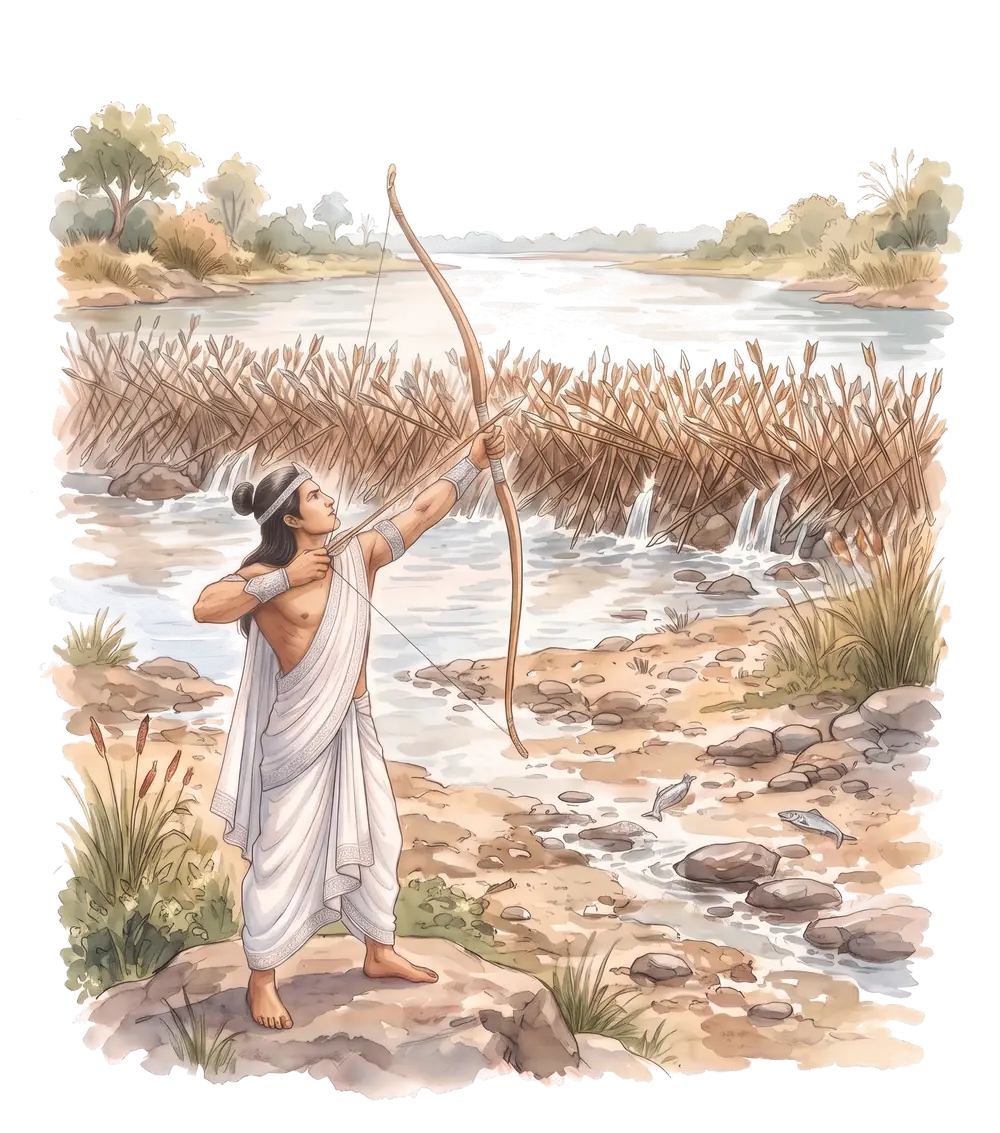
Why did he take his vow?
Four years later, Shantanu stopped eating. He had met Satyavati, a fisher chief's daughter who rowed a ferry on the Yamuna. Her father would let her marry the king only if her son became the next king.
Devavrata rode to the fishing village and gave up the throne. The fisher chief still worried. Devavrata's own sons might want it back one day. So the prince stood up in the chief's hall and swore that he would never marry and never have a child. Flowers fell from the sky, and voices called out a new name, Bhishma, the terrible one. Shantanu blessed his son with a strange gift. Death would not come for him until he allowed it. The story of Bhishma's vow tells it in full.
Bhishma and Amba
After Shantanu died, Satyavati's son Vichitravirya became king while still a boy, and Bhishma ruled for him. To find the young king a wife, Bhishma went to the swayamvara of the three princesses of Kashi, carried all three off in his chariot, and beat every king who chased him.
The eldest, Amba, had already chosen King Shalva. Bhishma let her go to him, but Shalva would not take her back. Bhishma would not break his vow to marry her either. His old teacher Parashurama fought him for twenty-three days and could not win. So Amba vowed to bring Bhishma down herself, and the god Shiva promised that one day she would.
Keeping his word
Vichitravirya died young and left no son. Satyavati begged Bhishma to take the throne and marry after all. He refused. "The sun may give up its light," he told her. "I will not give up my word." When she wept, he knelt at her feet. He asked her to find a holy man to bless the widows with sons. Satyavati sent for the sage Vyasa, and three sons were born in the palace. Bhishma raised all three boys as his own sons. When Dhritarashtra, the eldest, was grown, Bhishma chose Gandhari as his bride.
Grandsire to a hundred and five boys
When Pandu died in the forest, Kunti came home to Hastinapura with Pandu's five sons, and Bhishma was at the city gate to meet them. Now the palace held the five Pandavas and Dhritarashtra's hundred sons. Bhishma was really their grandfather's brother. Every boy called him Grandsire, and when they quarreled, he settled it.
One day the princes ran back from a well, out of breath. A stranger there could do anything with a bow. Bhishma knew at once who it was. He went out to welcome Drona himself and asked him to teach the princes every weapon.
At Yudhishthira's great sacrifice
Years later, Yudhishthira held a royal sacrifice at Indraprastha, and kings came from every direction. Bhishma stood up and said the first honor should go to Krishna, "like the sun among lamps." King Shishupala jeered at them both. He mocked Bhishma for carrying off Amba and for having no son. When Bhima leaped up to fight him, Bhishma held him back by the arm and told him the story of Shishupala's hundred pardons.
Questions about Bhishma
What does the name Bhishma mean?
Bhishma means the terrible one, in the way a mountain or a monsoon is terrible, too big to argue with. Voices from the sky called him that on the day of his vow, while flowers fell around him. Say it BHEESH-ma. Before the vow he was Prince Devavrata, said day-VAV-ra-ta.
Is Bhishma the Pandavas' grandfather?
Not quite. He is their grandfather's brother. Bhishma's father, King Shantanu, married again. His second wife, Satyavati, had a son named Vichitravirya, who was the princes' grandfather. Bhishma raised their fathers, Dhritarashtra and Pandu, himself. So the five Pandavas and the hundred Kaurava brothers all called him Grandsire, an old word for grandfather.
Who taught Bhishma to fight?
His mother, the river goddess Ganga, sent him to the greatest teachers in the three worlds. He learned the Vedas from the sage Vasishtha and every weapon from Parashurama, the fiercest warrior alive. The teachers of the gods and of the demons showed him how a kingdom is kept. Years later, even Parashurama could not beat him.
Why did Bhishma carry off Amba?
He wanted brides for his young half-brother, King Vichitravirya. The law of warriors let a prince carry off a bride if he could beat every king who came after her, so he took all three princesses of Kashi. Nobody asked them. When Amba said she had already chosen King Shalva, Bhishma let her go, but Shalva turned her away.
In Book Two: The Dice
Bhishma sits behind the blind king in the new dice hall while Yudhishthira loses everything to Shakuni (chapter 1). When Draupadi is dragged in and asks whether a man who has lost himself can stake his wife, Bhishma answers without lifting his eyes. "What is right is a subtle thing, child," he says, and he tells her he can't decide it (chapter 2). When Duryodhana wants a second game, Bhishma asks for peace, and the king will not listen (chapter 3).
At the cattle raid, Arjuna's weapon puts the Kuru chiefs to sleep in their chariots, and only Bhishma stays awake. He sends Duryodhana home and lets Arjuna take back the cows (chapter 11). Afterward he counts the years by the moon and its extra months, and says the Pandavas have kept every word of their promise (chapter 12).
When war comes, Duryodhana asks him to lead the army, and Bhishma agrees because he gave his word. "I'll kill ten thousand of their soldiers every day," he says. "I won't kill them." He quarrels with Karna, who refuses to fight while Bhishma lives. He also names one prince on the Pandava side he will never raise a weapon against, Drupada's son Shikhandi, and telling why takes him the rest of the night (chapter 15).
In Book Three: The War
On the first morning, Yudhishthira takes off his armor, walks across the field to Bhishma's chariot and asks for his blessing. Bhishma gives it, and still goes back to fight, because Duryodhana's wealth has kept him all these years (chapter 1). For ten days he leads eleven armies. Twice Krishna jumps down from Arjuna's chariot and runs at him, and both times Bhishma holds his fire and asks Krishna to strike (chapter 2).
On the ninth night the five brothers come to his tent unarmed and ask how he can be beaten. He tells them. He will not fight anyone who was born a woman, so they should put Shikhandi in front of Arjuna's chariot. On the tenth day Shikhandi rides in front, Bhishma will not shoot at him, and a little before sunset Arjuna's arrows bring the old man down. He lies on a bed of arrows, and Arjuna gives him a pillow of three more. When Karna comes to him alone, Bhishma tells him he knows Karna is Kunti's son. "I never hated you," he says (chapter 2, The Grandsire's Ten Days).
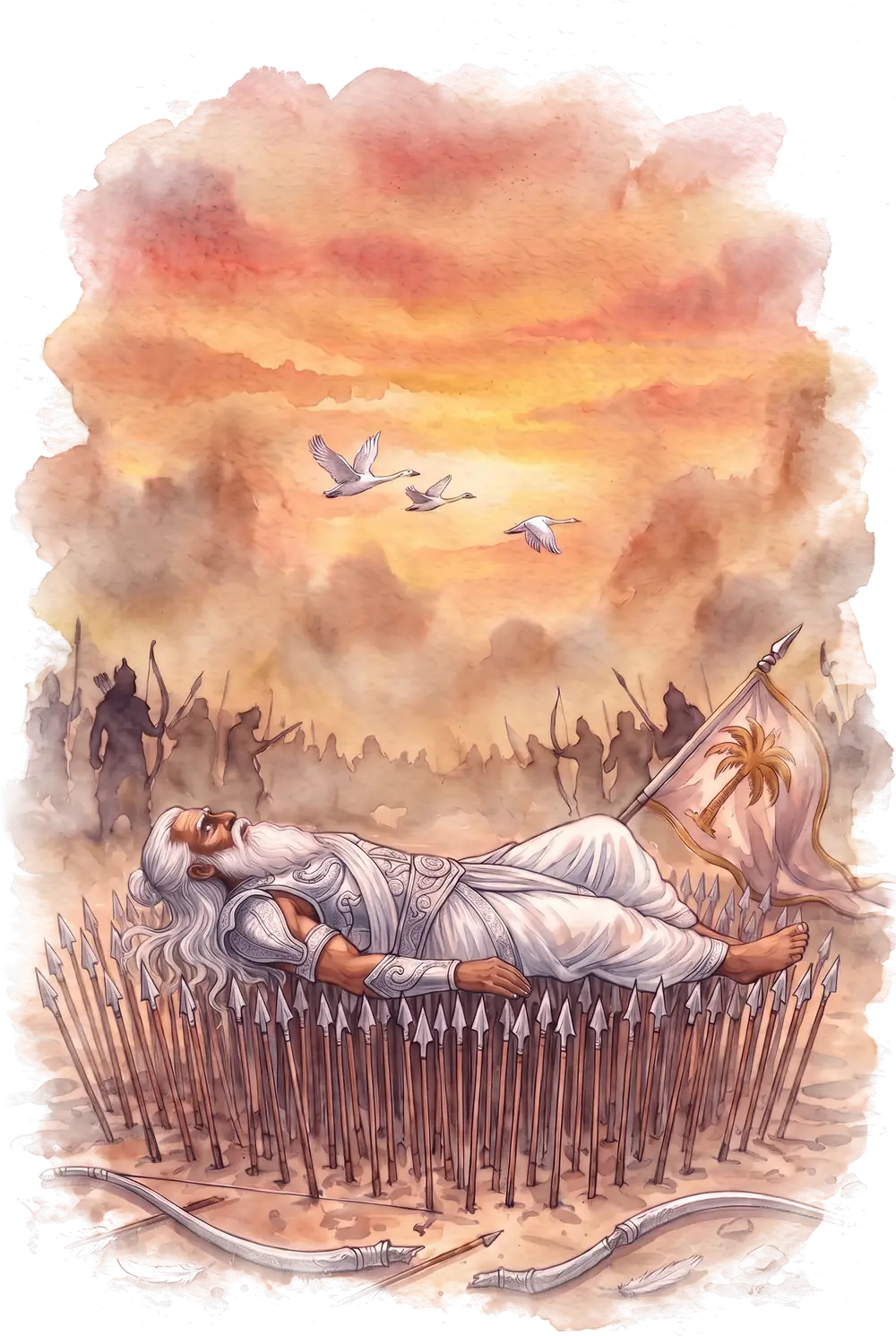
Bhishma waits fifty-eight nights for the sun to turn north. In those days he teaches Yudhishthira how to rule, and tells him why the rivers carry great trees to the ocean and never a reed (chapter 12, Lessons from a Bed of Arrows). When the time comes, he asks Krishna for leave to go, tells everyone to hold on to truth, and dies. At his funeral the river goddess Ganga rises weeping from the water. In heaven Yudhishthira finds him back among the Vasus, his brothers (chapter 15).
Where this comes from: Adi Parva §96–100 for Bhishma's birth and his vow, §101–102 for the princesses of Kashi, and §102–133 for the princes' childhood and Drona's arrival. Amba's story is in the Udyoga Parva §175–190, where Bhishma tells it himself, and the royal sacrifice is in the Sabha Parva §35–44. All are in the Ganguli translation. In Ganguli, the young prince stops the river with a celestial weapon; the wall of arrows is how this book paints it. Ganguli has flowers falling after the vow, and the thunder in the book was added. In Book Two his command and his promise about Shikhandi follow Udyoga Parva §156–197. Book Three follows Bhishma Parva §43–124 for his ten days, and Shanti Parva §1–56 and Anushasana Parva §166–168 for his lessons and his death. See Sources for every chapter.