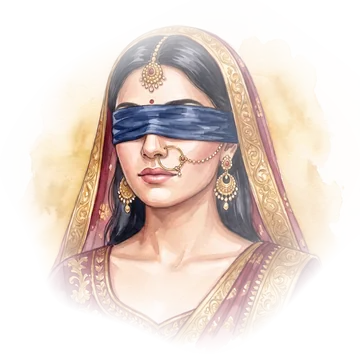
Amba is the eldest princess of Kashi in the Mahabharata. Bhishma carried her off from her own swayamvara as a bride for his young brother, and when the king she loved would not take her back, she swore to bring Bhishma down. In Book Three she is born again as Drupada's child Shikhandi, and Bhishma, who will not shoot at Shikhandi, falls in the war.
- Family
- Daughter of the king of Kashi. Older sister of Ambika and Ambalika. She had chosen Shalva, king of Saubha, as her husband.
- Known for
- Twelve years of hard vows, and the god Shiva's promise that in another life she would bring Bhishma down. In Book Three that life comes, as Shikhandi.
- First appears
- Book One, chapter 3, Amba's Fire
Amba's story in Book One
Who did Amba want to marry?
Amba had made up her mind long before her swayamvara, the ceremony where a princess walks among the kings and hangs her garland on the one she chooses. She had chosen Shalva, the young king of Saubha, and he had chosen her. Her father had given his blessing. On the day, she stood in the gallery of her father's hall in Varanasi with her two younger sisters, a marigold garland in her hands, waiting for the herald to finish the names.
Why did Bhishma carry Amba off?
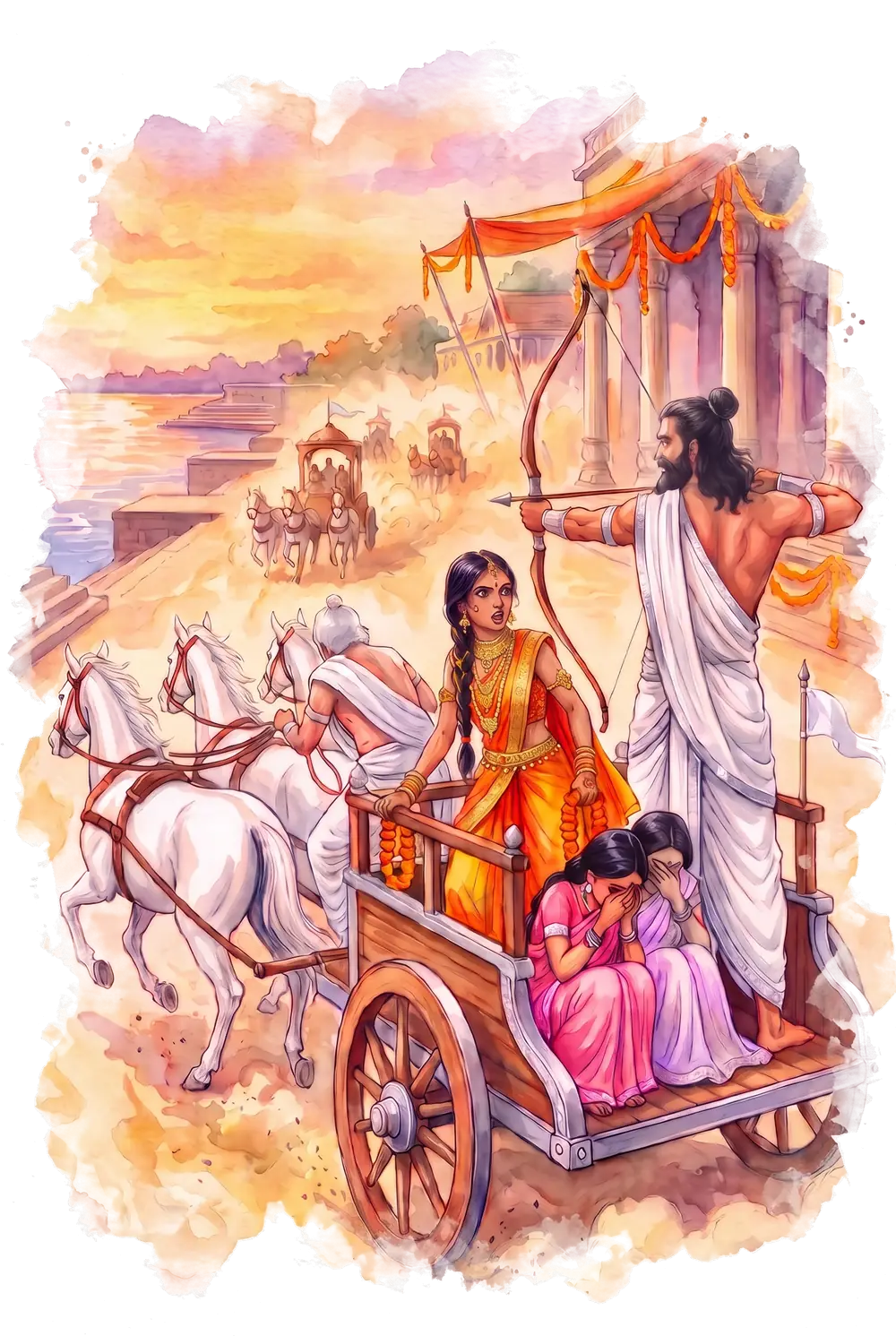
Bhishma had sworn never to marry, so he did not want a bride for himself. His half-brother Vichitravirya had just become king of Hastinapura while still a boy, and Bhishma ruled for him. The boy needed a wife. Bhishma walked into the hall alone, told the kings that the law of warriors let a man carry off a bride if he could beat everyone who came after her, and took all three princesses. Nobody asked them anything.
The kings chased the chariot. Shalva chased it too, calling on Bhishma to turn and fight. Bhishma shot down his charioteer and his horses, let him live, and drove on. By then Amba had crushed her garland to pulp.
Why did Shalva refuse Amba?
In Hastinapura, while the palace got ready for the weddings, Amba went to Bhishma and told him she had already chosen Shalva. Bhishma talked it over that evening with his mother and his counselors. The next morning he let her go. She traveled to Saubha with a few old priests and her nurse.
Shalva would not even come down from his seat. He said another man had won her, and that she had gone with Bhishma gladly. Amba told him she had been taken by force and had cried the whole way. Shalva turned his face away. He had already admitted the real reason: "I'm afraid of Bhishma."
Did anyone help Amba?
Her mother's father, an old king who had become a hermit, wept at her story and sent her to Parashurama, the warrior-sage who had taught Bhishma to fight. Parashurama called his old student to the plain of Kurukshetra and told him to take her back. Bhishma refused. He could not give her to his brother, he said, because she had chosen Shalva first, and he had sworn never to marry. He would not break his word out of fear, not even for his teacher.
Teacher and student fought for twenty-three days with the weapons of the gods. Parashurama could not win. Afterward he told Amba to go to Bhishma and ask for his protection. She said she would never go to him again, and that she would find a way to kill him in battle herself.
What did Shiva promise Amba?
Amba took the hardest vows a hermit can take. For six months she lived on air alone. She stood for a year in the cold water of the Yamuna, where Bhishma's mother, the river goddess Ganga, rose beside her and asked why she tormented herself. "To destroy Bhishma," Amba said. Ganga told her she would never do it. Amba kept going for twelve years in all, though her family begged her to stop.
At last the great god Shiva stood before her. He promised that she would bring Bhishma down. It would not happen in this body. She would be born again in a king's family, become a warrior fierce enough to face him, and remember everything.
How does Amba's story end in Book One?
On the bank of the Yamuna, Amba built a pyre of driftwood and walked into the fire, saying it was for Bhishma's destruction. The book tells this in a single sentence and shows only her shadow against the flames at dusk. It gives her death weight and no detail.
Bhishma had kept spies on her trail all those years. When one of them told him what she had done, Bhishma thanked him and went back to the archery ground. His first arrow missed the target. On the riverbank, the wind carried the ash away.
Is Amba mentioned again in Book One?
Her sisters Ambika and Ambalika married the boy king, and in Chapter 4 they are left young widows when he dies; their sons by the sage Vyasa are Dhritarashtra and Pandu. Years later, at the great ceremony in the Palace of Illusions, King Shishupala throws Amba's name in Bhishma's face: "You carried off Amba against her will." Shishupala means to wound, and he is also telling the truth. Shiva's promise is still waiting when Book One ends.
In Book Two: The Dice
Amba is named only once, when Ganesha retells Bhishma's vow in The Story So Far. "A princess named Amba paid first." In chapter 15, Bhishma says he will never raise a weapon against Drupada's son Shikhandi, and it takes him the rest of the night to say why.
In Book Three: The War
Shiva's promise comes true in the tale "Amba Born Again" (chapter 2, The Grandsire's Ten Days). Amba is born again as Drupada's child Shikhandi, a girl raised as a prince, who lives on as a man after a kind yaksha trades shapes with her. Ten days into the war, Shikhandi rides in front of Arjuna's chariot, and Bhishma, who will not shoot at him, falls to Arjuna's arrows.
Where this comes from: Adi Parva §101–102 and the Udyoga Parva §175–190 in the Ganguli translation, where Bhishma tells Amba's story himself; Shishupala's words are in the Sabha Parva. As in Ganguli, Amba speaks up in Hastinapura (many retellings have her speak in the chariot), and her pyre is on the bank of the Yamuna. Bhishma naming his own vow as a reason to refuse her is the book's addition. Her next life as Shikhandi, told in Book Three, follows Udyoga Parva §190–195. More in Where the stories come from.