Mock trial · Book Three
Mock Trial Cases from The War
Five ready cases for a classroom mock trial, from The War, Book Three of an illustrated Mahabharata for readers 10 to 16: Arjuna and the Grandsire, six against one boy, "Ashwatthama is dead", the sinking wheel, and the blow below the waist. Each has the charge, the evidence with chapter numbers, witnesses and questions for both teams. The roles, the plan and the rubric are in the mock trial kit.
Chapter numbers are the book's own. Every case is a death in battle, and the cases stay where the book does: on the choice, the rule and the reasons each side gave. The rules of war both sides agreed are in Book Two, chapter 15.
The cases
Case 1: Arjuna and the Grandsire
The charge. Arjuna, third of the five Pandava brothers, is charged with bringing down Bhishma, the Grandsire who raised him, by shooting at him from behind Shikhandi, the one warrior Bhishma had said he would never fight.
Evidence from the book
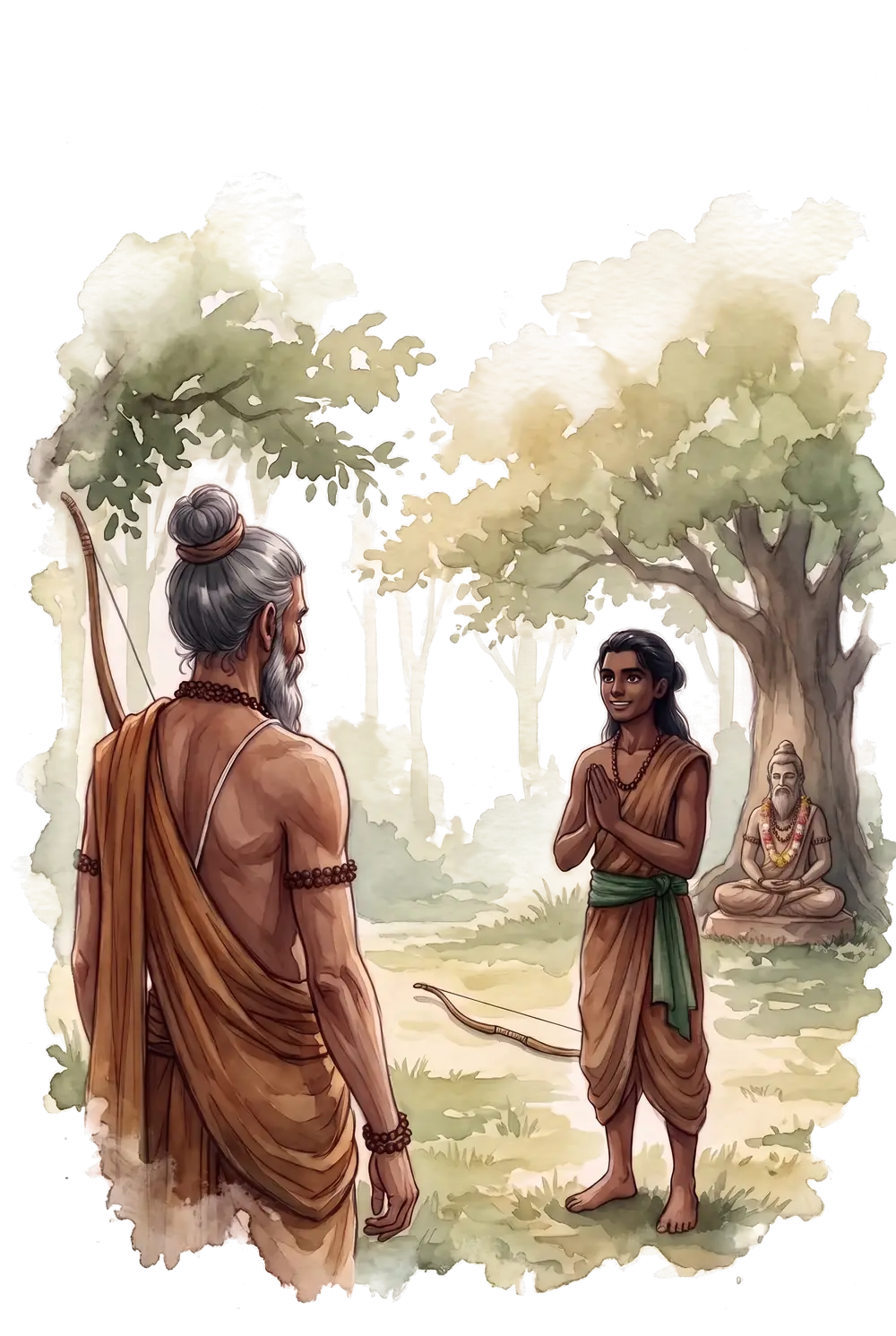
- On the first morning of the war, Yudhishthira asked Bhishma how anyone could beat him. "Nobody can, not yet," Bhishma said. "My time hasn't come. Come back to me another time." (Chapter 1)
- For nine days Bhishma kept his promise to Duryodhana of ten thousand Pandava soldiers a day. Arjuna "fought him gently, the way a pupil fights his teacher." (Chapter 2)
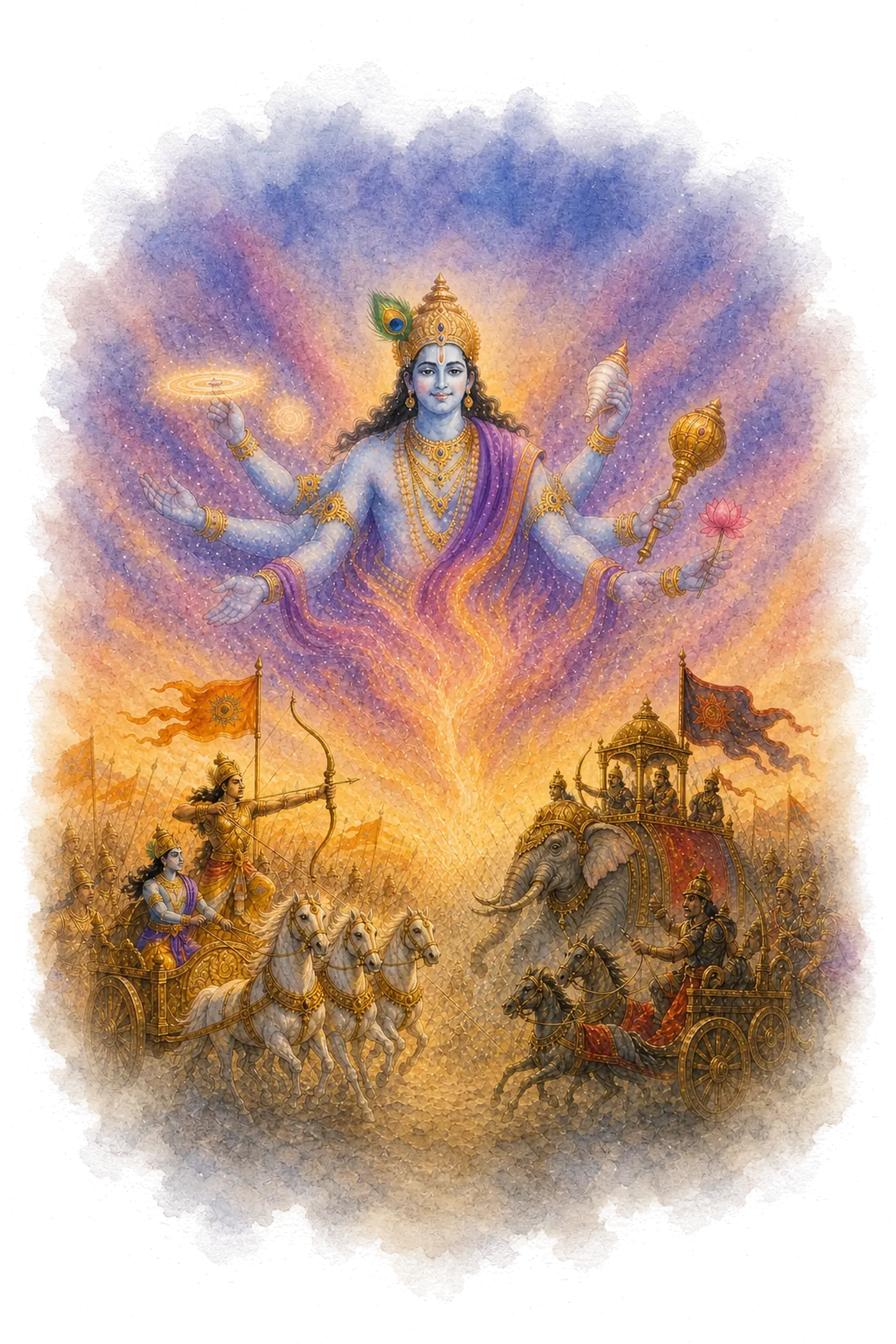
- Twice Krishna jumped down from the chariot to fight Bhishma himself, and twice Arjuna stopped him. The second time Arjuna said, "This is my burden. Leave the Grandsire to me." (Chapter 2)
- On the ninth night the five brothers went to Bhishma's tent unarmed. He told them, "While I live, you can't win," and "So bring me down, and soon. If you didn't know that, this would go on for days, and thousands more would die." (Chapter 2)
- Bhishma named the way himself: "Put Shikhandi in front of Arjuna's chariot, and let Arjuna shoot at me from behind. I won't raise my bow against Shikhandi." (Chapter 2)
- Bhishma said, "I won't fight a woman, or anyone who was born a woman." The chapter's Tale Within the Tale tells how Amba was born again as Drupada's child Shikhandi, raised as a prince, and later became a man by trading shapes with a kind yaksha. (Chapter 2)
- When the brothers left the tent, Arjuna went last. "At the door he looked back, and his face was wet." (Chapter 2)
- On the tenth day Shikhandi rode in front of Arjuna's chariot. "Bhishma looked at him once and would not shoot at him." He turned his bow on Arjuna instead, and Arjuna cut it in two, and the next, and the next. (Chapter 2)
- The book says, "This was the hour to let them bring him down." Voices from the sky told Bhishma, "What you have decided is good, child." (Chapter 2)
- "These arrows are not Shikhandi's," he told Duhshasana, and he smiled. (Chapter 2)
- After he fell, Bhishma laughed at the kings' soft pillows and asked Arjuna for "a pillow fit for this bed." In the morning he asked Arjuna again, for water. (Chapter 2)
- On the night after the war, Ashwatthama listed what the Pandavas had done: "They hid behind Shikhandi to shoot the Grandsire, because they knew he wouldn't fight back." (Chapter 10)
- Weeks later, Yudhishthira was afraid to face the Grandsire on his bed of arrows. "A warrior who is challenged has to fight," Bhishma said. "Even his own grandsire, if his grandsire stands on the wrong side." (Chapter 12)
Witnesses
Bhishma, who can speak from his bed of arrows. Shikhandi, who rode in front of Arjuna's chariot. Yudhishthira, who asked the Grandsire how he could be beaten. Ashwatthama, who called it hiding behind Shikhandi.
Questions for the prosecution
- Bhishma would never raise his bow against Shikhandi. Is it fair to turn a man's own vow against him?
- Bhishma would not shoot back at Shikhandi, and Arjuna knew it. Was the fight still fair?
- Arjuna had held back for nine days. Why did he go along with this plan on the tenth?
Questions for the defense
- Who told the Pandavas how to bring Bhishma down? Can a man be cheated by a plan he gave them himself?
- Bhishma said thousands more would die if the fighting went on for days. Did ending it sooner save lives?
- Bhishma asked Arjuna for his pillow and his water, and later said a warrior who is challenged has to fight. Does the Grandsire himself blame Arjuna?
After the verdict, you can tell the class what the old text adds. In the Ganguli translation, too, it is Bhishma who tells the brothers in his tent how he can be brought down (Bhishma Parva §108). The memory of the small boy climbing into the Grandsire's lap and calling him "Father" is there as well, though in Ganguli it is Arjuna who remembers it, as he walks away from the tent.
Case 2: Six against one boy
The charge. Drona, commander of the Kaurava army, and Karna are charged, with the warriors who fought beside them, with breaking the rules of war. Six of them closed around Abhimanyu, Arjuna's sixteen-year-old son, when he was alone inside their army, and they struck at him after his weapons were gone.
Evidence from the book
- Both armies had agreed on the rules. "No one was to strike a man who was already fighting someone else, or had lost his weapon, or was running away or asking for mercy." (Chapter 2)
- Drona drew up his army like a great wheel, and only a few people knew how to break into it. Abhimanyu told Yudhishthira, "My father taught me how to break into it," and "If anything goes wrong in there, I don't know how to get out." (Chapter 3)
- He broke in alone. Behind him, Jayadratha held the gap against all four of his uncles. "The ranks closed. Abhimanyu was alone inside the wheel." (Chapter 3)
- Drona watched him go by and called out to Kripa, "I don't know a bowman alive who's his equal." Duryodhana shouted that Drona was protecting him. (Chapter 3)
- "Six of the greatest fighters on the Kaurava side surrounded Abhimanyu: Drona and his son Ashwatthama, Kripa, Karna in a new chariot, Kritavarma, and the king of Kosala." (Chapter 3)
- Drona told the others how to beat him: "But you can cut his bow, and his reins, and his horses, and the men who guard his wheels. Take the bow first, Karna." (Chapter 3)
- Karna cut his bow, Kritavarma killed his horses, and Kripa struck down the men who guarded his wheels. When Abhimanyu fought on foot, Drona cut his sword at the hilt and Karna's arrows split his shield. (Chapter 3)
- He fought on with a chariot wheel, and then a mace. In the end, as Krishna says, they "struck him down as he got up from the ground." (Chapter 3)
- Voices high above the field said, "Six of them, against one boy on foot. That was wrong." (Chapter 3)
- Abhimanyu had fought hard that day. He drove off Duhshasana, cut Karna's bow in two, and killed Lakshmana, Duryodhana's son, and the king of Kosala. (Chapter 3)
- Back in the camp, Yudhishthira said, "It was me," and then, "I sent him in." (Chapter 3)
- Days later, Krishna asked Karna, "Where was it when Abhimanyu was fighting six of you by himself, and you cut his bow so the others could reach him?" Karna hung his head and did not answer. (Chapter 8)
Witnesses
Sumitra, Abhimanyu's charioteer, who warned him that Drona was the greatest master of weapons alive. Kripa, who heard Drona praise the boy. Jayadratha, who held the gap. Yudhishthira, who asked Abhimanyu to go in.
Questions for the prosecution
- The rules say nobody strikes a man who has lost his weapon. How many times did Abhimanyu lose his weapon that day?
- Drona said no bowman alive was the boy's equal. Why did he then show the others how to beat him?
- When Krishna asked Karna about it, Karna hung his head. What does his silence tell the jury?
Questions for the defense
- Abhimanyu had just killed Duryodhana's son and a king. Should a warrior that strong be treated like a child?
- Duryodhana screamed at his warriors to kill the boy, and Drona was his commander. Who gave the order, and who had to obey?
- Yudhishthira sent him in knowing he didn't know the way out. How much of the blame belongs to his own side?
After the verdict, you can tell the class what the old text adds. Some retellings say Karna cut Abhimanyu's bow from behind. The Ganguli translation has Karna cut it at Drona's word while the boy is shooting (Drona Parva §46), and the book follows it. The chapter's tale "Half a Lesson", where the unborn Abhimanyu hears only half of how to break the wheel, comes from a well-loved later telling.
Case 3: "Ashwatthama is dead"
The charge. Yudhishthira, eldest of the Pandava brothers, is charged with deceiving his teacher Drona. He told him "Ashwatthama is dead" so that Drona would think his son was dead and put down his bow, and he said the last word, "the elephant," under his breath. Either side may ask about Krishna's part in it.
Evidence from the book
- On the first morning of the war, Drona told Yudhishthira, "While I'm fighting, you can't win," and "But I'll put down my weapons if I hear something terrible from someone whose word I trust." (Chapter 1)
- On the fifteenth day Drona killed King Drupada and King Virata. Then he called up the Brahma weapon and "turned it on soldiers who had never learned the sacred words of any weapon." (Chapter 6)
- Krishna said, "Forget the rules for once. He lives for his son. If somebody tells him Ashwatthama is dead, he'll stop fighting." Arjuna turned his face away. Yudhishthira "said nothing for a long time," and at last nodded too. (Chapter 6)
- Bhima killed a war elephant named Ashwatthama and shouted the news to Drona. Drona did not believe him and raised his bow again. (Chapter 6)
- Old sages came to Drona and told him, "You are fighting against what is right," and "Your time on earth is over. Put down your bow." (Chapter 6)
- Drona searched the army for one face. "Yudhishthira," he called. "Is it true? Is my son dead?" The book says, "In all the years since, Yudhishthira had never once lied to him." (Chapter 6)
- Krishna spoke at his shoulder: "Save them. A lie told to save lives doesn't stain a man." Bhima said, "He'll believe you. He'll never believe me." (Chapter 6)
- "Yudhishthira said it loud enough for Drona to hear every word. 'Ashwatthama is dead.' And under his breath he added, 'the elephant.'" (Chapter 6)
- Until that moment his chariot had ridden four fingers above the ground. "Now the wheels came down." (Chapter 6)
- Drona laid down his bow, sat down with his eyes closed and began to say his son's name. Arjuna shouted to bring him alive, and Dhrishtadyumna killed him. (Chapter 6)
- Arjuna turned on his brother: "You lied to our teacher for a kingdom. He trusted you." (Chapter 6)
- That night Bhima answered Arjuna: "We're warriors. Drona was burning up our army, and you want us to be sorry he's gone?" (Chapter 7)
Witnesses
Krishna, who asked Yudhishthira to say it. Bhima, who shouted it first. Arjuna, who would have no part in it. One of the sages who came to Drona and told him to put down his bow.
Questions for the prosecution
- Drona told Yudhishthira on the first morning what would make him stop. Is it fair to use a teacher's trust against him?
- If "the elephant" was true, why did Yudhishthira say it under his breath?
- His chariot came down to the earth the moment he spoke. What does the book want the reader to think that means?
Questions for the defense
- Drona was burning men who had never learned his weapons, and the sages had told him to stop. How many lives did Yudhishthira's words save?
- Every word he said was true. Can a sentence made only of true words be a lie?
- Krishna asked him to say it, and Bhima begged him to. How much of the blame is theirs?
A note for the teacher. The story comes back to this moment at its very end. In heaven, in Chapter 15, Indra tells Yudhishthira, "You let Drona believe that his son was dead, so you were shown a lie in return." Read it to the class after the jury has voted. The Ganguli translation also has Yudhishthira say the name "distinctly" and the word elephant "indistinctly" (Drona Parva §191).
Case 4: The sinking wheel
The charge. Arjuna is charged with killing Karna while Karna stood on the ground without his bow, trying to free his chariot's wheel from the earth, after Karna had asked him to wait.
Evidence from the book
- Three nights before, Krishna had told Arjuna, "But one day his wheel will sink into the earth. That will be your chance, and I'll give you the sign." (Chapter 6)
- Karna had let four of the brothers go. He beat Nakula and "let him go." He had Yudhishthira in his hand, remembered his promise to his mother, and said, "Karna doesn't kill men like you." (Chapter 8)
- When the serpent in his arrow offered to fly at Arjuna a second time, Karna said, "I'm not going to win this fight with someone else's strength." (Chapter 8)
- Then Karna's left wheel sank "as if the earth were swallowing it," and the great weapon Parashurama had taught him was gone from his mind, as his teacher had said it would be. (Chapter 8)
- He jumped down and heaved at the wheel. With tears running down his face he called to Arjuna, "You know the rules. A brave man doesn't shoot someone standing on the ground with his weapon down. You're the bravest man alive. Give me a moment." (Chapter 8)
- Krishna answered, "So now you remember what's right, Karna?" He asked where Karna's sense of right had been when Draupadi stood in the dice hall, when the thirteen years were over and the kingdom was kept back, and when Abhimanyu fought six of them alone. (Chapter 8)
- "Karna hung his head. He did not answer." (Chapter 8)
- Karna climbed back onto his chariot and fought on. His next arrow hit Arjuna in the chest, and Arjuna dropped the Gandiva. (Chapter 8)
- While Arjuna was dazed, Karna jumped down again and pulled at the wheel. It would not come. (Chapter 8)
- "Now," said Krishna. "Before he gets back on his chariot." Arjuna shot, and "Karna fell beside his wheel." (Chapter 8)
- Duryodhana later named this as one of the Pandavas' tricks: "And Karna was pulling his wheel out of the earth when you had him killed." (Chapter 9)
Witnesses
Shalya, who drove Karna's chariot that day. Nakula, whom Karna beat and let go. Krishna, who gave Arjuna the sign. Duryodhana, Karna's friend, who called it a trick.
Questions for the prosecution
- Karna named the rule and asked for a moment. Why didn't Arjuna give it to him?
- Karna had spared four of Arjuna's brothers. Should that have counted for anything?
- Krishna was waiting for the wheel to sink three nights before it happened. Was this a fight, or a trap?
Questions for the defense
- Between the two times he jumped down, Karna climbed back up and struck Arjuna in the chest. Was he ever really out of the fight?
- Krishna reminded Karna of Abhimanyu. Can a man who broke the rules ask the rules to protect him?
- Arjuna shot when Krishna said "Now." Who should answer for the choice, the archer or his driver?
After the verdict, you can tell the class what the old text adds. In the Ganguli translation Karna asks Arjuna to wait in almost the same words, and Krishna's answer names the dice hall, the kingdom kept back and Abhimanyu (Karna Parva §90 and §91). The Earth goddess holding the wheel fast comes from a later telling, and Book Two tells how she made that promise. Arjuna did not know that day that Karna was his eldest brother. Kunti tells her sons after the war, in Chapter 11.
Case 5: The blow below the waist
The charge. Bhima, second of the Pandava brothers, is charged with striking Duryodhana below the navel in a fight with the mace, a blow the rules of the mace forbid.
Evidence from the book
- Yudhishthira called Duryodhana out of the lake and offered him one fight: "Choose one of us to fight, with any weapon you like. Kill him, and the kingdom is yours." (Chapter 9)
- Krishna was angry with Yudhishthira for the offer. "For thirteen years he's practiced with the mace on an iron figure of Bhima," he said, and "You've sat down to another game of dice." (Chapter 9)
- Balarama had taught both of them the mace, and he came to watch. Duryodhana hit Bhima on the head and the chest, then split his armor and knocked him flat, "and flowers came drifting down out of the sky for Duryodhana." (Chapter 9)
- Across the ring, Arjuna was talking with Krishna. "Arjuna looked straight at Bhima and slapped his own left thigh." Duryodhana saw it, and remembered baring that thigh at Draupadi in the dice hall. (Chapter 9)
- Duryodhana leaped into the air to let the next blow pass under him. Bhima's mace came low and struck him across both thighs, and he could not get up. (Chapter 9)
- Bhima lifted his foot over Duryodhana's head. Yudhishthira stopped him: "You've kept your vow, fairly or not. Don't put your foot on him." (Chapter 9)
- Balarama cried shame on Bhima, saying no one had ever struck below the navel in a fight with the mace. "As long as people talk about this war," he said, "they'll call Bhima a crooked fighter. Duryodhana fought fair." (Chapter 9)
- Krishna held Balarama back. "Bhima swore in the hall that he would break that thigh," he said. "A man has to keep his vow." (Chapter 9)
- Duryodhana said he had seen Arjuna's sign, and listed the tricks that had won the war. Krishna answered, "Every one of them died for what you did." (Chapter 9)
- Krishna told the Pandavas, "You could never have beaten them fairly," and "I did what I did for your sake." (Chapter 9)
- After the war, Gandhari asked Bhima why he had struck her son "where no fighter may strike." Bhima said, "I was afraid, mother. Nobody could beat him in a fair fight. If I hadn't done it, he'd have killed me and taken the kingdom again." (Chapter 11)
Witnesses
Balarama, who taught them both and cried shame. Arjuna, who slapped his thigh. Gandhari, who asked Bhima why. Yudhishthira, who offered Duryodhana the fight and stopped Bhima's foot.
Questions for the prosecution
- Balarama taught both fighters. Why should his word count for more than anyone else's?
- Arjuna gave a sign, and Bhima struck low. Was the blow planned?
- Bhima told Gandhari he was afraid. Is fear a reason to break a rule?
Questions for the defense
- Bhima swore in the dice hall that he would break that thigh. Which should come first, a vow or a rule of the mace?
- Duryodhana had practiced for thirteen years on an iron Bhima. Was the fight ever even?
- The whole kingdom rode on this one fight. If Bhima had lost, what would have happened to everyone who fought for the Pandavas?
After the verdict, you can tell the class what the old text adds. In the Ganguli translation the reader hears what Krishna tells Arjuna across the ring: Duryodhana has more skill, Bhima can win only by an unfair blow, and Bhima should keep his vow. Then Arjuna slaps his thigh (Shalya Parva §58).
A harder case for older students
Put Ashwatthama on trial for the night after the mace fight. While Kripa and Kritavarma kept the gate, he went into the Pandava camp and killed Dhrishtadyumna, Shikhandi, Draupadi's five sons and the Panchalas in their sleep (Chapter 10). Before he went, Kripa told him, "Nobody strikes sleeping men, son." Ashwatthama answered with a list of every rule the Pandavas had broken, from the Grandsire to Bhima's blow, so the class can bring back its verdicts in Cases 1, 3 and 4 as well as this one. Kripa can take the stand, and so can Draupadi, who asked only for the jewel he was born with. "I only wanted the debt paid," she said.
Debate topics from The War
For a shorter lesson, use one of these as a debate. One team argues for the statement and one against, and the rest of the class votes at the end. Every topic comes from The War, Book Three.
- Yudhishthira was right to ask the men he had to fight for their blessing. (Chapter 1, the walk across the field)
- Krishna was right to break his promise not to fight. (Chapter 2, the discus and the whip)
- Yudhishthira was right to send Abhimanyu into the wheel. (Chapter 3, "Do this for us, child")
- Krishna was right to hide the sun. (Chapter 4, Jayadratha and the fire)
- Arjuna was right to shoot from outside the fight to save Satyaki. (Chapter 5, Bhurishravas and Satyaki)
- Krishna was right to send Ghatotkacha against Karna. (Chapter 6, the night battle)
- A promise stops counting when keeping it would harm a good person. (Chapter 7, Arjuna's vow and the story of Kaushika)
- Karna was right to send the serpent away. (Chapter 8, the arrow he wouldn't shoot twice)
- Kripa and Kritavarma are as guilty as Ashwatthama. (Chapter 10, the gate of the camp)
- The Pandavas were right to let Ashwatthama live. (Chapter 10, the jewel)
- Kunti was wrong to keep Karna's secret from her sons. (Chapter 11, the water poured for Karna)
- Yudhishthira was right to stay with his brothers in the dark. (Chapter 15, the voices in the dark)
Verdict sheet for the jury
Print one for each group of jurors. They fill it in while they listen and finish it together before they vote.
| The case | |
|---|---|
| The charge | |
| The prosecution's strongest evidence | |
| The defense's strongest evidence | |
| Our verdict (circle one) | Guilty · Not guilty · Guilty, with reasons the court should weigh |
| Why we decided | |
| What would have changed our minds |
Book details for ordering
| Title | The War |
|---|---|
| Series | Mahabharata, Book Three of three |
| Author | Ankita Sharma |
| Pages | 236 |
| Format | Paperback, 6 × 9 in, full color |
| ISBN | 979-8-9828468-2-2 |
| Publisher | Sharma Ink |
| Ages | 10 to 16 (about grades 5 to 10) |
| Release | December 14, 2026 |
Where this comes from: The cases follow The War, which follows the English translation of the Mahabharata by Kisari Mohan Ganguli (1883 to 1896): the Bhishma, Drona, Karna and Shalya Parvas for the battle, the Sauptika Parva for the night raid and the Stri Parva for Gandhari. Our sources page gives each chapter's sections. Krishna's questions were written for the book. The mock trial and its questions were written for these lessons.