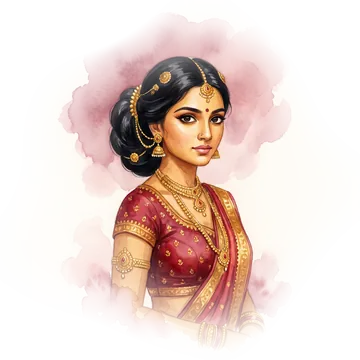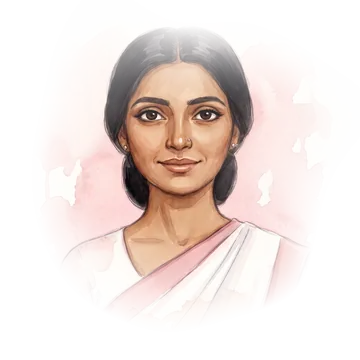
Kunti is the mother of the Pandava brothers Yudhishthira, Bhima and Arjuna, and she raised Madri's twin sons as her own. Before she married, she had a first son by the blessing of the sun god and set him afloat on a river in a basket. That baby grew up to be Karna. Kunti keeps the secret until Book Two, when she goes to Karna at the river and tells him she is his mother, and she tells her other sons only after the war, in Book Three.
- Family
- Born a Yadava princess, daughter of King Shura, and raised by King Kuntibhoja. Wife of King Pandu, who later married Madri too. Mother of Karna, her secret first son, and of the Pandavas. Aunt of Krishna.
- Known for
- The sacred words that could call any god, the basket on the river, and the day she said "Share it equally." Years later, going to Karna at the river to tell him she is his mother.
- First appears
- Book One, chapter 4, Three Princes and a Blindfold
Kunti's story in Book One
A girl called Pritha
Kunti was born Pritha, the daughter of King Shura of the Yadavas. Before she was born, her father had promised his firstborn child to his cousin, King Kuntibhoja, who had no children of his own. He kept his promise. Pritha grew up in Kuntibhoja's palace as his daughter, and that is why everyone called her Kunti. Her brother's son is Krishna, so Krishna calls her his aunt.
Her work in the palace was looking after guests. When the sage Durvasa came to stay, a man with a temper so famous that the king feared for his whole family, Kunti was the one who served him. For a year he came and went at odd hours and called for food in the middle of the night. She always had it ready. Before he left, he taught her sacred words. Any god she called with them would have to come and give her a son.
The sun god and the basket on the river
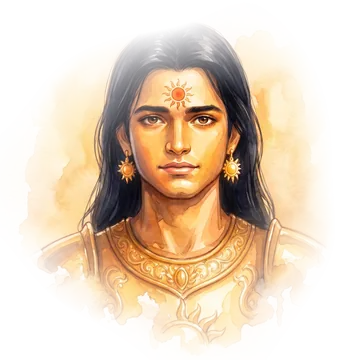
One morning at her window, Kunti whispered the words to the rising sun, only to see whether they worked. Surya, the sun god, stepped into her room. She begged him to go back. He would not leave with nothing, he said, and if she sent him away he would curse her father and the sage who had taught her. To save them, she asked that her son be born in armor and earrings like Surya's own, so that no weapon could pierce him.
The baby came in secret, with golden armor on his chest. Kunti was a princess with no husband, and she knew what people would say about her father. So she and her old nurse sealed a wicker basket with wax and set it on the river Ashva at night. Far downstream a charioteer named Adhiratha and his wife Radha found it and raised the boy as their own son. The world would know him as Karna.
Pandu's bride
At her swayamvara, where a princess chooses her own husband, Kunti walked past a hall full of kings and hung her garland around King Pandu's neck. When Pandu married a second wife, Princess Madri, Kunti came down the palace steps to welcome her and took both her hands.
She said nothing about the river. But in Hastinapura she went down to the water at sunrise to pray to the sun, and she stayed long after the others had gone. One morning Vidura saw her come back up the steps in tears. She had searched the water, he thought, as if she had lost something there long ago.
Five sons on the mountain
Pandu shot a deer in the forest that turned out to be a sage, and the dying sage cursed him. Pandu could never have sons of his own now. He gave away his riches to live as a hermit in the Himalayas, and Kunti and Madri went with him.
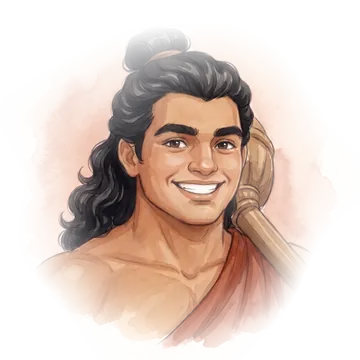
On the mountain of a hundred peaks, Pandu begged Kunti to have a son by the blessing of a great sage or a god. So she told him about Durvasa's words. She did not tell him she had used them once before. First she called Dharma, the god of justice, and Yudhishthira was born. Next was Bhima, by the blessing of Vayu, the wind. For Arjuna, Pandu prayed to Indra for a whole year while Kunti kept a vow of her own. Then she gave Madri the words to use once, and Madri had twins, Nakula and Sahadeva.
Years later Pandu forgot the sage's curse one spring day, and he died. Madri went with him onto the funeral fire. She was afraid she would always love her own two boys more, she told Kunti, and Kunti's heart was big enough for all five. So Kunti came home to Hastinapura a widow, with five sons, and every one of them was hers. The Hunter's Curse tells it in full.
A mother in Hastinapura
The palace was not safe for her sons. When Bhima vanished for eight days, Kunti told Vidura she was afraid Duryodhana had killed him. Vidura warned her to say nothing aloud and to guard the sons she still had. Bhima did come home, carrying the strength of ten thousand elephants from the kingdom of the serpents.
The day she fainted at the tournament
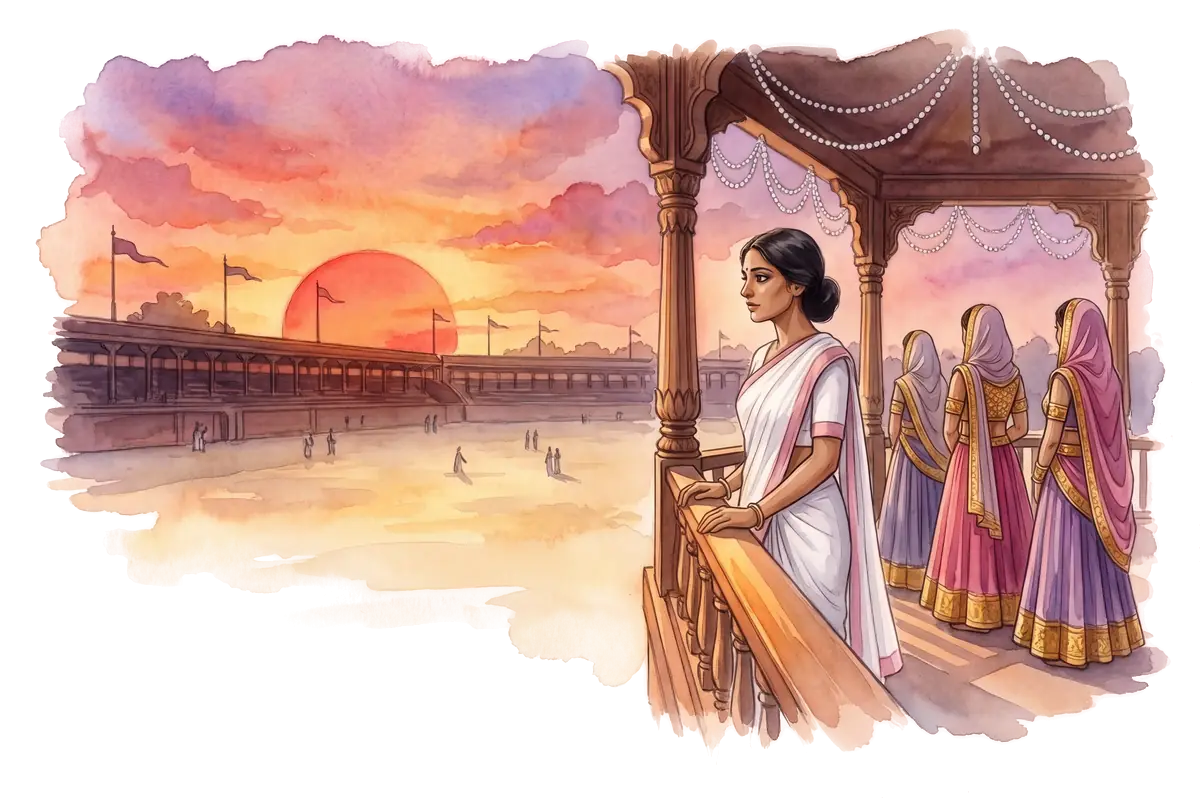
When the princes showed their skills before the whole city, Kunti watched from the royal ladies' stand. A young stranger in golden armor and earrings walked into the arena and challenged Arjuna. The crowd split in two, and up in the stand, Kunti fainted. Vidura and the maids brought her round with water and sandalwood paste. Anyone could see why a mother might faint with a son on that field. Only Kunti knew she had two of them down there.
Out of the burning house
Duryodhana sent Kunti and her sons to the town of Varanavata, to a new house built to burn. Vidura warned them in time, and a tunnel was dug under the floor. On the night of the fire, Bhima carried his mother through the forest on his shoulder. Back in Hastinapura, the court poured water for the dead and called out Kunti's name with her sons'.
Hiding in the forest
Now the family had no home and no money, and no name they dared to use. "I am the mother of five sons," Kunti said under a banyan tree at nightfall, "and I am dying of thirst." When a rakshasa girl named Hidimbi knelt before her and asked to marry Bhima, Kunti looked at the girl's shaking hands and nodded to Yudhishthira.
Later, in the town of Ekachakra, the family lived as poor brahmins with a kind brahmin's household. A rakshasa called Baka demanded a person from one house after another, and the turn came to their host. Kunti offered Bhima in his place. Yudhishthira was furious. She had seen a rock break under baby Bhima on the mountain, she told him, and she knew what Bhima was. Bhima came home that night without wanting any supper, and Baka was dead.
"Share it equally"
In Panchala, Arjuna won Princess Draupadi at her swayamvara. Kunti was at the hearth with her back to the door when Bhima called out that they had brought home alms. "Share it equally, all of you," she said, and then she turned and saw the princess. Her word must not become a lie, she told Yudhishthira, and no wrong must touch the girl. Yudhishthira remembered what Vyasa had told them, and the brothers chose together that Draupadi would marry all five. That night Krishna came to find them, and he touched his aunt's feet.
Who knows Kunti's secret?
By the end of Book One, almost no one. Her old nurse helped her with the basket. Pandu never heard about the river, and none of the Pandavas knows that the champion Bhima laughed at is Kunti's eldest son. Karna believes he is a charioteer's son. Long ago Kunti's spies told her he was alive and growing up in Anga, and she has said nothing since. She goes to Karna herself in Book Two, chapter 14, soon after Krishna tells him, and she tells her other sons only after the war, in Book Three, chapter 11.
In Book Two: The Dice
When the Pandavas lose the second game and must go into the forest, Vidura asks to keep their mother with him, and Kunti lives in his house through the years of exile. She asks Draupadi to watch over Sahadeva, then holds on to Sahadeva's arm and begs him to stay, until her sons talk her into letting go (chapter 3).
When Krishna comes to Hastinapura to ask for peace, she weeps over news of her sons and laughs when Vidura feeds Krishna banana peels. She sends a message back to the Pandavas. "Tell my sons the time has come," she says (chapter 13).
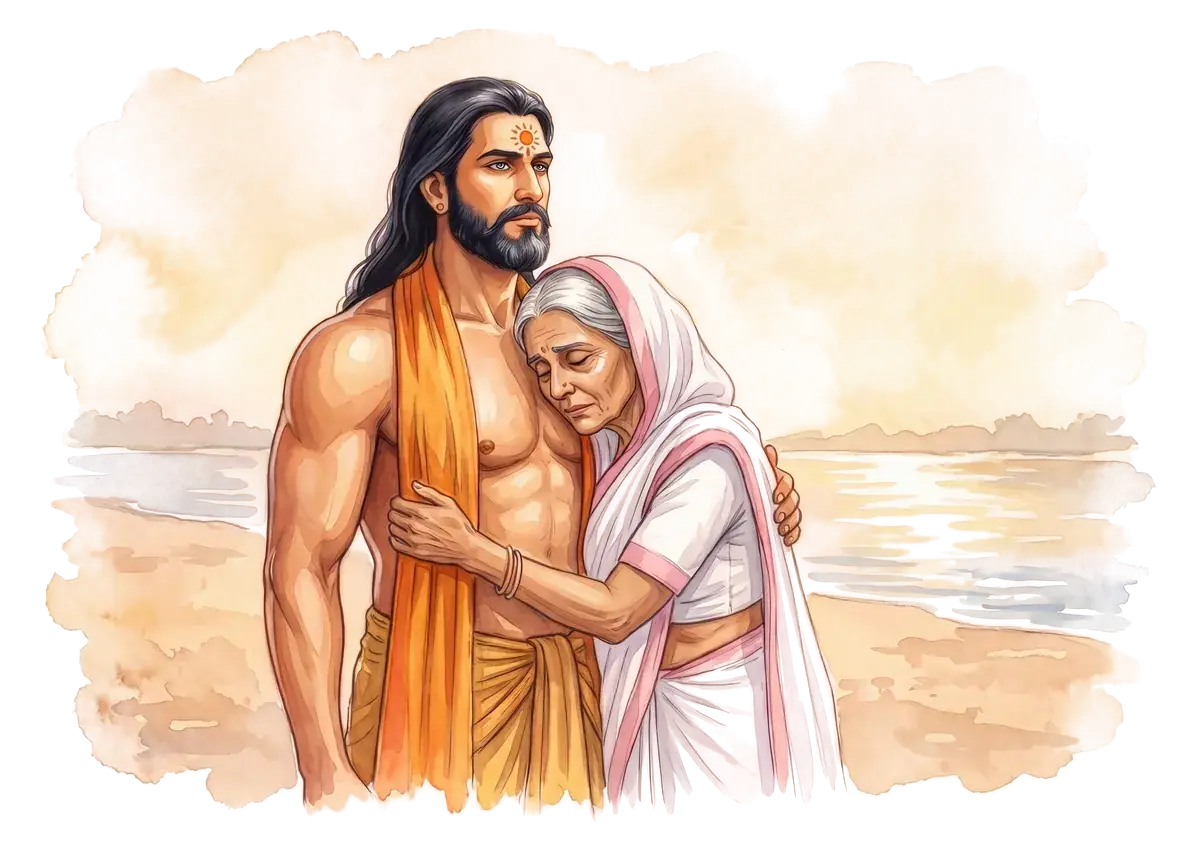
After the peace mission fails, Kunti goes down to the Ganga at dawn and waits behind Karna while he prays, standing in his shadow out of the hot sun. She tells him she is his mother, and the sun god's voice tells him it is true. Karna will not leave Duryodhana. Instead he makes her one promise. He will fight only Arjuna to the death and spare her other four sons. "If I kill him, or he kills me, you'll still have five sons" (chapter 14, A Mother at the River).
In Book Three: The War
Kunti keeps her secret all through the war. Only afterward, standing in the Ganga to pour out water for the dead, does she tell her sons that Karna was their eldest brother. Yudhishthira asks how she could hide him "like a fire wrapped in a fold of cloth," and he weeps harder for Karna than he wept for Abhimanyu (chapter 11, The Mothers' Grief).
When Abhimanyu's son is born dead, Kunti runs to Krishna and begs him to keep his promise, and he gives the baby life. For fifteen years she waits on Gandhari like a daughter. Then she walks out of Hastinapura into the forest with the old king and queen, Gandhari's hand on her shoulder. Her sons beg her to come back, and she tells them why she sent them to war. They had lost everything at dice, and Draupadi's wrong had to be answered. She did not do it to sit on a throne (chapter 13).
In the forest she asks Vyasa for one thing, to see Karna. On the night the dead rise out of the Ganga, he bows to her, and her other sons crowd around him with no anger left. Two years later, when a forest fire comes, Kunti leads Gandhari to the old king's side and sits down with them (chapter 13, The Last Walk into the Forest). In heaven Yudhishthira finds her beside Pandu (chapter 15).
Where this comes from: Kunti's girlhood and Karna's birth are in Adi Parva §111 of the Ganguli translation, with the fuller story in the Vana Parva, §301–307. Her marriage and the years on the mountain are in Adi Parva §112–127, the tournament in §136–139 (she faints in §138), the fire and the forest in §141–170, and "Share it equally" in §193. Vidura seeing her cry at the river is this book's own addition. In Book Two, Kunti and Karna at the river follow Udyoga Parva §137–146. Book Three follows Stri Parva §9–27 for her words in the river, and Ashvamedhika Parva §63–90 and Ashramavasika Parva §1–37 for Parikshit's birth and the forest. More about the sources.