A story of Krishna's childhood
Krishna the Butter Thief: Yashoda's Rope and the Two Trees
A favorite story of Krishna's childhood, told in the Bhagavata Purana and, more briefly, in the Harivamsa. Little Krishna steals butter from the pots of Gokul until his mother Yashoda ties him to a heavy wooden mortar. He drags it between two great trees, and they crash down and set two cursed brothers free.
- KrishnaKRISH-naकृष्णalso called Kanha, Kanhaiya
- Yashodaya-SHO-daaयशोदा
- NandaNAN-daनन्दalso Nand
- NaradaNAA-ra-daनारदalso Narad
- Nalakuvarana-la-KOO-va-raनलकूवर
- Manigrivama-ni-GREE-vaमणिग्रीव
In the cowherd village of Gokul, every house made butter. Each morning the women stood at their big clay pots and pulled the churning rope back and forth, and the butter rose thick and white to the top. Then they hung it up high, in pots that swung from the rafters in rope slings, where no cat or child could reach.
Krishna could. He was the little son of Nanda, the headman of the cowherds, and his wife Yashoda. His skin was dark as a rain cloud, his hair curled all over his head, and he was into everything.
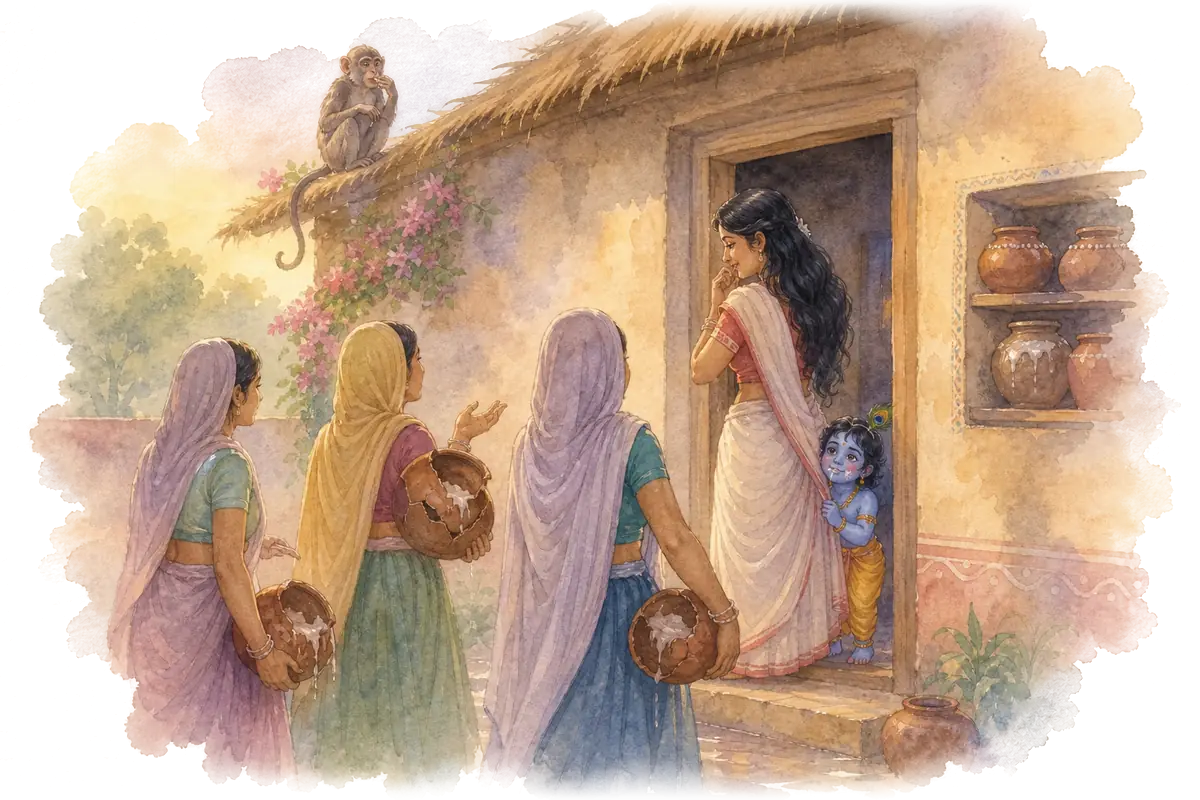
Soon the women of the village were coming to Yashoda's door.
"He lets our calves loose before milking time," said one.
"He eats our curds," said another, "and what he can't finish he gives to the monkeys. If the monkeys won't eat it, he breaks the pot."
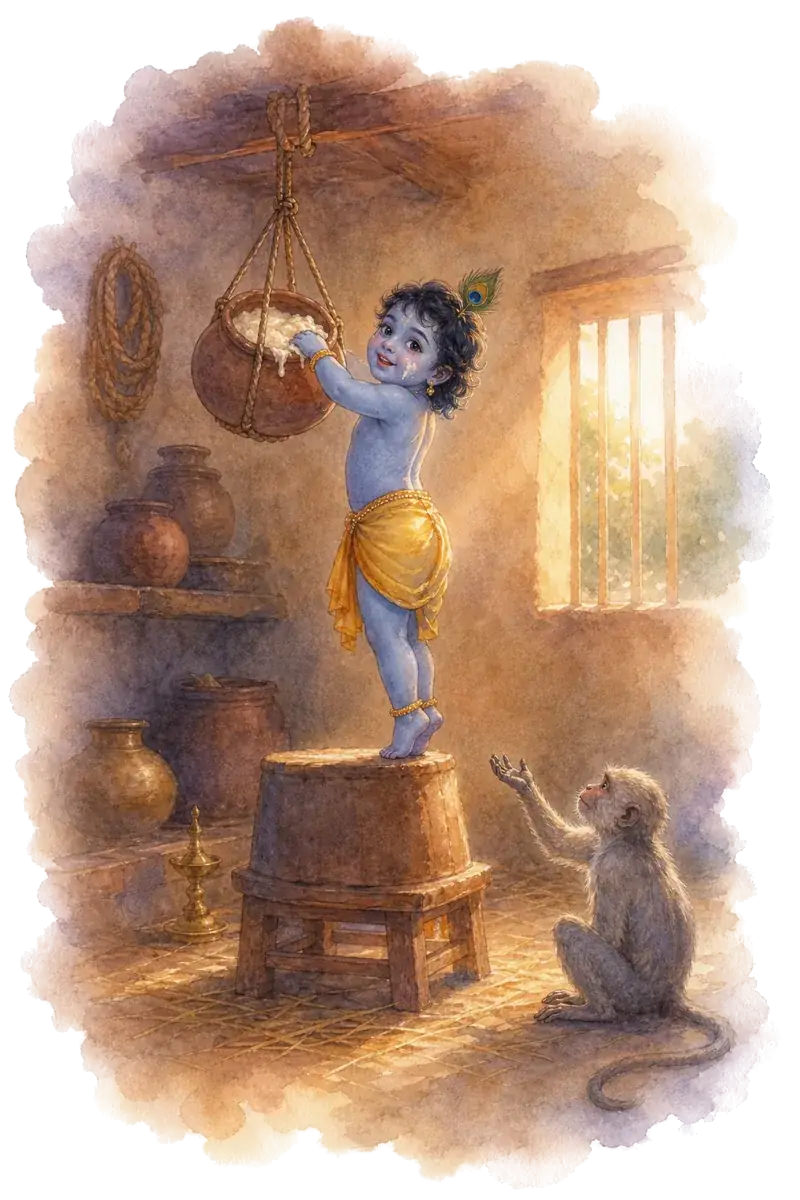
"We hang the butter where he can't get it," said a third, "and he piles up stools and climbs on the grinding mortar. We hide it in a dark room, and he finds it by the glow of his own jewels."
Krishna stood behind his mother all through this, looking as if he had never heard of butter. Yashoda looked at his face, and she laughed and couldn't scold him.
One day his elder brother Balarama and the other boys came running. "Krishna's been eating mud," they said. Yashoda took him by the hand. "Is that true?"
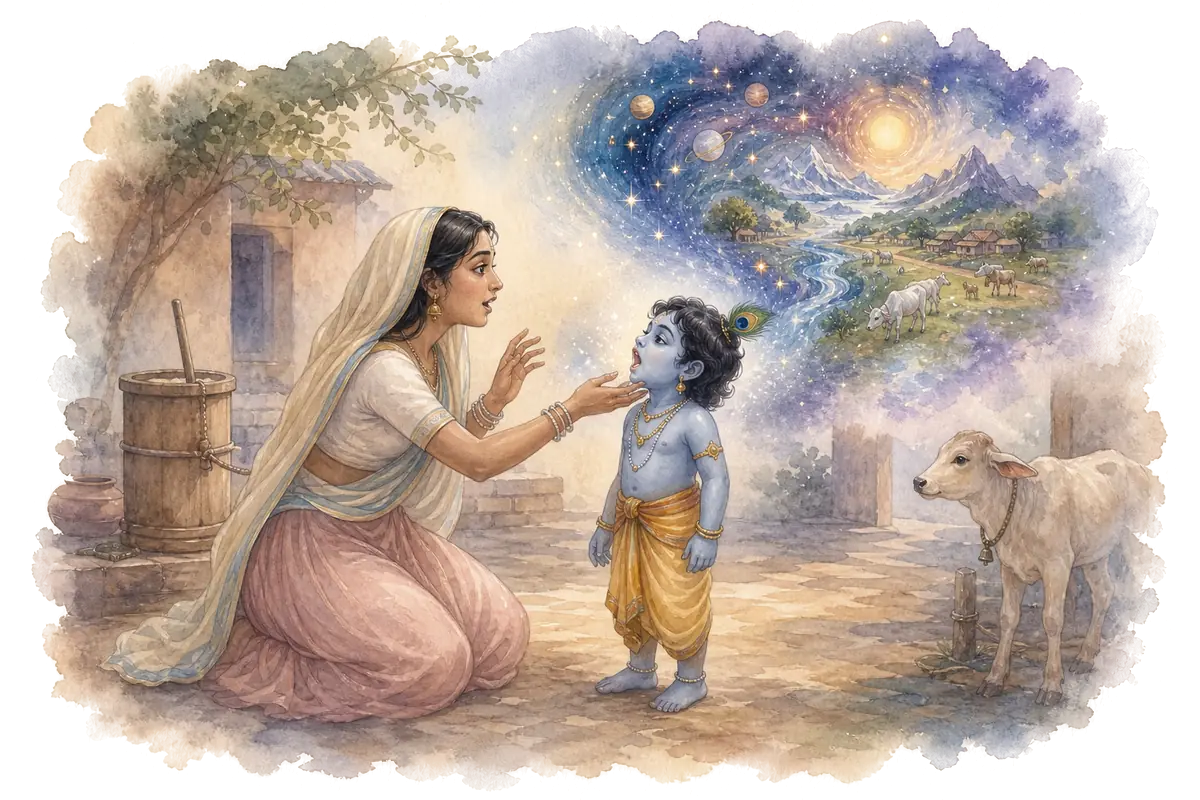
"They're making it up," said Krishna. "Look in my mouth if you don't believe me." He opened it wide.
Yashoda looked in, and she saw the whole universe. She saw the sky full of stars, and the mountains and the seas. She saw the earth with Gokul on it, and in Gokul she saw herself, standing in her own yard, looking into her little son's mouth. She was filled with wonder and fear together. Then the vision faded and she forgot it, and she picked him up and hugged him, her own small boy again.
Another morning Yashoda sat churning, singing about the things her son had done. Krishna came and caught hold of the churning rod because he wanted his milk, so she took him on her lap. Then the milk heating on the fire began to boil over. She put him down and ran to it.
Krishna was cross at being put down. He picked up a stone, cracked the pot of curds and went off into the next room with the fresh butter. When Yashoda came back, she saw the broken pot and knew at once who had done it. She found him standing on an upturned mortar, reaching into a hanging pot and handing butter out to a monkey.
She crept up behind him with a stick in her hand. Krishna jumped down and ran. Yashoda ran after him across the yard, round the cowsheds and back, until she caught him by the arm. He rubbed his eyes with his fists and looked up at her, frightened. She threw the stick away. "Then I'll tie you up," she said, "so you can't run off again."
She wound a rope around his waist to tie him to the big wooden mortar. It was two fingers too short. She knotted on another rope, and it was still two fingers short. She brought every rope in the house, then her neighbors' ropes, and every time the rope came up two fingers short. The women of the village gathered to watch and laughed. Yashoda's face was hot and her hair was coming loose. Krishna looked at his tired mother, and then he let himself be tied. That is why one of his names is Damodara, the one with a rope around his belly.
Near the house grew two tall arjuna trees, side by side. They had not always been trees. Long ago they were two young men, Nalakuvara and Manigriva, the sons of Kubera, the god of wealth. They were so proud and so careless that when the sage Narada came by, they didn't even stand up to greet him. Narada cursed them to be trees until Krishna came to free them, and he promised they would remember who they were.
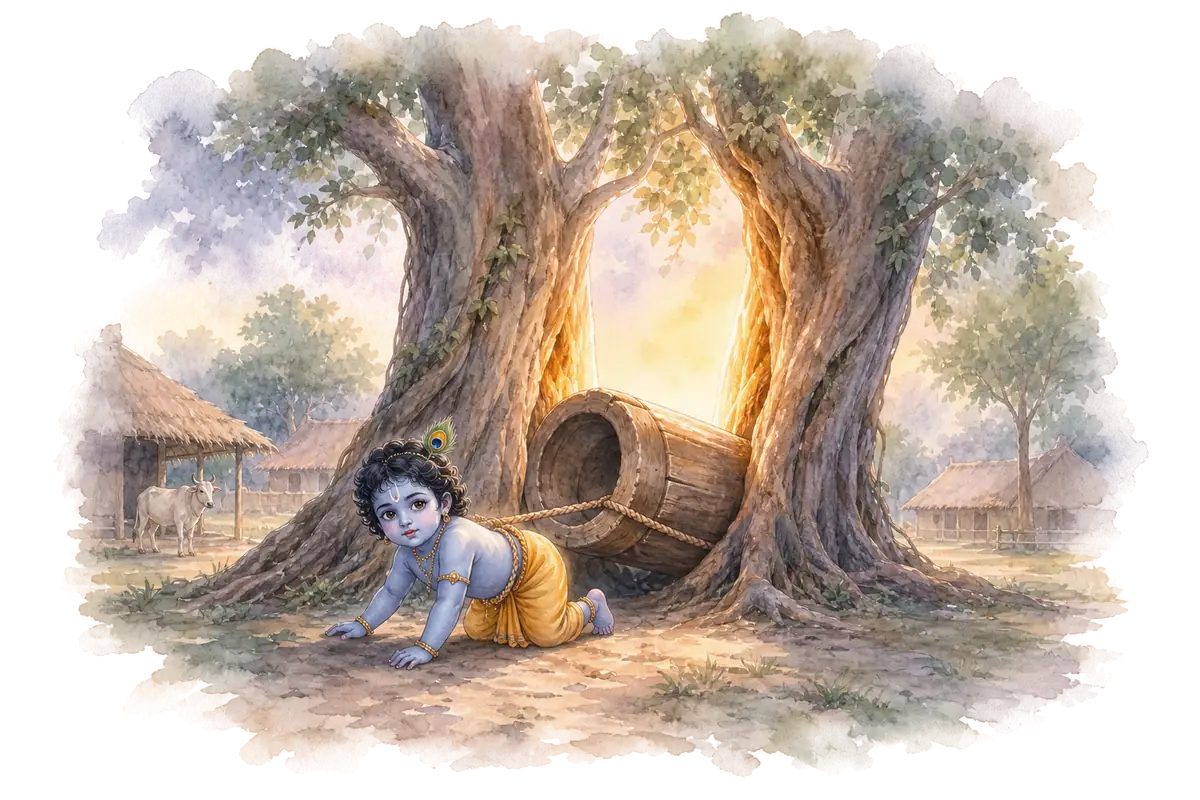
While Yashoda went back to her work, Krishna crawled off across the yard, dragging the heavy mortar behind him. He crawled straight between the two trees. He got through, but the mortar turned crosswise and stuck. Krishna gave one pull. With a great crash both trees came down, roots and all.
Out of them stepped two shining young men. They bowed to the little boy tied to the mortar, thanked him with their palms joined, and went home to their father.
The cowherds came running at the crash. "How could they fall?" they said. "There's no storm and no elephant." The children who had been playing nearby told them that Krishna had pulled the mortar between the trees and two men had come out of them. Hardly anyone believed it. Nanda found his son sitting in the dust, still tied to the mortar, and he laughed and untied him.
Why it matters
The story gave Krishna two of his best-loved names. In Hindi he is Makhan Chor, the butter thief, and in Sanskrit he is Damodara, for the rope around his waist. On Janmashtami, his birthday, teams of young people in Maharashtra and across India climb onto one another's shoulders to break a pot of curds hung high over the street. The custom is called Dahi Handi, and it acts out the little boy who climbed to reach the butter.
Where this comes from: The Bhagavata Purana, Book 10, chapters 8 to 11 (the complaints and the mouth in chapter 8, the rope in chapter 9, the two trees in chapters 10 and 11), as rendered in English in Purnendu Narayana Sinha's A Study of the Bhagavata Purana (1901). The Harivamsa tells a simpler version in the Vishnu Parva, chapter 7 (M. N. Dutt's translation, 1897). There Yashoda ties Krishna to the mortar to stop his mischief, he drags it into the woods between the two trees, and they fall on top of him without hurting him. The cowherds call him Damodara from that day. The Harivamsa has no curse and no sons of Kubera, who come from the Bhagavata. Dahi Handi is a festival custom found in neither book. More about the sources.
Keep reading
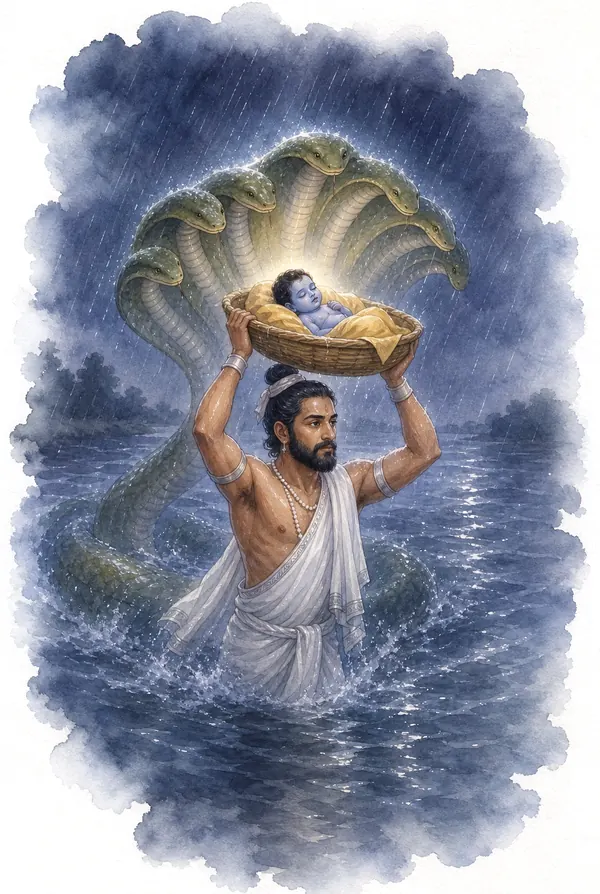 The Night Krishna Was BornKrishna is born at midnight in King Kamsa's prison, and his father carries him through a storm to Gokul.
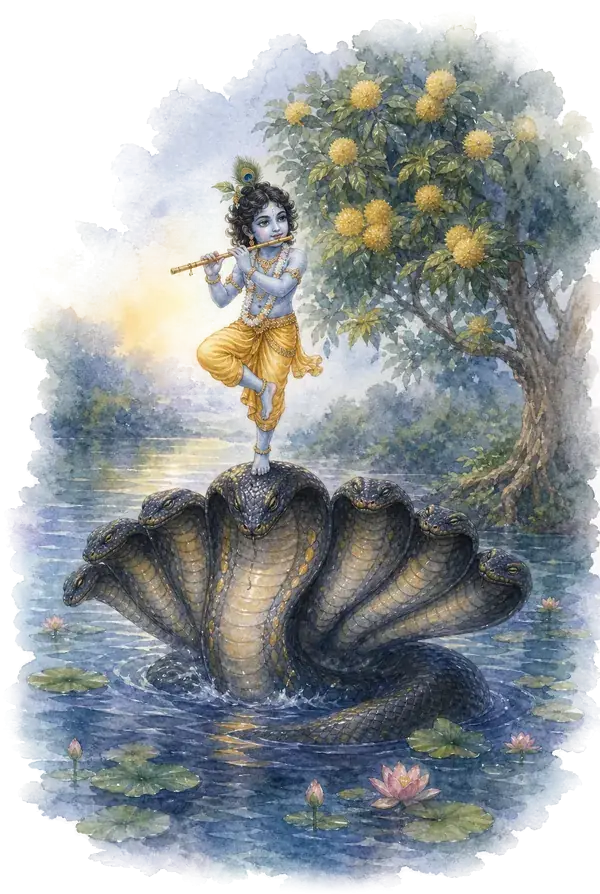 Kaliya the SerpentA serpent king poisons a pool in the Yamuna, and young Krishna dances on his hoods until he leaves.
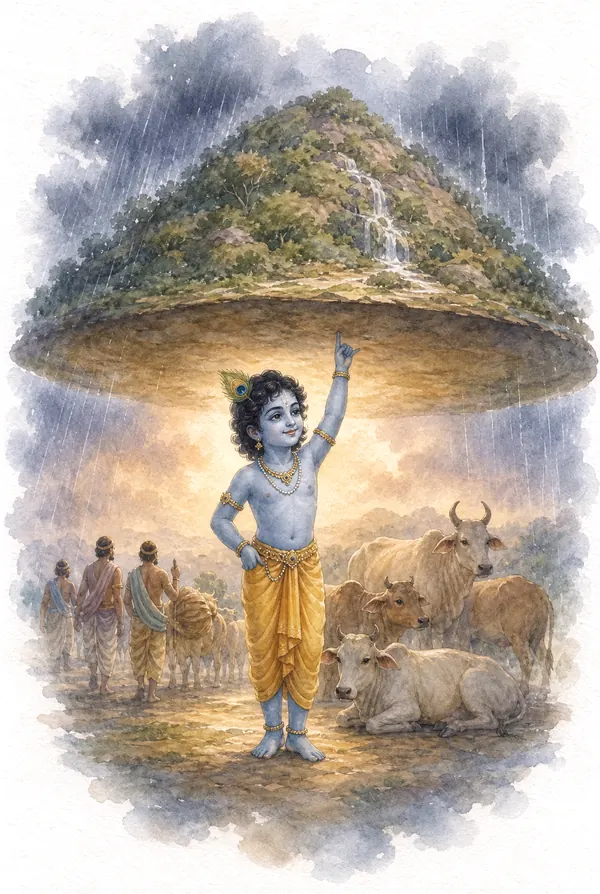 Lifting Govardhan HillIndra sends a week of storms on the cowherds, and seven-year-old Krishna holds a hill over their heads.
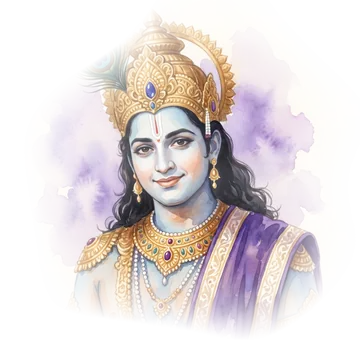 Krishna in the MahabharataThe grown-up Krishna, Arjuna's friend and charioteer, in all three books.