A well-known side story from the Mahabharata
Garuda Steals the Nectar: How Garuda Set His Mother Free
One of the best-known side stories of the Mahabharata, told near the very start of the epic by the bard Sauti to a gathering of sages in the Naimisha forest. Garuda, the king of birds, flies to heaven and takes the nectar of immortality from the gods to free his mother from slavery, and on the way he becomes Vishnu's carrier and Indra's friend.
- GarudaGA-ru-daगरुडalso Garud
- Vinatavi-NA-taaविनता
- KadruKAD-rooकद्रू
- VishnuVISH-nuविष्णु
- IndraIN-draइन्द्र
The sage Kashyapa had two wives, the sisters Kadru and Vinata. He offered each of them a wish. Kadru asked for a thousand sons, all of them mighty serpents. Vinata asked for just two sons, stronger than all of Kadru's put together.
Kadru laid a thousand eggs and Vinata laid two, and their maids kept them in warm pots. After five hundred years out slid Kadru's thousand snakes. Vinata's eggs lay still.
Too impatient to wait, Vinata broke one egg open, and inside was a boy whose body was only half formed. He was angry. Because she had broken his egg too soon, he told her, she would become a slave. If she waited patiently for the second egg, the son inside it would set her free. Then he rose into the sky. His name was Aruna, and he became the charioteer of the sun. He is the red glow you see at dawn.
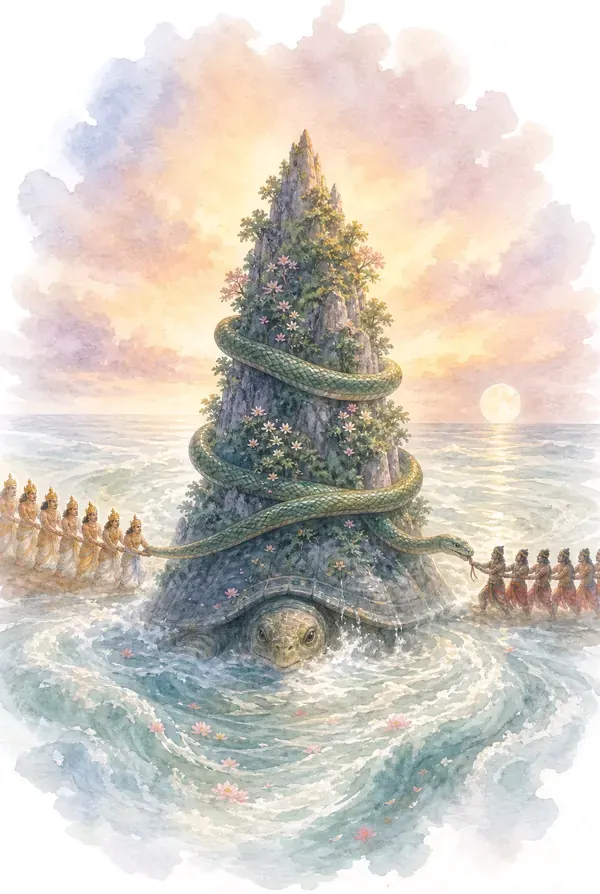
One day the sisters saw a wonderful horse, Uchchaihshravas, who had come up out of the ocean when the gods churned it for the nectar.
"What color is he?" Kadru asked.
"White, of course," said Vinata.
"His tail is black," said Kadru. "Let's bet on it. Whoever loses becomes the other's slave."
That night Kadru told her snake sons to go and hang in the horse's tail like black hairs. At first they refused, and she cursed them to burn one day in the fire of a king's great sacrifice. Afraid of her, they went and did it after all. In the morning the sisters flew over the ocean to look, and there were black hairs in the white horse's tail. Vinata became her sister's slave.
When the five hundred years were over, the second egg burst open. Out came Garuda, blazing like fire, and he grew until the gods were afraid of him. At their pleading he made himself smaller and flew to his mother.
Soon Garuda too had to serve Kadru, carrying her snakes wherever they wanted to go. He asked his mother why. She told him about the bet and the trick with the tail.
"What can I bring you," Garuda asked the snakes, "to set my mother free?"
"Bring us the nectar of immortality," they said.
Vinata blessed her son, and he flew off. On the way he was hungry, so he snatched up an elephant and a giant tortoise, one in each claw. He landed on a huge tree to eat, and the branch broke. Tiny sages, each no bigger than a thumb, were hanging upside down from it at their prayers. Garuda caught the branch in his beak before it fell and flew on, carrying the sages along with his dinner. The amazed little sages gave him his name. Garuda means the one who carries heavy loads. Later his father Kashyapa asked the sages to climb off.
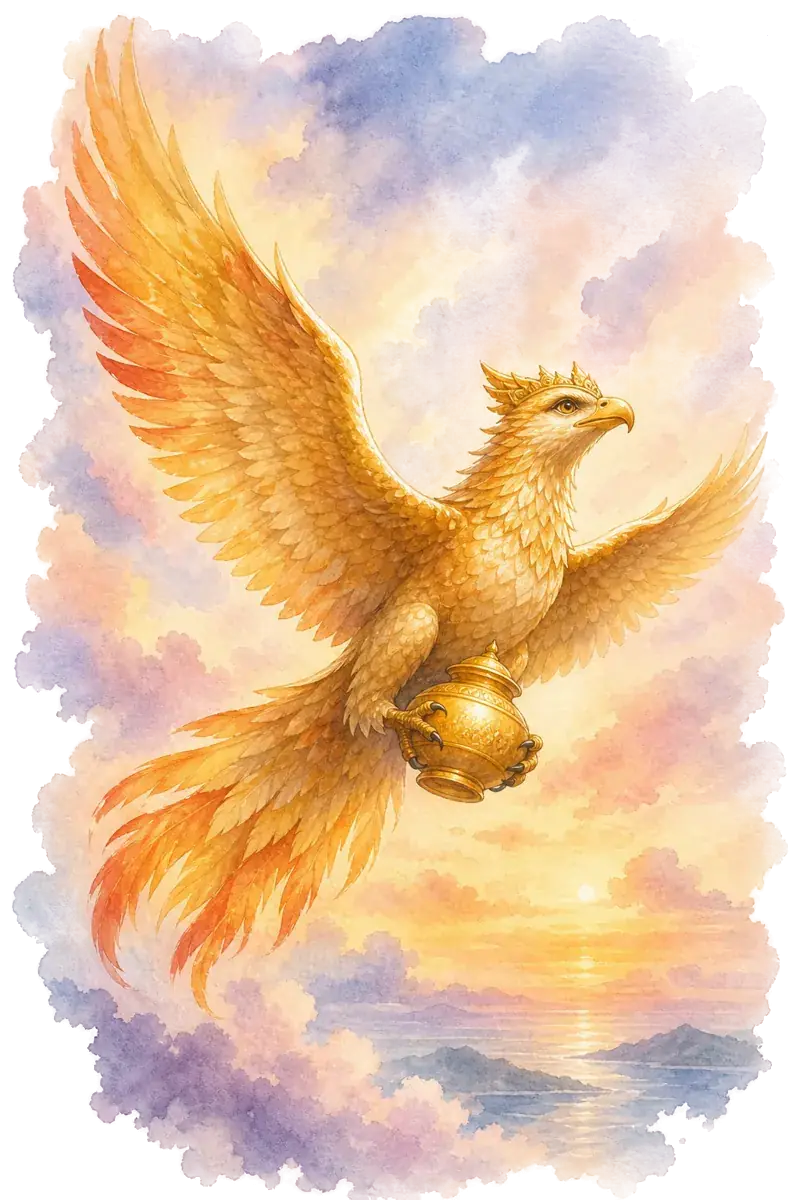
In heaven the gods were waiting with all their weapons. Garuda beat his wings and raised a storm of dust so thick they couldn't see, then knocked them over one by one. The nectar was ringed with fire. He drank up whole rivers and put the fire out. Next came a spinning wheel of razor-sharp spokes. He made himself tiny and slipped between the spokes. Two fiery snakes guarded the nectar itself, and he blinded them with dust. Then he took the pot and flew away. He did not drink a drop.
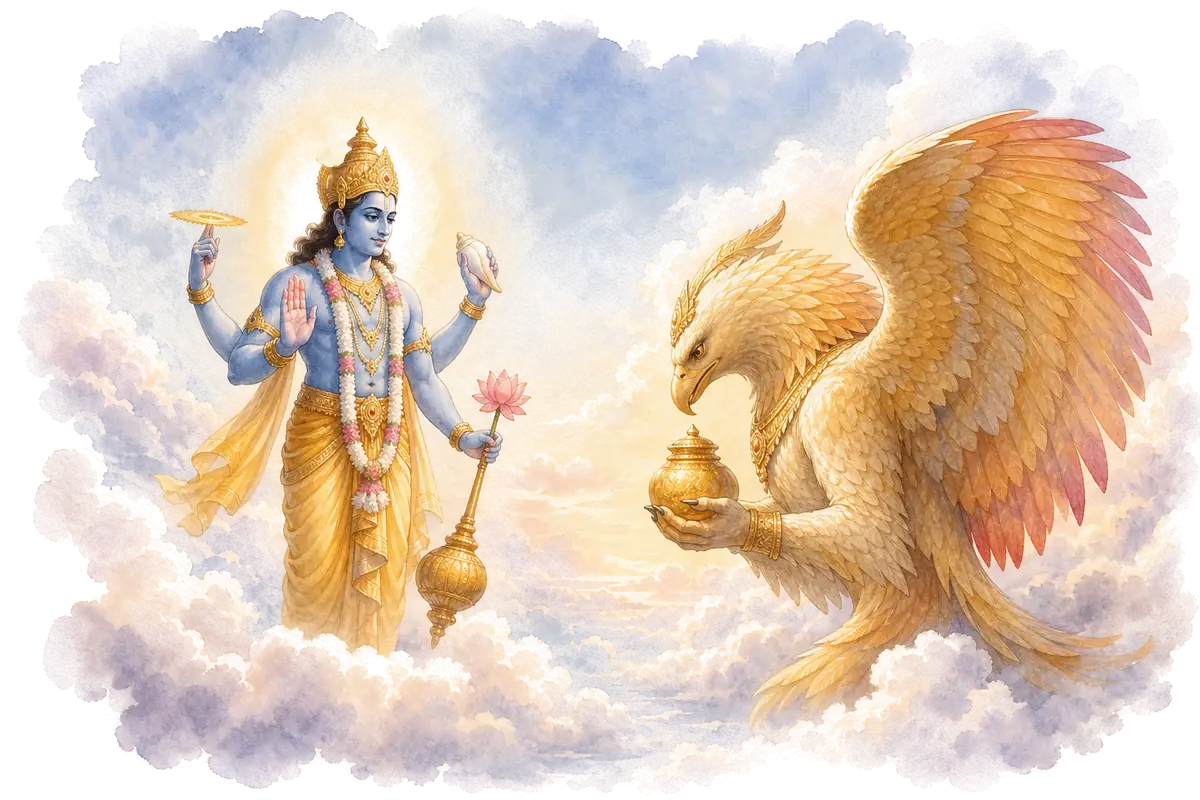
High in the sky the god Vishnu met him, pleased that he had carried the nectar without tasting it. "I'll grant you a wish," said Vishnu.
"Let me be above you," said Garuda, "and let me live forever without drinking the nectar." Vishnu agreed, and Garuda offered him a wish in return. Vishnu asked Garuda to carry him, and he gave Garuda a place on the flagstaff of his chariot. That way Garuda would always be above him.
Then Indra, king of the gods, hurled his thunderbolt. Garuda only laughed. It didn't hurt him at all, he said, but out of respect for the thunderbolt he would drop one feather. It was so beautiful that everyone who saw it fall called him Suparna, the one with beautiful feathers.
Indra wanted to be his friend. He asked Garuda for the nectar back.
"I need it to free my mother," said Garuda. "But I won't let anyone drink it. Once I set it down, you can take it." Indra was so pleased that he granted Garuda a wish, and Garuda asked that from then on snakes would be his food.
Garuda flew to the snakes and set the pot down on a bed of sharp kusha grass. "Here is the nectar," he said. "My mother is free. Go and bathe and say your prayers, and then you may drink."
While the snakes were bathing, Indra took the pot back to heaven.
The snakes came back and found the grass empty. They licked and licked the blades where the pot had stood, and the sharp grass split their tongues in two. That is why a snake's tongue is forked, and why kusha grass is holy.
Why it matters
The story explains why Garuda carries Vishnu and why Vishnu's banner shows a bird. It also explains why Garuda and the snakes are enemies, and Kadru's curse on her own sons is the start of a much longer tale, the snake sacrifice of King Janamejaya.
Where this comes from: Adi Parva §16 and §20–34 in the Ganguli translation of the Mahabharata, where the horse is spelled Uchchaihsravas and the nectar is called both amrita and Soma. More about the sources.