A well-known side story from the Mahabharata
The Churning of the Ocean: The Story of Samudra Manthan
One of the best-known side stories of the Mahabharata, told by the bard Sauti to the sages of the Naimisha forest to explain where a wonderful white horse came from. The gods and the asuras use a mountain as a churning stick and a giant serpent as the rope to churn the ocean for the nectar of immortality, and Vishnu makes sure only the gods get to drink it.
- VishnuVISH-nuविष्णु
- ShivaSHI-vaशिवalso Shiv
- VasukiVAA-su-kiवासुकि
- MohiniMO-hi-neeमोहिनी
- RahuRAA-huराहु
Long ago the gods met on the golden peak of Mount Meru, wishing for amrita, the nectar that would let them live forever. Vishnu had an idea. "Churn the ocean," he said, "the gods and the asuras together. The nectar will come up out of it, along with every kind of healing herb and jewel."
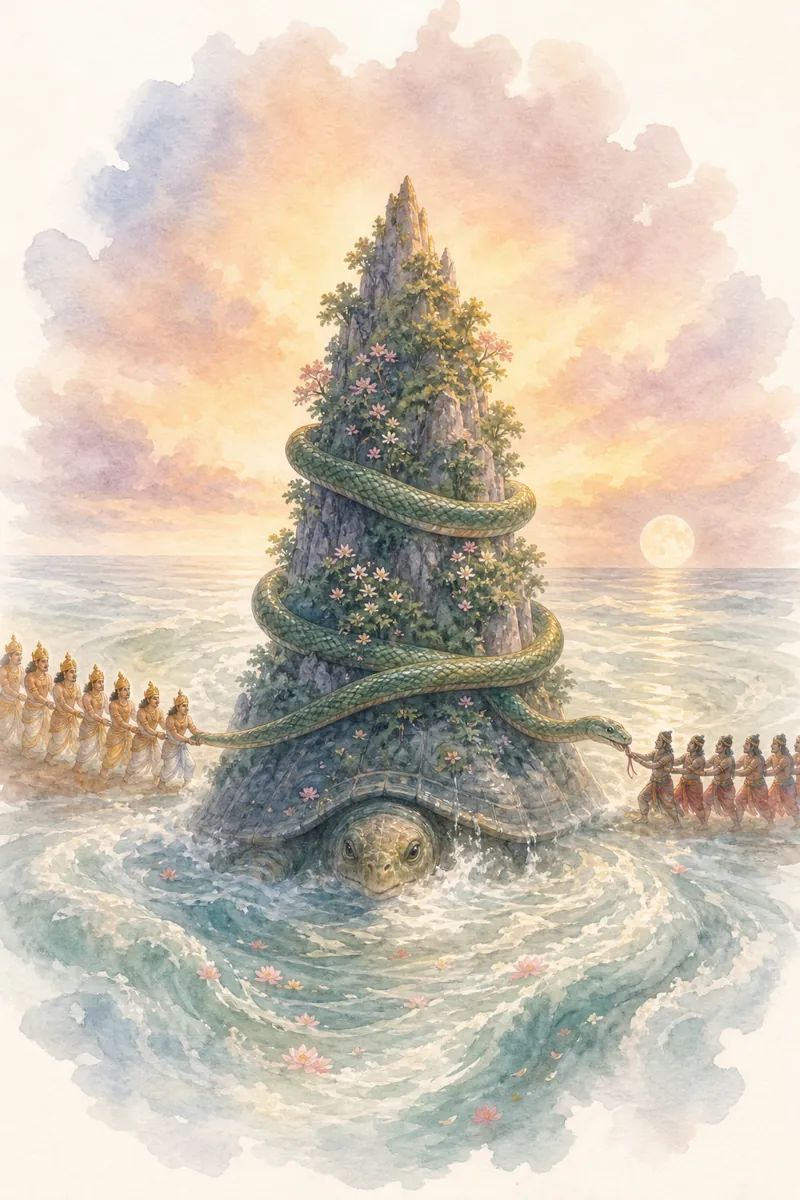
To churn something as big as the ocean, they needed a churning stick, and they chose Mount Mandara. It rose eleven thousand yojanas into the sky and went just as deep into the earth, and its slopes were covered in forests full of birds and wild animals. The gods tried to pull it up and couldn't even shift it. So Vishnu and Brahma gave the job to Ananta, the great serpent, and Ananta tore the mountain out of the ground, forests and all.
The gods carried it to the shore. "We have come to churn your waters for the nectar," they told the Ocean.
"Go ahead," said the Ocean, "as long as I get a share. I can bear it."
The mountain needed something to stand on, so the gods went to the king of the tortoises, and he agreed to hold it on his back. Indra set the mountain in place. For a rope they used the serpent king Vasuki, wound around and around the mountain. The asuras took hold of his head. The gods took his tail. And they began to pull, first one side and then the other, so that the mountain spun back and forth in the sea.
As Vasuki was stretched, smoke and flames puffed from his mouth. They turned into clouds full of lightning, and the clouds rained down and cooled the tired gods. Flowers shook loose from the trees on the spinning mountain and fell over everyone.
The sea roared like thunder. Trees on the mountain rubbed together until they caught fire, and Indra had to send heavy rain to put the fire out. The sap of all the herbs and trees ran down into the water. Slowly the sea turned white as milk, and then thick and golden like ghee. But still no nectar came.
The gods were worn out. "We have no strength left," they told Brahma. Vishnu gave them fresh strength, and they pulled again.
At last wonderful things began to rise from the waves. First came the gentle Moon, then the goddess Lakshmi dressed in white, then the white horse Uchchaihshravas and the jewel Kaustubha, which Vishnu wears on his chest to this day. Then up came Dhanvantari, the healer of the gods, holding a white pot. It was full of nectar.
"It's ours," shouted the asuras.
Next the great white elephant Airavata rose out of the sea with two pairs of tusks, and Indra took him for his own. But the churning had not finished. The last thing to come up was a poison called Kalakuta. It blazed up like fire and gave off a smoke so foul that the smell alone left all three worlds reeling.
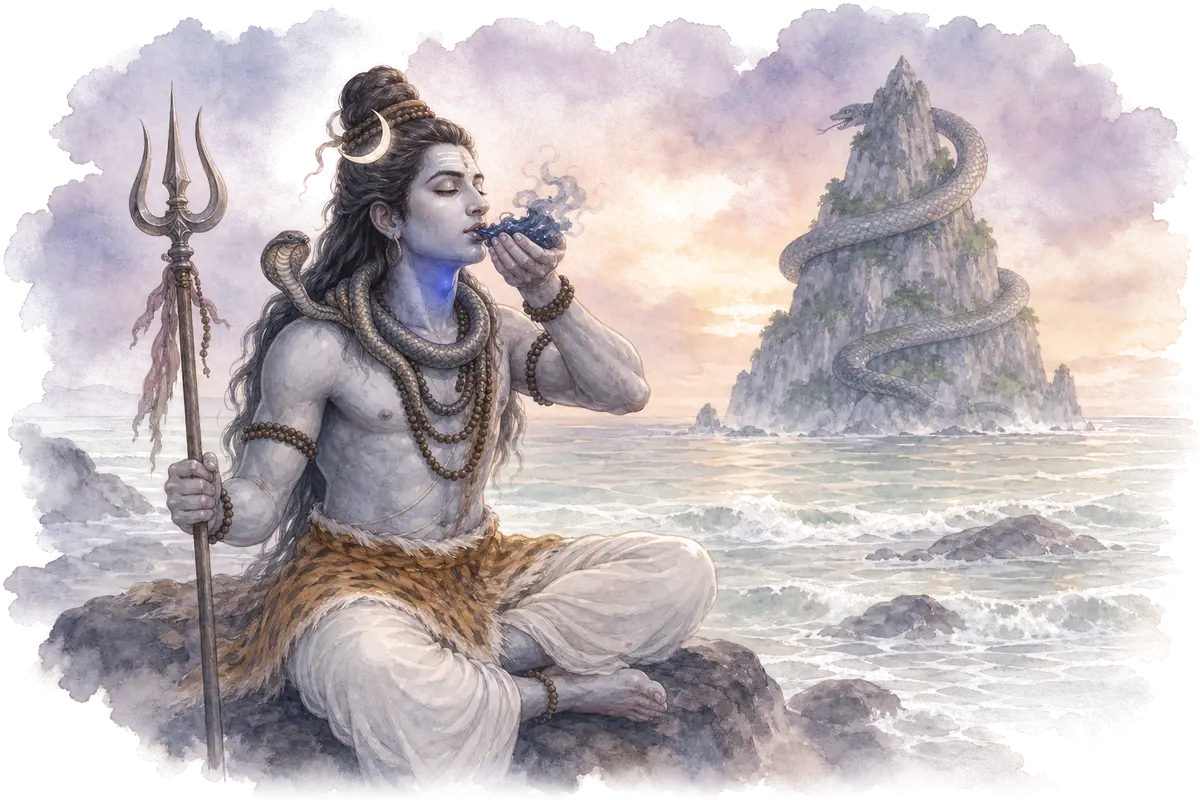
Brahma asked Shiva for help. Shiva took the poison and swallowed it to save the world. He did not let it go any further down than his throat, and his throat turned blue. That is why one of his names is Nilakantha, the blue-throated one.
Now the asuras made ready to fight for the nectar and for Lakshmi. Vishnu took the form of a woman so lovely that the asuras forgot everything else. Later stories call her Mohini, the enchantress. The asuras put the pot of nectar into her hands, and she gave it to the gods.
While the gods were drinking, an asura named Rahu sat down among them dressed as a god and drank too. The nectar had only reached his throat when the Sun and the Moon recognized him and called out. Vishnu threw his discus, and Rahu's head flew off into the sky. Because the nectar had touched it, the head could never die.
Then came a great battle on the seashore, and the asuras were beaten. Some fled under the earth and some into the sea. The gods set Mount Mandara back on its own base and gave the pot of nectar to Vishnu to keep safe.
Rahu's head still roams the sky, angry with the Sun and the Moon for giving him away. Now and then it catches one of them and swallows it. That is an eclipse.
Why it matters
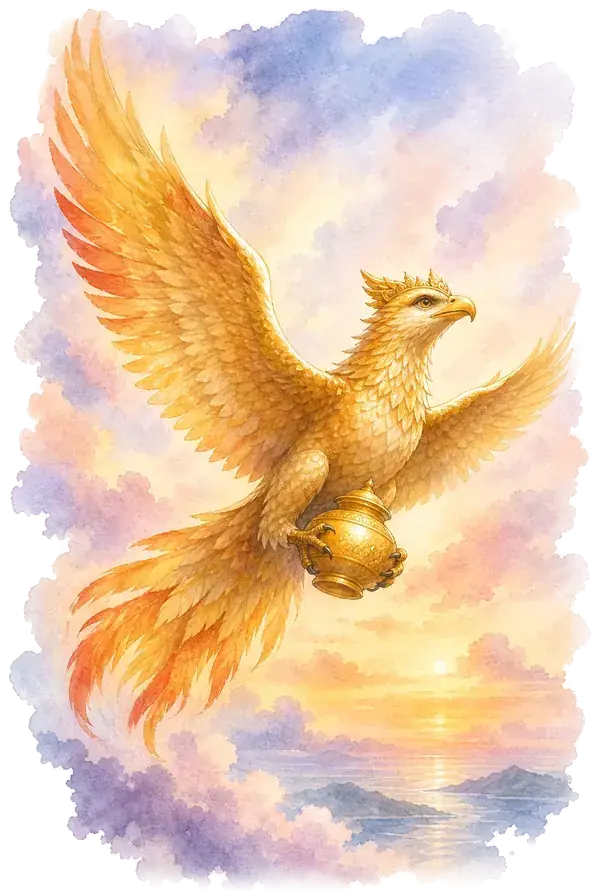
The churning tells where many famous things in Indian stories came from: Indra's white elephant, the jewel on Vishnu's chest, Shiva's blue throat and the old explanation of eclipses. It is also where the white horse Uchchaihshravas comes from, the horse at the heart of the bet that sends Garuda to steal the nectar.
Where this comes from: Adi Parva §17–19 in the Ganguli translation of the Mahabharata. There the great serpent Ananta pulls up the mountain and the king of the tortoises holds it; in the later Puranas the tortoise is Vishnu himself, as Kurma. The Mahabharata calls the poison Kalakuta, which many tellings call Halahala, and it does not name Vishnu's enchanting form; the name Mohini comes from later tellings. More about the sources.