A well-known side story from the Mahabharata
Ashtavakra Story: The Boy Who Won the Debate at King Janaka's Court
One of the best-known side stories of the Mahabharata, told by the sage Lomasha to the Pandavas during their years in the forest. Ashtavakra, a boy born bent in eight places, talks his way into King Janaka's court, beats the champion debater Bandi and brings home the father Bandi had sent under the water.
- Ashtavakraash-TAA-vak-raअष्टावक्र
- JanakaJA-na-kaजनकalso Janak
- BandiBAN-dee
- Kahodaka-HO-da
- Shvetaketushvay-ta-KAY-tuश्वेतकेतु
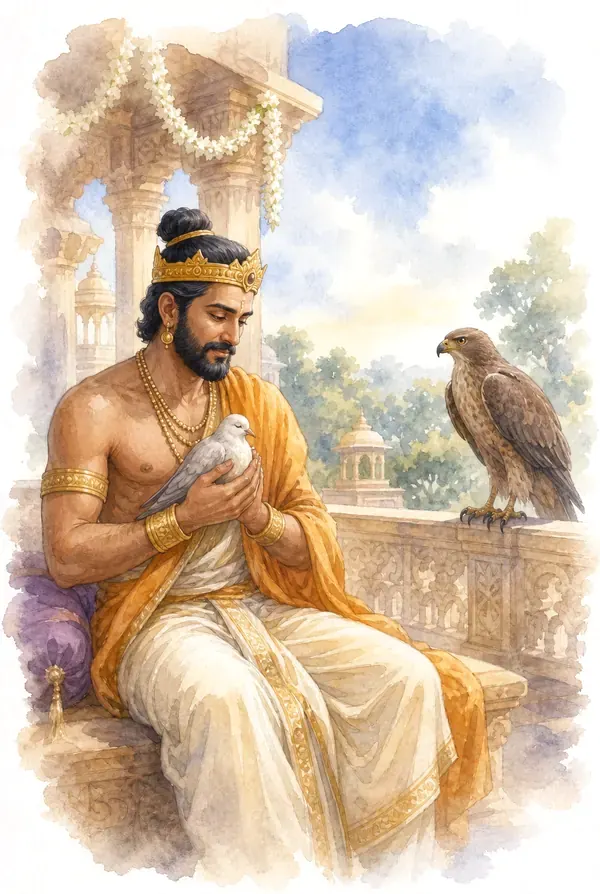
Long ago the sage Uddalaka taught the Vedas in his forest hermitage. His most faithful student was a young man named Kahoda, and in time Uddalaka gave Kahoda his daughter Sujata as a wife.
One night, while Kahoda read aloud to his students, a voice spoke from inside Sujata, from the baby who had not yet been born. "Father, you've been reading all night," it said, "and you keep getting it wrong."
Kahoda was shamed in front of his students. In his anger he cursed his own child. "You talk like that before you're even born? Then you'll be born bent in eight places."
The baby was born exactly so, crooked in eight places, and he was called Ashtavakra, which means "bent in eight".
Before the birth, though, Sujata begged her husband to find them some money, because they had none. Kahoda went to King Janaka of Mithila to ask for wealth. At that court lived a famous debater named Bandi. Anyone Bandi beat in an argument was thrown into the water. Kahoda lost, and into the water he went.
Uddalaka told Sujata to keep it secret. So Ashtavakra grew up believing that Uddalaka was his father. Uddalaka's son Shvetaketu, who was really his uncle, was the same age, and the two boys grew up like brothers.
When Ashtavakra was eleven, he was sitting in Uddalaka's lap one day when Shvetaketu pulled him off by the hand. "That isn't your father's lap," he said.
Ashtavakra ran home in tears and asked his mother where his father was. Sujata was frightened, and she told him everything.
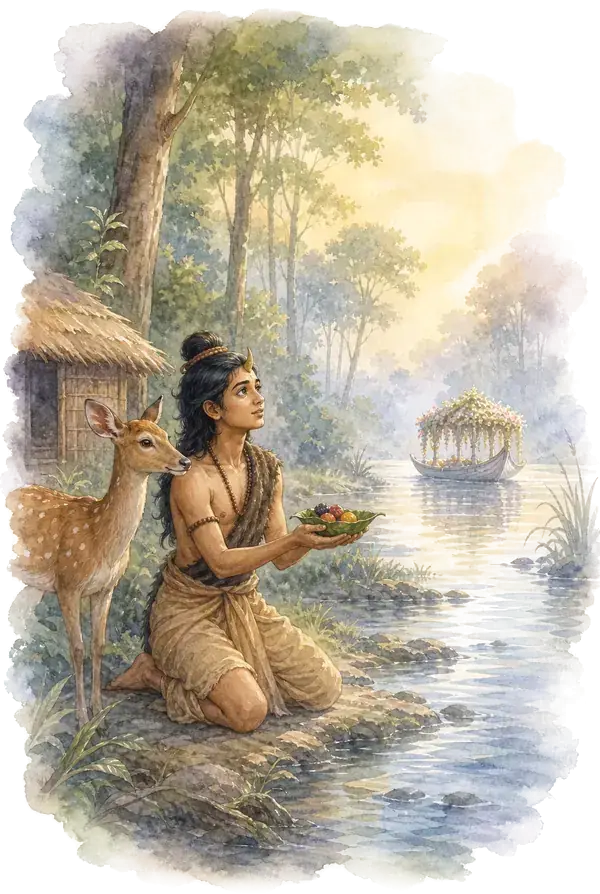
That night Ashtavakra went to find Shvetaketu. "Let's go to King Janaka's sacrifice," he said. "There'll be wonderful things to see. We can listen to the brahmins debate, and the food will be good."
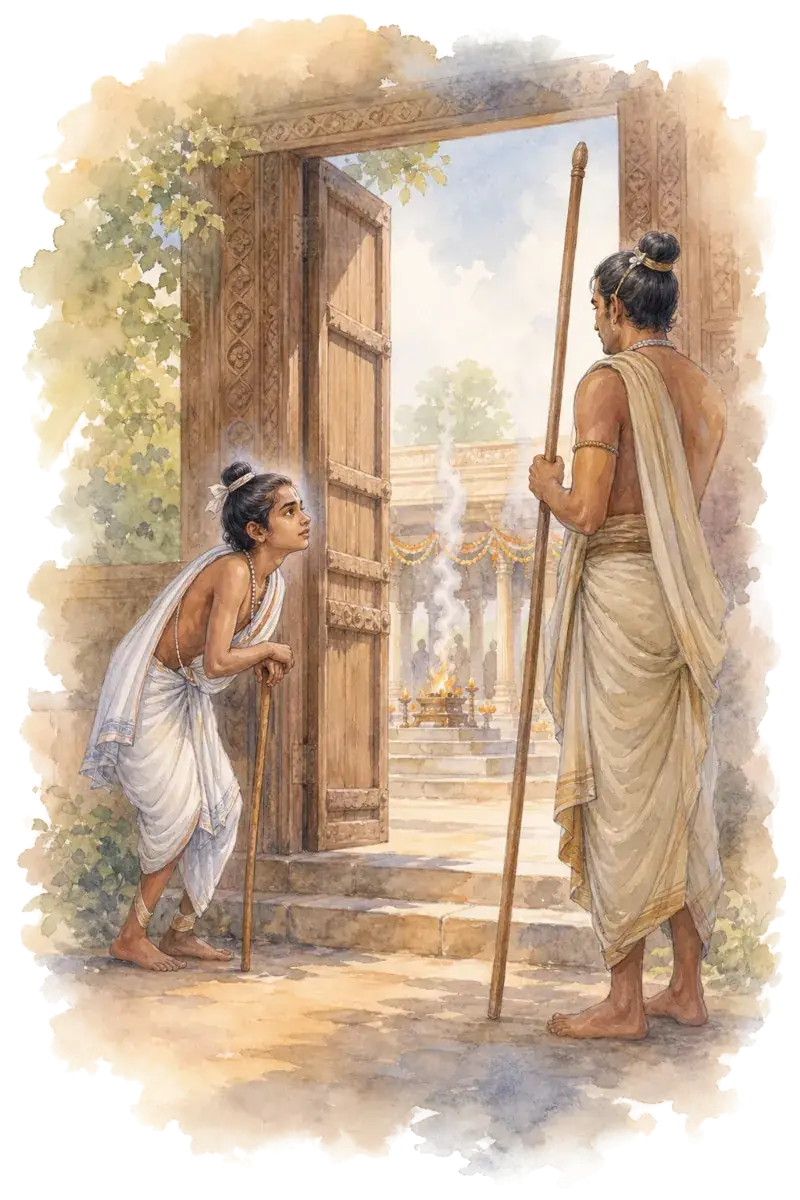
At the gate a guard stopped them. "Boys aren't allowed in. Only old, learned brahmins."
"Then let us in, because we're old," said Ashtavakra. A man isn't old because his hair is gray, he told the guard. The gods call someone old when he knows things, even if he is a child. And a small fire still burns the hand that touches it.
Word reached King Janaka, who wore a garland of lotuses. He warned the boy kindly. Great scholars had faded in front of Bandi the way stars fade when the sun comes up.
"Bandi has never argued with anyone like me," said Ashtavakra.
So the king tested him with riddles. What wheel has three hundred and sixty spokes? Ashtavakra said it was the wheel of time, the year with its days. What doesn't close its eyes when it sleeps? What doesn't move once it's born? What has no heart? What grows by its own running?
"A fish sleeps with its eyes open," said Ashtavakra. "An egg doesn't move once it's laid. A stone has no heart. And a river grows as it runs."
Janaka looked at him for a long moment. "I don't think you're a boy at all," he said. "Go in. There is Bandi."
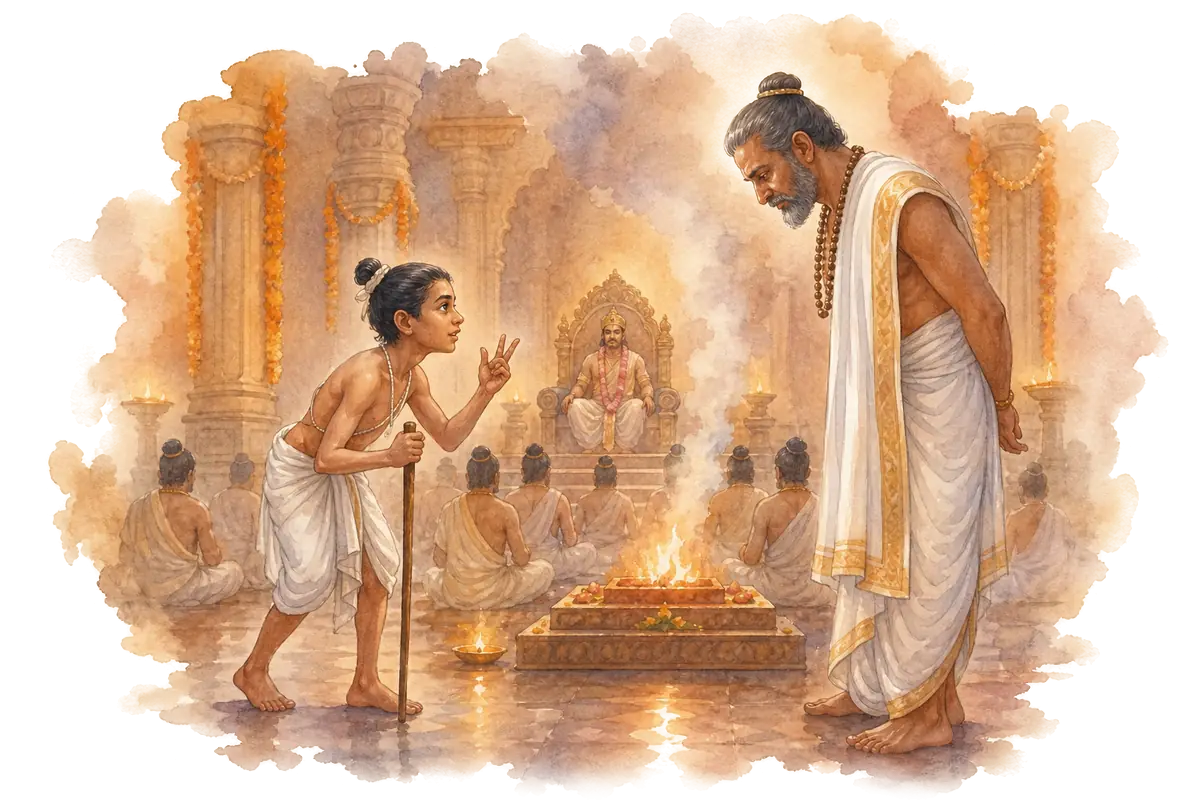
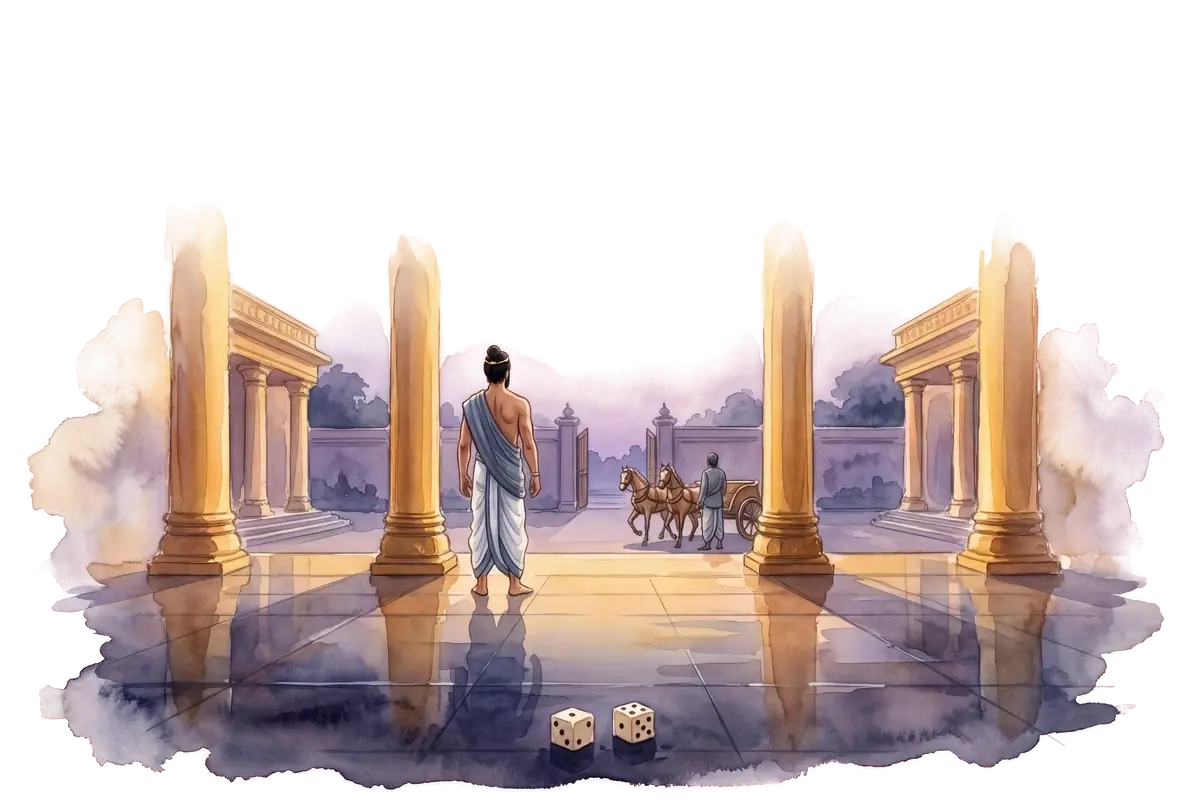
They took turns, counting upward. Bandi began with one. There is one fire that blazes in many shapes, he said, and one sun that lights the whole world. Ashtavakra answered with two. Indra and Agni always travel together, and a chariot runs on two wheels. Bandi gave three. Ashtavakra gave four, the four directions and the four legs of a cow. Each verse was harder than the last, up past five and on to twelve, until the whole hall was listening.
At thirteen Bandi began a verse and stopped halfway. He stood with his head bowed and said nothing more. Ashtavakra finished the verse for him.
The hall broke into an uproar. The brahmins came up to the boy with their hands joined to honor him.
"This man threw the brahmins he beat into the water," said Ashtavakra. "Let the water have him now."
Then Bandi told his secret. He was the son of Varuna, lord of the waters. Under the sea his father was holding a sacrifice that would last twelve years, and Bandi had been sending him the best scholars from Janaka's court to take part. "I'm not afraid of the water," he said. "And today Ashtavakra will see his father."
Up from the water came the lost brahmins, honored by Varuna, and Kahoda was among them. "This is why people pray for sons," he said. "What I failed to do, my son has done." Then Bandi took leave of the king and walked into the sea to join his father.
Ashtavakra bowed at his father's feet. Father and son went home together with Shvetaketu. There, with Sujata watching, Kahoda told his son to step into the river Samanga. Ashtavakra waded in. When he came up out of the water, all eight of his bent places were straight.
Lomasha told the Pandavas this story near Shvetaketu's old hermitage, close to that same river, and they went down to bathe in it.
Why it matters
The story explains how the sage Ashtavakra, "bent in eight", got his name, and how the river Samanga, "with even limbs", got its own on the day he came out of it straight. It also holds one of the Mahabharata's best-known sayings about age, that gray hair doesn't make anyone old. The Ashtavakra Gita, a much later book of teachings, is named after him.
Where this comes from: Vana Parva §132–134 in the Ganguli translation of the Mahabharata, where Lomasha tells the tale. Ganguli spells the debater's name Vandin; Bandi is the form most retellings use. Some later retellings add a scene where the court laughs at Ashtavakra's body when he walks in; that scene isn't in the Mahabharata. More about the sources.