A well-known side story from the Mahabharata
King Shibi and the Dove: The King Who Put Himself on the Scales
One of the best-known side stories of the Mahabharata, told by the ancient sage Markandeya to the Pandavas during their years in the forest. A dove fleeing a hawk drops into King Shibi's lap. The king won't hand it over, and he offers his own flesh, and then himself, on a pair of scales to save it. The two birds turn out to be the gods Agni and Indra, testing him.
- ShibiSHI-beeशिबिalso Sibi
- AgniAG-neeअग्नि
- IndraIN-draइन्द्र
- Markandeyamaar-KAN-day-yaमार्कण्डेयalso Markandey
Long ago the gods wanted to find out how good King Shibi, the son of Ushinara, really was. So two of them came down to earth to test him. Agni, the god of fire, took the shape of a dove. Indra, the king of the gods, became a hawk and chased it.
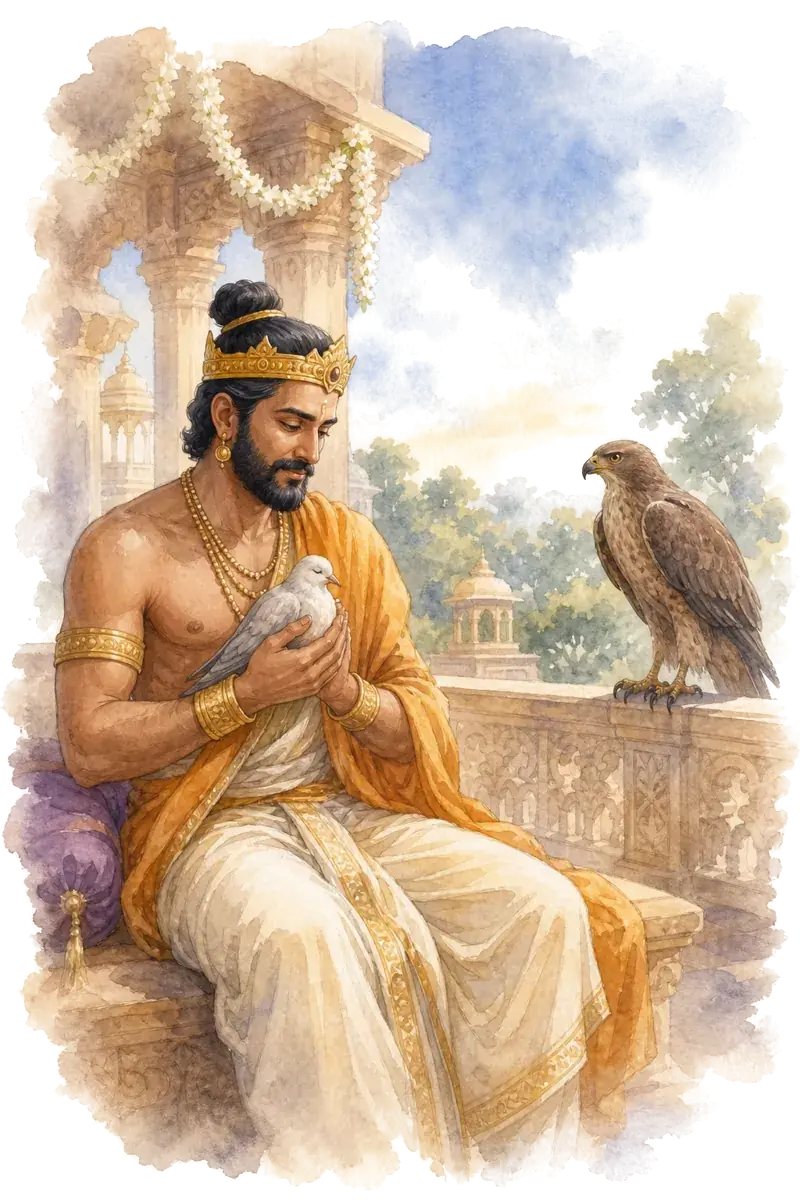
King Shibi was sitting in his court when the dove dropped out of the sky into his lap. He could feel its heart racing under the soft gray feathers.
The king's priest frowned. A dove falling on a king was a bad sign, he said. The king should give away riches to keep the danger off.
Then the dove spoke, in a voice like a man's. "I'm running from the hawk. Please save my life. I'm not really a dove. I'm a sage who has taken this shape, and I have kept every vow I ever made. Don't give me up to the hawk."
The hawk landed close by, and it could talk too. "That bird is my food," it said. "The gods gave it to me today. You have no business standing between a hawk and its meal."
Shibi looked from one bird to the other. "Has anyone ever heard birds speak like people?" he said. With both of them arguing so well, how was he to know what was right?
But of one thing he was sure. A person who hands a frightened creature over to its enemy, he said, will find no one to shelter him when he is frightened himself. The rain won't come for him when it should, and the seeds he sows won't grow.
So he offered the hawk a trade. His people would cook a whole bull with rice for it and carry as much meat as it liked to wherever it lived.
"I don't want a bull," said the hawk. "I don't want any other meat, and I don't want more than this one bird. This one was given to me."
"Then I'll give up my life before I give up this dove," said the king. "Ask me for anything else. Whatever it is, I'll do it."
The hawk thought about that. "Then give me your own flesh," it said at last, "as much as the dove weighs. That will save the dove, and your people will praise you for it."
Shibi agreed at once. A great pair of scales was brought, and the dove was set in one of its pans.
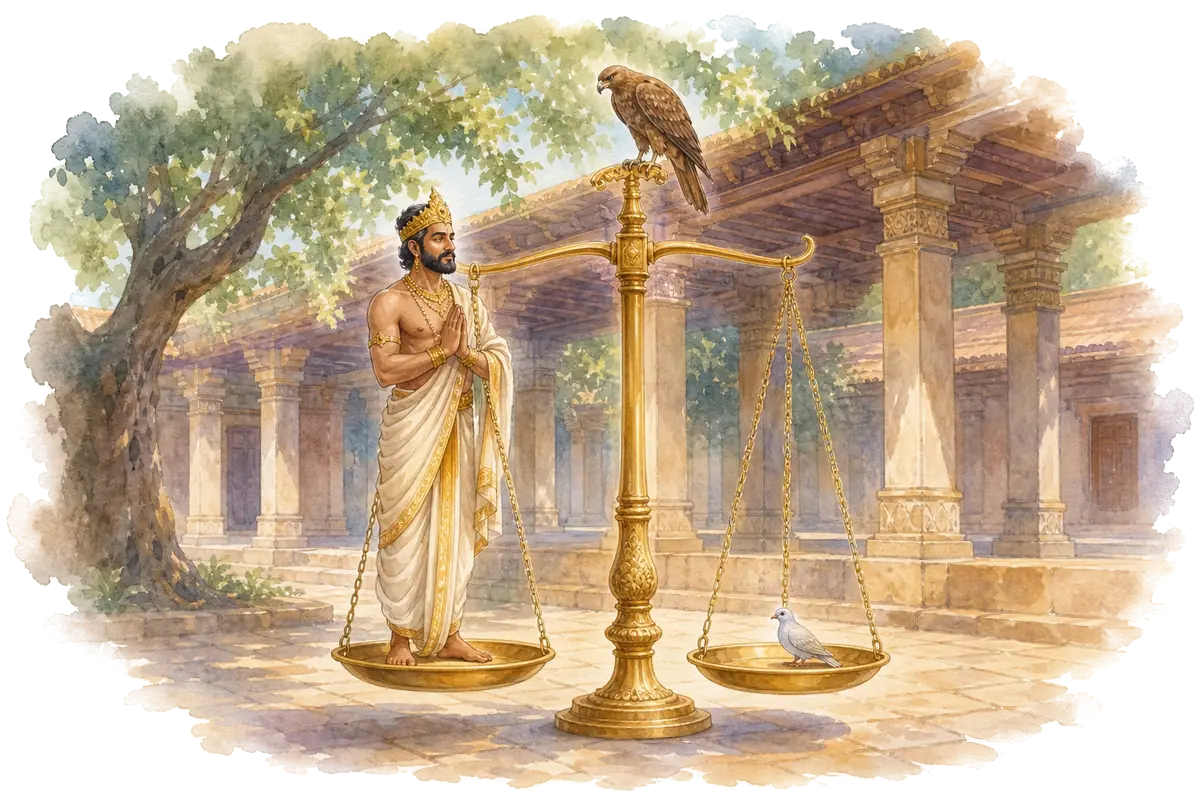
The king gave of his own body to fill the other pan, but however much he gave, the little dove was always heavier.
At last Shibi stood up and stepped into the pan himself. He didn't complain, and there was no sorrow on his face.
"Saved," said the hawk, and vanished.
Shibi turned to the dove. "Who was that hawk?" he asked. "Only the lord of the whole world could do what he just did. Tell me, holy one."
"I am Agni, the fire," said the dove. "The hawk was Indra, who carries the thunderbolt. We came to test you."
Then Agni made the king a promise. Every place where Shibi had given of himself would heal and shine like gold and smell as sweet as flowers. He would rule his people for many years, honored by gods and sages alike. And he would have a son who would grow up famous and brave.
Markandeya told this story to the Pandavas in the forest, when Yudhishthira asked him about the greatness of kings.
Why it matters
Shibi is the Mahabharata's great example of a king who will not abandon anyone who comes to him for shelter, whatever it costs him. The epic tells his story twice, once from Lomasha and once from Markandeya. Right after this telling, Markandeya passes on a story about the sage Narada, who names Shibi as a king so good that Narada himself would fall from heaven before Shibi did.
Where this comes from: Vana Parva §196 in the Ganguli translation of the Mahabharata, where the sage Markandeya tells it to Yudhishthira and the king is named Shibi (Ganguli spells it Sivi). Ganguli's word for the bird is pigeon; most retellings call it a dove. The sage Lomasha tells a shorter version earlier, in Vana Parva §130–131, where the king is called Ushinara and the hawk argues that its family will starve without the bird. More about the sources.