A well-known side story from the Mahabharata
Rishyashringa: The Forest Boy Who Brought the Rain
One of the best-known side stories of the Mahabharata, told by the sage Lomasha to the Pandavas during their years in the forest. Rishyashringa, a sage's son with a small horn on his forehead, has never met anyone but his father until visitors from the drought-struck kingdom of Anga coax him away, and the moment he arrives there, the rain comes.
- RishyashringaRISH-ya-SHRING-gaऋष्यशृङ्गalso Rishyasringa
- Vibhandakavi-BHAAN-da-kaविभाण्डक
- Lomapadalo-ma-PAA-daलोमपाद
- ShantaSHAAN-taaशान्ता
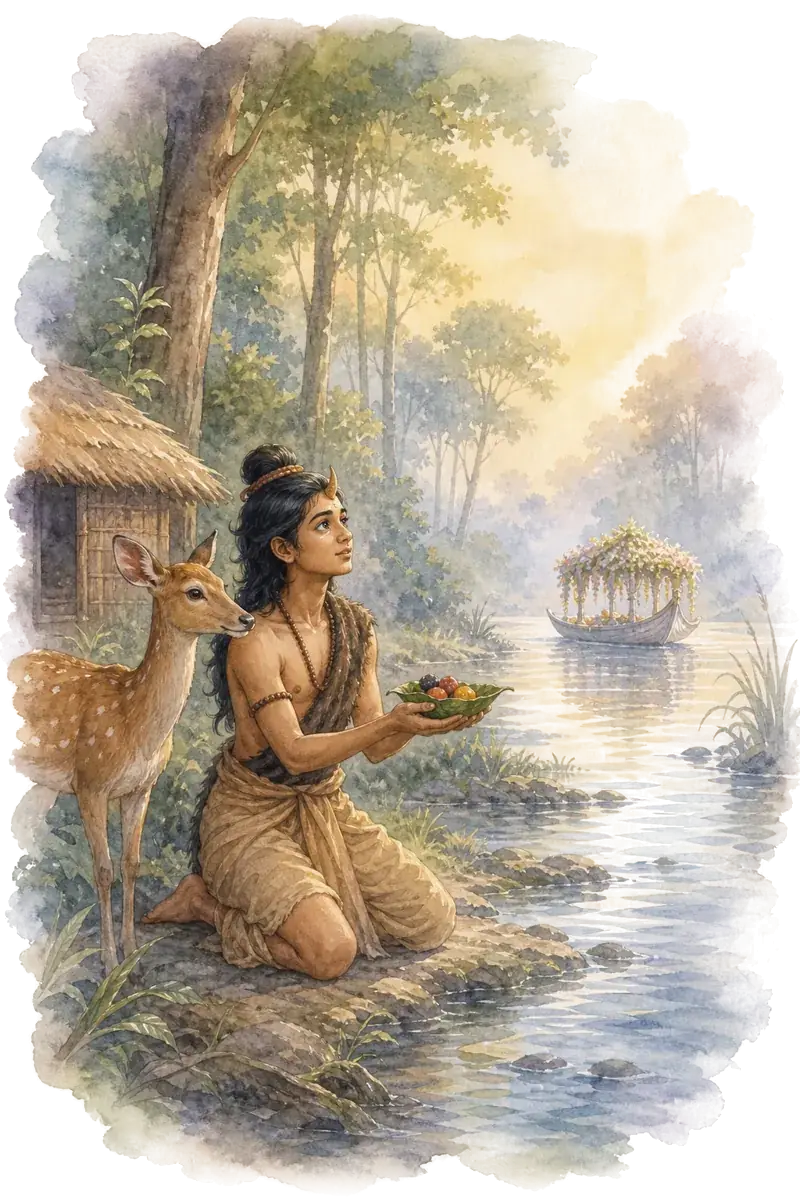
Deep in a forest beside the river Kaushiki lived a sage named Vibhandaka with his son, Rishyashringa. The boy had a small horn growing from his forehead, like a young deer's, and that is where his name comes from. It means "deer's horn". His mother, the story says, was a doe of the forest who was really a daughter of the gods under a spell from Brahma, and she was set free when her son was born.
Rishyashringa had never seen another human being except his father. He cut firewood and kept the sacred fire burning, and he knew nothing at all about the world beyond the trees.
Far away, in the kingdom of Anga, the rain had stopped. King Lomapada had once told a lie to a brahmin, and the brahmins had turned their backs on him. Then Indra held back the rain. The fields cracked and the people went hungry.
The king asked the wisest men he could find what to do. One of them told him to make peace with the brahmins first. "Then send for Rishyashringa, the sage's son who lives in the forest. If he sets foot in your kingdom, the rain will come with him."
Lomapada made amends, and the brahmins forgave him. But how was he to fetch Rishyashringa? The boy's father was famous for his temper, and nobody wanted to be cursed by him.
At last an old woman of the town said she would try. She gathered some young women to help her and built something strange, a hermitage on a boat, with little trees all over it covered in flowers and fruit. They took it along the river and tied it up not far from Vibhandaka's hut.
One day, while Vibhandaka was away, one of the young women walked into the clearing. Rishyashringa had never seen anyone like her. He took her for a hermit from some other forest, and a very splendid one. Like a good host he offered her water for her feet and a seat on his deerskin, and he brought out the best wild fruits he had.
She laughed and gave him her own food instead, sweets with no rinds and no stones in them, better than anything he had ever tasted. She gave him sweet-smelling garlands and bright new clothes. Then she played with a ball, bouncing it and spinning around to catch it. After a while she said it was time for her to make her offerings at the fire, and she slipped away.
When Vibhandaka came home, he found his son sitting alone, sighing. The firewood hadn't been cut. "Who was here today?" he asked.
Rishyashringa told him all about the wonderful young hermit, with hair tied up in strings of gold and ornaments that jingled like geese on a lake, and a round fruit, as he called it, that leaped back into his hand every time he struck it. "His vows must be different from ours," the boy said. "I want to go and live the way he does."
"Those were rakshasas," said his father. "They put on beautiful shapes to spoil a hermit's prayers. Have nothing to do with them." Then he went looking for the visitor. For three days he searched and found no one.
The next time Vibhandaka went out to gather fruit, the young woman came back. Rishyashringa ran to meet her. "Let's go to your hermitage," he said, "before my father comes home."
So he went aboard the floating hermitage. The women untied it and let it carry him all the way to Anga.
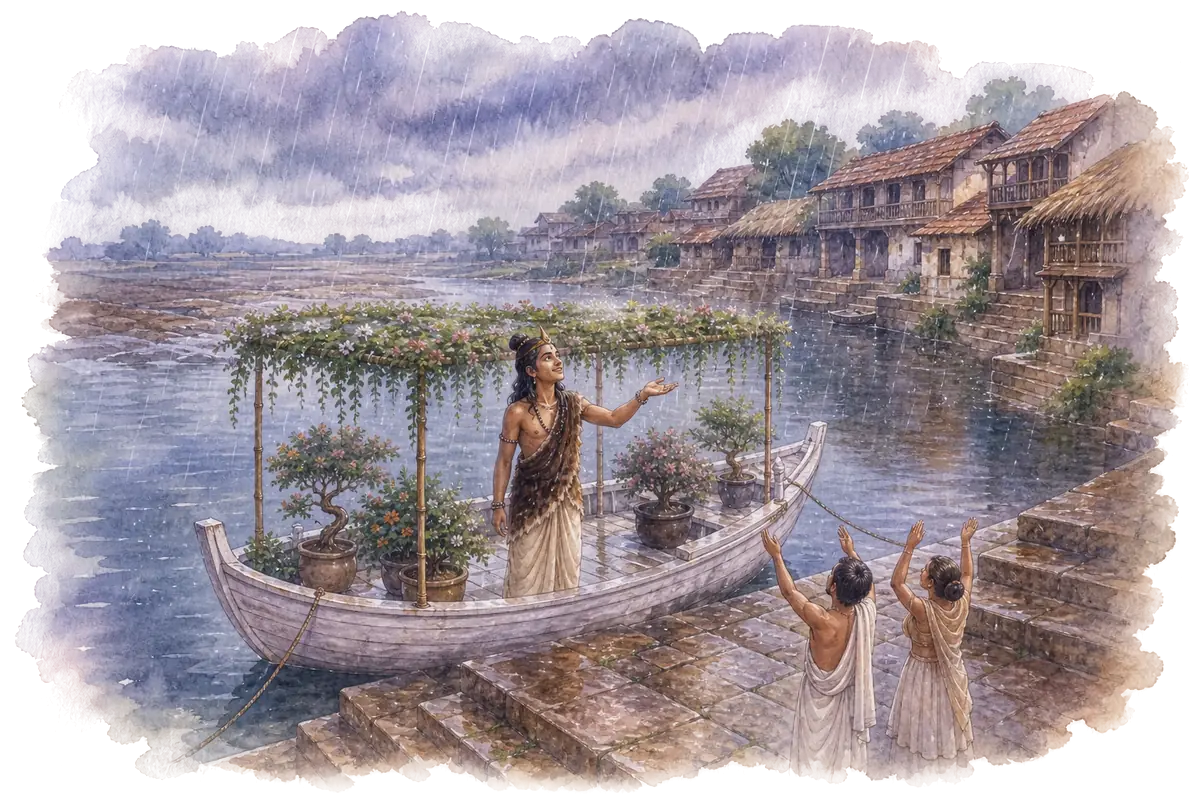
The moment Rishyashringa arrived, the sky opened. Rain poured down until the rivers rose and the dry fields drank. King Lomapada had what he wanted most, and he gave Rishyashringa his daughter Shanta as a wife.
Then the king prepared for Vibhandaka's anger. All along the road from the forest he set out herds of cattle and freshly plowed fields, with cowherds who had their orders.
Sure enough, Vibhandaka came out of the forest in a fury, meaning to burn the king and his city of Champa to the ground. On the way he grew tired and hungry. The cowherds welcomed him and fed him like a king. "Whose cattle are these?" he asked. "They all belong to your son," they said, and he heard the same at every village he passed.
By the time he reached the city and saw his son, honored like a god, with Shanta beside him, his anger had melted away. He blessed them both. Once Rishyashringa had a son of his own, he told him, he must come back to the forest. Rishyashringa did as his father asked, and Shanta went with him and lived with him there.
Lomasha told this story to the Pandavas beside the lake at Rishyashringa's old hermitage, and they bathed in it.
Why it matters
This story explains why a boy from the forest could end a drought, and it is one of the rare stories that reaches into both of India's great epics. In the Ramayana, King Dasharatha of Ayodhya, a friend of Lomapada's, asks Rishyashringa to lead the sacrifice that brings him four sons, Rama and his brothers.
Where this comes from: Vana Parva §110–113 in the Ganguli translation of the Mahabharata, where Lomasha tells the tale (Ganguli spells the names Rishyasringa and Santa). In the Ramayana, Shanta is King Dasharatha's daughter, raised by Lomapada; the Mahabharata calls her Lomapada's daughter. More about the sources.