A well-known side story from the Mahabharata
Agastya Drinks the Ocean: The Sage, the Demon Dinner and the Mountain That Waited
One of the best-known side stories of the Mahabharata, told by the sage Lomasha to the Pandavas at Agastya's own hermitage during their years in the forest. Agastya eats a demon who has been tricking guests, stops the Vindhya mountain from growing with a single request, and drinks the whole ocean dry so the gods can reach the demons hiding at the bottom.
- Agastyaa-GAS-tyaअगस्त्यalso Agasthya
- Lopamudralo-paa-MUD-raaलोपामुद्रा
- IlvalaIL-va-laइल्वल
- VatapiVAA-taa-peeवातापि
On their pilgrimage the Pandavas came to the hermitage of the sage Agastya, and Yudhishthira asked Lomasha why Agastya had once killed a demon there. Lomasha had more than one story to tell.
In the city of Manimati lived an asura named Ilvala and his younger brother Vatapi. Ilvala had once asked a brahmin for a son as mighty as Indra, and the brahmin had refused. From that day on, Ilvala hated brahmins.
He had a nasty trick. Vatapi could take any shape he liked, so Ilvala turned him into a ram and served him up, cooked, to brahmin guests. When the meal was over, Ilvala called his brother's name. Vatapi always came when Ilvala called, even back from death, and he answered from inside the guest, alive and laughing. The guest never got up again.
Now Agastya had married Lopamudra, a princess of Vidarbha. She had given up her silks and jewels to live with him in the forest in clothes made of bark. One day she asked him for the comforts she had grown up with, a bed as soft as the one in her father's palace and jewels for both of them.
Agastya didn't want to spend his holy power conjuring riches, so he went to ask kings for wealth. The first king showed him his accounts. Everything that came in went out again, so taking anything would hurt someone. The second king's accounts were the same, and so were the third's. At last the three kings said, "There's an asura named Ilvala who is richer than anyone on earth. Let's all go and ask him."
Ilvala welcomed them politely and served them a fine dinner of ram. The kings knew exactly who the ram was, and they went pale.
"Don't worry," said Agastya, and he sat down in the best seat. "I'll eat the great asura myself."
He ate every bite. Then Ilvala began to call for his brother. "Vatapi, come out."
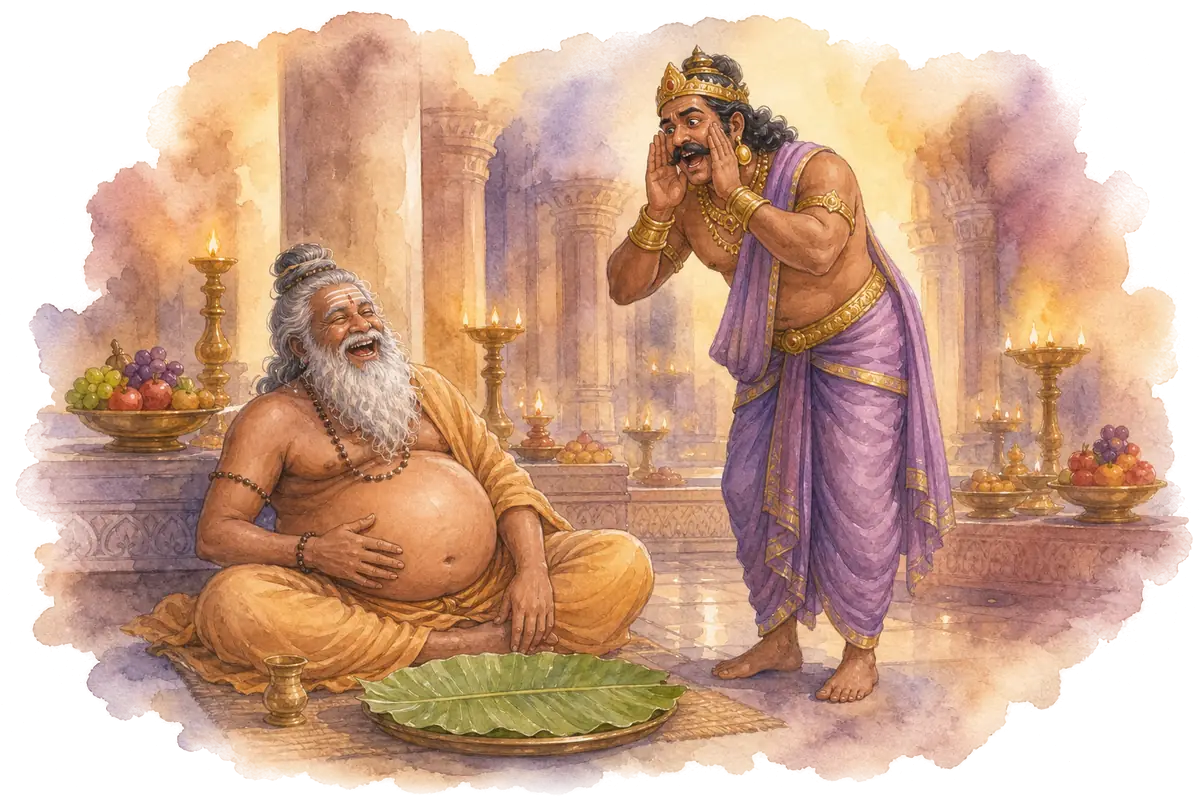
Nothing came out of Agastya but a rumble of wind, as loud as a thundercloud. Ilvala called again and again.
Agastya burst out laughing. "How can he come out? I've already digested him."
Ilvala sagged. He joined his hands and asked what they wanted. Agastya told him the kings needed riches and so did he. "And I know what you were already planning to give us," he said. Ilvala had meant to give each king ten thousand cows and as many gold coins, and Agastya twice that, along with a golden chariot and two horses as fast as thought. Ilvala went to look, and the chariot really was made of gold. He handed it all over, and the two horses carried everyone home in the blink of an eye. Lopamudra had everything she had asked for, and in time she and Agastya had a learned son.
Lomasha told another story too. The Vindhya mountain was once jealous of Mount Meru, because the sun went around Meru every day. "Go around me too," Vindhya told the sun. The sun said it didn't choose its own path. So Vindhya began to grow, taller and taller, until it was blocking the way of the sun and the moon.
None of the gods could talk the mountain down, so they went to Agastya. He walked to the Vindhya with Lopamudra. "Let me through," he said. "I need to go south. Wait for me until I come back, and then grow as much as you like." The mountain let him pass. Agastya never came back from the south, and the Vindhya is still waiting.
Then came the greatest wonder. A fierce clan of demons called the Kalakeyas, who had fought for the demon Vritra, fled into the ocean after Indra killed him. By day they hid at the bottom of the sea. By night they came out to raid the forest hermitages, and nobody could catch them, because by morning they were back under the water.
The gods asked Vishnu for help. Only Agastya can dry up the ocean, Vishnu told them. So the gods went to Agastya and asked him to drink it.
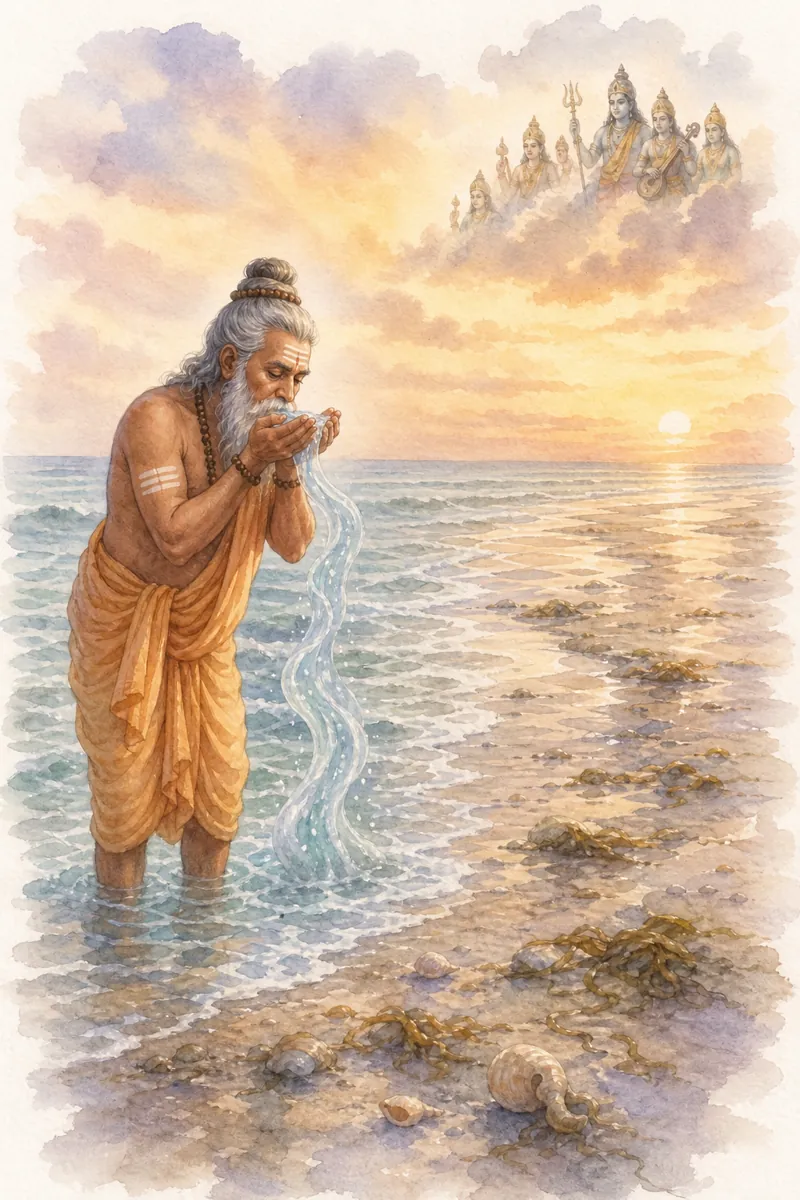
"Let it be so," said Agastya. He walked to the shore, and a great crowd of gods and sages followed him to watch. Agastya began to drink. The waves drew back and back, until the wide ocean was empty and the Kalakeyas lay exposed on the seabed. The gods charged down and defeated them. A few escaped by splitting the earth open and fleeing down into the underworld.
Then the gods asked Agastya to put the ocean back.
"I can't," he said. "I've digested it."
Why it matters
Agastya is one of the most honored sages in the Mahabharata, and these stories show why. They also explain why the Vindhya mountains never grew any higher, and why Agastya belongs to the south of India, where tradition says he stayed. The empty ocean leads into Lomasha's next story, about King Bhagiratha, whose family was destined to fill it again.
Where this comes from: Vana Parva §96–105 in the Ganguli translation of the Mahabharata, where Lomasha tells these stories at Agastya's hermitage. Ganguli spells the asura's name Ilwala. In Ganguli, Agastya asks the Vindhya to make way for him and wait; the popular telling says the mountain bowed low to let him pass. More about the sources.