A well-known side story from the Mahabharata
The Butcher Who Taught a Sage: The Story of Dharmavyadha
One of the best-known side stories of the Mahabharata, told by the sage Markandeya to Yudhishthira during the Pandavas' years in the forest. A proud young sage named Kaushika kills a crane with one angry look, a housewife sends him to a meat-seller in the city of Mithila, and the meat-seller, remembered as Dharmavyadha, teaches him what goodness really is.
- KaushikaKOW-shi-kaकौशिक
- Dharmavyadhadhar-ma-VYAA-dhaधर्मव्याध
- Markandeyamar-KAN-day-yaमार्कण्डेयalso Markandey
- Yudhishthirayu-DHISH-ti-raयुधिष्ठिर
Long ago, the sage Markandeya told Yudhishthira, there lived a young brahmin named Kaushika who knew all the Vedas by heart.
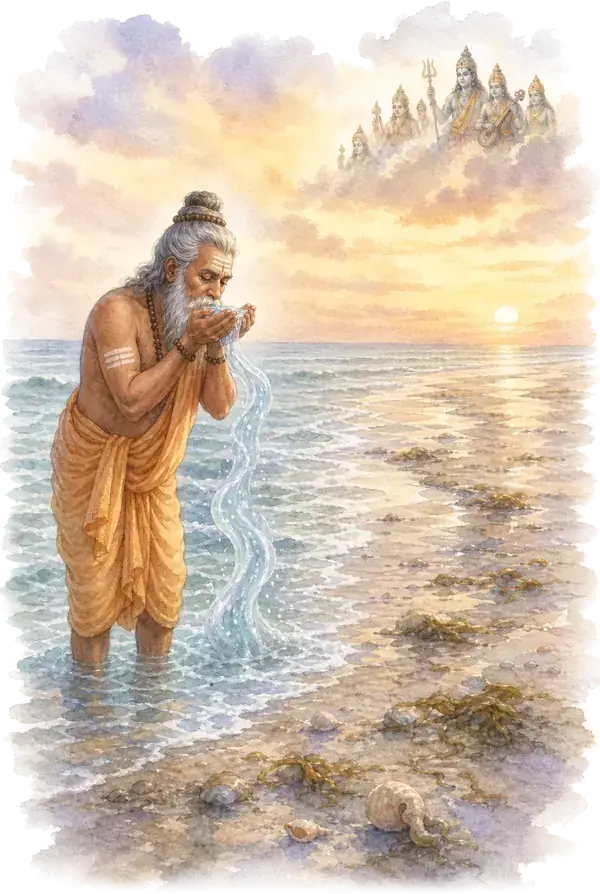
One day he sat under a tree chanting them aloud, and a crane on the branch above let her droppings fall right on his head. Kaushika looked up in a rage. His anger was so strong that the look alone was enough. The crane dropped from the branch and lay dead on the ground.
He was sorry at once. “Anger made me do a wicked thing,” he kept saying.
Then it was time to beg for his food, as young sages did. At a house he knew he called out, “Give.” A woman inside answered, “Wait.”
Just then her husband came home, worn out and hungry. She forgot the sage at the door. She brought her husband water for his feet, sat him down and served his meal. Only then did she remember Kaushika. She hurried out with food and found him blazing.
“You told me to wait and then left me standing here. Don't you know brahmins are like fire? We can burn up the whole earth.”
The woman stayed calm. “I'm not a crane, sir. Your angry looks can't do anything to me.”
Kaushika stared at her. Nobody had seen what happened under that tree.
“Serving my husband is my way of doing right,” she went on. “And anger is the worst enemy a person has. You know the Vedas, yet I don't think you know what dharma really is. Go to Mithila. A man who sells meat lives there. He looks after his mother and father and never lies, and he can teach you. Forgive me if I've spoken too plainly.”
Kaushika's anger went out like a lamp. “Your words will do me good,” he said.
He walked through forests and villages until he came to Mithila, King Janaka's city, where flags flew over the gates and the streets were full of chariots and elephants. Some brahmins pointed him to the meat market.
The butcher sat in his stall with a crowd of buyers around him, so Kaushika stood well back. But the butcher saw him, left his customers and came straight over.
“Welcome, holy one. The good woman sent you here, and I know why you've come. This isn't the place for you. Come to my house.”
That was the second wonder Kaushika had seen.
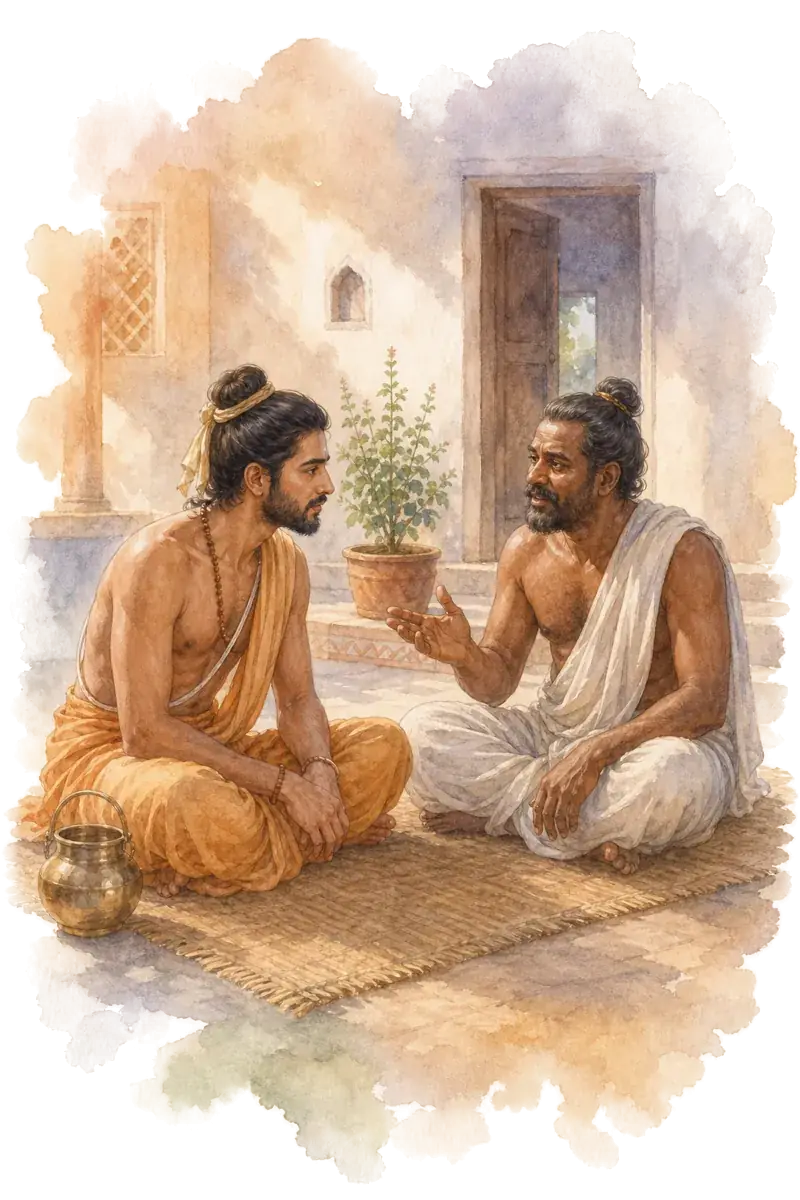
At the house the butcher gave his guest a seat and water for his feet. Kaushika couldn't keep quiet. “I'm sorry you have such cruel work,” he said.
“It's my family's trade. My father and grandfather did it before me,” the butcher said. “Don't be sorry for me. I tell the truth and I envy nobody. I eat only after my guests and my family have eaten. A person can be born to a hard trade and still live a good life.”
They talked for a long time. The butcher said that someone who is truly sorry for a wrong, and never does it again, is washed clean of it. He said the senses run like wild horses, and a wise person holds the reins like a good charioteer. Kaushika had studied all his life and had never heard these things put so plainly.
At last the butcher stood up. “Now come and see where everything I know comes from.”
In an inner room, bright and sweet-smelling, an old man and an old woman sat in white, resting after their meal. The butcher bowed and touched his head to their feet.
“Get up, son,” they said. “Nobody could look after us better.”
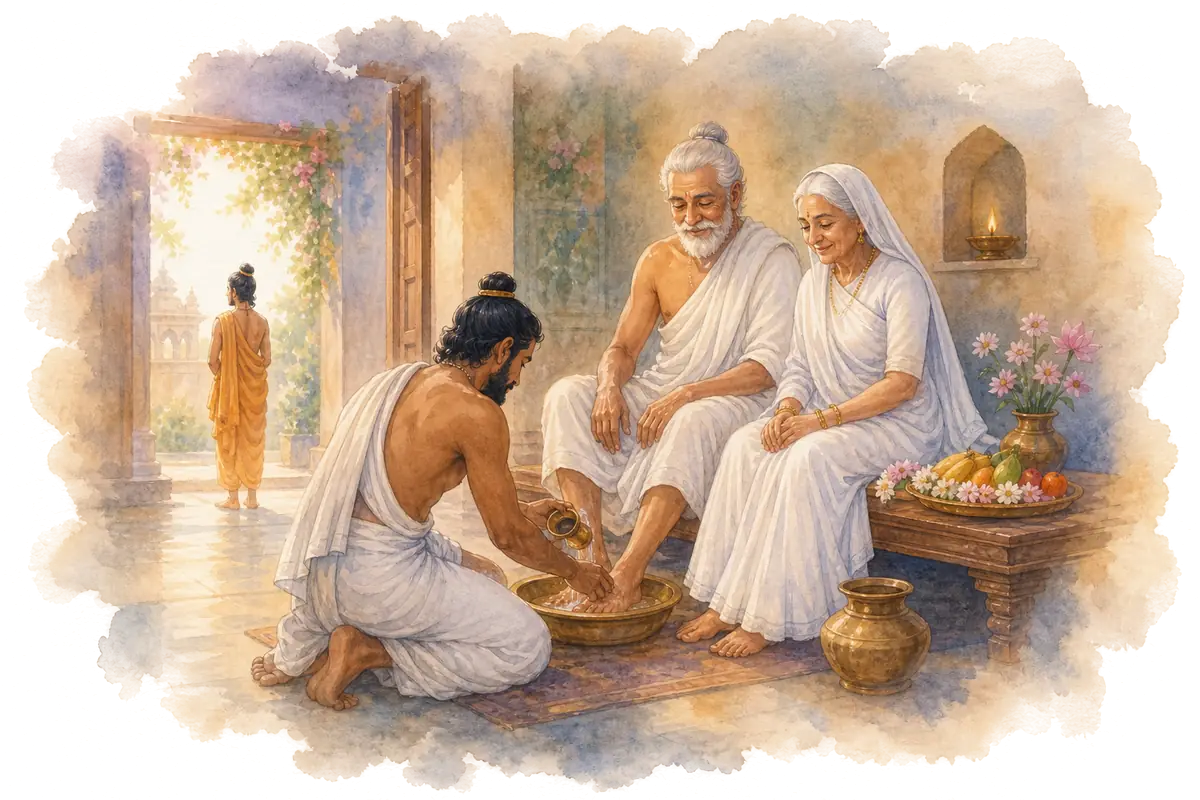
“These two are my gods,” the butcher told Kaushika. “I bathe them with my own hands and wash their feet and bring their food. I only ever say kind things to them.”
Then he looked hard at his guest. “So I have to tell you something. You left home to study without asking your mother and father. They are old now, and they have cried for you until they went blind. All your learning is no use while they sit alone. Go home, today.”
Kaushika bowed his head. “Every word of that is true.”
Before he went, he asked one more thing. How had a man so wise been born into a butcher's family?
In his last life, the butcher said, he had been a brahmin who learned archery from a king. Out hunting one day near a hermitage, he shot at what he took for a deer, and the arrow struck a sage. He begged forgiveness, but the sage cursed him to be born a hunter. When he kept pleading, the sage softened. He would still honor his parents, remember his past life and one day be a brahmin again. The young archer carried the sage back to his hermitage, and the sage lived.
“I don't think of you as low-born at all,” Kaushika said. “A man becomes a brahmin by the way he lives. A proud, cruel brahmin is a brahmin only in name, and a good man of any birth is a brahmin to me.”
He walked around the butcher with his palms joined, the way you honor a teacher, and set off for home. There he looked after his old mother and father with great care.
Why it matters
The story turns the usual order upside down. A sage who knows every holy book has to learn from a housewife and a man who sells meat, the very people his world expected to learn from him. The butcher's teaching is often called the Vyadha Gita, the Song of the Hunter, and it makes a point the Mahabharata comes back to many times. A person is judged by how they live, whatever family they were born into.
Where this comes from: Vana Parva §205–215 in the Ganguli translation of the Mahabharata, where Markandeya tells the story to Yudhishthira. Ganguli calls the teacher “the virtuous fowler” (in Sanskrit vyadha, a hunter) who sells meat in Mithila; he is popularly known as Dharmavyadha, and his teaching as the Vyadha Gita. The long middle of his teaching (§207–212) is shortened here. This Kaushika is a different sage from the Kaushika who told robbers where travelers were hiding, in the Karna Parva. More about the sources.