A well-known side story from the Mahabharata
Mudgala and the Gleaned Grain: The Sage Who Said No to Heaven
One of the best-known side stories of the Mahabharata, told by the sage Vyasa to Yudhishthira in the eleventh year of the Pandavas' exile in the forest. Mudgala, a poor sage who lives on grain left behind in the fields, feeds the bad-tempered Durvasa six times without a word of complaint, and when a chariot of the gods comes to carry him to heaven, he asks what is wrong with heaven first.
- MudgalaMUD-ga-laमुद्गलalso Mudgal
- Durvasadur-VAA-saaदुर्वासा
- VyasaVYAA-saव्यासalso Ved Vyas
- Yudhishthirayu-DHISH-ti-raयुधिष्ठिर
In the eleventh year of the exile, the sage Vyasa came to see the Pandavas in the forest. Yudhishthira asked him which was harder, giving things away or living a life of hardship. Giving, said Vyasa, because people work so hard for what they have. Then he told this story.
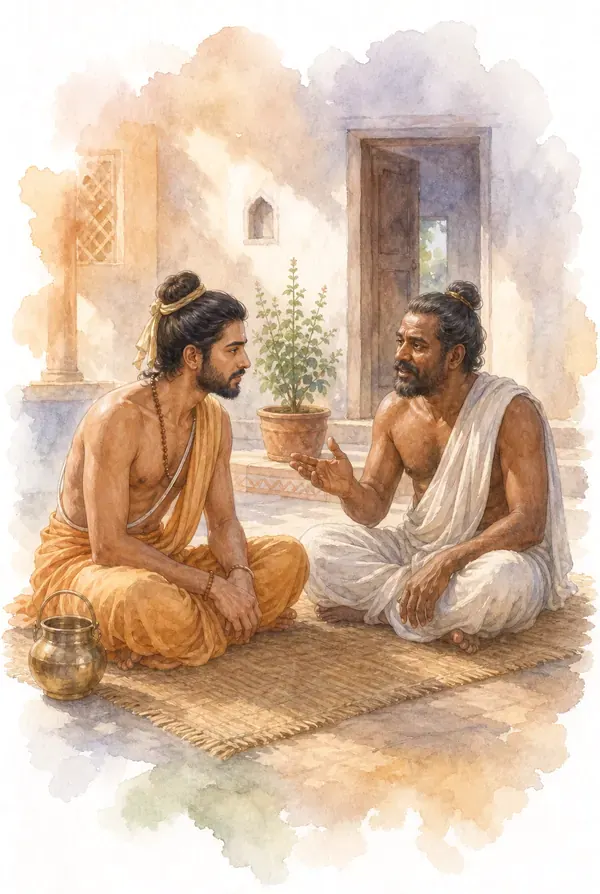
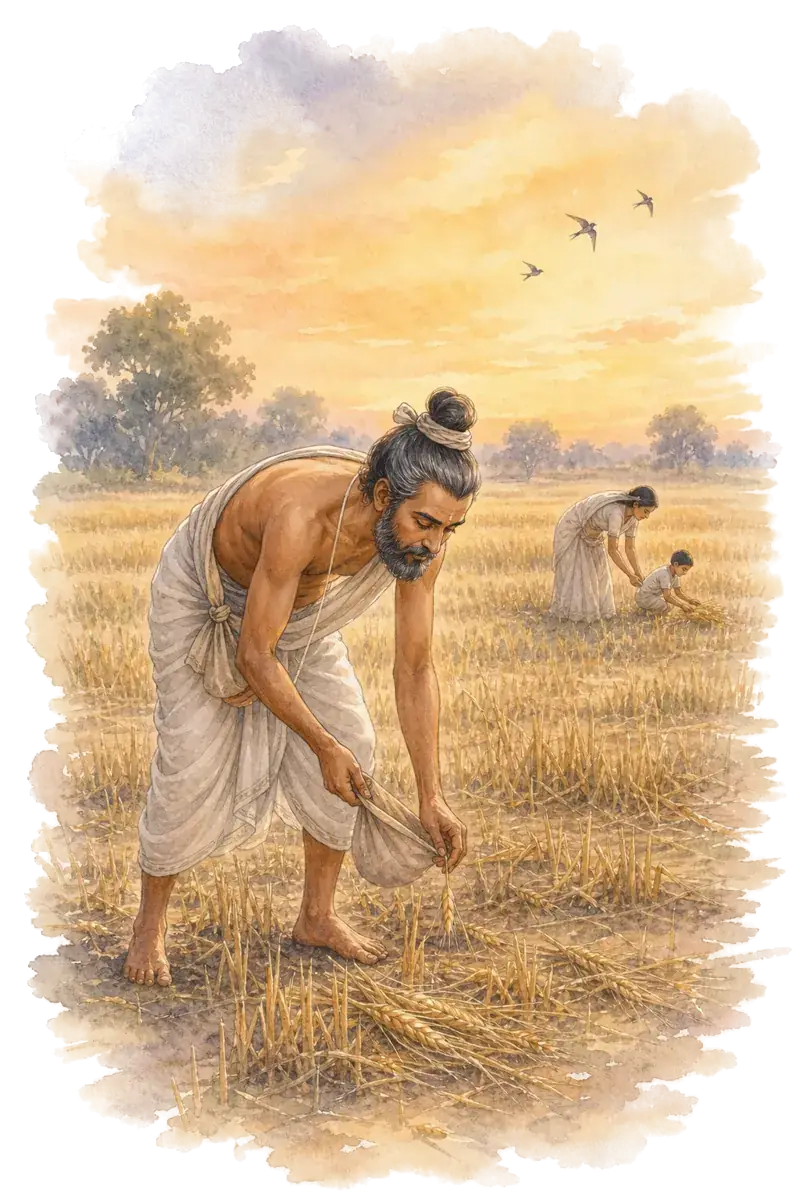
At Kurukshetra there lived a sage named Mudgala with his wife and his son. He owned nothing. After the farmers had cut their grain and carried the sheaves home, Mudgala walked the bare fields and picked up what they had left behind, a fallen ear here, a single grain there. People called this living like a pigeon.
It took him half a month to gather one small measure of grain. At the new moon and the full moon he made his offerings to the gods and fed any guest who came, and the family lived on whatever was left.
Something strange happened to that grain. Whenever a guest arrived, it grew. Mudgala gave it away so gladly that hundreds of hungry brahmins were fed from it, and on holy days Indra and the gods came to share his offering.
Word of Mudgala reached the sage Durvasa, who was famous for his temper. Durvasa decided to see for himself.
He arrived looking wild, his head shaved bare, shouting insults. “I've come for food,” he said.
“You're welcome here,” said Mudgala. He brought water for the sage's feet and set the best food he had in front of him.
Durvasa ate all of it. Mudgala brought more, and Durvasa ate that too. Then he smeared the leftovers over his body and walked off without a word of thanks.
There was nothing left. Mudgala went back to the fields with his wife and son and began again, one grain at a time.
At the next new moon Durvasa came back and ate everything again. He came six times in all. Each time Mudgala welcomed him and fed him and watched the food disappear, and each time the family went back to gleaning with empty stomachs. Durvasa watched Mudgala's face closely. He was looking for a flash of anger or a sulk. He never found one.
At last Durvasa stopped pretending. “There's nobody on earth as generous as you,” he said. “Hunger drives goodness out of most people. Again and again you gave away food you had worked hard for, and your heart stayed clear. The gods are talking about you. You will go to heaven in your own body.”
As he spoke, a chariot came down out of the sky. Swans and cranes drew it, little bells hung from it, and it smelled of flowers that grow nowhere on earth. A messenger of the gods stood beside it.
“Climb in,” he said. “You've earned this.”
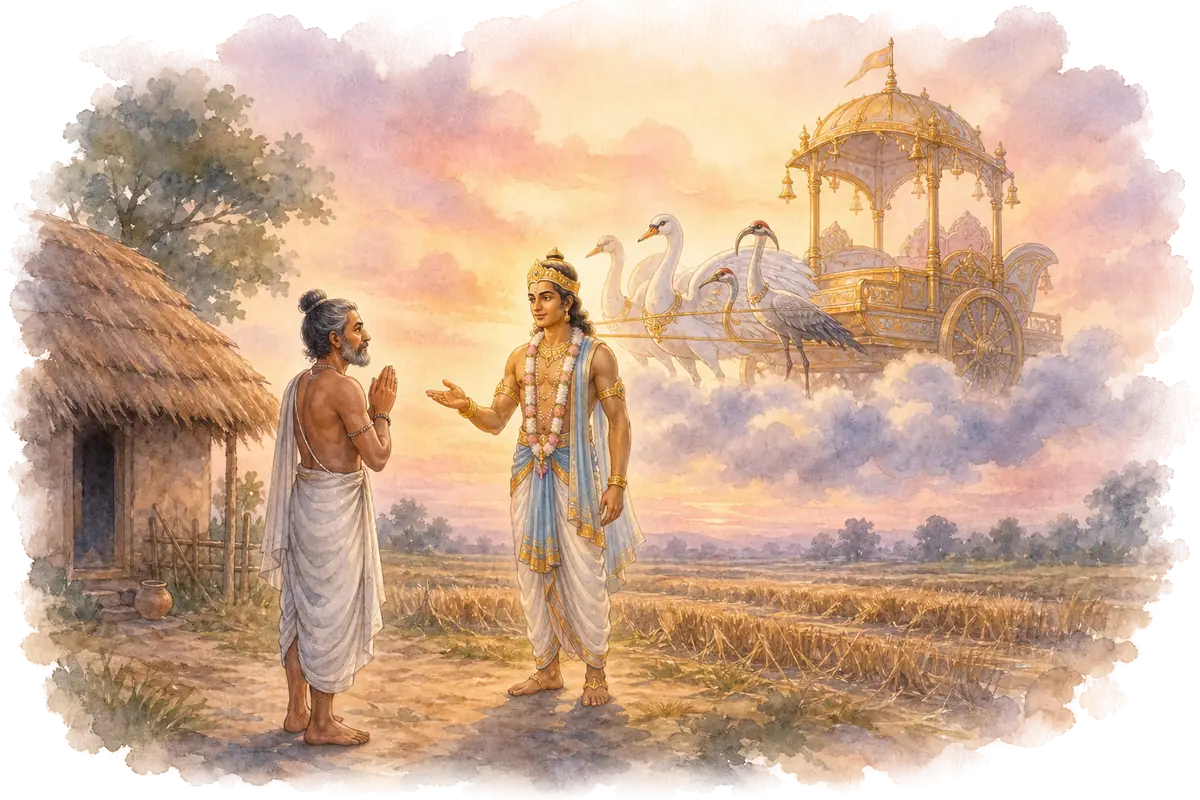
Anyone else would have jumped in. Mudgala asked a question first. “They say two people who walk seven steps together are friends, and friends tell each other the truth. What is heaven like? And what's wrong with it?”
The messenger told him about heaven. Nobody there is ever hungry or tired or afraid, the breezes are soft and the garlands never fade. “But there is one thing,” he said. “In heaven you can't do anything new. You only enjoy what your good deeds have earned, and when that runs out, you fall back to earth. The fall hurts more than if you had never gone. Even before it comes, your garland starts to wilt, and you know.”
Mudgala thought about this for a long while.
“Then go in peace,” he told the messenger. “I don't want a happiness that ends in falling. Is there a place nobody falls from?”
There is, said the messenger. Far above all the heavens is the home of Vishnu. No one gets there by being rewarded. People get there by letting go of pride and anger and wanting things.
The chariot rose into the sky with no one in it. Mudgala went back to his fields. From then on praise and blame sounded the same to him. A lump of clay looked no different from a lump of gold. He spent his days in meditation, and in time he reached the place the messenger had spoken of, where there is no falling.
“So don't grieve, son of Kunti,” Vyasa told Yudhishthira. “Happiness and sorrow take turns, like the spokes of a turning wheel.”
Why it matters
Vyasa tells this story to a king who has lost his kingdom and is living on roots and fruit in the forest. Mudgala has even less, and gives it away anyway. His question to the messenger also carries one of the Mahabharata's big ideas. Heaven is a reward that runs out, and the deeper goal, which the epic calls moksha, is freedom from the whole round of rising and falling.
Where this comes from: Vana Parva §257–259 in the Ganguli translation of the Mahabharata: Yudhishthira's question about giving in §257, and the story of Mudgala, told by Vyasa, in §258–259. Ganguli says the grain Mudgala gathered each fortnight was a drona, “a very small measure.” The messenger's long account of the worlds of the gods is shortened here. More about the sources.