A well-known side story from the Mahabharata
Uttanka and the Stolen Earrings: A Student's Gift for His Teacher
One of the side stories at the very start of the Mahabharata, told by the bard Sauti to the sages of the Naimisha forest before he begins the main tale. A student named Uttanka goes to fetch a queen's earrings as a thank-you gift for his teacher, the snake king Takshaka steals them, and Uttanka follows him down into the land of the Nagas to get them back.
- Uttankaut-TAN-kaउत्तङ्कalso Utanka
- TakshakaTAK-sha-kaतक्षकalso Takshak
- IndraIN-draइन्द्र
- Janamejayaja-na-may-JA-yaजनमेजयalso Janmejay
Uttanka was a student of a teacher named Veda. When his studies were over, Veda told him he was free to go home.
“Let me bring you a gift first,” said Uttanka. A student who left without thanking his teacher, people said, left in debt.
Veda sent him to ask his wife what she would like. She knew at once. “Go to King Paushya and ask for the earrings his queen wears. In four days there is a holy feast, and I want to wear them when I serve the guests. Bring them in time.”
Uttanka set off. On the road he met a giant of a man riding a giant bull. “Eat some of this bull's dung,” said the man.
Uttanka did not want to.
“Eat it and don't fuss,” said the man. “Your teacher ate it before you.”
So Uttanka ate a little, rinsed his mouth standing up because he was in a hurry, and went on to the palace.
King Paushya was glad to help. “Go to the queen's rooms and ask her yourself.” But Uttanka searched every room and found nobody. He came back cross. “You're playing tricks on me. She isn't there.”
The king thought for a moment. “Did you wash properly after you ate? My queen can't be seen by anyone who isn't clean.”
Uttanka remembered rinsing on his feet, in a rush. This time he sat down facing east and washed his face and hands and feet with care. When he went back in, the queen was right there.
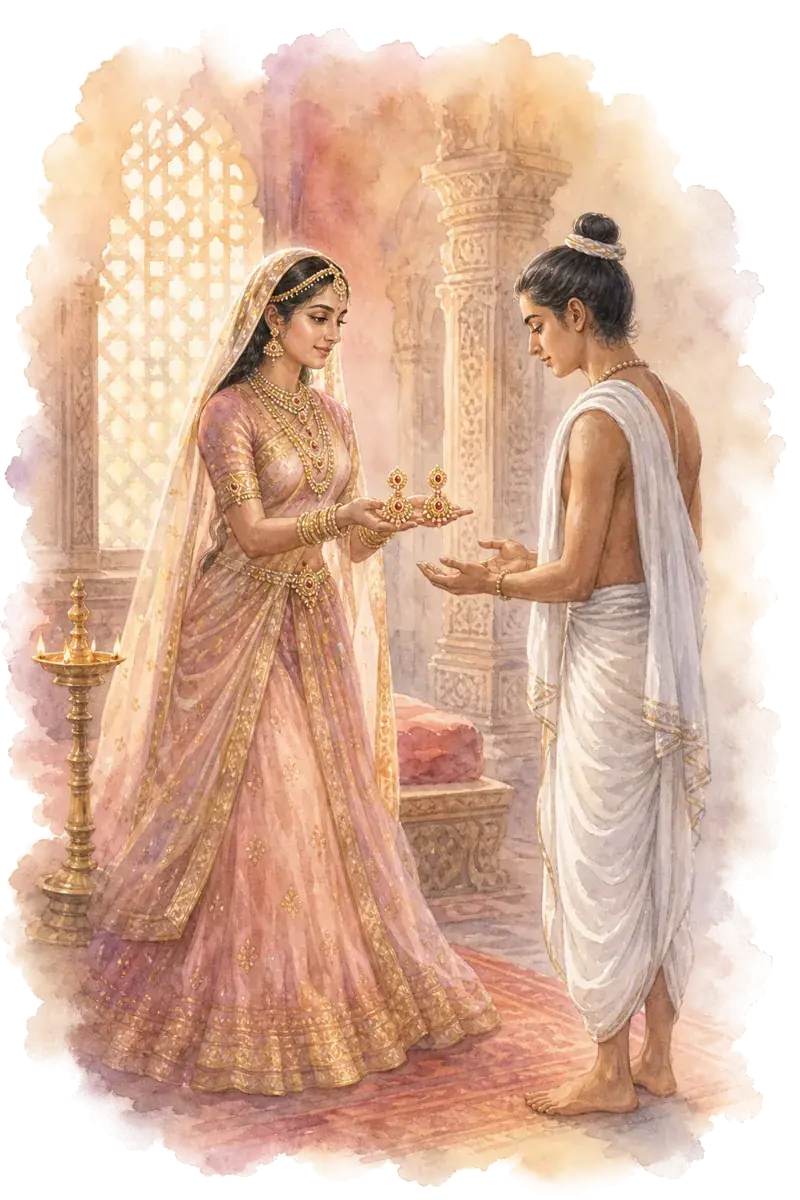
She took off her earrings and gave them to him. “Guard these well,” she said. “Takshaka, king of the snakes, has wanted them for a long time.”
“Takshaka won't catch me,” said Uttanka.
On the way home he set the earrings down beside some water while he washed. A beggar who kept flickering in and out of sight darted up and snatched them. Uttanka raced after him and caught hold of him, and at his touch the beggar turned into a great snake. It was Takshaka. He slid into a hole in the ground and was gone.
Uttanka dug at the hole with a stick and could barely scratch it. Indra, king of the gods, saw his trouble and sent his thunderbolt into the stick. The earth split open, and Uttanka climbed down after the thunderbolt into the land of the Nagas, the snake people.
It went on without end, full of palaces and towers and gateways. Uttanka sang the praises of the snake kings, but nobody gave back the earrings.
Then he saw stranger things. Two women sat at a loom, weaving cloth from black and white threads. Six boys were turning a wheel with twelve spokes. Nearby a man stood beside a magnificent horse.
Uttanka praised the man, and the man was pleased. “What can I do for you?”
“Put the snakes in my power.”
“Blow into this horse.”
Uttanka blew. Flames and smoke poured from the horse and filled the land of the Nagas. Takshaka came rushing out, coughing, with the earrings in his hands. “Take them. Take them back.”
Now Uttanka had the earrings, but the feast day had come and home was far away. “Ride the horse,” said the man. “He will carry you there in a moment.”
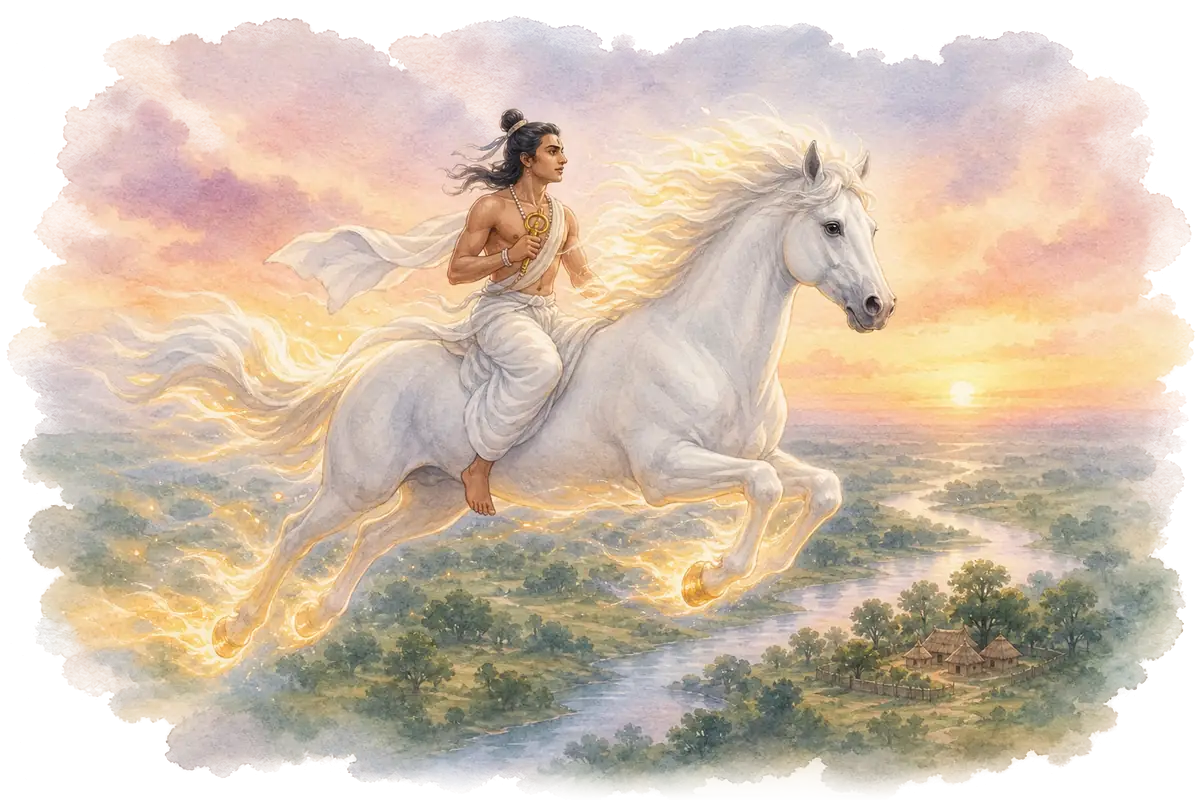
At home, the teacher's wife had bathed and was combing her hair, ready to curse Uttanka if he failed her. He walked in and put the earrings in her hands. “Just in time,” she said, smiling. “Good fortune is waiting for you, child.”
Then Uttanka asked his teacher what he had seen. The two weavers, Veda told him, were Dhata and Vidhata, who make the world, and their black and white threads were night and day. The wheel was the year, turned by the six seasons. The man was Parjanya, the god of rain, and the horse was Agni, the fire god. The rider on the road was Indra himself. “And what he gave you to eat,” said Veda, “was amrita, the nectar of the gods. That is why you came back alive from the land of the snakes.”
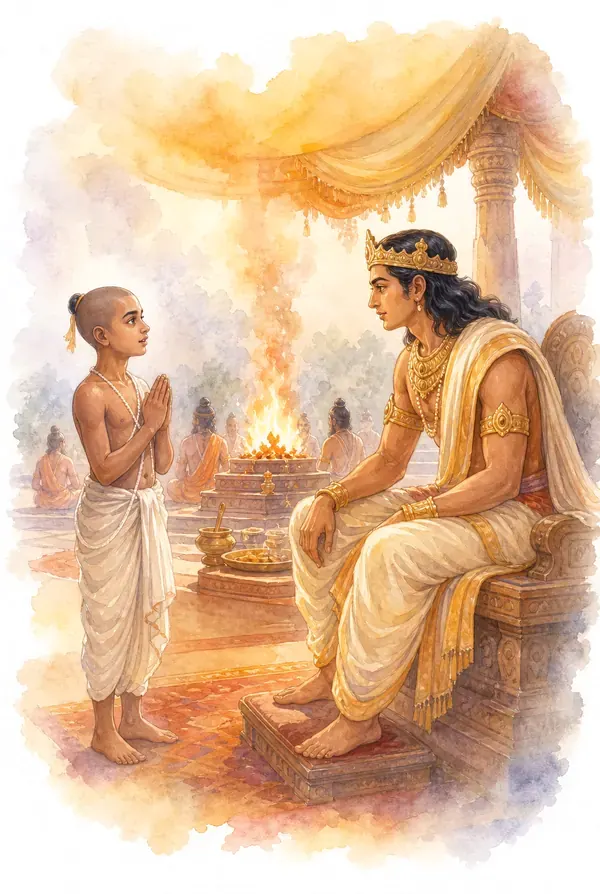
Uttanka went home with his teacher's blessing, but he had not forgiven Takshaka. He walked to Hastinapura, where a young king named Janamejaya ruled. He was a king of the Kuru line who lived long after the Pandavas, the great-grandson of Arjuna. Uttanka told him that Takshaka was the snake whose bite had killed his father, King Parikshit.
“Burn him in the fire of a great sacrifice,” said Uttanka. “Avenge your father, and you'll be doing me a favor too.”
Why it matters
Uttanka's story sits near the very beginning of the Mahabharata, and it starts the frame the whole epic is told inside. His grudge against Takshaka sends King Janamejaya to hold a great snake sacrifice, and it was at that sacrifice that Vyasa's pupil Vaishampayana first told the Mahabharata aloud. What happened when the snakes began to fall is the story of Astika and the snake sacrifice.
Where this comes from: Adi Parva §3, the Paushya section, in the Ganguli translation of the Mahabharata, where Ganguli spells the name Utanka. A few side scenes are left out, among them the curses Uttanka and King Paushya trade over a cold meal. A different Uttanka story, set after the war, is told much later in the Ashvamedhika Parva. More about the sources.