A well-known side story from the Mahabharata
King Yayati and the Borrowed Youth: The Story of Yayati and Puru
One of the best-known side stories of the Mahabharata, told by the sage Vaishampayana to King Janamejaya about one of the oldest kings in the Kuru family line. King Yayati is cursed with sudden old age and asks each of his five sons to trade their youth for it, and only the youngest, Puru, says yes.
- Yayatiya-YAA-tiययाति
- Devayaniday-va-YAA-neeदेवयानी
- Sharmishthashar-MISH-taaशर्मिष्ठाalso Sharmistha
- ShukraSHUK-raशुक्रalso called Shukracharya
- PuruPU-ruपुरु
In the old wars between the gods and the asuras, the asuras had one great advantage. Their teacher, the sage Shukra, knew a secret way to bring the dead back to life. Shukra lived at the court of the asura king Vrishaparva, and he loved nobody as much as his daughter Devayani.
Devayani had once loved a young student named Kacha. He refused to marry his teacher's daughter, and in the quarrel that followed he told her that no sage's son would ever marry her.
One day Devayani went to bathe in a forest lake with the king's daughter Sharmishtha. Their friends came too. They left their clothes on the bank. While they were in the water a wind came by and tossed the clothes into one heap, and when the girls climbed out, Sharmishtha put on Devayani's by mistake.
"You're wearing my clothes," said Devayani. "And you're supposed to be my pupil."
Sharmishtha's temper flared. "Your father sits on a lower seat than mine and sings his praises for pay," she said. "Mine gives gifts. Yours takes them."
Devayani grabbed at the clothes. Sharmishtha pushed her into a dry well and went home.
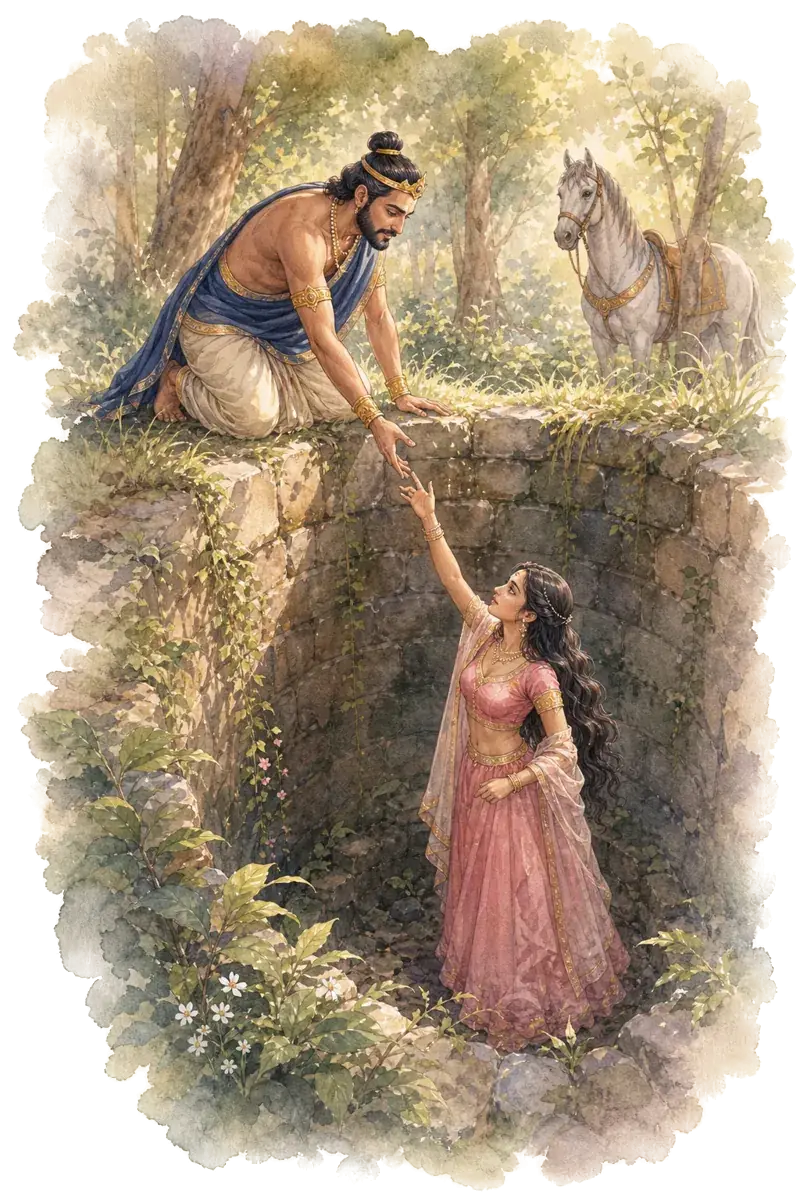
A little later a young king rode by, hot and thirsty from hunting. He was Yayati, son of King Nahusha. He looked down into the well for water and saw a girl sitting at the bottom.
"I am the daughter of Shukra," she told him. "This is my right hand. Take it and pull me out."
Yayati took her right hand and lifted her up. Then he rode home.
Devayani refused to set foot in the asura city again. When her father heard what had happened, he told King Vrishaparva he was leaving. The king begged him to stay. Without Shukra the asuras would have no one to bring their warriors back to life.
"Ask my daughter," said Shukra.
Devayani's price was high. Sharmishtha must become her servant, with a thousand maids, and follow her wherever she married. Sharmishtha agreed without a word of complaint. She would not let her people lose their teacher because of her.
Some time later Yayati came hunting in the same woods and found Devayani there, with Sharmishtha rubbing her feet. Devayani asked him to marry her. He had held her right hand, she said, and no other man ever would. Yayati would not marry a sage's daughter without her father's word, so Devayani sent for Shukra, who gave his blessing. He added one warning. Yayati must treat Sharmishtha with honor, but he must never make her his wife.
At the palace Sharmishtha was given a house beside a grove of ashoka trees. Years passed. One day she asked the king to make her his wife as well, and he did, in secret. Devayani had two sons, Yadu and Turvasu. Sharmishtha had three, and the youngest was Puru.
For a long time Devayani believed Sharmishtha's sons had a sage for a father. Then one day she saw three handsome boys playing in the garden and asked them who their father was. They pointed at the king and ran to hug his knees. Yayati did not dare pick them up.
Devayani went straight to her father in tears, and Shukra cursed Yayati. Old age fell on the king that very moment. His hair went white and his skin wrinkled.
"I'm not done with being young," Yayati begged.
"I never take back my word," said Shukra. "But you may pass your old age to someone who will take it. The son who does will be king after you."
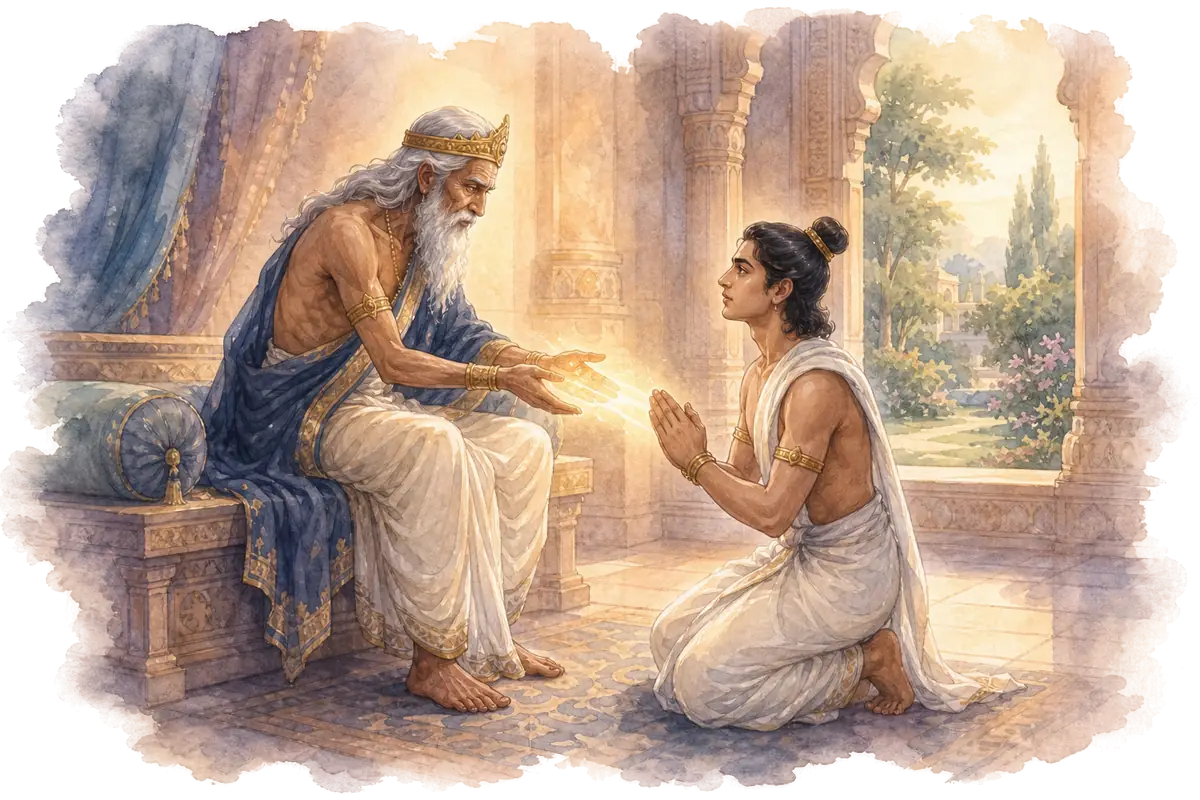
Yayati went home and called his eldest son. "Take my old age for a thousand years, Yadu," he said, "and lend me your youth. Then I'll give it back."
Yadu shook his head. Old people couldn't eat what they liked, he said, and even their friends got the better of them. Turvasu said no as well, and so did Sharmishtha's two elder sons. Yayati was furious with each of them, and he cursed them all.
Last of all he turned to Puru, his youngest.
"I'll do it, Father," said Puru. "Take my youth and enjoy your life."
So Yayati became young again, and Puru became an old man.
Yayati ruled well, and for a thousand years he enjoyed everything a king could want. But at the end of it he called Puru to him. "Wanting things is never cured by getting them," he said. "It flares up like a fire when you pour ghee on it." He took back his old age and gave Puru his youth, and told his people that Puru would be king.
The people objected. Yadu was the eldest, and Shukra's own grandson. Why should the youngest son be crowned?
"Puru alone did what I asked," Yayati told them, "and Shukra himself promised the throne to the son who took my old age." The people agreed.
So Puru was crowned, and old King Yayati walked away into the forest to spend the rest of his days among the deer.
Why it matters
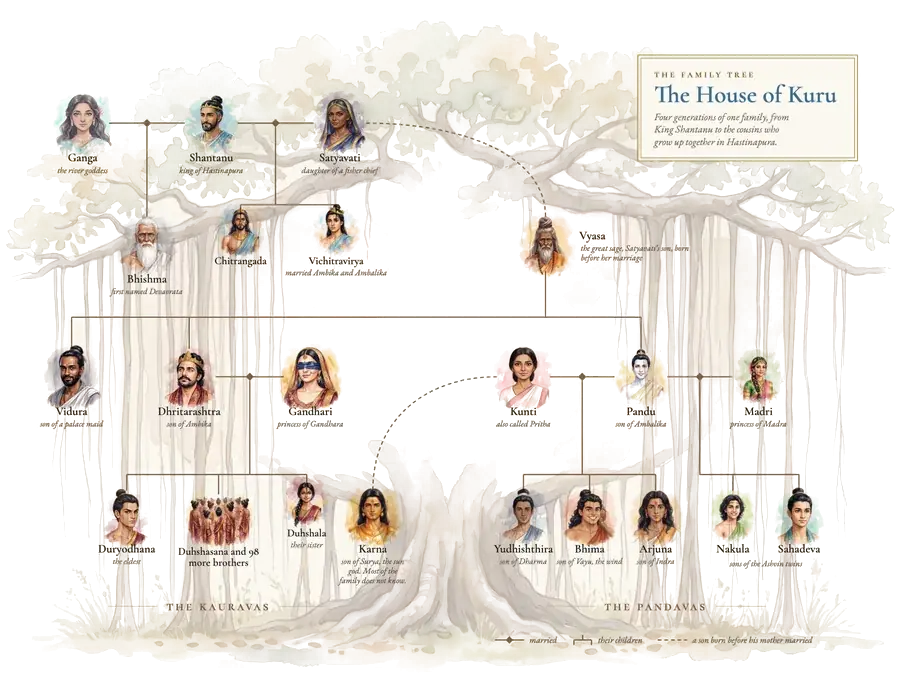
Puru's descendants were called the Pauravas. King Dushyanta, the father of Bharata, was one of them, and so, long afterward, was King Kuru, which makes the Pandavas and the Kauravas Puru's descendants too. Yadu's descendants were the Yadavas, the people Krishna was born among. Two of the epic's great families go back to these two half-brothers.
Where this comes from: Adi Parva §75–93 in the Ganguli translation of the Mahabharata, with Kacha and Devayani in §76–77. Ganguli calls Shukra by his other name, Usanas, and Sharmishtha's three sons are named there as Drahyu, Anu and Puru. From §86 to §93 the story goes on to Yayati's fall from heaven for his pride. More about the sources.