A well-known side story from the Mahabharata
Shakuntala and Dushyanta: The Story of How Bharata Got His Name
One of the best-known side stories of the Mahabharata, told by the sage Vaishampayana to King Janamejaya as the start of the Kuru family's history, long before the Pandavas were born. King Dushyanta marries Shakuntala, a sage's daughter, in a forest hermitage, then says he has never seen her when she brings their son to his court, until a voice from the sky tells him the truth and names the boy Bharata.
- Shakuntalasha-KUN-ta-laaशकुन्तलाalso Sakuntala
- Dushyantadush-YAN-taदुष्यन्तalso Dushyant
- BharataBHA-ra-taभरतalso Bharat
- KanvaKAN-vaकण्व
Long before Hastinapura had Pandavas or Kauravas, it had a king named Dushyanta.
One day he went hunting with a huge army. Conches blared and chariot wheels rattled. After a long hunt he crossed a dry, empty plain with one companion. On the far side he found a different forest altogether. The trees were heavy with blossom and full of birdsong. A clear river called the Malini ran past a hermitage.
This was the home of the sage Kanva. The king left his army at the edge of the trees and walked in alone.
"Is anyone here?" he called.
A young woman came out of the hut, dressed as a hermit's daughter. She gave him a seat and water to wash his feet, and asked how she could help. Her father had gone to gather fruit, she said. He would be back soon.
Dushyanta could hardly take his eyes off her. Kanva had given up the world, he said, so how could he have a daughter?
Her real father, she told him, was the great sage Vishvamitra, and her mother was Menaka, a dancer of heaven. Menaka had left her as a newborn baby on the bank of the Malini and gone back to the sky. Birds had gathered around the baby and guarded her until Kanva came down to the river to bathe and found her. The sage carried her home and raised her as his own. Because the birds, the shakuntas, had protected her, he named her Shakuntala.
"Marry me," said the king. "Today."
Shakuntala asked him to wait for her father. Dushyanta explained that a king's family allowed one kind of marriage made by two people's own choice, with no priest and no ceremony, called a gandharva marriage. She was free to give herself.
Shakuntala thought about it. Then she named one condition. "Promise that our son will be your heir, and king after you."
The king promised without stopping to think. He would send soldiers, he said, to bring her to his city as his queen. So they married in the hermitage, by their own free consent, and then he rode away.
When Kanva came home with his load of fruit, Shakuntala was too shy to go out and meet him. But the sage could see what had happened with his inner sight, and he was pleased. Her son, he told her, would be a great king.
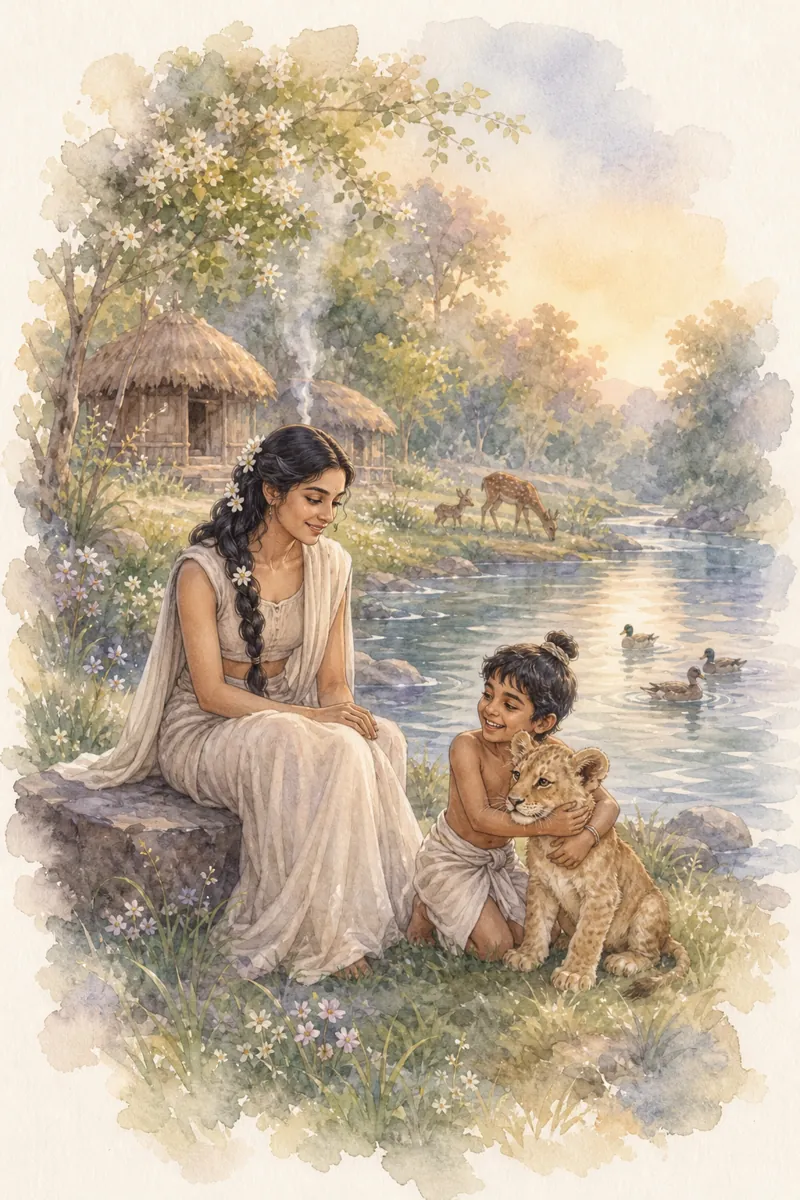
The son was born, and he grew fast. By the time he was six he could catch lions and even wild elephants and tie them to the trees around the hermitage. The hermits called him Sarvadamana, the tamer of everything.
No soldiers ever came from the city. At last Kanva said it was time for the boy to take his place as his father's heir, and he sent mother and son to Hastinapura with some of his pupils.
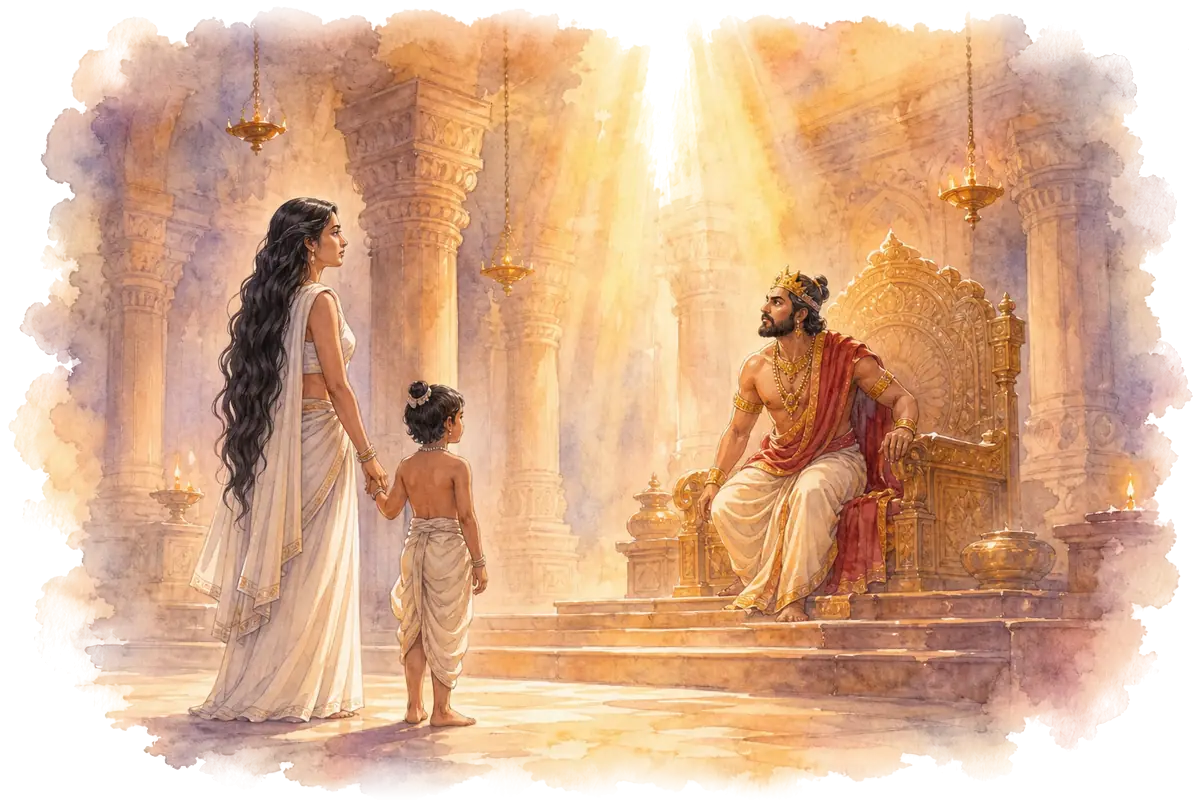
Shakuntala stood before the king in his crowded hall. "This is your son," she said. "Make him your heir, as you promised me in Kanva's hermitage."
Dushyanta looked at her. "I don't remember anything of the kind," he said. "Who are you? Go or stay, as you please."
For a moment Shakuntala stood as still as a wooden post. Her eyes turned red as copper and her lips shook. With a great effort she held her anger back, and then she spoke.
"You know the truth," she told him. "Your own heart is a witness. You think nobody saw what you did. The sun and the moon saw it, and so did the god who lives in every heart." She asked him to look at the boy, his own face looking back at him like a face in a clear lake. Truth, she said, weighed more than a hundred great sacrifices put together.
The king answered with insults about her mother and father.
"You can see other people's faults when they are as small as a mustard seed," said Shakuntala. "You can't see your own when they are as big as a bel fruit." If he would not believe her, she would leave. "But this son of mine will rule the whole earth."
She turned to go. And a voice spoke out of the sky, heard by every priest and minister in the hall.
"Shakuntala has spoken the truth. You are this boy's father, Dushyanta. Cherish your son, and do not insult his mother. Because you must cherish him at our word, let him be called Bharata, the cherished one."
The king's face filled with joy. He had known all along that the boy was his, he told his court, but his people would never have trusted a son accepted on his mother's word alone. He took his son in his arms and welcomed Shakuntala as his queen.
Bharata became crown prince, and later a king who ruled every land from sea to sea. The wheels of Bharata's chariot, people said, rolled over every land, and their rumble filled the whole earth.
Why it matters
Bharata gave his name to the family. His descendants are the Bharatas, so the Mahabharata is the great story of the Bharatas. Many people also link India's own name, Bharat, with him. Dushyanta was of the line of King Puru, whose story of the borrowed youth comes from the same early part of the epic, and the Kurus of Hastinapura descend from Bharata.
Where this comes from: Adi Parva §68–74 in the Ganguli translation of the Mahabharata, where the king's name is spelled Dushmanta; Dushyanta is the spelling most readers know. The lost ring, the sage Durvasa's curse that makes the king forget, and the ring found inside a fish come from Kalidasa's much later play, The Recognition of Shakuntala, and are not in the Mahabharata. More about the sources.