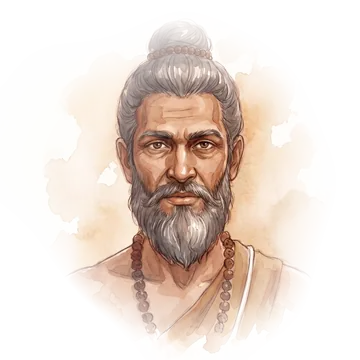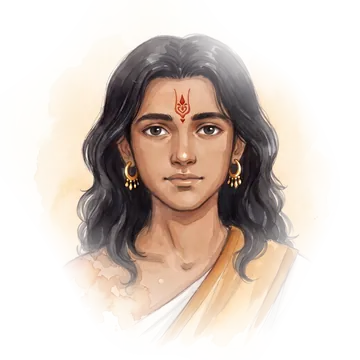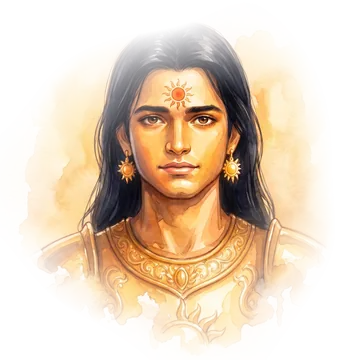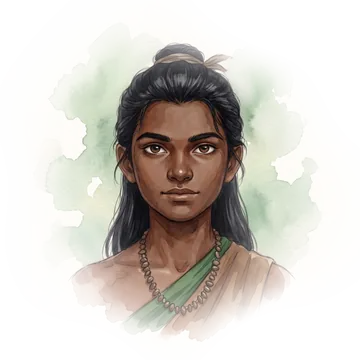
Ekalavya, often spelled Eklavya, is the son of the king of the Nishadas, the hunting people of the forest, in the Mahabharata. Drona would not teach him, so he made a Drona out of clay and taught himself in front of it until he shot better than Arjuna. In Book One, The Vow, Drona comes to the forest and asks for the thumb of his right hand as a teacher's fee, and Ekalavya gives it.
- Family
- Son of Hiranyadhanu, king of the Nishadas. The name Hiranyadhanu means golden bow.
- His people
- The Nishadas, who lived by hunting in the forest
- Known for
- Teaching himself archery in front of a clay figure of Drona, and giving Drona his right thumb as a teacher's fee
- First appears
- Book One, chapter 10, The Thumb
Ekalavya's story in Book One
Why did Drona refuse to teach Ekalavya?
Ekalavya grew up with a bow in his hand. While the princes of Hastinapura were still at their lessons, word reached the forest of their great teacher, and he walked all the way to the city. Kings and princes had come by the thousand, hoping to learn from Drona.
He found Drona at the practice ground and bowed low. Drona looked at the boy's bow, and then at his fingers, where the string had worn hard ridges into the skin. "A Nishada," he said. "I do not teach Nishadas. Stand aside."
In the epic, Drona turns him away because a Nishada might one day outshine his high-born pupils. Ekalavya was a king's son himself, so his birth was the only thing against him. He knelt, touched Drona's feet and walked home to the forest.
How did Ekalavya learn archery?
Deep in the forest he cleared a space under a tree and dug clay from the bank of a stream. Out of it he made a Drona of his own, with the teacher's hawk nose and high topknot and a sacred thread across its chest, and he hung a garland of wildflowers around its neck. Every morning he bowed to it, smiling, before he picked up his bow.
The clay teacher never said a word, so Ekalavya did the talking. He told it about the deer that drank at the stream at dusk and the wind that pushed his arrows left. When he asked it a question, he waited in front of it, and more often than not an answer came. He knew it rose from somewhere inside himself. He thanked his teacher for it anyway.
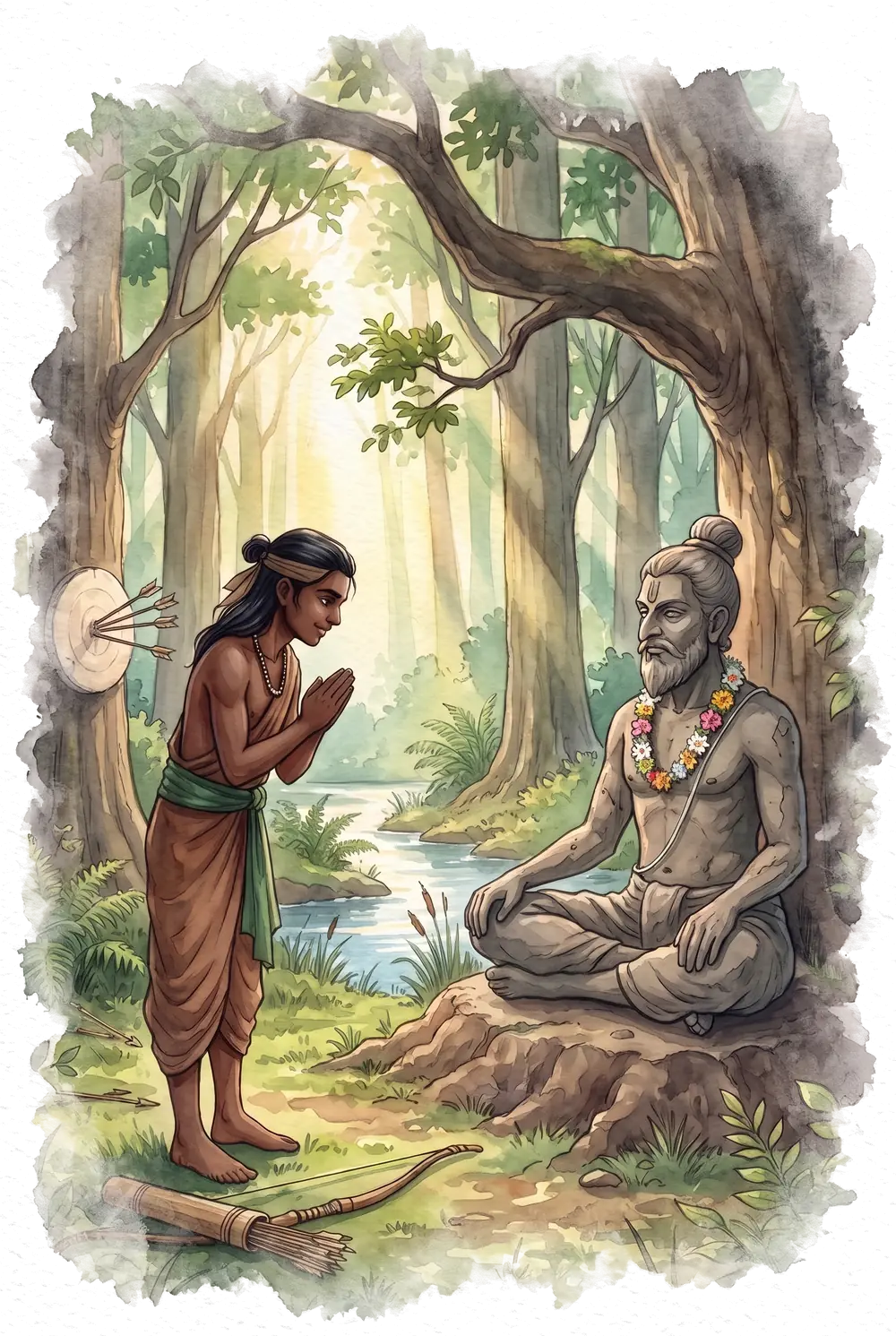
The rains came and went for years. A storm knocked the nose off the clay figure, and Ekalavya made it a new one. Slowly his arrows stopped going wide. At last every part of a shot ran together into one movement. He would look at a mark, and the arrow would already be there.
The dog and the seven arrows
One day a hunting dog burst out of the bushes into the clearing and began to bark at him. Before it could shut its mouth, Ekalavya sent seven arrows into it, one after another, and they propped its jaws wide open. As in many retellings, the dog came to no harm. It bolted back to its masters.
Its masters were the princes of Hastinapura, out hunting. They came looking for the archer and found him still shooting. "Who are you?" asked the eldest. "Whose son?"
"I am the son of Hiranyadhanu, king of the Nishadas," Ekalavya said. "And I am a pupil of Drona." One of the princes, a lean boy with a leather guard on his right hand, went very still. That was Arjuna.
Why did Drona ask for Ekalavya's thumb?
Back in Hastinapura, Arjuna waited until he could find his teacher alone. Drona had once held him in his arms and promised to make him an archer with no equal in all the world. "Then why is there a pupil of yours," Arjuna asked, "the son of the Nishada king, who's better than me?"
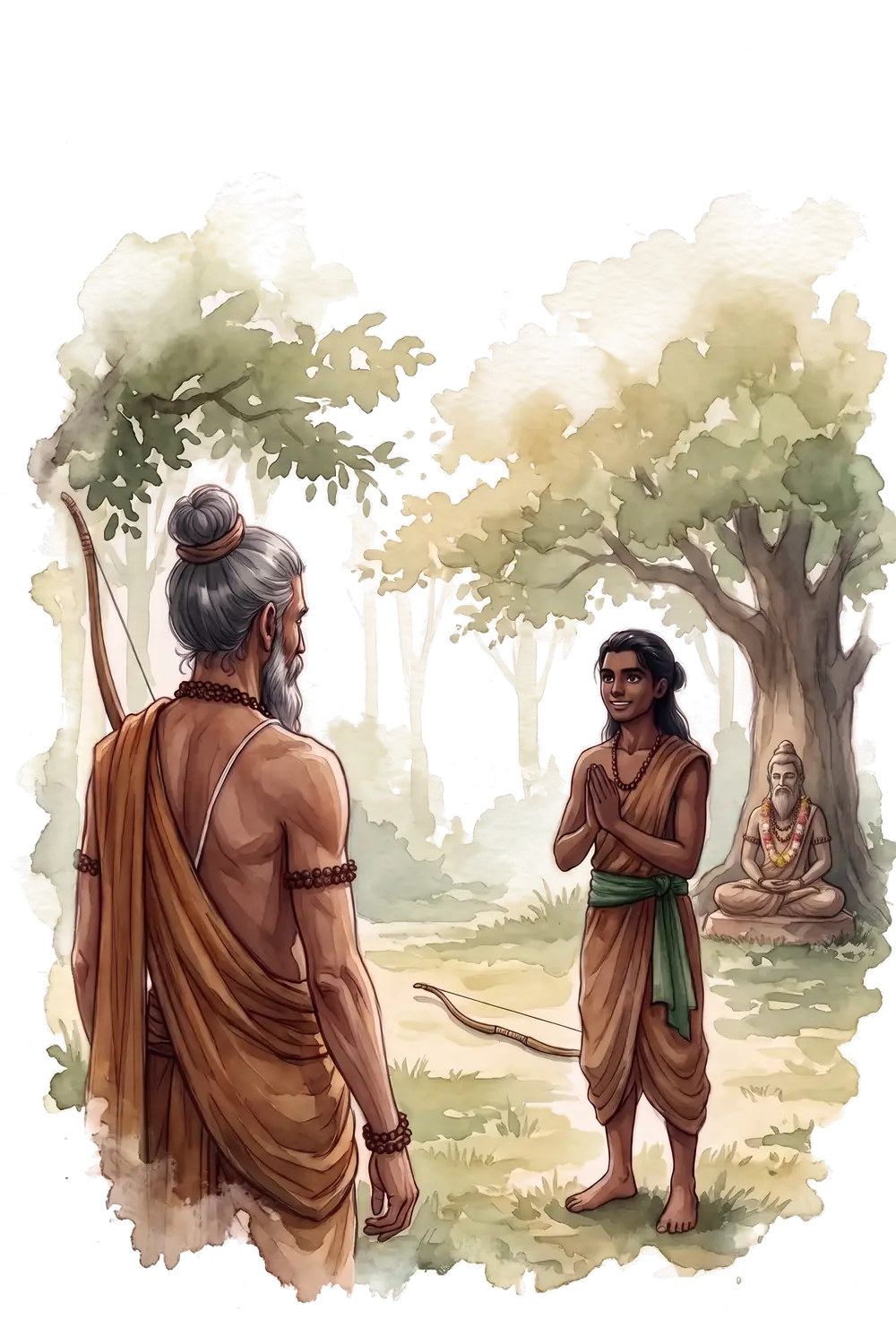
Drona thought for a moment. "Come with me," he said, and took Arjuna into the forest. When Ekalavya saw his teacher at the edge of the clearing, he dropped his bow, ran to him and threw himself flat at his feet.
"If you are really my pupil," said Drona, "then give me my fee." Ekalavya's face lit up. There was nothing, he said, that he would not give his teacher. So Drona asked for the thumb of his right hand, the thumb that drew his bowstring.
Ekalavya smiled at him, the way he smiled at the clay figure every morning, and reached for his knife. The book shows no more of that moment.
What happened to Ekalavya after he gave his thumb?
Drona walked home with Arjuna, whose step was light on the path. No pupil of Drona's was better than him now.
Back in the clearing, Ekalavya bound his hand with a strip of cloth and picked up his bow. He set an arrow on the string with the fingers he had left. The shot that had become one movement had come apart into slow steps again, and the arrow wobbled and dropped into the grass short of the mark. He went and fetched it, and set it on the string again. Book One leaves him there.
Questions about Ekalavya
Is it Ekalavya or Eklavya?
Both name the same person. Ekalavya, said ay-ka-LAV-ya, is closer to the Sanskrit. Eklavya is how the name is often written and said in Hindi and other modern Indian languages, where a short a in the middle of a name is dropped.
Why did Drona refuse to teach Ekalavya?
In the epic, Drona turned him away because he was a Nishada, and a Nishada might one day outshine the high-born princes Drona was teaching. Ekalavya was the son of the Nishada king, so the reason was his birth alone. The book shows the refusal as unfair and lets readers judge it.
What is the story of Dronacharya and Eklavya?
Dronacharya, the teacher of the Kuru princes, refused to teach Ekalavya. The boy made a clay Drona in the forest and taught himself in front of it until he shot better than Arjuna. Arjuna reminded Drona of his promise that no pupil would equal him, so Drona asked Ekalavya for the thumb of his right hand as a teacher's fee. Ekalavya gave it gladly.
What happened to Ekalavya later?
He kept shooting with the fingers he had left, though more slowly, and Book One leaves him fetching his arrow to try again. He does not come back in Books Two and Three. In the epic itself, during the war, Krishna tells Arjuna that he had killed Ekalavya in battle, for the Pandavas' good.
Where this comes from: Ekalavya's story is told in Adi Parva §134 of K. M. Ganguli's translation, before the bird test. Ganguli calls him the son of Hiranyadhanus, king of the Nishadas, and says Drona refused him because a Nishada might in time excel his high-born pupils. In Ganguli the dog runs back pierced by the seven arrows. In the book, as in many retellings, it is unhurt. The clay figure's garland, the talk with it and the new nose are the book's own touches. Krishna's words about killing Ekalavya are in Drona Parva §181. See where the stories come from.