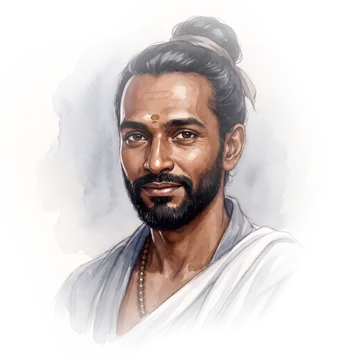
Vidura is the wise younger half-brother of the blind king Dhritarashtra and of Pandu in the Mahabharata, the son of the sage Vyasa and a palace maid. His mother's place kept him from ever being king, so he became the man at court who told the blind king the truth, whether he wanted it or not. He saves the Pandavas from the house of lac in Book One and warns against the dice game in Book Two, and in Book Three he walks into the forest with his brother at the end of his life.
- Family
- Son of the sage Vyasa and a maid of Queen Ambika · younger half-brother of Dhritarashtra and Pandu · uncle of the Pandavas and the Kauravas
- Who he really is
- Dharma, the god who judges right and wrong, born on earth as a maid's son because of the sage Mandavya's curse
- Known for
- Warning Yudhishthira about the house of lac in a language only he understood · begging the blind king to stop the dice game · keeping Kunti in his house through the Pandavas' exile · feeding Krishna banana peels
- First appears
- Book One, chapter 4, Three Princes and a Blindfold
Vidura's story in Book One
Who were Vidura's parents?
When young King Vichitravirya died and left no son, Queen Satyavati called on her first son, the sage Vyasa, to father heirs for the family by an old custom. One widow, Ambika, shut her eyes in fear of him, and her son Dhritarashtra was born blind. The other, Ambalika, went white, and her son Pandu was born pale. When Ambika was asked to receive the sage a second time, she dressed her maid in her own jewels and sent her instead.
Nobody asked the maid. She belonged to the household and could not leave it. She was not afraid of the sage, though. She rose and welcomed Vyasa as she would an honored guest. "You are no longer a slave," he told her. "Your son will be the wisest man on earth." That son was Vidura. The bards never sang about his mother.
Why was Vidura born a maid's son?
An old tale explains it. The sage Mandavya had taken a vow of silence, and when robbers hid their loot in his hermitage, he would not answer the king's guards. The king took him for one of the gang and sentenced him to die on the stake with them. Mandavya lived. Once the king learned the truth, he fell at the sage's feet and begged forgiveness.
Mandavya went to Dharma, the god who judges right and wrong, and asked what he had done to deserve it. As a small boy, Dharma said, he had pushed a blade of grass through an insect. Mandavya was furious. A child doesn't know what he is doing, he said. From that day nothing a child did before the age of fourteen would count as a sin, and Dharma himself would be born on earth as the son of a servant woman. Many years later, in Hastinapura, a maid who was not afraid rose to greet a sage.
Why couldn't Vidura be king?
Bhishma raised the three boys as his own sons. Dhritarashtra grew into the strongest man in the kingdom and Pandu into its finest archer. Vidura knew the law better than his teachers. When the elders met to choose a king, they passed over Dhritarashtra because he could not see. Vidura was the wisest of the three, but his mother had been a servant, and the law of the court would not let him rule. He studied the floor tiles until the elders moved on, and the crown went to Pandu.
At the crowning Vidura stood beside his blind brother. Dhritarashtra smiled all the way through it. Only Vidura, standing close, saw his hands clenched into fists. Later, when Gandhari arrived as Dhritarashtra's bride with a cloth tied over her eyes, it was Vidura who leaned close and told him what she had done.
What did Vidura say when Duryodhana was born?
The first cry of Duryodhana, the blind king's eldest son, was the bray of a donkey, and jackals began to howl all around the city. Vidura looked down at the baby's small face. "This child will destroy your family," he said. "Give him up, brother. You'll still have ninety-nine sons." Dhritarashtra's arms tightened around his son. He could not do it.
How did Vidura save the Pandavas from the house of lac?
When Pandu died, his five sons and their mother Kunti came to live in Hastinapura, and Duryodhana hated them from the start. Once, when Bhima vanished after a feast, Kunti sent for Vidura in terror. "Don't say that aloud," he told her. "If you accuse him, he may kill the others. Guard the sons you have."
Years later the king sent the Pandavas off to a festival in the town of Varanavata. After the crowd turned back at the gate, Vidura walked on beside Yudhishthira's chariot and spoke to him in a foreign tongue that hardly anyone in Hastinapura knew. "The fire that eats dry grass and wood cannot reach the creature in a hole in the forest," he said. "A jackal digs its den with more than one way out." Yudhishthira understood him. The fine new house waiting in Varanavata was meant to burn.
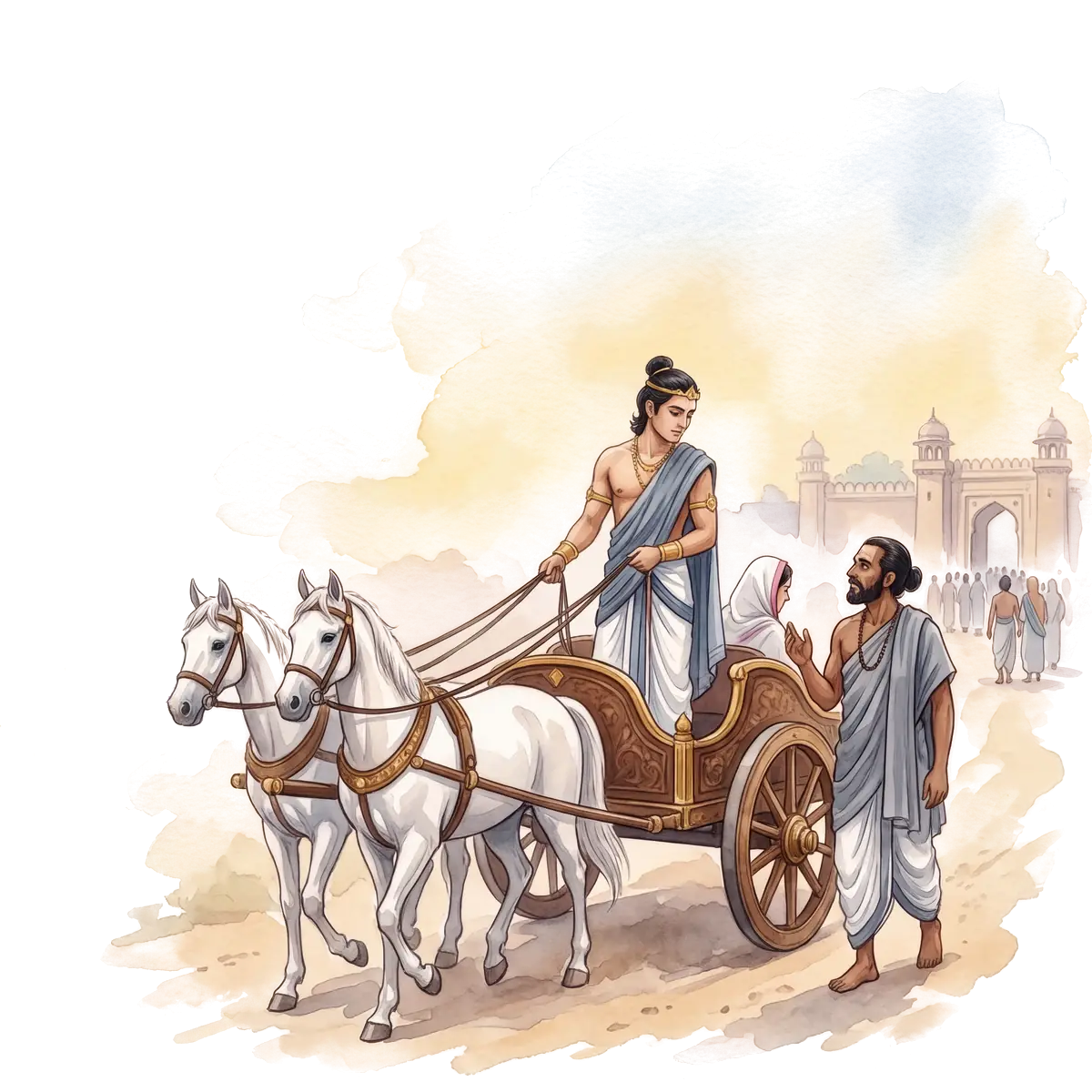
A few days later a miner came to the brothers. "Vidura sent me," he said, and repeated the line about the jackal's den to prove it. Night after night he dug them a tunnel under the floor. On the night the house burned, the family escaped through it to the Ganga, where a boatman was waiting with Vidura's words. "Vidura kisses the tops of your heads," the man said. "He says, don't be careless."
Back in Hastinapura everyone believed the Pandavas were dead, and the whole court went down to the river to pour out water for them. Vidura poured with the rest. He did not weep much.
The invitation to the dice game
When the Pandavas turned up alive, married to Draupadi and friends of King Drupada, it was Vidura who came with gifts to bring them home. At the end of Book One, though, Duryodhana talked his father into a game of dice against Yudhishthira. "Vidura will stop you," he warned. The king asked his brother anyway. "I do not approve," Vidura said. "This game will turn the cousins against each other."
The king sent him to Indraprastha with the invitation all the same. Vidura told Yudhishthira the truth. "I tried to stop him. He sent me anyway." Shakuni would be playing, with a few others. "Gamblers and cheats, all of them." Yudhishthira had sworn never to refuse a challenge, and he said yes.
In Book Two: The Dice
Vidura rides beside Yudhishthira to Hastinapura and hardly says a word. As the stakes climb in the dice game, he can sit still no longer. "Men who climb cliffs for wild honey look only at the honey," he tells the blind king. "They never see the drop below them. Your son is on that cliff now." Duryodhana says they have kept Vidura like a snake in their lap. When Yudhishthira stakes Draupadi and loses her, Vidura sits with his head in his hands, and when Duryodhana orders him to go and fetch her, he does not get up (chapter 1, Shakuni's Dice).
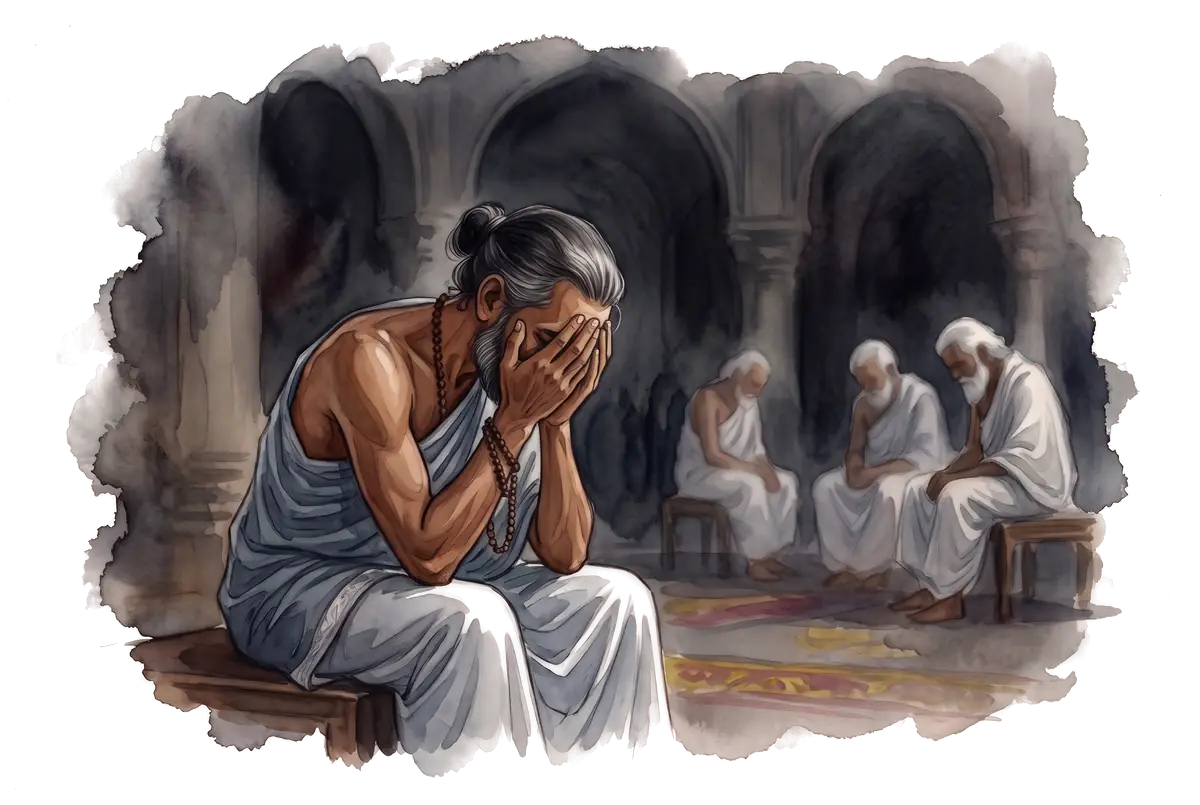
When Draupadi asks the elders whether she was lost fairly, Vidura is the one who begs the kings to answer her. "A man who knows what is right and keeps it to himself carries half the sin of a lie," he says, and he tells them the tale of Prahlada, a king of the asuras who told the truth against his own son. Not one of the kings looks back at him (chapter 2, Draupadi's Question).
After the second game sends the Pandavas into exile, Yudhishthira says goodbye to the elders, and nobody can answer him. Vidura looks around at old men staring at the floor, and so he answers. Kunti will stay in his own house, he says. "When a man is beaten by cheating, there's no shame in it for him." Then the blind king sends for him. Vidura tells his brother how each of the Pandavas is leaving the city, and what Draupadi's loose hair promises (chapter 3, The Second Game).
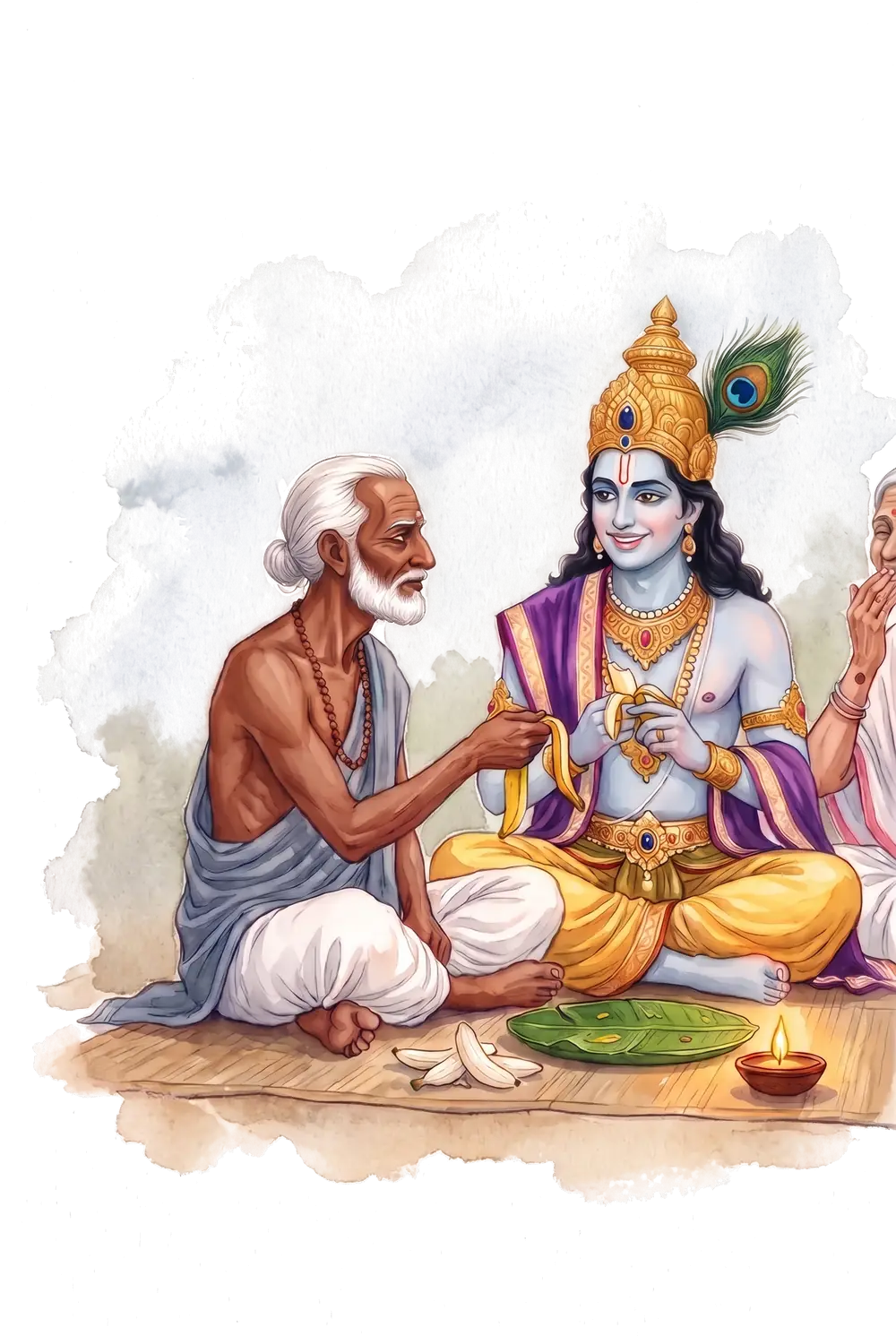
When the exile is over, Krishna comes to Hastinapura to ask for peace, and chapter 13, The Peace Mission, is told through Vidura's eyes. Krishna will take a pot of water for his feet and a kind word, Vidura tells his brother. "Give him what he's coming for. Give him peace." Krishna turns down Duryodhana's feast and eats at Vidura's house, where Kunti sets the food in front of him. Afterward Vidura sits beside him peeling bananas, so busy watching Krishna that he throws away the fruit and holds out the peels. Krishna eats them one after another, smiling, until Kunti begins to laugh.
That night Vidura begs Krishna not to go into the court. In the morning he walks in on Krishna's arm. When Duryodhana will not give his cousins as much land as the point of a needle would cover, Vidura brings Gandhari in to plead with her son. And when light pours out of Krishna, and the kings shut their eyes, Vidura keeps his open and sees. Before the war he tells Kunti he has shouted himself hoarse and cannot sleep (chapter 14, A Mother at the River).
In Book Three: The War
Vidura takes no part in the fighting, but the others remember his warnings. On the night Abhimanyu dies, Yudhishthira thinks of Vidura's honey gatherer. "That was me today," he says (chapter 3, The Wheel of Death). After the war Gandhari tells Draupadi, "It was always coming. Vidura told us so." Vidura sees to the funeral fires for the dead on the plain (chapter 11, The Mothers' Grief), and later he and Yudhishthira wrap Bhishma in silk and garlands for his pyre (chapter 12, Lessons from a Bed of Arrows).
Fifteen years after the war, Vidura goes into the forest with the blind king and the two old queens. When the Pandavas come to visit, they hear that he eats nothing but air. Far off between the trees stands a man as thin as a stick, with wildflowers caught in his matted hair, and he turns and runs. Yudhishthira follows him alone. Vidura leans against a tree and looks at him, and Yudhishthira feels Vidura's breath and strength come into his own body, like a lamp carried into a dark house. Then Vidura is gone. Kunti remembers the old story. Vidura was Dharma himself, and Yudhishthira is Dharma's son (chapter 13, The Last Walk into the Forest).
Questions about Vidura
Why couldn't Vidura become king?
His mother was a maid in the palace, a servant who belonged to the household, and the law of the court would not let a servant's son rule. The elders passed over Dhritarashtra because he was blind, so the crown went to Pandu, though Vidura was the wisest of the three brothers.
Is Vidura an incarnation of Dharma?
Yes. In the old tale, the sage Mandavya was punished as a robber, and Dharma, the god who judges right and wrong, told him it was for something he had done as a small child. Mandavya cursed Dharma to be born on earth as a servant woman's son, and that son was Vidura. It makes him close kin in spirit to Yudhishthira, who is Dharma's son.
What is Vidura Niti?
Vidura Niti, Vidura's wisdom, is the name people give to a long talk in the epic's Udyoga Parva, sections 33 to 40 in the Ganguli translation. The blind king cannot sleep while he waits for the Pandavas' message, so he sends for Vidura, who tells him at length what makes a person wise or foolish and urges him to make peace with his nephews. The Dice gives Vidura's counsel in short warnings, such as the man who climbs a cliff for honey and never sees the drop below.
Why did Krishna eat banana peels at Vidura's house?
Vidura was so happy to have Krishna at his house, and watched him so closely, that he threw away the bananas he was peeling and handed Krishna the peels. Krishna ate them anyway, smiling, until Kunti laughed and Vidura saw what he had done. In The Dice, Krishna says it was still the best meal he ate in Hastinapura. The story comes from a popular telling. Ganguli's text has only the meal.
How did Vidura die?
In his last years he lived in the forest near his brother Dhritarashtra and ate nothing but air. When Yudhishthira came to find him, Vidura leaned against a tree, looked at him, and passed his breath and strength into Yudhishthira's body. His own body was left standing against the tree, and a voice told Yudhishthira not to burn it.
Where this comes from: Vidura's birth is in Adi Parva §106 of K. M. Ganguli's translation, and Mandavya's tale and curse in §107–108. The choice of a king and the brides follow §109–110, Duryodhana's birth §115, and the house of lac §141–152, with Vidura's warning in a foreign tongue in §147. Book Two follows Sabha Parva §57–79 for the dice games, with the tale of Prahlada in §67, and Udyoga Parva §86–131 for the peace mission. The banana peels come from a later popular telling. Vidura's sleepless night of counsel, known as Vidura Niti, is Udyoga Parva §33–40, and his death in the forest is Ashramavasika Parva §26. See where the stories come from.